Rwa Bhineda Keeps Opposites From Going to War
· 10 min read
Rwa bhineda is the Balinese philosophy that opposites such as good and evil, light and dark must be kept in balance rather than defeated, and it explains why Bali feeds its demons instead of trying to destroy them.
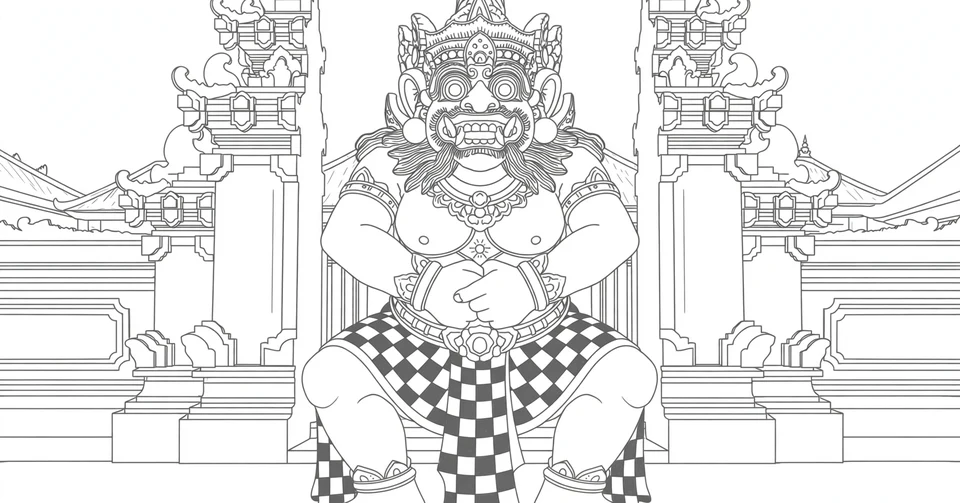
Spend any length of time in Bali and you will keep meeting the same two colours. A black and white checkerboard is wrapped around temple guardians, tied around the trunks of banyan trees, and worn at the waist of the village guards who hold back traffic outside ceremonies. The pattern is not decoration, and it is not branding. It is the visible form of rwa bhineda, the philosophy that quietly organises Balinese life.
Rwa bhineda teaches that the world is built from pairs of opposites, and that the two sides of each pair are not at war. Light needs darkness, joy needs sorrow, life needs death, and good needs evil, not as an enemy to be annihilated but as a counterweight that keeps the universe level. Harmony, in this view, is never the victory of one side over the other. It is the balance held between them.
That one idea explains a great deal that puzzles first time visitors to the island. It explains why offerings are set on the ground for demons with the same care that other offerings are raised on shrines for gods. It explains why Bali's most famous sacred battle never ends with a winner. Seen through rwa bhineda, the island's rituals stop looking like contradictions and start looking like maintenance work on the cosmos.
What rwa bhineda actually says
The name is usually translated as "two differences" or "two opposites", and the teaching begins with a claim about how things exist at all. Nothing stands alone. There is no day without night to define it, no height without depth, no happiness that could be recognised without sadness somewhere behind it. Each pole calls the other into being, which is why Balinese thinkers describe rwa bhineda as mutual dualism: the pairs are opponents, but they are also partners, and each depends on the other for its meaning.
It follows, under rwa bhineda, that neither side can ever be removed. Push the world too far in one direction and, like a hanging mobile knocked off centre, it swings back the other way with equal force. Trying to stretch the tension by fixing everything at once is considered not just impossible but counterproductive. Writers explaining rwa bhineda sometimes compare its pairs to the two poles of a magnet: cut the magnet in half to discard the negative pole, and each half simply grows both poles again.
Nothing is purely one thing, either. Every aspect of the universe is understood to contain a little of both sides, and that includes the gods themselves, who are creative at some times and destructive at others. The same logic extends to the largest pair of all, sekala and niskala, the seen world and the unseen world. Balinese life is lived in the middle of that balance too, tending a relationship with invisible neighbours as carefully as with visible ones. Rwa bhineda is less a doctrine to be believed than a law of how things hold together, closer to gravity than to opinion.
A philosophy you can fold and wear
Most philosophies live in books. Rwa bhineda is woven into cloth and put to work outdoors. The black and white checks of saput poleng, the chequered cloth of balance, carry the teaching of rwa bhineda in its simplest form: white for good, light and positivity, black for darkness and negativity, arranged in an exactly equal number of squares. The point of the pattern is the equality. I have written elsewhere about how Bali wraps its statues in saput poleng and what that wrapping says to passers by, and the cloth only makes sense once the philosophy underneath it is clear.
There are softer versions of the cloth that admit grey squares alongside the black and white, a reminder that most of life happens in the transition between the poles, and rarer versions that add red for energy and passion. But the classic black and white form is rwa bhineda stated in full. Count the squares on either colour and the numbers match. Neither colour wins, anywhere on the cloth, ever.
Historically, the pattern was not for everyone. It was reserved for people trusted to judge what is black and what is white in the life of the community: priests, rulers, lawmakers and the pecalang, the village security men whose checked sarongs still tell you at a glance who is keeping order, something I looked at in a piece on how to read a pecalang from across the street. The cloth also marks and protects places where the unseen world is close, wrapped around banyan trees believed to house spirits and around statues that stand guard at the border between the two worlds. Rwa bhineda, in other words, is not only thought in Bali. It is worn, tied, draped and stood next to, every day.
Feeding the dark side instead of fighting it
The most startling consequence of rwa bhineda is what it does to evil. The disruptive forces of the unseen world are called bhuta kala, and where many religions promise that such forces will one day be defeated and banished for good, Balinese teaching holds that they cannot be. Negative forces are a permanent pole of existence. They can be soothed, balanced and kept in their place, but they cannot be deleted, and pretending otherwise only stretches the tension.
So Bali feeds them. A whole class of offerings called caru exists for the bhuta kala and, philosophically, for the negative aspects of the universe. Offerings for the gods are placed up on shrines; offerings for the demons are placed on the ground, a matter of addressing each recipient at its own level rather than a statement about worth. A fed demon, in the Balinese understanding, leaves people alone and may even turn its power to helping them. The smallest caru, the segihan, is a tiny daily peace payment left at doorways, and its most popular form carries shallots, which are considered cold, together with ginger, which is considered hot, a pair of opposites packed into the offering itself as a reminder to its recipients about balance. That is rwa bhineda at its smallest scale, a whole philosophy measured out in pinches of rice.
The scale rises from there, up to the great Tawur ceremonies performed at crossroads and at the mother temple of Besakih in the days before Nyepi, the day of silence. Tawur literally means payment, which tells you exactly how the transaction is understood. Nothing is being worshipped in the sense of admiration. A debt is being settled so that the year can begin level. It is rwa bhineda practised at the scale of the whole island, a public correction of the tilt. Priests give the practice its most philosophical reading: the bhuta are centres of destructive force and imbalance, and the offerings exist to smooth them out and nullify their disturbance. It is pest control conducted as theology, except that the pests are acknowledged citizens of the cosmos with a permanent address.
The battle that is not allowed to end
If you want rwa bhineda performed rather than explained, watch Barong and Rangda. Barong, the shaggy lion-like guardian, embodies goodness and protection. Rangda, the wild-haired widow witch, embodies chaos and destruction. Their dance drama is staged in temple courtyards across Bali, and it follows a rule that surprises audiences raised on stories where good triumphs: neither side is allowed to win. Their conflict never reaches an absolute victory, because the balance of the universe depends on the two forces continuing to exist and to meet.
A permanent Barong victory would not complete the story. It would break it. Without Rangda there is nothing for Barong to guard against, and the cosmos the dance describes would tilt as badly as it would if Rangda prevailed. Rwa bhineda forbids both endings. It is fitting that in religious settings the dancers who fall into trance as Barong or Rangda wear poleng cloth. The performers dress in the philosophy they are about to enact, two colours in equal squares, and then they go out and demonstrate that the fight between them is not a war to be finished but a tension to be held.
I find this more honest than the alternative most of us grew up with. The promise that darkness can be permanently defeated has been made by many cultures and kept by none of them, and the effort to keep it has justified some very dark behaviour of its own. Rwa bhineda starts from the observation that the dark pole is load bearing. Remove it, and the structure does not become pure. It collapses. What the philosophy asks instead is constant, unglamorous attention: notice the balance, feed what needs feeding, correct the tilt early, and expect to do it all again tomorrow.
Balance is a chore, not a trophy
That last part matters, because rwa bhineda in practice is not a state anyone achieves and then keeps. The offerings that hold the seen and unseen worlds in good relation are made fresh every single day, as routine and as non-negotiable as bathing or eating. Yesterday's balance does not carry over. Each morning the small palm leaf trays are woven again, the flowers are picked again, the ground at the doorway and the shrine in the family temple are attended to again, and the scales are set level again by hand. That daily rhythm is rwa bhineda as housekeeping.
There is something quietly demanding about rwa bhineda here: it offers no finish line. It does not let its followers declare the work done, and it does not let them blame the darkness for existing. Inside a person, the same pairs are at work: the Balinese understanding places bhuta within human beings too, as greed, appetite and temper, forces to be managed and fed their proper portion rather than amputated. The work of rwa bhineda is therefore double, outward in the village and inward in the self, and it never signs off.
What the philosophy refuses to offer is despair. If the poles are permanent, then a bad season is not a sign that the world is ending; it is a tilt, and tilts can be corrected. Grief sits inside the teaching as the necessary partner of joy, not as joy's failure. Even the gods create and destroy in turn. For a visitor, watching an old woman set a tiny offering on the ground for the demons before she sets one on the shrine for the gods, the whole system can look like hedging. Spend longer with it, and it starts to look like the opposite: a clear eyed refusal to pretend that half of existence can be wished away.
Bali wraps its statues in equal squares of black and white, feeds its demons at ground level, pays its debts before the silent new year, and stages its greatest battle with instructions that nobody wins. Underneath all of it sits rwa bhineda, patient and unsentimental: the opposites are not going to war, because they were never enemies. They are the two hands holding the same world, and the holding is the whole job.
More in Culture & Society
Latest posts
- Shimekasu Was Herring You Never Ate
- A Hana Donko Wears Its Cracks Like Flowers
- A Lembaga Perkreditan Desa Is a Bank the Village Owns
- Kaburiyu Is How You Talk Your Body Into the Bath
- Kuki Is the Spring the Sea Turned White
- Tatsuko Wished for Beauty and Became a Statue
- Warangan Is the Wash That Reveals the Pattern
- Ganbanyoku Is Bathing Without Water
- The Obuki Throws Out Nine Thousand Litres a Minute
- Every Village Writes Its Own Awig-Awig
- Sainokawara Is a Bath You Share With a Hundred Strangers
- Umaji Refused to Disappear
- Kasepekang Is Exile Without Leaving Home
- Jamasan Washes a Blade Thinner Every Year
- Herring Fed the Fields That Fed Osaka