Melasti Walks the Temple Down to the Sea
· 8 min read
A few days before Nyepi, Balinese villages carry their temple gods and heirlooms to the sea for melasti, a purification that washes the old year off the small world of the body and the great world around it.
A few days before Bali shuts its doors for Nyepi, the island does something that looks, from the roadside, like an entire village moving house. Hundreds of people dressed in white walk in a long line toward the sea, carrying offerings and the most sacred objects their temple owns. This is melasti, the great washing that opens the Balinese new year.
Melasti is a purification ceremony held every year in the days running up to Nyepi, the Balinese day of silence. Its purpose is stated plainly by those who perform it: to cleanse the world of the filth of sin and bad karma, and to draw the water of life, Tirta Amerta, from the sea. Nothing about it is private or hurried. A whole community walks its gods down to the water, washes them, and walks them home again.
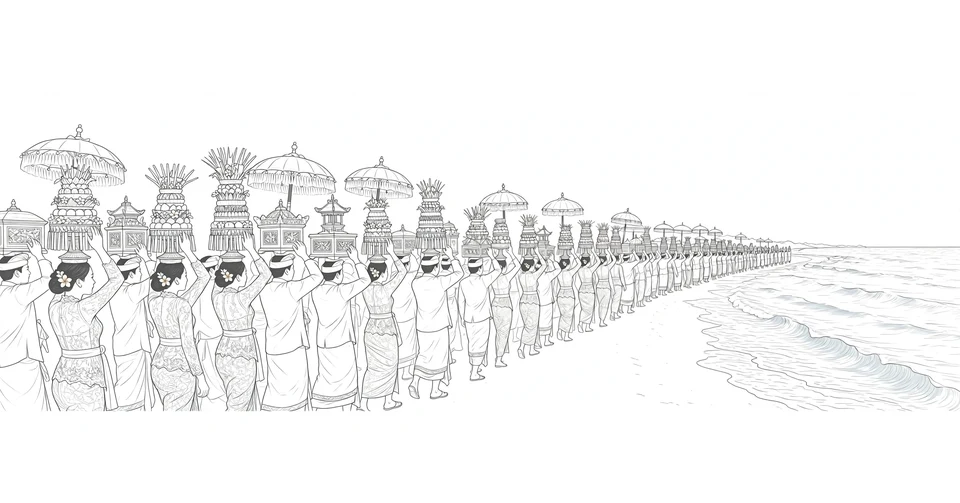
What stays with me is the direction of the journey. In most religions the sacred stays put and the people come to it. During melasti the temple itself travels, carried on shoulders along ordinary roads, because the cleansing has to happen where the water is. The gods go down to the sea like everyone else.
What melasti is washing
The name already contains the job description. Ask what the word means in plain terms and the answer is direct: to cleanse, to purify. Melasti is usually traced to Sanskrit roots, mala meaning dirt or impurity and asti suggesting its removal, a casting away. The ceremony is that etymology acted out at full scale. The summary of the ritual on Wikipedia describes melasti as a rite meant to cleanse the world from all the filth of sin and bad karma through the symbolic act of acquiring the Tirta Amerta, the water of life.
Balinese Hindu teaching frames the dirt as sitting in two places at once. There is buana alit, the small world, meaning the human body and everything it has carried through the year. And there is buana agung, the great world: the village, the fields, the shoreline, the whole surrounding order of things. Melasti washes both in a single gesture. The pratima and pralingga, the sacred images and regalia of Ida Sanghyang Widi Wasa kept in the village temple, are carried to the water and purified, and the people carrying them are purified alongside.
I find that double target honest. A year leaves marks on places as well as on people: on a household that argued too much, a field that was neglected, a beach that quietly took the village rubbish. Melasti refuses to separate the inner cleanup from the outer one. You do not get to arrive at the new year tidy on the inside while the world you live in stays exactly as it was.
For the community, melasti is also an act of gratitude. It is a moment to give thanks for the blessings of the year that is ending, and to say so out loud, together, before asking anything of the year to come. That is part of why nobody performs it alone on behalf of everyone else. The faith being reaffirmed here is not a private possession. It belongs to the banjar, to the temple congregation, to the family line, and it has to be carried, quite literally, by all of them at once. A tradition survives centuries that way, by being walked down the road in public every single year.
The long white line
The walking starts days earlier, in courtyards. Preparing for melasti is communal work organised through the banjar, the neighbourhood association that runs so much of Balinese life. Homes and temples are cleaned thoroughly, inside and out, because the physical scrubbing belongs to the same idea as the spiritual one. Women prepare the offerings, canang sari and larger arrangements of flowers, incense, fruit, sweets and rice, each element a small act of gratitude. By the time the procession forms, half the ceremony has already happened at kitchen tables and in temple yards.
On the morning itself the village assembles and the line sets off. Men carry the temple heirlooms, among them keris daggers handed down through generations, and the sacred objects ride above the crowd. Everyone walks. A guide to the ceremony describes hundreds of people in white moving together toward the ocean, and where a temple stands far inland, that white line can unspool along the road for a very long way before it reaches the water.
Bali is an island whose sacred calendar keeps taking to the road. Its cremation ceremonies process through the village too, and a great ngaben can take years of saving and preparation before its procession finally moves. Melasti asks for less and returns more often. It comes back every year like a tide, and the walking is not mere transport to the ritual. The walking is a large part of the ritual itself, a community moving at the pace of its slowest carriers, in public, where everyone can see the village keeping its promises.
Not always the sea
The sea is the classic destination, and the ceremony is usually held at the edge of the beach, where the bad things of the past are thrown symbolically into the ocean. But Bali's geography is varied, and melasti belongs to mountain villages as much as to coastal ones. Communities far from the shore go instead to a lake, a river or a sacred spring, because in the island's Hindu belief any living water, a mountain lake no less than the sea, counts as a source of life.
Water earns this trust because of what the belief says it is. It is not merely a symbol of life but the substance of it, Tirta Amerta, and its cleansing is understood to work on far more than skin. The same water that rinses dust off a temple heirloom is believed to clear the spirit of the person holding it, and to freshen the world the procession walked through to reach the shore. Body, object and landscape are washed in a single act, which is why the destination matters less than the element itself: the sea if you have it, a lake or a spring if you do not.
At the water the tempo changes. The offerings are set out first, arranged on the sand, and only then do the prayers begin. Priests lead the prayers and chants. The sacred objects are bathed. Devotees step into the water themselves and wash, letting the year rinse off in the most literal way available to them. Holy water is gathered and carried back up the road, to bless the temple and its people through the year ahead. Then the procession turns around and walks home, the same road, at the same unhurried pace.
Quiet first, then noise, then silence
Melasti makes most sense as the first movement of a three part arc, and it is the calm one. Days later, on the eve of Nyepi, comes Pengerupukan, when ogoh-ogoh monsters are paraded through the streets with as much noise as a village can manufacture, driving the year's demons out by main force. And after the shouting, Nyepi stops the entire island for a day of silence. Wash, expel, be still. Seen in that order, melasti is the gentle opening of a sequence that ends in one of the most radical public silences anywhere on earth.
There is a discipline in starting with water rather than with noise. Pengerupukan treats evil as something to be frightened off. Melasti treats the year's accumulation as something to be carried, patiently and together, to a place where it can be set down. Most of what a year leaves behind is not demonic. It is just heavy. The ceremony seems to know the difference.
Watching melasti without getting in the way
Visitors are welcome to watch, and many do, standing along the road or at the edge of the beach as the white line passes. The etiquette is simple, and mostly a matter of not confusing a rite with a show. Stay out of the areas reserved for the ceremony. Take photographs from a respectful distance and never block the procession. Keep your voice down. Leave no rubbish behind on a beach that people have just finished blessing.
My own feeling, watching processions like these as a guest on the island, is that the right posture is gratitude with empty hands. You are not part of the washing. But a village that cleans its temple in public, on foot, once a year, is showing you exactly what it values, and that kind of openness deserves quiet in return.
By the time the procession comes back and the temple doors close behind the gods, the year has effectively already turned. Nyepi will bring the silence, and the silence will get the attention. But the new year really begins here, on the road to the sea, with wet feet, heavy heirlooms and a whole village walking its small world and its great world down to the water to be made clean.
More in Culture & Society
Latest posts
- Shimekasu Was Herring You Never Ate
- A Hana Donko Wears Its Cracks Like Flowers
- A Lembaga Perkreditan Desa Is a Bank the Village Owns
- Kaburiyu Is How You Talk Your Body Into the Bath
- Kuki Is the Spring the Sea Turned White
- Tatsuko Wished for Beauty and Became a Statue
- Warangan Is the Wash That Reveals the Pattern
- Ganbanyoku Is Bathing Without Water
- The Obuki Throws Out Nine Thousand Litres a Minute
- Every Village Writes Its Own Awig-Awig
- Sainokawara Is a Bath You Share With a Hundred Strangers
- Umaji Refused to Disappear
- Rwa Bhineda Keeps Opposites From Going to War
- Kasepekang Is Exile Without Leaving Home
- Jamasan Washes a Blade Thinner Every Year