Umaji Refused to Disappear
· 9 min read
Umaji, a mountain village in Kochi that lost its cedar wealth and most of its people, rebuilt itself around yuzu and then did something stranger. It sold the village itself as the product.
Umaji is a village high in the mountains of Kochi Prefecture, on the island of Shikoku, where about 96 percent of the land is forest and the Yasuda River runs cold and clear through two old settlements, Umaji and Yanase. In 1960 the village held 3,425 people. By the 2020 census it held 745, and local estimates since then still put it below 900. By the usual arithmetic of rural Japan, Umaji should not exist anymore.
A village that shrinks that far normally gets two offers. Merge with a neighbour and lose your name, or stay and fade quietly. Umaji refused both, more than once, and chose a third path that sounds like a joke until you see it working. The name Umaji now sits on supermarket shelves across Japan, printed on bottles of ponzu and a sweet yuzu drink, and thousands of people who have never lived there are registered as its honorary residents.
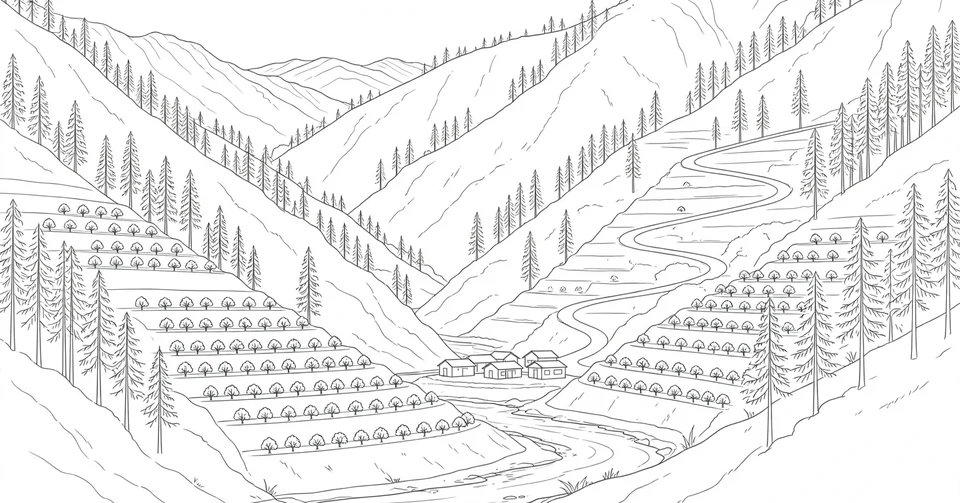
The fruit mattered, of course. But plenty of Japanese villages grow yuzu. What Umaji did differently was to decide that the fruit was only the vehicle. The real product was the village itself: its forests, its grandmothers, its inconvenient distance from everywhere, and above all its name.
When the cedar stopped paying
Umaji was not always poor or quiet. Its wealth grew on the slopes in the form of Yanase cedar, a sugi so well regarded that it had been famous for hundreds of years. In the Edo period the Tosa Domain, which ruled this part of Shikoku, designated the Yanase cedar stands as a protected asset, effectively a treasury that happened to be alive. The tree later became the prefectural tree of Kochi, prized for architecture and sculpture, and generations of Umaji families lived from felling, hauling and milling it. The region even built one of western Japan's largest forest railways to carry the logs out of these mountains.
That world ended slowly and then completely. As Japan's forestry industry contracted and timber lost its value, the income that had supported thousands drained out of the valley. The census tells the story without any decoration: 3,425 people in 1960, then 2,134 in 1970, 1,740 in 1980, and a steady fall through every count since. The village's encyclopedia entry notes that Umaji has repeatedly been on the verge of merging with nearby municipalities, and repeatedly stepped back, held together by a strong sense of independence. Independence, though, does not pay for a school or a clinic. Umaji needed an economy, not just a spirit.
The fruit in everyone's garden
The replacement had been hanging in people's gardens all along. Yuzu had grown around Umaji's houses for centuries, by some accounts since the Heian period, used the way mountain households use it: a squeeze of juice here, peel in the bath there, flavour for pickles and winter food. It was a seasoning, not an industry. Kochi as a whole would become Japan's great yuzu prefecture, a rise I have written about in the story of how Kochi turned yuzu into Japan's favourite citrus, but Umaji's part in that rise began with a problem rather than a plan.
Fresh yuzu is a hard sell from a steep valley. The slopes around Umaji are short on flat orchard land, the branches carry thorns that scar the fruit as it grows, and a scarred yuzu is a discounted yuzu or an unsold one. In the early years, as a professor at Tokyo's Advanced Institute of Industrial Technology recounts in a study of the village, damaged fruit barely sold at all. The growers' answer was to stop selling fruit and start selling what the fruit becomes. Processed products do not care about a scar. But they carry a catch: nobody sets your price for a processed good, and no wholesaler is obliged to stock a drink invented in a village of a few hundred people. If Umaji wanted the margins, Umaji would have to do the selling itself.
While other districts merged their farming cooperatives into larger organisations, Umaji kept its own small cooperative independent. That stubbornness turned out to be the foundation of everything that followed, because a village selling itself needs to own its own name.
Putting Umaji on the label
The push came from inside and outside at once. Mochifumi Totani, an Umaji native who had left for Kochi City, came home and, as president of the agricultural cooperative, set out to build a new industry on processed yuzu just as the forestry world was collapsing. In 1988 the village signed an agreement with the Ark Institute, a Tokyo design and planning group it had connected with through a department store exhibition prize, and two outsiders, planner and copywriter Ryozo Matsuzaki and designer Yasuaki Tagami, became long term partners in the project.
Their shared idea was the unusual one. Umaji would not simply develop products and advertise them. It would sell the village: the way people live there, the look of the place, the remoteness itself, reframed as proof of purity. The drink they developed was named Gokkun Umajimura, a name they took months to settle on, and the village is inside the name. Its label carries Gokkun Boya, a gulping boy character drawn by Tagami, who went on to appear across the village's products, its tourist materials and its official leaflets, a single face for the whole place. The marketing pamphlets do not use young models. They use Umaji's own children and elderly residents, volunteering to be the image of where they live.
I find that choice quietly radical. Rural marketing usually hides the old people and photographs the one young family. Umaji put its grandmothers on the brochure, because its grandmothers were, in fact, the workforce and the truth of the place. The brand worked precisely because it was not a costume.
The first signature product was a ponzu soy sauce called Yuzu no Mura, and the range kept growing. Today the cooperative handles around 70 original yuzu products, from the ponzu and the Gokkun drink to cosmetics made in its own factory. The Yuzu no Mori processing plant, built from Yanase cedar, holds a juice factory, a bakery and a shop, and receives more than 10,000 visitors a year, many of them mail order customers who make the long drive to see where their boxes come from. Mail order, remarkably, accounts for more than half of total sales. Annual sales have been reported at around 3.3 billion yen, with close to 100 jobs created in a village of well under 1,000 people. Even the cedar got a second act: a semi public company was set up to revive the forest industry, and its Monacca bags, made from Yanase cedar, have been shown at trade fairs in Europe and the United States and sold at the Museum of Modern Art in New York.
The village also invented a way to let strangers belong to it. Under its Honorary Village Resident programme, fans of Umaji anywhere in Japan can register as residents in spirit. Some 10,000 people have done so, more than eleven times the actual population, and many of them visit, filling the hot spring and riding what remains of the forest railway story. Umaji did not just find customers. It recruited a population that does not need houses.
A kingdom next door
Umaji is not the only village in these mountains that bet on yuzu, and it is honest to say it is not even the biggest grower. The five towns and villages of the Chugei region, tied together by the old forest railway, now form Japan's leading yuzu producing area. Next door, the village of Kitagawa grows the fruit on a larger scale than Umaji and sells it under a Yuzu Kingdom brand, a name with its own loyal following. Kochi Prefecture as a whole produces about half of Japan's yuzu, so this one valley system sits close to the centre of the country's supply.
What separates Umaji from its neighbours is not tonnage. It is the decision about what a brand is for. Kitagawa sells excellent fruit and juice under a kingdom's banner. Umaji sells belonging, and the juice is how you take part. Both work. Only one of them gets its name spoken in business schools.
What the brand could not fix
Here is the part of the story that the case studies sometimes soften, and Umaji deserves better than softening. The yuzu economy did not reverse the demography. The census kept falling through the very decades when sales were climbing: 1,313 people in 1990, 1,195 in 2000, 1,013 in 2010, 745 in 2020. The farmers are old. The Tokyo study notes that ageing arrived early in Umaji and that nearly every elderly resident is now a part time farmer, short on hours for a harvest that happens on steep ground among thorns. The brand saved incomes, jobs and pride. It did not, and could not, manufacture young families.
And yet Umaji still exists, unmerged, with its own village office, its own cooperative and its name on bottles in Tokyo. Some young people have come the other way, city dwellers moving in and former residents returning, the U-turn and I-turn migrants that rural Japan talks about with such hope. Not enough to grow the village. Enough to keep it a place rather than a memory.
That, I think, is the honest lesson of Umaji, and it is more useful than the miracle version. Branding did not defeat decline. It bought the village the right to decline on its own terms, at its own pace, with its name intact and its work respected, instead of vanishing into a merger and a footnote. For a village of fewer than 900 people at the end of a winding mountain road, that is not a consolation prize. That is the whole game, played about as well as it can be played.
More in Food & Travel
Latest posts
- Hashigo-Nori Is Riding a Ladder Someone Else Holds
- At a Goma, Prayers Are Written to Be Burned
- The Sekaa Teruna Builds the Monsters
- A Lembaga Perkreditan Desa Is a Bank the Village Owns
- Every Melasti Goes to Fetch Tirta Amerta
- Kaburiyu Is How You Talk Your Body Into the Bath
- When the Kulkul Stops Sounding for You
- A Caru Is an Offering for the Ones You Fear
- Tatsuko Wished for Beauty and Became a Statue
- Warangan Is the Wash That Reveals the Pattern
- Ganbanyoku Is Bathing Without Water
- The Obuki Throws Out Nine Thousand Litres a Minute
- Every Village Writes Its Own Awig-Awig
- Sainokawara Is a Bath You Share With a Hundred Strangers
- Rwa Bhineda Keeps Opposites From Going to War