Hashigo-Nori Is Riding a Ladder Someone Else Holds
· 9 min read
Hashigo-nori is the Edo fire brigade art of performing acrobatics on top of a free standing bamboo ladder, and the people who matter most in it are not the climbers but the holders below, whose hands are the only support the ladder has.
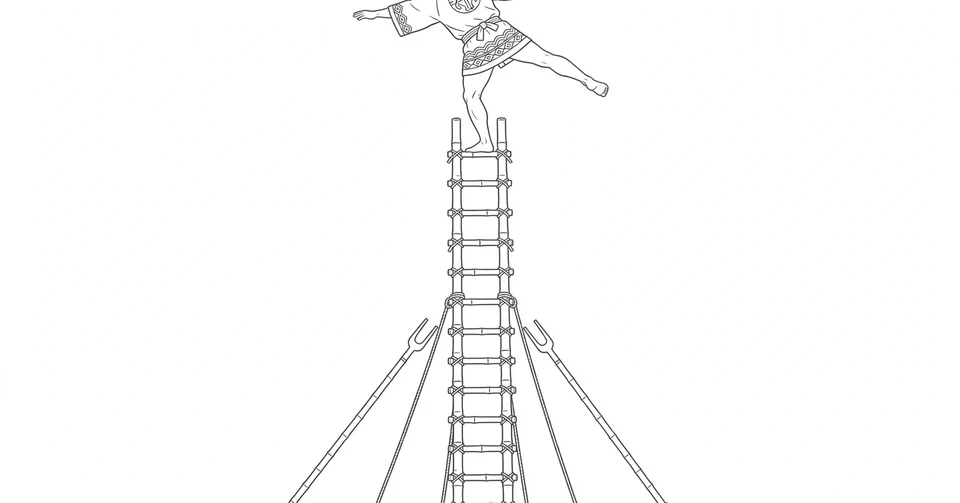
Every January in Japan, a man climbs a bamboo ladder that is not leaning against anything, reaches the top about six metres up, and calmly begins to pose. The art is called hashigo-nori, which simply means riding the ladder, and the ladder underneath him is held upright by nothing more technical than ropes, poles and the arms of his colleagues.
Watch it once and the natural thing is to watch the climber. Watch it a second time and you begin to notice that he is the calmest person in the whole picture. The real work, and the real management of risk, is happening at ground level, inside the ring of holders who cannot look away, cannot shift their grip casually and cannot think about anything else until he is safely back down.
That division of labour is the heart of hashigo-nori, and it is older than the performance itself. The poses were once a working language between a man posted above a fire and the crews waiting below him, and the trust the display runs on was once a plain condition of employment in the most dangerous trade in Edo.
What hashigo-nori involves
A hashigo-nori performance starts on the ground, with the ladder lying flat and the team gathered around it. The ladder is bamboo, roughly six metres long, light enough to be carried through the streets in procession and far too flexible to stand anywhere on its own. The team raises it together, and once it is vertical they steady it with ropes and with long poles braced against it from several sides, the poles interlocking so that the whole structure is held in tension from the ground up.
Only then does anyone climb. The performers are known as noriko, and they go up one at a time or in small formations of two or three. At the top, each climber works through an inherited repertoire of poses, standing upright with empty hands, leaning far out over nothing, stretching along the top of the ladder in positions that look impossible from below. The poses are not improvisation. Each one has been handed down with the repertoire, and accounts of the tradition note that each carries a historical meaning of its own.
There is no harness, no net and no hidden rigging. Bamboo sways, so the ladder sways gently for the entire performance, and the holders absorb every movement through their poles and ropes in small, constant corrections that the audience mostly never notices. The Japan National Tourism Organization's account of the performance at Ikegami Honmonji Temple describes the ladder being raised by a team of six, secured and balanced with ropes before the climbers ascend, which gives some idea of how much of hashigo-nori happens before anything spectacular begins.
The holders are the performance
I wrote about Tokyo's New Year fire ceremony elsewhere and ended that piece with a piece of advice: watch the holders rather than the climber. A whole article about hashigo-nori is really just that sentence taken seriously, because the holders turn out to be where the skill, the history and the meaning of the art are all concentrated.
Consider what a holder actually does. His feet are planted, his eyes are up, and his job is to read the lean of a six metre ladder before the lean becomes a fall. He works through a forked pole and a rope, feeling movements that begin above his head, and he answers them with pressure rather than force, early rather than late. The holders in hashigo-nori also work as one body. A correction on one side has to be matched on the other, and the ring communicates constantly, in calls and glances, while the crowd applauds something else entirely.
The climber, for all his nerve, is in a sense the passenger of hashigo-nori. His balance matters, of course, and his courage is real, but his safety has been outsourced completely to the people below. I find that arrangement quietly moving. Most spectacles hide their safety systems so the audience can enjoy the illusion of danger. Hashigo-nori does the opposite. Its entire safety system is standing in a circle in plain view, wearing the same uniform as the star, and the applause simply goes to the wrong end of the ladder. That, more than the poses, is what hashigo-nori is really asking you to admire.
A ladder that used to earn its keep
None of this began as theatre. Edo, the city that became Tokyo, was built of wood, straw and paper, with one and two storey houses packed along narrow lanes and every household cooking and heating over open flame. Fires were so routine that they acquired a grim nickname, the flowers of Edo, and a city that flammable needed men who could fight fire with almost no water. The standard method was demolition: tear down the buildings around a blaze before the flames reached them, and starve the fire of fuel.
Demolition, though, is blind work unless somebody can see. Somebody had to find the fire in a maze of lanes, judge which way the wind was pushing it, watch the roofs around it and direct the crews below. So the brigade raised a ladder, and a firefighter climbed it, turning himself into a watchtower. A detailed account of hashigo-nori at Ikegami Honmonji describes how the climber identified the fire's location from above and signalled it down to his colleagues, and how the contortions of that signalling survived, long after the fires changed, as the acrobatics themselves.
The men with the nerve and balance for that work were the tobi, the scaffolders and roof men who spent their working days at height. When the magistrate Ooka Tadasuke organised Edo's town brigades in 1718, the famous 48 companies of the Iroha, their leaders and ladder men were drawn from the tobi, and the tobi became the folk heroes of the fire ground. The same brigades carried the matoi, the crested standard that went up first above the smoke, so that everyone below could see where the brigade stood and where its climbers were working.
Seen that way, every element of modern hashigo-nori is a fossil of a job. The free standing ladder is a watchtower that had to be raised wherever the fire was, not where a wall happened to be. The holders are the ground crew, keeping the tower alive in wind and chaos. The poses are a signal language, exaggerated over generations into display, the way working songs become folk songs. Even the pride is original. The tobi were famous for showing off, and a skill practised in public, in front of the city it protected, was always halfway to a performance.
Who keeps hashigo-nori alive
The skill survives because specific people have taken responsibility for it. At Tokyo's dezomeshiki, the January ceremony where the fire service opens its year, hashigo-nori is performed by members of the Edo Firemanship Preservation Association. The association was founded in 1939 by volunteers from the city's former municipal fire companies, with the aim of keeping the arts of the old brigades alive: the kiyari work songs of the log carriers, the preserved hanten livery coats, the dance of the brigade standards, and the ladder work itself. I have described dezomeshiki, the ceremony that opens the firefighting year on top of a ladder, and the ladder segment remains the moment the whole crowd is waiting for.
Tokyo's association is not the only keeper. Local groups maintain their own versions of hashigo-nori across Japan, often attached to a temple, a shrine or a fire company with deep roots in its district. At Ikegami Honmonji Temple in Tokyo's Ota Ward, the performers are the Omori Steeplejack Association, steeplejack being the modern trade name for the same high work the tobi once did. Their event draws more than two thousand visitors, begins with the performers receiving a blessing at the temple, and ends in a mood closer to a village festival than a museum piece, with treats thrown to the crowd and children invited to try a few moves on a much smaller ladder. It is one of the most approachable places in Tokyo to watch hashigo-nori performed by a local association rather than the metropolitan one.
That last detail matters more than it might seem. A tradition kept only by specialists, behind glass, is already half gone. Hashigo-nori keeps recruiting its audience at ground level, letting a small boy discover on a short ladder that the wobble is real and the holders are not decoration. Some of those boys presumably grow up to join the ring.
The view from the ground
Stand in the crowd at a hashigo-nori performance and try the experiment of watching only the bottom of the ladder. The show changes completely. Instead of one man's balance you see ten people's attention, a single shared task performed without a word wasted, and a structure that stays in the air purely because a group of humans has agreed, completely and without distraction, that it will.
I think that is why the art has outlived its usefulness by more than a century. Cities no longer need watchtowers made of bamboo, and nobody signals fire positions with his body any more. But a crowd still recognises the thing hashigo-nori is really displaying, which is trust made visible: one person's nerve resting openly on other people's reliability. The climber gets the photograph. The holders get the truth of it, and they have been holding it, January after January, all along.
More in Culture & Society
Latest posts
- Shimekasu Was Herring You Never Ate
- A Hana Donko Wears Its Cracks Like Flowers
- A Lembaga Perkreditan Desa Is a Bank the Village Owns
- Kaburiyu Is How You Talk Your Body Into the Bath
- Kuki Is the Spring the Sea Turned White
- Warangan Is the Wash That Reveals the Pattern
- Ganbanyoku Is Bathing Without Water
- The Obuki Throws Out Nine Thousand Litres a Minute
- Every Village Writes Its Own Awig-Awig
- Sainokawara Is a Bath You Share With a Hundred Strangers
- Umaji Refused to Disappear
- Rwa Bhineda Keeps Opposites From Going to War
- Kasepekang Is Exile Without Leaving Home
- Jamasan Washes a Blade Thinner Every Year
- Herring Fed the Fields That Fed Osaka