Sainokawara Is a Bath You Share With a Hundred Strangers
· 8 min read
A short walk west of Kusatsu's steaming centre, sainokawara pairs a quiet volcanic park of hot streams and foot baths with one of the largest open air baths in Japan, a single pool roomy enough for a hundred bathers at once.
Most hot spring towns hide their best bath behind a door. Kusatsu keeps its biggest one outdoors, at the far end of a park. A twelve minute stroll west from the Yubatake, the steaming field at the centre of town, sainokawara opens out along a hot little river, and waiting there is a single open air pool of about 500 square metres, large enough to hold a hundred bathers at the same time.
That scale changes the feeling of a soak completely. There is no edging past strangers in a tub built for six, and no quiet competition for the good spot under the spout. You lower yourself into the water, drift toward whichever stretch of rock looks emptiest, and the sainokawara pool simply absorbs you, the way a lake absorbs a swimmer.
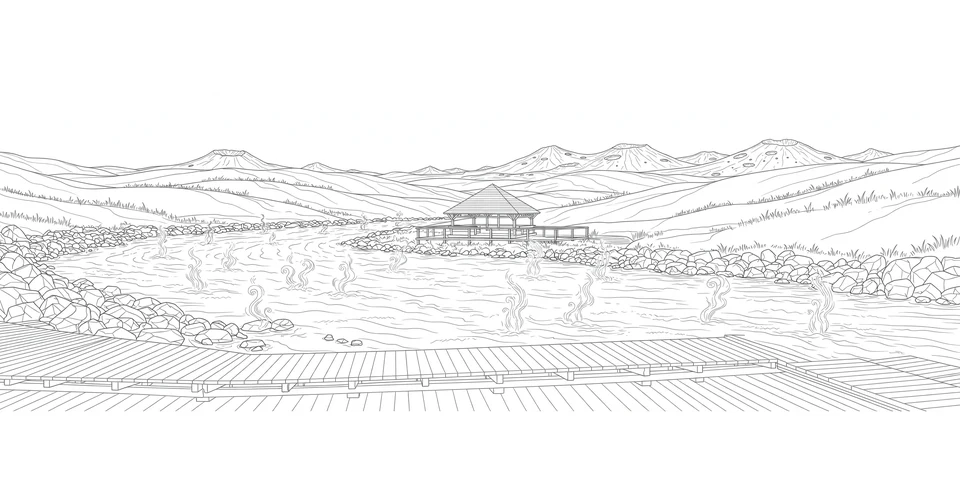
And yet sainokawara seldom feels as crowded as its numbers suggest. The park around the bath sets the pace first. Steam curls off the sainokawara stream, the stones along its banks are whitened with mineral crust, and visitors in yukata wander the paths at strolling speed. By the time you reach the bath at the end of the park, you have already slowed down to the place's rhythm.
The park comes first
Sainokawara Park occupies a shallow volcanic valley on the western edge of Kusatsu, and the walk through it is half the experience. A stone paved promenade follows the stream past small pools that bubble far too hot to touch, and a large free foot bath waits partway along for anyone who wants a preview of the water without committing to it.
The path is also a small museum of the town's memory. It passes the Anamori Inari shrine and the Oni no Chagama monument, then a row of Jizo statues known as the Matchmaking Jizo, said to protect children and travellers. Further along stand busts of Erwin von Baelz and Julius Scriba, the two German doctors who studied Kusatsu's waters in the Meiji era and told the outside world about them.
I have written before about how Kusatsu refuses to water down its onsen, protecting the strength of its water as a point of local pride. Sainokawara is that same stubbornness drawn at landscape scale. Nothing in the park apologises for the volcano underneath it. The stream runs hot, the rocks stain, the air smells of sulphur, and the bath at the end simply takes the water as it comes.
Entry to the park itself is free, and plenty of people treat sainokawara as the destination, walking the loop, soaking their feet, and heading back to town. The bath charges admission at its own gate, which keeps the two pleasures neatly separate: the stroll costs nothing, the soak is the paid event.
One pool, a hundred strangers
The bath, called Sainokawara Rotenburo, is split into a men's pool and a women's pool, each fed by the same source. At roughly 500 square metres in total it ranks among the largest open air baths in the country, and japan-guide's survey of Kusatsu's baths describes it as wide enough to accommodate more than a hundred bathers, with autumn colours in fall and snowy forest in winter as the backdrop.
At sainokawara a hot cascade pours into the pool like a small waterfall, and because there is open sky instead of a roof, the seasons do the decorating. On clear nights bathers stargaze from the water. In winter the steam thickens in the cold air and snow settles on the rocks around shoulders that stay warm. It is the opposite of the town's little community baths, where four people is a full house and the water is almost too hot to bear. Here the luxury is not intensity. It is room, and sainokawara has more of it than any bath I know in the town.
The bathing itself is pleasingly bare bones. There are no showers at the facility. You rinse by pouring water over yourself at the entrance, the old way, and there is no soap or shampoo provided, so a proper wash happens back at your inn. Bring a towel, or buy one there. I find the plainness honest. A bath this size does not need amenities. It needs water, sky, and enough space that nobody has to perform the careful, apologetic choreography of a crowded tub.
The water is still Kusatsu water
None of this space softens what is in the pool. Sainokawara draws from the Bandai source, an acidic chloride sulphate water with a pH somewhere between 1.7 and 2.1, which makes it some of the most aggressive bathing water in Japan. This is the same family of water that made Kusatsu famous and that the town, as the Japan Tourism Agency listing repeats, has traditionally recommended for digestive complaints and recovery from illness.
Those recommendations belong to the water's long reputation rather than to modern medicine, and I would treat them the way I treat all onsen lore, as a reason people have loved the place for centuries, not as a prescription. What the acidity means in practical terms is simpler. Rinse your skin well when you get out, keep your face and eyes above the surface, and let common sense rather than enthusiasm decide how long you stay in. At sainokawara, the sting on a small cut will teach you more about pH than any signboard.
Friday nights at sainokawara
Most of the week the two pools stay strictly separated, but on Friday evenings the routine changes. Since 2019, the men's pool has opened as a mixed bath from 5:30 to 8 in the evening, so couples and families can soak together, while the women's pool remains women only.
Nobody bathes bare in the mixed session. Everyone in that pool wears a bathing garment: men are lent one free of charge, and women can rent one for 400 yen or wear a swimsuit of their own. The garment has a name, yuamigi, and a whole quiet etiquette of its own, which I explored in a yuamigi lets strangers share one bath. I think the arrangement is a small masterpiece of compromise. Rather than letting mixed bathing quietly disappear, Kusatsu gave it a time slot, a dress code, and a fair price, and carried on.
There is something touching about the hour, too. The mixed session at sainokawara runs into the evening, when the park empties, the lanterns come on, and the steam turns gold in the low light. A hundred strangers by day becomes a few dozen companions by night.
A name from a sadder river
Say the name sainokawara slowly and another place surfaces. Sainokawara sounds exactly like the sai no kawara of Japanese Buddhist belief, the dry, stony riverbank that lies before the Sanzu river, the crossing of the dead. In the old teaching, children who died young waited on that riverbank, piling stones into little towers to make merit for their parents. Demons came and knocked the towers down, and the children began again, until Jizo, the bodhisattva who protects children and travellers, gathered them into the sleeves of his robe and carried them to safety.
Whether the park took its name from that riverbank or simply shares its sound, the echo is impossible to unhear once you know it, and the Jizo statues waiting along the promenade make the resonance feel less like coincidence. I would not push the connection further than that. But I like that a place devoted to pleasure carries a name with a little grief folded inside it, and that the walk to the sainokawara bath passes guardians set there to look after the most vulnerable travellers of all. It gives the steam a second meaning. The living soak in the warm river above ground, and the name remembers another river where the water never ran warm at all.
Before you go
The practical details are simple. Sainokawara Park is a twelve to fifteen minute walk from the Yubatake along the promenade, an easy stroll with no climbing. The sainokawara bath opens long hours, from 7 in the morning to 8 at night between April and November, and from 9 in the morning in the winter months, with last entry at 7:30 in the evening. Published prices disagree with each other, which is common for listings written in different years: the tourism agency page says 600 yen for adults, a more recently updated guide says 800, so treat the exact figure as something to confirm on the day rather than a promise.
Go in winter if you can, and go late in the day. Snow on the rocks, steam standing in still columns, and a pool so wide that a hundred people can share it without ever quite meeting: that is sainokawara at its best, and it has stayed with me longer than many grander sights. Some baths impress you with what they exclude. This one impresses you with how much it can hold.
More in Life & Style
Latest posts
- Shimekasu Was Herring You Never Ate
- A Hana Donko Wears Its Cracks Like Flowers
- Hashigo-Nori Is Riding a Ladder Someone Else Holds
- At a Goma, Prayers Are Written to Be Burned
- The Sekaa Teruna Builds the Monsters
- A Lembaga Perkreditan Desa Is a Bank the Village Owns
- Every Melasti Goes to Fetch Tirta Amerta
- Kuki Is the Spring the Sea Turned White
- When the Kulkul Stops Sounding for You
- A Caru Is an Offering for the Ones You Fear
- Tatsuko Wished for Beauty and Became a Statue
- Warangan Is the Wash That Reveals the Pattern
- Every Village Writes Its Own Awig-Awig
- Umaji Refused to Disappear
- Rwa Bhineda Keeps Opposites From Going to War