Kasepekang Is Exile Without Leaving Home
· 8 min read
Kasepekang is the heaviest sanction in Balinese customary law, a social and spiritual exile that leaves a family inside its own home while the village quietly closes around it.
Some punishments take away a person's freedom. Kasepekang takes something harder to name. A family under this sanction goes to sleep in its own house, on its own street, in the village where its ancestors are buried, and wakes to find that the village has ended for them. Nobody has been arrested, nothing has been seized, and no one has been ordered to leave. Kasepekang is the heaviest sanction in Balinese customary law, and it works by leaving you exactly where you are while everyone around you withdraws.
Kasepekang formally suspends a person, or more often an entire household, from membership of the desa adat, the customary village. In 2010, The New York Times, reporting on the growing weight of customary law in Indonesia, likened kasepekang to a social and spiritual death sentence, and the phrase has clung to the sanction ever since. In a society where the whole cycle of life and religion runs through the ancestral village, the comparison is not much of an exaggeration.
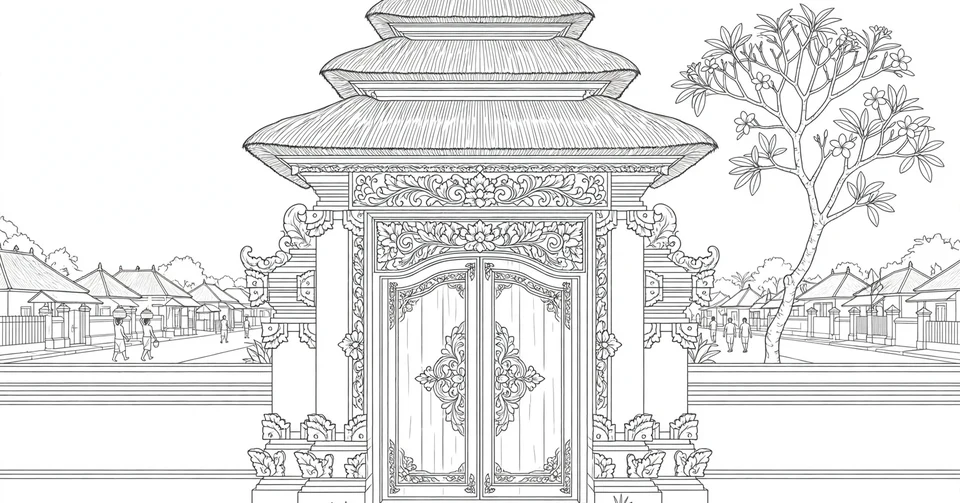
To understand the weight of it, it helps to understand what membership carries. As I wrote in a piece on how a desa adat governs itself, the customary village is not a neighbourhood association with ceremonies attached. It keeps the temples, sets the ritual calendar, maintains the cemetery, organises the labour behind every wedding and cremation, and writes its own rules, the awig-awig, that its members agree to live under. Belonging there is infrastructure. Kasepekang is what happens when that infrastructure is switched off for one household and left running for everyone else.
What kasepekang actually cuts off
The decision is taken by the village in assembly, the paruman, and once it falls, the mechanics are simple and close to total. Neighbours are instructed not to speak to the family or have dealings with them. The kulkul, the wooden slit drum whose sound summons members to rituals, emergencies and gatherings, is no longer sounded for them. Communal assistance, called panyanggran, the pooled labour and support that Balinese life quietly depends on, is withdrawn across the board: for ceremonies of joy, for religious observance, for disaster, and for death. Membership in a desa adat is a pairing of duties, swadharma, and privileges, swadhikara, and kasepekang revokes the second while the family remains surrounded by people still living inside both.
That last item, death, is where the sanction shows its depth. Under the island wide guidelines agreed in 2010, a sanctioned person formally keeps the right to use the village cemetery, the setra, for burial or cremation. What disappears is every pair of hands. A Balinese cremation is a collective undertaking, carried by dozens of relatives and neighbours, and a family under kasepekang faces the obligations of death with no one permitted to help. In practice, disputes over death ceremonies at the setra have at times grown bitter enough to need government mediation. The house itself is no certain refuge either. Village house plots, the pekarangan desa, sit inside the customary village's own land order, so the ground beneath a sanctioned family's home is bound up with the very membership it has lost.
The texture of the thing is silence. Greetings stop. Invitations stop. The family's name stops being called across the meeting hall, and the offerings it leaves go untouched. The same collective machinery that produces Bali's most famous act of togetherness is at work here, aimed the other way. Nyepi stops the entire island for a day, and even that silence is organised village by village, through the same customary structures. Kasepekang borrows that machinery and points it at a single gate. Nothing about it requires force. It is performed by hundreds of people doing nothing, together, on instruction, and I find that design more unsettling than many louder punishments, because the whole community becomes the instrument.
A ladder of sanctions, not a leap
It matters that kasepekang is not supposed to arrive quickly. Village councils work with a ladder of lesser measures first: warnings, mediation by elders, fines, public shaming. The sanction sits at the top of that ladder, above every material penalty, because it touches belonging itself. In 2010, the Pasamuhan Agung III, a grand assembly of the Majelis Desa Pakraman, the island wide council of customary villages, restated the guardrails. Kasepekang is a last resort, to be imposed only after warnings, mediation and material sanctions have failed. Its stated purpose is not revenge but the restoration of balance within the community. It is temporary, a suspension of membership reviewed across village meetings rather than anything like a life sentence, and the assembly set an outer limit of three formal meetings spent reviewing a case.
Beyond it sits one heavier thing, kanorayang, permanent expulsion from the village, and the same guidelines prohibit it unless every earlier stage has failed. The distinction is not a technicality. Kasepekang, in its formal design, suspends a member; it does not erase one. A door is closed, and the rules themselves insist that it remains a door.
In the Karangasem villages where researchers have documented the sanction most closely, the people living under it even have their own name: krama nanggulang, members who are isolated inside their own village. The term captures the strangeness of the status better than any translation can. A krama nanggulang has not left, has not been expelled, and is still, in the village's own accounting, a member. He is a member the village has agreed, for now, not to treat as one, and that small word, member, is what separates kasepekang from banishment proper. Exile here is not a place you are sent to. It is a status you are kept in.
Where village law meets state law
Indonesia runs on layered law, and kasepekang sits exactly on the seam. The tension is a product of the reform era: since 1998, customary law has regained authority across the country, which is much of what brought foreign reporters to Bali in 2010. The constitution recognises customary law communities and their traditional rights, and Bali's provincial regulation on customary villages, passed in 2019, gives the desa adat a firm legal footing. At the same time, national human rights law guarantees freedoms of religion, association and movement that a total communal boycott presses hard against. Both claims are real, and neither simply cancels the other out.
Modern cases keep testing where the seam tears. In Paselatan, a customary village in Karangasem regency, one family was dismissed as krama for a strikingly ordinary reason: they could not repay a loan from the village credit institution, the LPD that many Balinese villages run. The case was later examined in a study in the law journal IUS QUIA IUSTUM, which concluded that the sanction, as applied there, sat poorly with the values of legal humanism and conflicted with juridical principles. Land scholars have raised a parallel objection, arguing that whatever kasepekang may do to a family's ritual standing, it should not be able to strip away rights over village land that national agrarian law and the constitution protect.
The village's answer deserves a fair hearing too. Membership of a desa adat is a bundle of duties before it is a bundle of rights: labour owed, ceremonies staffed, rules kept. A community held together by voluntary ritual work has very few enforcement tools that do not eventually end at the same place, exclusion, and its elders argue that a sanction aimed at restoring balance is being misread as a punishment aimed at suffering. That argument is strongest, I think, when the guardrails hold: when kasepekang is genuinely last, genuinely temporary, and genuinely aimed at bringing the family back in. The cases that reach national news are almost always cases where one of those three words failed.
The way back
Reintegration is built into the design. A household under kasepekang can be received back through established rituals and obligations, fulfilling what the village asks and being readmitted by the village's decision. Elders describe the whole apparatus in the language of healing rather than retribution: a fracture in the community is being repaired, and the repair is only finished when the family is inside again. Read generously, kasepekang is less a door slammed than a door held shut by many hands, waiting for the household on the other side to knock in the agreed way.
Read ungenerously, of course, it is also a demonstration of how completely a close community can unmake a life without ever touching it. Both readings are true at once, which may be why the sanction survives every attempt to simply abolish it or simply defend it.
What stays with me about kasepekang is what it measures. The sanctioned family keeps its house, its shrine, its gods, its fields in daily use. What it loses is the layer of other people that made those things function as a life. Most legal systems punish the body or the wallet; this one audits belonging itself. Bali's long argument over kasepekang, between elders and lawyers, villages and ministries, is really the argument every tight community eventually has about how much power it should hold over the people who compose it. The closed gate can be opened again. The whole dispute is about who holds the key, and how long they may keep it turned.
More in Culture & Society
Latest posts
- Shimekasu Was Herring You Never Ate
- A Hana Donko Wears Its Cracks Like Flowers
- A Lembaga Perkreditan Desa Is a Bank the Village Owns
- Kaburiyu Is How You Talk Your Body Into the Bath
- Kuki Is the Spring the Sea Turned White
- Tatsuko Wished for Beauty and Became a Statue
- Warangan Is the Wash That Reveals the Pattern
- Ganbanyoku Is Bathing Without Water
- The Obuki Throws Out Nine Thousand Litres a Minute
- Every Village Writes Its Own Awig-Awig
- Sainokawara Is a Bath You Share With a Hundred Strangers
- Umaji Refused to Disappear
- Rwa Bhineda Keeps Opposites From Going to War
- Jamasan Washes a Blade Thinner Every Year
- Herring Fed the Fields That Fed Osaka