A Hana Donko Wears Its Cracks Like Flowers
· 9 min read
A hana donko is the rarest grade of dried shiitake, a donko whose thick cap split into a white pattern like a flower as it grew. The cracks are not damage. They are the most expensive surface in Japan's mushroom trade.
In almost every food market on earth, a cracked surface means a lower price. Split skin is damage, and damage gets discounted. Then there is the dried shiitake tray in a Japanese department store, where the most expensive mushroom in the box is the one whose cap has split open into a web of white cracks. That mushroom is a hana donko, and the cracks are the whole point.
Hana donko means flower donko. The white pattern spreading across the dark brown cap honestly does look like a flower pressed into the surface, or like frost ferns on a winter window. Nobody carved it and nobody painted it. The mushroom grew that way, slowly, in the cold, and the pattern is simply what its skin did when it could not keep up.
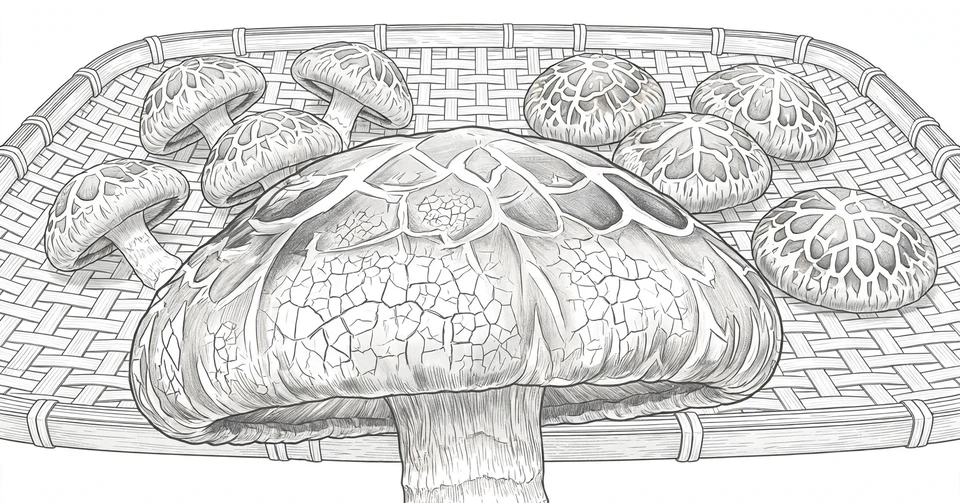
To see why this matters, it helps to know the family it sits at the top of. A donko is a shiitake picked young, while the cap is still thick, domed and curled shut, and I have written before about a donko and its interrupted childhood. A hana donko is a donko that went one step further. It kept growing in winter conditions until its own cap split, and instead of being sorted down for the blemish, it was sorted up, above every smooth donko in the shed.
What a hana donko actually is
The first thing to understand is that a hana donko is not a variety. There is no hana donko spore, no special log and no separate farm. It is a grade, awarded after harvest to individual mushrooms, and whether a given shiitake earns it depends on the weather it happened to grow through. The same log that produces plain donko all winter might produce a handful of flowered ones in one cold, dry week, and none at all the week after.
The naming alone tells you how closely Japanese growers read these caps. Agricultural writers at Mynavi point out that dried shiitake names change with the crack pattern on the cap, and the list includes tenpaku donko, hana donko and chaka donko, the last one a browner, tea coloured flowering. In Miyazaki, the great shiitake prefecture of the southwest, the most fully whitened grade is usually called tenpaku donko, and the Miyazaki trade centre describes it as a very rare type of dried shiitake whose cap cracks naturally because of temperature, weather and humidity. Two names, one mushroom, and both of them are really descriptions of a surface.
Below it sits the ordinary donko, smooth capped and already expensive, and below that the half opened koko and the fully opened koshin, the thin fragrant mushroom I described in the koshin article. A hana donko crowns that whole ladder. It is the only rung of it that is defined neither by when the mushroom was picked nor by how far the cap opened, but by what the weather wrote on its skin.
Why the cap splits
The mechanism is almost sad in its simplicity. A winter shiitake on an oak log grows slowly. Cold air keeps the surface of the cap dry, while inside, the flesh keeps quietly swelling, pushing outward day after day. The listing for Morotsuka village in Miyazaki, one of the famous homes of this grade, explains it plainly: exposed to cold, dry air, the mushroom keeps trying to grow larger from the inside, and the outer skin, unable to follow the growth, splits apart into a beautiful flower pattern.
Dryness is the other half of the recipe. Sugimoto, the Kyushu producer whose forest grown hana donko is sold as its most premium shiitake, notes that when less moisture touches the surface of the cap, beautiful white cracking patterns appear. Rain is the enemy of the pattern. A mushroom that gets rained on swells evenly and stays smooth and dark, which is why Sugimoto says a natural hana donko can only form in sheltered spots, tucked under logs, where rain never falls directly on the cap. Japanese growers even have weather names for the crop, amako for mushrooms that grew through rain and hiyoriko for ones that grew through continuing fine weather, and it is the dry weather children that flower.
This is why I find the grade so likeable. A hana donko is not bred, engineered or finished by hand. It is what happens when a mushroom grows too slowly for its own skin in exactly the right kind of cold. The flower is a growth accident, standardised by a market patient enough to sort for it.
Rare enough to be bagged one by one
Rarity is where the prices come from, and here the sources speak in producers' estimates rather than statistics, so they deserve a small caution. Okada Shoten, a Miyazaki shiitake house, calls the tenpaku or hana donko a miraculous mushroom that makes up less than one percent of the shiitake harvest. The Morotsuka listing is blunter about the labour involved. Growers watch the weather and the temperature closely and slip a protective bag over each mushroom, one by one, to guard the forming pattern. After all that, only a limited few of the mushrooms are good enough to be sent out as the finished grade.
The result travels the way luxury food usually travels in Japan, in a presentation box. Sugimoto describes its gift packaged hana donko as a present for gourmet friends and family, and on the hometown tax programme, a gift box of about 300 grams from Morotsuka sits at a 44,000 yen donation tier, which tells you roughly where this mushroom sits in the gift economy. Nobody buys a hana donko the way they buy a bag of ordinary dried shiitake for Tuesday's soup. They buy it the way they buy a famous tea or a boxed melon, as an object first and an ingredient second.
What you are actually paying for
Honesty requires a small deflation here. The hana donko grade is, at bottom, a visual grade. The chemistry that makes dried shiitake taste like dried shiitake does not live in the white cracks. As I noted in the earlier articles in this series, the flavour compound guanylate is produced when drying breaks down the mushroom's cells and soaking brings it back, and that chemistry works across the grades, in a humble koshin as faithfully as in a flowered cap. Sugimoto does claim its forest grown hana donko is the most delicious of its shiitake with the best aroma, and a thick winter donko of any kind is a dense, chewy, deeply flavoured mushroom. But the premium over a plain donko is mostly for the pattern, and Sugimoto is candid that greenhouse grown versions can be produced easily and look beautiful while tasting less. The flower guarantees a biography, not a flavour.
What the pattern does guarantee is texture and presence. These are the thickest caps of the winter crop, slow grown and tight fleshed. The Oita prefectural guide recommends donko for simmered dishes and hot pots like sukiyaki and oden, and the Morotsuka growers suggest soaking their tenpaku slowly and serving it as a mushroom steak, where the cap is the whole dish. On nutrition, the claims in my sources are modest and I will keep them that way: the Oita guide notes dried shiitake is a rich source of vitamin D, which is a property of the dried mushroom generally, not a magic held only by the flowered ones.
Personally, I do not think paying for the pattern is foolish. Food cultures everywhere charge extra for evidence that someone, or something, took time. The white cracks are a legible record of a cold, dry, unhurried winter, and a cook who serves a whole simmered hana donko is serving that record. What I would resist is the suggestion that the smooth donko beside it is somehow a failure. It is the same mushroom in the same winter. It just kept its skin intact.
In the kitchen, the flower disappears into the dish
Cooking a hana donko is an exercise in patience that starts a day early. Sugimoto advises soaking in cold water in the fridge, up to 24 hours for the best result, and Mynavi's agricultural guide gives the traditional ideal as water at 5 to 6 degrees for eight hours or more. The soaking water is never thrown away. It is now a light dashi, carrying the guanylate the mushroom released, and it goes into the simmering pot with the mushrooms themselves.
And here is the quiet punchline of the whole grade. Once soaked and simmered, the famous white flower softens into the general darkness of a cooked mushroom. In a bowl of onishime, the New Year simmered vegetables where whole donko appear like dark coins among the carrots and lotus root, what your guest actually experiences is thickness, chew and depth of flavour. The pattern that justified the price has done its work long before the first bite, in the shop, in the gift box, and in the grower's cold field. It was never really for the eater. It was for the choosing.
That, I think, is the right way to hold the hana donko in your mind. It is a mushroom whose beauty was caused by growing too slowly for its own skin, graded by people who learned to read cracks the way other people read calligraphy. Buy it when you want the story as much as the soup. Cook it slowly, drink the soaking water as part of the dish, and let the flower go. It was a record of one cold winter on an oak log, and records, unlike mushrooms, do not need to be eaten to have been worth keeping.
More in Food & Travel
Latest posts
- Hashigo-Nori Is Riding a Ladder Someone Else Holds
- At a Goma, Prayers Are Written to Be Burned
- The Sekaa Teruna Builds the Monsters
- A Lembaga Perkreditan Desa Is a Bank the Village Owns
- Every Melasti Goes to Fetch Tirta Amerta
- Kaburiyu Is How You Talk Your Body Into the Bath
- When the Kulkul Stops Sounding for You
- A Caru Is an Offering for the Ones You Fear
- Tatsuko Wished for Beauty and Became a Statue
- Warangan Is the Wash That Reveals the Pattern
- Ganbanyoku Is Bathing Without Water
- The Obuki Throws Out Nine Thousand Litres a Minute
- Every Village Writes Its Own Awig-Awig
- Sainokawara Is a Bath You Share With a Hundred Strangers
- Rwa Bhineda Keeps Opposites From Going to War