Shimekasu Was Herring You Never Ate
· 10 min read
Shimekasu was the hard pressed cake of boiled herring that powered Hokkaido's great herring boom, a fertiliser so valuable that its sales rivalled the island's coal output and paid for the famous herring palaces.
Order herring in Japan today and you get a fish for the table: grilled, simmered sweet in soy, its roe served as a New Year delicacy. For generations, though, the great majority of herring caught in northern Japan was never meant for anyone's dinner. It was boiled whole, pressed until the oil ran out, and dried into dense cakes called shimekasu, a fertiliser that travelled the length of the country by ship and ended its life under cotton plants.
Shimekasu is the forgotten centre of the herring story. The famous numbers of that age, the record catches and the mansions along the Hokkaido coast, only really make sense once you accept that the fishery was not a food industry at all. It was a fertiliser industry that happened to begin with a fish.
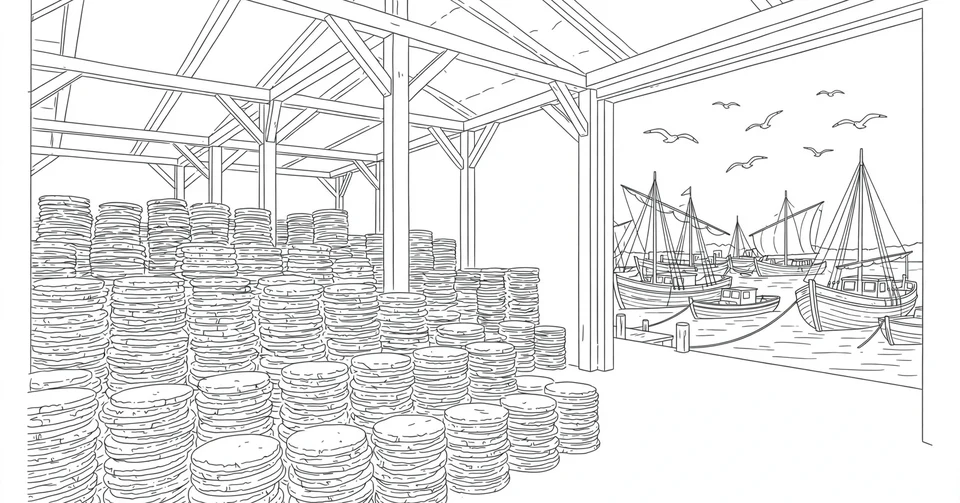
This piece stays with the cake itself: how shimekasu was made, why farmers hundreds of kilometres away competed to buy it, and what its disappearance meant when the herring failed. The fish built two landscapes at once, palaces in the north and harvests in the south, and the link between them was a grey, unglamorous block of pressed fish.
What shimekasu actually was
The first herring fertilisers were scraps. Producers sold the heads and backbones left after the flesh was taken off, the gills, and the soft roe, and farmers worked these into their fields. Then, in the early nineteenth century, the trade settled on the product that would dominate it. Whole herring were boiled and pressed hard, and the dry residue left behind, crumbled or formed into cakes, was shimekasu.
The name is descriptive. Kasu is the pressed residue left after squeezing, the same word used for the lees of sake brewing, and shimekasu was exactly that: what remained of a herring after everything liquid had been forced out of it. The pressing also yielded herring oil, a second product with its own market, in an age when fish oils were among the fuels ordinary households burned for light. Almost nothing of the fish was wasted. It was simply that the most valuable part of it was destined for soil rather than stomachs.
What made shimekasu valuable was the combination of strength and patience. It was rich in nitrogen, the nutrient hungry commercial crops demand most, and in its dried cake form it kept for months without spoiling. A fresh fish rots within days and can only feed people nearby. A cake of shimekasu could wait in a warehouse, survive a long sea voyage, and still deliver its fertility at the other end of the country. That shelf life turned a local glut into a national commodity.
A fishery aimed at fields, not tables
None of this was the herring's original role. The Ainu had eaten herring in Hokkaido since deep antiquity, and herring bones turn up in excavated ruins from the Jomon period onward. The change came in the Edo period, when Japanese operators began running large net fisheries whose stated purpose was fertiliser production. From the middle of the eighteenth century, the customer for Hokkaido herring was increasingly not a cook but a farmer.
The demand grew in a clear pattern. Herring fertiliser was first used in Omi, the province around Lake Biwa, in the first half of the eighteenth century. It spread through the Kinki region around Osaka in the following decades, and by the middle of the nineteenth century it had reached the Hokuriku coast and the shores of the Seto Inland Sea. As the market widened, so did the fishery, and by the peak years the proportions had become startling. According to the Otaru City Museum's history of the trade, 80 to 90 percent of the herring landed in the peak period was processed into fish fertiliser. The nets came up full of a crop, not a catch.
It helps me to picture the boats differently because of this. We imagine fishing fleets supplying kitchens, but the great spring fleets off Hokkaido were closer to a harvest industry, gathering a raw material for processing plants on the beach. The fish were raw material first and food second, and shimekasu was the form in which that material became money.
South on the old sea routes
From the processing beaches, the cakes moved south along the traditional sea routes built up in the age of the kitamaebune, the wooden cargo ships that linked the northern coasts with Osaka. Shimekasu was landed at ports along the Hokuriku coast and around the Seto Inland Sea, then distributed inland to farming districts. The same shipping world carried other northern harvests south, including the kombu that quietly underpins so much of Japanese cooking, but few cargoes matched the meal in sheer dependable bulk.
The fields waiting for it grew cash crops, the hungry kind that exhaust soil and repay feeding: cotton, indigo and rapeseed above all, with mulberry in the mix as well. These were not subsistence plots. They were commercial agriculture, tied to textile towns and dye works, and their owners could calculate exactly what an extra bale of cotton was worth against a shipment of fish cakes. Shimekasu was bought the way a factory buys fuel.
You can still see the far end of that chain in stone. At Shimotsui, a port on the Seto Inland Sea in what is now Kurashiki, farmers had reclaimed land from the sea that was too salty for rice, so they grew cotton and rapeseed on it instead, fed with herring meal unloaded from northern ships. Storehouses for the meal went up one after another in the town, and the Ogino family grew wealthy on the warehousing business alone, renting storage space for the herring lees the ships brought in. The district later became cotton country important enough to host a modern spinning mill. Northern fish, southern field, factory cloth: the shimekasu sat quietly at the start of the whole sequence.
Meal money, counted against coal
By the early twentieth century the trade had grown large enough to measure against heavy industry, and the comparison is the single most revealing statistic of the herring age. In 1905, herring sales in Hokkaido came to just over 8.11 million yen, some 66 percent of all marine products sold on the island. The pressed meal alone, shimekasu by itself, accounted for 5.56 million yen of that total. Set beside it, the island's coal output that year was just over 7 million yen.
Read that again slowly. A product whose very name means dregs, the squeezed remainder of a fish, generated sales in the same league as coal on Japan's resource frontier. Coal dug railways and steamships out of the ground. Shimekasu did something quieter: it made other regions' harvests bigger, year after year, invisibly, underground. Economists of the time could see both figures in the same statistical yearbook, and the meal was not embarrassed by the company.
This is why I think the usual telling of the herring boom gets the emphasis wrong. It is told as a fishing story, full of boats and nets and brave seasonal labour, and those things were real. But the engine underneath was agricultural demand in the south. Osaka and the Kinki plain did not merely enjoy the herring age; their cotton fields ordered it into existence, and the shimekasu trade was the contract between the two regions.
Palaces paid for by cake
The machinery that filled the warehouses was the set net, a fixed trap net known as tateami, put into successful practical use off the Shakotan Peninsula in 1885. Set nets let the fish do the travelling: a boss with a good ground could take an industrial share of the spring run for the cost of maintaining nets and crews. In 1897 the Hokkaido catch peaked at roughly 970,000 tons, with about 30 percent of it landed along the Shiribeshi coast and more than 80 percent taken in set nets, as the museum's history of the fishing grounds records.
The profits hardened into architecture. Up and down that coast, fishing bosses built the compounds known as nishin goten, herring palaces: dormitories for seasonal crews, warehouses and workshops, and a villa for the master's family, all far grander than a fishing village seemed to require. The former Aoyama family villa still stands in the Shukutsu district of Otaru, its rooms full of the art and furniture the fish paid for. The old Tanaka family house was moved to Otaru in 1958 and survives as the Otaru City Herring Palace, and the former Fukuhara fishing grounds in Yoichi are preserved as a national historic site.
These buildings are usually presented as monuments to fishing, and in a sense they are. But on the numbers, they are monuments to shimekasu. Four fifths or more of the catch that paid for every beam and roof tile was never eaten by anyone. The palaces were built by fertiliser, decorated by fertiliser, and heated through winters of fertiliser money. The herring those bosses grew rich on were, in the main, the herring that fed the fields around Osaka, and only incidentally a fish at all.
When the fish stopped coming
The end, when it came, was not a slow fade. The stock had been declining year by year from its extraordinary peak, and in the middle of the 1950s the spawning herring disappeared from the coasts of Hokkaido altogether. The causes most often given are the familiar pair: decades of fishing at a scale the stock could not sustain, and changes in the marine environment the fish depended on. Within a single generation, an industry that had organised life along the northern coast for two centuries simply stopped.
Notice what Japan lost in that moment. It did not lose a beloved dish; herring as food had always been the smaller part of the story. It lost a fertiliser supply. The cotton, indigo and rapeseed districts of the south had been fed for generations by a wild fish they never saw, delivered as grey cakes by wooden ships and then by steam. In the postwar decades, chemical fertilisers took over that job, made in factories from air and fossil fuel rather than gathered from the spring sea. The replacement worked, and was arguably more reliable, but the old link between a northern fishery and a southern harvest was broken for good.
Herring have returned to Hokkaido waters in recent years, in numbers nowhere near the old abundance, and around Otaru the fish is celebrated again each spring as something to eat, fresh and local. It is a pleasant ending, but it is a different story from the old one. Nobody is pressing the catch into cakes. The word shimekasu survives mostly in museum displays and in the storehouses of ports like Shimotsui, waiting for visitors to ask what the smell in the walls once was.
There is something worth keeping in that reversal. For a century, one of Japan's great industries rested on a fish most people never tasted, converted into a form most people never saw, feeding fields most fishermen never visited. Shimekasu was herring you never ate, and for a long time, that was precisely the point of it.
More in Food & Travel
Latest posts
- Hashigo-Nori Is Riding a Ladder Someone Else Holds
- At a Goma, Prayers Are Written to Be Burned
- The Sekaa Teruna Builds the Monsters
- A Lembaga Perkreditan Desa Is a Bank the Village Owns
- Every Melasti Goes to Fetch Tirta Amerta
- Kaburiyu Is How You Talk Your Body Into the Bath
- When the Kulkul Stops Sounding for You
- A Caru Is an Offering for the Ones You Fear
- Tatsuko Wished for Beauty and Became a Statue
- Warangan Is the Wash That Reveals the Pattern
- Ganbanyoku Is Bathing Without Water
- The Obuki Throws Out Nine Thousand Litres a Minute
- Every Village Writes Its Own Awig-Awig
- Sainokawara Is a Bath You Share With a Hundred Strangers
- Rwa Bhineda Keeps Opposites From Going to War