Warangan Is the Wash That Reveals the Pattern
· 11 min read
Warangan is the arsenic wash that reveals the hidden pamor pattern inside a keris blade, darkening the iron while the nickel rich layers stay bright. It is poisonous, it was long a secret of the smiths, and every treatment costs the blade a little of itself.
A keris fresh from the forge is a disappointment to look at. The blade is grey, smooth and almost plain, and nothing on its surface hints at the pale rivers of pattern that collectors prize. Those patterns are already inside the metal, folded there layer upon layer by the smith, but they stay invisible until the blade meets warangan, the arsenic wash that finishes the forging and starts the blade's real life.
Warangan is a preparation built on arsenic compounds, traditionally made from arsenic bearing minerals such as realgar, the orange arsenic stone. A study at Universitas Indonesia glossed the word without any romance: warangan, poison to wash a kris or spear. Paired with the acidic juice of citrus fruit, the wash is worked over a blade that has first been cleaned, and it does one thing with great precision. It darkens the iron almost to black while leaving the nickel rich layers bright, so the hidden pattern stands up in silver against charcoal.
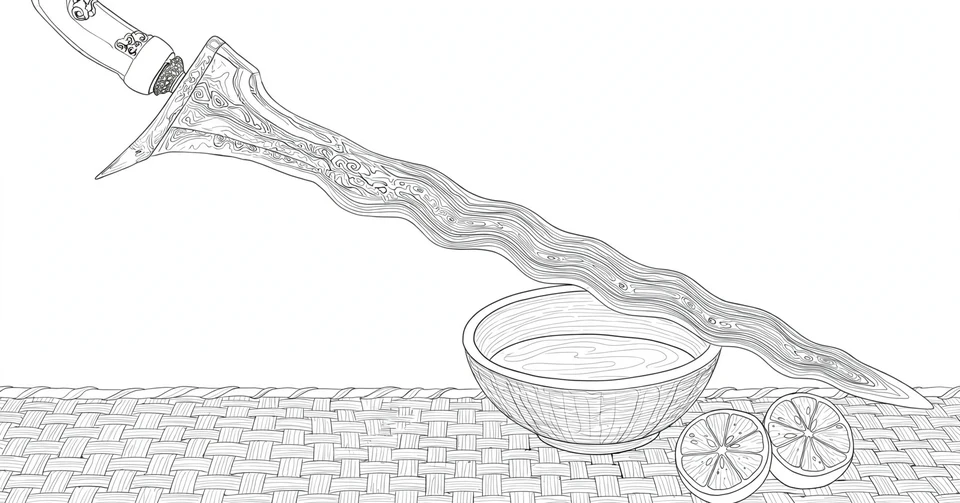
It needs saying plainly, because the word poison is not a metaphor here. Warangan can kill. It belongs in the hands of smiths and caretakers who were trained to handle it, and a description of what it does is not an invitation to attempt it. What follows is about why the keris cultures of Java and Bali kept such a substance close for centuries, and what it quietly costs the blades it serves.
What warangan actually is
A keris is judged by three things: its form, its age, and its pamor, the pattern in the blade. Warangan is the treatment that decides whether the third of those can be seen at all. Reference works describe the process as a washing of the blade with acid and minerals containing arsenic compounds, and they note that the details were kept secret among smiths. The citrus juice does the cleaning and helps the reaction along. The arsenic does the darkening. Together they form the oldest chemical step in the keris tradition, older than any living memory of how it began.
Old accounts gave the wash a darker reputation. Blades, it was said, were infused with poison during their forging, so that any wound they made would be fatal, and warangan was named as that poison. That story should be read as the legend it is. The wash certainly made a blade dangerous to handle carelessly, and arsenic on a blade is nothing to dismiss. But the daily work of warangan was never really about warfare. It was about revelation. The poison was a tool of the eye before it was ever imagined as a tool of the battlefield.
The secrecy had a practical side as well as a mystical one. A smith whose wash produced deep, even contrast, black where the iron should be black and bright where the nickel should shine, had something his rivals wanted. In a craft organised around courts, patrons and apprenticeships, recipes were capital. They were demonstrated to a chosen successor, not written down for strangers, and that is why accounts of warangan tend to describe its effects in detail while going quiet about its making.
Why the iron darkens and the pamor stays bright
The trick works because a keris blade is not one metal but two, interleaved. The smith forge welds iron or steel together with iron rich in nickel, folding the stack back on itself dozens or even hundreds of times, until the finished blade carries both metals in fine strata. Acid treats the two metals differently. It bites into the iron, corroding and darkening its surface towards black, while the nickel rich layers resist the bath and keep their pale shine. The contrast is not painted on. It is the sound of two metals answering the same question differently.
I have written before about the pamor as the fingerprint of the blade, the pattern that runs through the metal rather than sitting on it, planned by the smith yet never fully controlled by him. Warangan is simply the moment that hidden structure becomes legible. Nothing is added in the bath. The beras wutah, the scattered rice, and the udan mas, the golden rain, were folded into the steel at the forge. The wash only persuades them to show themselves.
This is also why nickel mattered so much to smiths. The most prized nickel bearing iron of all fell from the sky at the end of the eighteenth century, the meteorite that came down near the temple complex of Prambanan and was carried to the court of Surakarta. After etching, even the small percentage of nickel in that iron lit up faintly against the darkened steel around it. Later laboratory tests have shown that bright nickel alone does not prove a meteorite was involved, since ordinary ores can shine too. The wash reveals nickel, wherever the nickel came from. It does not certify legends.
The first appointment, at the end of the forge
Warangan appears twice in the life of a blade, and the first time is at the very end of its making. By then the empu, the master smith, may have spent weeks or months on a single piece: choosing the irons, folding them, shaping the waves of the blade, carving the details at its base. All of that labour is hidden inside grey metal. Only when the blade is finished, cleaned and given to the wash does anyone, including the smith, see what the folding actually produced. Writers who have followed the process describe it as a moment of revelation, the dark iron turning deep black or purple in the bath while the nickel layers hold their silver.
I find that moment the most honest in the whole craft. The wash cannot flatter. It reports exactly what the layers are doing at the surface the grinding reached, the pattern the smith aimed at and the one the fire allowed, arriving together in the same glance. A great empu could steer the result, but he could not proofread it in advance. Warangan was his first reader, and it read without mercy.
It is worth remembering what tradition this small bath belongs to. The making of the keris was the specialised work of the empu, craftsmen expected to hold technical skill and spiritual discipline together, and UNESCO recognised the Indonesian kris as part of the intangible heritage of humanity, proclaimed in 2005 and inscribed on the Representative List in 2008. The wash is a modest part of that heritage, a bowl rather than a forge. It is also the part on which all the rest depended, because a pamor nobody can see might as well not exist.
The second life of warangan, in the yearly washing
The second appointment comes once a year, for as long as the blade is kept. In the Javanese month of Suro, heirloom keris are taken out and washed in the ritual called jamasan, and warangan is the step that gives that washing its edge. Owners bring their blades to specialists, or the palaces wash their collections in public, and after the flower water and the lime juice cleansing, the arsenic treatment renews the dark finish and lifts the pamor back into view. A year of air, oil and handling dulls any blade towards grey. The wash returns it to the way its maker intended it to look.
I wrote recently about jamasan and how it washes a blade thinner every year, and warangan is the reason that sentence is true. The yearly cleaning was required by the spirituality surrounding the weapon, and reference works note plainly that it often left ancient blades worn and thin. The pattern is not what wears away first, because the pattern runs through the whole thickness of the metal. What wears is the blade itself, a whisper at a time.
There is a quiet logic in pairing the two events. At the forge, warangan introduces the blade to the world. In jamasan, it reintroduces the blade to its family, children and grandchildren who may never have seen the pattern at full strength meeting it again, sharp and dark, the way their great grandfather saw it. The same bowl of poison does both jobs. It is midwife and memory at once.
Every revelation costs a little metal
Nothing in this process is free. Acid dissolves a little of whatever it touches, and a treatment strong enough to stain iron is strong enough to spend some of it. One washing takes almost nothing, an amount no eye could measure. Two hundred washings, one for every Suro in a long family line, add up to a blade that feels delicate in the hand, its edges softened by care rather than by use. The oldest pusaka blades in Java carry their devotion in their thinness.
Families have always had the other option, and it is not obviously safer. A blade left unwashed keeps every micron of its metal and loses the argument slowly to rust, which eats unevenly and without ceremony. Jamasan and its warangan step trade that slow, ugly loss for a tiny, deliberate one. To wash the blade is to spend it on purpose, in exchange for keeping it readable. To refuse is to keep the metal and let the meaning fade to grey.
Because the pamor runs through the blade, the bargain holds longer than anyone has a right to expect. Each generation's washing reveals the pattern at a fractionally deeper level, the same rivers of nickel appearing again in slightly new country. A keris is not consumed into blankness by its washings. It is read the way a long book is read, page by page, and the text is still there near the end of the volume.
Keeping a poison, on purpose
So the honest question stands. Why would a culture keep an arsenic preparation in the cupboard of its most treasured heirlooms, generation after generation, knowing exactly what it was? The gloss from Universitas Indonesia leaves no room for pretending otherwise: poison to wash a kris. The people who used warangan knew it was poison. They said so in the definition.
The answer, I think, is that the alternative was judged worse. An heirloom keris is not kept for its steel. It is kept because it can be read: for the pattern its maker folded into it, for the family stories that attached to that pattern, for the sense that the object still says what it was made to say. Without warangan, all of that dims within a few years, and the blade becomes a grey knife in a nice sheath. The tradition looked at that loss, looked at the danger, and chose the danger, fenced around with secrecy, specialisation and ritual care so that it would be handled rarely and by the right hands.
That choice is still being made. Specialists still perform the washing each Suro, museums hold jamasan sessions where registered family heirlooms are cleaned alongside collection pieces, and the knowledge, narrower than it once was, has not broken. None of this makes warangan safe for amateurs, and it should not be read that way. The fence exists because the danger is real. But a danger that is named, bounded and accepted for a clear reason is not carelessness. It is closer to its opposite.
Warangan leaves nothing in the blade that was not already there. It adds no pattern and invents no beauty. It persuades two metals to answer one bath differently, iron in shadow and nickel in light, and for a while the work of a long dead smith stands readable again, as sharp as the year it was forged. That a poison does this work is the uncomfortable part, and the tradition never hid it. It simply decided that a blade worth keeping was a blade worth reading, and went on paying the small, careful price, one Suro at a time.
More in Culture & Society
Latest posts
- Shimekasu Was Herring You Never Ate
- A Hana Donko Wears Its Cracks Like Flowers
- A Lembaga Perkreditan Desa Is a Bank the Village Owns
- Kaburiyu Is How You Talk Your Body Into the Bath
- Kuki Is the Spring the Sea Turned White
- Tatsuko Wished for Beauty and Became a Statue
- Ganbanyoku Is Bathing Without Water
- The Obuki Throws Out Nine Thousand Litres a Minute
- Every Village Writes Its Own Awig-Awig
- Sainokawara Is a Bath You Share With a Hundred Strangers
- Umaji Refused to Disappear
- Rwa Bhineda Keeps Opposites From Going to War
- Kasepekang Is Exile Without Leaving Home
- Jamasan Washes a Blade Thinner Every Year
- Herring Fed the Fields That Fed Osaka