Herring Fed the Fields That Fed Osaka
· 8 min read
At its peak, Hokkaido landed close to a million tons of herring in a single year, and most of it was never eaten. Boiled and pressed into meal, the fish travelled south to fertilise the cotton fields of the Kinki region around Osaka.
Here is the strangest thing about Japan's great herring age: almost none of the fish was eaten. In the peak period, according to the Otaru City Museum's history of the fishery, 80 to 90 percent of the herring hauled out of Hokkaido's cold spring seas was processed into fish fertiliser. The north's most valuable catch was, for the most part, not food at all. It was plant food, landed in almost unimaginable quantity and shipped south to feed other people's fields.
The scale is hard to picture now. In 1897, the best year on record, Hokkaido landed roughly 970,000 tons of herring, and in the peak years around the turn of the century the catch was reported at about a million tons a year. Ports in the south planned around the arrival of the meal those fish would become, because cotton, indigo and rapeseed crops hundreds of kilometres away depended on it.
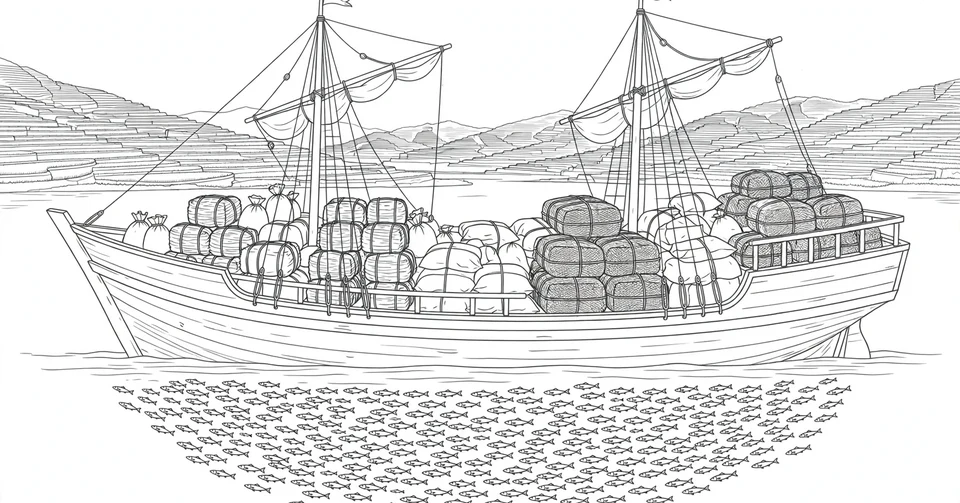
This is the journey that most herring took: out of the sea off Hokkaido, across the country in the hold of a wooden cargo ship, and into the soil under commercial crops in the south. The fish built mansions on one coast and harvests on the other. Then, within a single generation in the middle of the twentieth century, it was gone.
A fish that arrived like weather
Pacific herring came to the Hokkaido coast the way spring itself did, on a schedule everyone could plan around. From late winter into spring, huge schools crowded into the shallows to spawn among the seaweed beds, and in the biggest events the males released their milt at the same time and turned whole stretches of sea milky white. The phenomenon has a name, kuki, and for centuries it was one of the sights of the northern spring.
The Ainu had eaten herring since deep antiquity, and herring bones turn up in excavated ruins from the Jomon period onward. What changed in the Edo period was the customer. From the middle of the eighteenth century, Japanese operators were running large net fisheries whose purpose was not the table but the field. Seasonal workers, many of them farmers from Tohoku, travelled north for the season in a migration remembered as oi-nishin, chasing the herring. A folk song of the era boasted that spring in the port of Esashi had no equal, not even in Edo. Given the money involved, the boast was probably fair.
The herring that nobody ate
The first fertiliser products were scraps: the heads and backbones left after the flesh was removed, the gills, the soft roe. Then, in the early nineteenth century, producers settled on the form that would conquer the market. Whole herring were boiled and pressed hard, a process that squeezed out the oil and left a dry, dense residue that was broken into cakes. The product was called shimekasu, pressed herring meal, and it had the two qualities a trade good needs: it kept well, and it was rich enough to be worth shipping across the country.
Herring fertiliser use had begun in Omi, the province around Lake Biwa, in the first half of the eighteenth century. It spread through the Kinki region around Osaka in the following decades, and by the middle of the nineteenth century it had reached the Hokuriku coast and the Setouchi shore. By 1905 the numbers had become startling. Statistics from that year, quoted in the Otaru City Museum's account of the trade, put herring sales at just over 8.11 million yen, some 66 percent of all marine products sold in Hokkaido. The pressed meal alone accounted for 5.56 million yen of that, a figure in the same league as the island's coal output of just over 7 million yen. I find that comparison quietly astonishing. A cake of boiled fish, pressed out of an animal nobody much wanted to eat, nearly matched coal as an industry on Japan's newest frontier.
South on the old sea routes
The meal moved south along the traditional sea routes built up in the age of the kitamaebune, the wooden cargo ships that linked Osaka with Hokkaido for two centuries. Southbound was where the money was on that circuit. The same hulls that carried herring meal into the ports of Hokuriku and the Seto Inland Sea also carried salmon, and carried the dried kelp that northern waters gave up in such quantity, the kombu that quietly underpins so much of Japanese cooking. Osaka, the merchant city at the end of the Kinki market, was one of the great trading points for fish fertiliser, and the fields it fed ringed the whole region.
What those fields grew tells you how commercial the agriculture already was. Herring meal went under cotton, indigo and rapeseed above all, with mulberry in the mix as well: cash crops, hungry crops, the kind that exhaust soil and repay feeding. The pattern survived in stone far from Hokkaido. At Shimotsui, a port on the Seto Inland Sea in what is now Kurashiki, farmers had reclaimed land from the sea that was too salty for rice, so they grew cotton and rapeseed on it instead, fertilised with herring meal brought in by ship. Storehouses for the meal went up one after another in the town, and a local family grew rich simply on storing it. That same cotton country later hosted a modern spinning mill. Northern fish, southern field, factory cloth: the chain is longer than it first looks.
Palaces built on fish meal
Back on the northern coast, the money concentrated in the hands of the fishing bosses who ran the great grounds. Their instrument was the set net, a fixed trap net known as tateami or kakuami, put into successful practical use off the Shakotan Peninsula in 1885. Set nets caught herring on an industrial scale while the fish did the travelling. In the record year of 1897, more than 80 percent of the catch came from set nets, and the Shiribeshi coast alone, with ports like Otaru and Yoichi, accounted for about 30 percent of the whole Hokkaido landings.
The bosses spent their fortunes where they could see the sea. Up and down the coast they built the great wooden compounds known as nishin goten, herring palaces: part fishermen's dormitory for the seasonal crews, part warehouse and workshop, part villa for the master's family, all of it far grander than a fishing village had any obvious reason to hold. The former Aoyama family villa still stands in the Shukutsu district of Otaru, filled with the art and furniture the fish paid for. The old Tanaka family house was moved from Tomari to Otaru in 1958 and survives as the Otaru City Herring Palace, and the former Fukuhara fishing grounds in Yoichi are preserved as a national historic site, as the museum's history of the grounds describes. The palaces are usually presented as monuments to fishing. On the numbers, I think they are better understood as monuments to fertiliser. Four fifths or more of the catch that paid for every beam went to fields, not to tables.
The collapse, and a modest return
The end came fast. After the Second World War, the white spawning seas of kuki were no longer seen, and by the middle of the 1950s the herring had all but disappeared from Hokkaido's Sea of Japan coast. The causes most often given are the obvious pair: decades of overfishing, and changes in the marine environment that the fish depended on. An industry that had organised the life of the northern coast for two centuries effectively ended inside one generation. The palaces outlived the fish, which is why so many of them are museums now.
What has happened since is smaller, and more careful. A prefectural project has released herring fry along the Sea of Japan coast since 1996, in recent years about 3.4 million fry a year, and fishermen have helped it along with larger mesh nets and shorter seasons. The results are real but modest. The catch on that coast, down to 200 or 300 tons a year in the early 2000s, rose past 2,000 tons in 2009 and reached 5,326 tons in 2022, the best figure in twenty years. Set against the 970,000 tons of 1897, it is barely half of one percent. Yet the kuki have been seen again, year after year since 2020, and around Otaru the fish has quietly resumed its old role as a taste of spring, eaten fresh and celebrated in local news each season.
I like the modesty of this ending, if it is an ending. The herring age was built by treating a wild abundance as if it were a mine, something to be emptied before a rival emptied it first, and the fish answered that treatment in the plainest possible way. The fields around Osaka were fed, the palaces were built, and the sea went quiet. If herring feeds anyone in the future, it will be on the new terms: smaller catches, watched closely, with the white water of the spawning season treated as the main event rather than a starting gun.
More in Food & Travel
Latest posts
- Hashigo-Nori Is Riding a Ladder Someone Else Holds
- At a Goma, Prayers Are Written to Be Burned
- The Sekaa Teruna Builds the Monsters
- A Lembaga Perkreditan Desa Is a Bank the Village Owns
- Every Melasti Goes to Fetch Tirta Amerta
- Kaburiyu Is How You Talk Your Body Into the Bath
- When the Kulkul Stops Sounding for You
- A Caru Is an Offering for the Ones You Fear
- Tatsuko Wished for Beauty and Became a Statue
- Warangan Is the Wash That Reveals the Pattern
- Ganbanyoku Is Bathing Without Water
- The Obuki Throws Out Nine Thousand Litres a Minute
- Every Village Writes Its Own Awig-Awig
- Sainokawara Is a Bath You Share With a Hundred Strangers
- Rwa Bhineda Keeps Opposites From Going to War