Every Melasti Goes to Fetch Tirta Amerta
· 8 min read
Once a year, a few days before Nyepi, Balinese villages walk to the sea, a lake or a sacred spring to fetch tirta amerta, the water of life. Hindu myth says that water was churned out of an ocean of milk by gods and demons together, and fetching it still sits at the centre of Balinese religion.
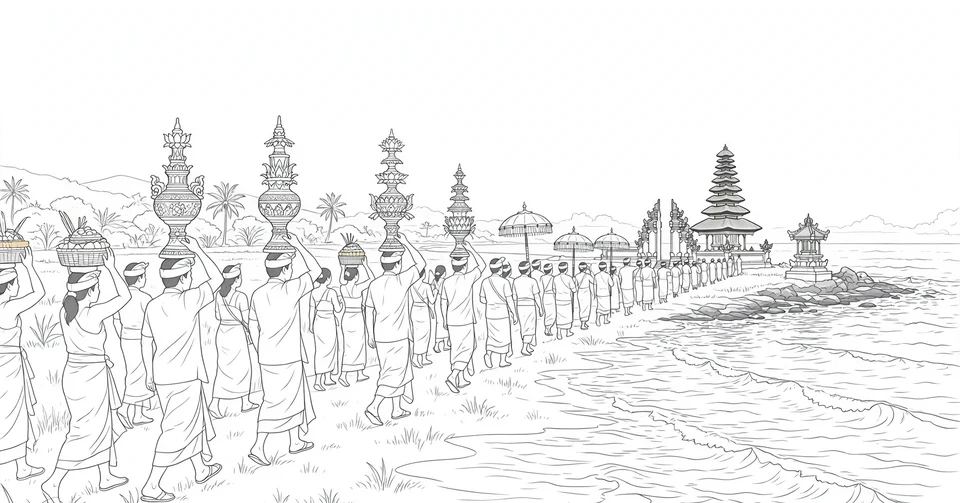
Stand on a Balinese road a few days before Nyepi, which usually falls in March, and you will see a village on the move. Hundreds of people in white walk in one long line toward the water, temple heirlooms carried high, gamelan ringing. The procession is melasti, usually described as a purification ceremony. That is true, but it is not the whole job description. In its own terms, the village is running an errand. It is going to fetch tirta amerta, the water of life.
Everything else about the day hangs off that errand. The gods are washed, the people are washed, the old year is rinsed off the world. But the point of all the walking is the water itself, drawn from the sea, a mountain lake or a sacred spring and carried home like something precious. In Balinese Hindu belief, tirta amerta is exactly that.
The name gives the errand away. Tirta amerta is not a Balinese coinage. It comes out of one of the oldest and strangest stories in Hindu mythology, in which gods and demons stopped fighting long enough to churn an entire ocean, because the water of immortality lay hidden at the bottom of it.
Where tirta amerta comes from
The story is told at length in the Vishnu Purana and retold in the Mahabharata and the Bhagavata Purana, with details that shift from telling to telling. It is mythology and it announces itself as mythology. Nobody is asked to believe in the engineering. But Bali believes in the meaning completely, so the story of tirta amerta is worth getting right.
The devas, the gods, had lost their strength. A curse from the sage Durvasa had drained their fortune, and their old rivals the asuras ruled the three worlds. Vishnu proposed an unlikely alliance: gods and demons would churn the Ocean of Milk together and bring up amrita, the nectar of immortality. In Bali that nectar has a name of its own, tirta amerta, and the agreement was that both sides would share it. Vishnu quietly assured the gods that the sharing would never happen.
The equipment was the landscape itself. Mount Mandara was uprooted and set in the sea as the churning rod. Vasuki, the great serpent, coiled around the mountain as the rope, so the two sides could haul him back and forth like teams in a tug of war. When Mandara began to sink under its own weight, Vishnu became Kurma, a giant tortoise, dived beneath it and held the mountain up on his shell. The episode is known as the Samudra Manthana, and its machinery is deliberately impossible: a mountain for a paddle, a snake for a rope, a god for a foundation.
What rose first was not tirta amerta. The churning released halahala, a poison strong enough to end creation, and Shiva swallowed it to save the worlds, which is why his throat is painted blue. Then the treasures came up one by one: goddesses, a wish granting cow, a seven headed horse, the moon itself. Only at the end did Dhanvantari, physician of the gods, surface through the foam carrying a pot of amrita.
The ending is a heist. The asuras grabbed the pot and ran. Vishnu took the form of Mohini, a woman of impossible beauty, and offered to divide the nectar fairly. Seated in two obedient rows, the asuras watched her serve the gods first, all of them, while their own turn never came. One disguised asura did manage a sip and lost his head for it; the myth says the head and body became Rahu and Ketu, the powers behind eclipses. Restored by tirta amerta, the gods won their war. The demons, who had done half the churning, received nothing.
Read coldly, the story is not flattering to anyone. Tirta amerta enters the world as a strategic resource, won by trickery and hoarded by the winners. I keep that in mind, because Bali does something quietly subversive with the same inheritance.
A religion that runs on water
Balinese Hinduism was once commonly called Agama Tirta, the religion of holy water, and the name was earned. Tirta, water blessed for ritual use, is the working medium of the faith. It is sprinkled over offerings to consecrate them, flicked onto bowed heads at the end of prayer, sipped from cupped palms, and carried home from the temple in bottles and jars for daily offerings and family rites. Almost no ceremony on the island begins or ends without it, because every rite assumes a share of tirta amerta close at hand.
Tirta has to be made, and making it is skilled work. Through a consecration called maweda, a temple priest, the pemangku, prepares holy water for his temple's worshippers, to use in prayer or to take home. A high priest, a pedanda, working with mantras and ritual hand gestures, makes tirta of greater potency for rites of passage, cremations and house blessings. Even the dalang, the shadow puppet master, produces a special holy water in the middle of a performance. The grades differ by source, by maker and by purpose, the way medicine differs by prescription. Each grade is understood as tirta amerta prepared for a particular job.
Here is the part outsiders usually miss. The water in the temple bottle and tirta amerta are not two different things in Balinese thinking, one practical and one mythical. They are the same substance at different scales. Every flask of tirta is a small, reachable portion of the water of life the gods fought over, and that is why tirta amerta has to be fetched from its source, in person, once a year. The faith restocks itself at the origin.
Why the sea counts as holy ground
Visitors sometimes assume the sea is the low and dangerous end of Bali's sacred map, because the gods live toward the mountains. The compass does set kaja, mountainward, as the holy direction, and kelod, seaward, as its opposite. But in Bali opposite has never meant worthless. Rwa bhineda, the teaching that the world holds together through pairs of opposites that need each other, runs too deep for that. The sea is honoured for a specific reason: it is where the gods created amerta. Holy water drawn from the sea has its own name, tirta segara, and you could call it tirta amerta taken straight from the place of manufacture.
The lakes are spoken for as well. Water is asked from Wisnu, lord of water, and from Dewi Danu, goddess of the lakes. Fetching it from far away is a recognised religious duty, and pilgrimages to collect holy water, metirta yatra, lead to crater lakes and mountaintop springs. Every temple keeps its own sacred well or spring. An island that runs its rice irrigation through temples was never going to treat water as a utility. It treats tirta amerta as a relative: approached politely, visited regularly, and never taken for granted.
The errand, done on foot
Against that background, melasti stops looking like a parade with some washing attached. The long white procession, carrying the temple gods down to the shore, is the largest water pilgrimage of the year. The pratima and pralingga, the sacred images and regalia of Ida Sanghyang Widi Wasa, are carried to the water to be purified. And the community draws tirta amerta from the source, an act that the standard reference summary of melasti describes as the heart of the rite: cleansing the world of the filth of sin and bad karma through the symbolic act of acquiring the water of life.
At the shore the year's damage is symbolically cast into the ocean. Prayers are said. The sacred objects are bathed, and people wade in and wash themselves. Then the containers are filled, and the procession turns for home carrying tirta amerta in jars and vessels, to be kept at the temple for the year's ceremonies and taken into houses, where stored tirta is treated as something between a medicine chest and a member of the family. The small world of the body and the great world around it, buana alit and buana agung, are washed and supplied in a single journey.
There is a modesty in this that I find moving. In the myth, tirta amerta was a one time prize, seized once and guarded forever. In Bali, tirta amerta is a renewable commons. Nobody owns it, nobody can stockpile the sea, and the blessing expires unless it is fetched again, together, on foot, next year. What the water actually delivers turns out not to be immortality at all. It is renewal, rationed out annually to anyone willing to walk for it.
So the white line on the road before Nyepi is not just a purification, and not really a parade. It is a village reenacting, in ordinary clothes, the oldest story it knows about where life comes from. In the myth, gods and demons churned an ocean and then fought over the pot. In Bali, their heirs walk down to the same sea every year, fill their vessels with tirta amerta, and share it out without a fight. Of the two versions of the story, I know which one sounds more like wisdom.
More in Culture & Society
Latest posts
- Shimekasu Was Herring You Never Ate
- A Hana Donko Wears Its Cracks Like Flowers
- A Lembaga Perkreditan Desa Is a Bank the Village Owns
- Kaburiyu Is How You Talk Your Body Into the Bath
- Kuki Is the Spring the Sea Turned White
- Warangan Is the Wash That Reveals the Pattern
- Ganbanyoku Is Bathing Without Water
- The Obuki Throws Out Nine Thousand Litres a Minute
- Every Village Writes Its Own Awig-Awig
- Sainokawara Is a Bath You Share With a Hundred Strangers
- Umaji Refused to Disappear
- Rwa Bhineda Keeps Opposites From Going to War
- Kasepekang Is Exile Without Leaving Home
- Jamasan Washes a Blade Thinner Every Year
- Herring Fed the Fields That Fed Osaka