Tenugui Is the Thin Cotton Cloth Japan Uses for Everything
· 15 min read
A tenugui is a thin cotton cloth about 35 by 90 centimetres, and Japan has used it for centuries as a towel, a head wrap, a gift wrap, and a small work of art.
A tenugui is a strip of thin cotton cloth, about 35 centimetres wide and 90 centimetres long, and it may be the hardest working object in a Japanese home. It dries hands, wipes sweat, wraps a lunch box, covers a head at a festival, and hangs on a wall as a seasonal picture. It does all of this without a single button, zip, or seam, and it has done it for centuries.
I first met the tenugui properly in a sentence about kendo armour. In the article on this site about bogu, the practitioner wears a tenugui, a thin cotton towel wrapped around the head, underneath the padded helmet. It absorbs sweat, protects the hair, and keeps the helmet from slipping. That one small detail stayed with me, because the cloth doing that quiet job turned out to have a history of its own, and a list of uses far longer than anything inside a dojo.
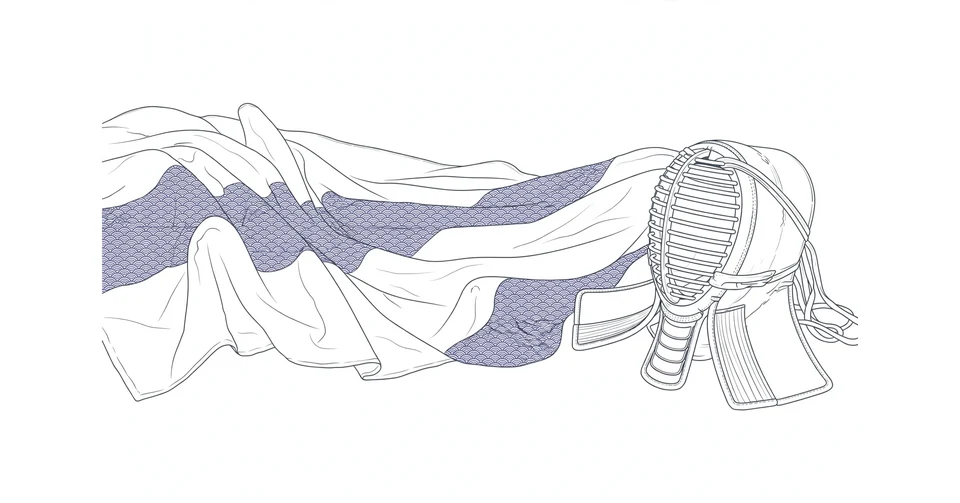
What makes a tenugui worth a closer look is not that it is exotic. It is that it is ordinary in the best sense of the word. It is cheap, light, quick to dry, and easy to carry, and it asks its owner to be a little inventive. A towel that can only dry hands is a finished product. A tenugui is a starting point, and the person holding it decides what it becomes next.
What a tenugui actually is
A tenugui is woven from plain cotton, lighter and thinner than a terry towel, and printed or dyed with a pattern. The name itself is plain too. It comes from the words for hand and wiping, so a tenugui is literally a cloth for wiping the hands. That modest name hides how much the cloth is expected to do.
The standard size, about 35 by 90 centimetres, is no accident. It is long enough to fold into a headband, to wrap around a bottle, or to tie into a small bundle, and short enough to fold flat into a pocket or a bag. It weighs almost nothing when dry, and it dries fast when wet, because the cotton is thin and the weave is open. A thick towel stays damp for hours in a humid Japanese summer. A tenugui can be washed in the morning and dry by the afternoon.
Most tenugui carry a pattern, and the pattern is part of the point. Traditional designs include seigaiha waves, asanoha hemp leaves, cherry blossom, chrysanthemum, and cranes, each carrying a wish for good luck, health, or long life. Modern designs cover everything from cats and trains to local landmarks and festival crests. The pattern is not decoration added at the end. It is the reason many people buy a particular tenugui in the first place, and the reason they keep it long after its days as a towel are over.
There is something refreshing about an object that does not try to be more than it is. A tenugui does not promise to change your life. It promises to dry your hands, and then it quietly goes on to do nine other jobs as well. I think we underrate objects like that, and I think Japan is right to keep making room for them.
From sacred cloth to everyday essential
The history of the tenugui stretches back about 1,300 years, to the Heian period, from 794 to 1185. In those early days it was not a household item at all. It was used in religious ceremonies, for cleansing the body and washing utensils, and cotton was not yet grown in Japan, so the cloth was scarce and made from silk or hemp instead. It belonged to shrines and to people of high rank, not to ordinary households.
During the Kamakura period, from 1185 to 1333, samurai began wearing these cloths under their armour, to wipe away sweat and to protect the skin from metal and lacquer. By the Muromachi period, from 1336 to 1568, common people had started using them to wipe their bodies after a bath. The cloth was slowly moving out of the shrine and the castle and into daily life.
The real turning point came in the Edo period, from 1603 to 1868. Cotton cultivation spread near the towns, cotton kimono became common, and the tenugui was made from the scrap cotton left over from making kimono. What had been precious became affordable, and what had been ceremonial became everyday. People used a tenugui to dry their hands, wipe dishes, cover their heads against dust, and carry small things. A detailed history of the tenugui traces this slow journey from sacred cloth to household essential, and it shows how each period added a use without taking any away.
Late in the Edo period, the shogunate banned luxury, and common people were restricted to cotton and hemp, with colours limited to brown, grey, and indigo and flashy patterns forbidden. The restriction backfired in the most human way possible. Within those limits, people found endless variety, and the tenugui became a fashionable way to show personality, trade, and belief. Different professions wore it in different styles, each with its own name. Kabuki actors wore tenugui as headgear and costume, printed with their family crests, and gave them to favoured patrons like business cards, while fans collected them eagerly. Ukiyo-e woodblock prints from the period show townspeople wearing tenugui everywhere, which is how we know the cloth had truly arrived.
The unfinished edges are the point
Look at the short ends of a tenugui and you will notice something strange. They are cut and left unhemmed. No stitching, no folded edge, nothing to stop the threads from fraying. A new tenugui sheds a few loose threads in its first washes, and the fringe softens over time. This is not a manufacturing shortcut. It is the design.
The unhemmed edge is what lets a tenugui dry so quickly. A hemmed towel traps water in its folded seams. A tenugui has nowhere for water to hide, so air moves through the whole cloth and it dries in a fraction of the time. The thin cotton and the open edge work together, and the result is a towel that stays fresher than a thick one, because damp cloth is where smells and bacteria grow.
The raw edge has another advantage. A tenugui can be torn by hand along the weave, cleanly and without scissors, which means it can be cut down in an emergency. Travellers and workers have used it as a makeshift bandage for generations, and in a kitchen it can be torn into smaller cloths when one large one is not needed. A hemmed towel cannot do that. It resists being divided. A tenugui accepts it.
There is a lesson in that unfinished edge that goes beyond laundry. We tend to assume that a finished product is a better product, and that every loose end should be tied off. The tenugui argues the opposite. Leaving the edge open makes the cloth more useful, not less, and the small imperfection is what gives it its long life. I have come to think of that as a very Japanese idea, that a thing can be complete precisely because it is left a little open.
Ten jobs for one cloth
The list of things a tenugui can do is long, and every item on it is ordinary, which is the charm of it. In the kitchen it dries hands, wipes dishes, and leaves little lint on glasses. It covers a bowl of rising dough or a pot of rice. Folded, it becomes a small mat for a tray or a placemat for a guest. In the bathroom it works as a hand towel, a washcloth, or a light bath towel, and it is gentle enough for sensitive skin. At home it dusts shelves, polishes a mirror, or covers a box that needs hiding.
Its life outside the house is just as busy. Rolled and tied, a tenugui becomes a hachimaki headband, worn for work, for sport, and above all at festivals, where it keeps sweat out of the eyes and marks the wearer as part of the group. Dampened and worn around the neck, it cools the skin on a hot day. Wrapped around a bottle or a lunch box, it carries the thing and becomes part of the gift. A guide to the many uses of the tenugui lists even more, from a glasses case folded out of a single cloth to a wall hanging that dresses up a plain room.
The martial arts use deserves its own mention, because it is where I first met the cloth. Under the men of kendo armour, a tenugui absorbs sweat through a long practice and stops the helmet from sliding at the worst moment. Chefs wear a tenugui rolled on the forehead too, as a sign of determination, in small neighbourhood restaurants as well as in famous ones. The same fold, the same cloth, in a dojo and in a kitchen, doing the same honest job.
Then there is the tenugui as decoration. Hung from a simple rod or framed on a wall, it becomes a seasonal picture, changed with the year. Plum blossom in early spring, morning glories and fireworks in summer, maple leaves in autumn, snow in winter. A home can mark the seasons for the price of one cloth, and the cloth can go back to drying dishes when its season is over. Few objects move so easily between work and art, and fewer still do it without fuss.
How a tenugui is dyed
Most tenugui are dyed rather than printed, and the technique matters to how the cloth feels. The most famous method is chusen, developed in the Meiji period, from 1868 to 1912. In chusen dyeing, layers of cloth are folded and stacked, paste is applied through a stencil to block out the parts that should stay undyed, and dye is poured over the stack so that it soaks through every layer at once. The dye reaches both sides of the fabric, so the pattern looks the same from the front and the back, and the lines come out soft, with a gentle blur at the edges that a machine print cannot copy.
Chusen dyeing has a practical benefit as well. Because the dye soaks deep into the threads instead of sitting on the surface, the cloth stays soft and absorbent. A screen printed towel can feel stiff where the ink lies thick. A chusen dyed tenugui feels like cloth first and picture second, which is how it should be for something that touches the skin all day.
Indigo is the colour most people associate with a tenugui, and for good reason. Indigo dyeing has a long history in Japan, and the deep blue suits the simple cotton and the bold traditional patterns. But a tenugui can be any colour, and the seasonal patterns are half the pleasure of collecting them. A shop in summer will be full of waves, goldfish, and fireworks. In autumn the shelves turn to maple leaves, chestnuts, and chrysanthemum. Buying a tenugui for the season, the way you might buy flowers, is one of the small rituals that keeps the cloth alive as a living craft rather than a museum piece.
The dyeing is also why a tenugui changes with use in a way that feels honest. The colours soften a little with each wash, and the white of the cotton warms. It does not stay perfect, and it is not supposed to. A tenugui that has faded a little has simply been used well, and the fading is a record of the hands and the days it has served.
How to fold, wear and care for a tenugui
Using a tenugui well is mostly a matter of folding. For a headband, fold the cloth lengthwise two or three times until it is a band a few centimetres wide, place the middle of the band across the forehead, bring the ends around the head, and tie a firm knot at the back. For a bandana style cover, place the centre of the cloth on the forehead with the fold at the hairline, pull the corners back over the hair, and tie them behind the head. The cloth is forgiving, and the fold can be adjusted until it sits comfortably.
As a towel, a tenugui needs no technique at all, but it rewards a simple habit. Fold it into quarters for drying hands, so that a dry section is always ready, and unfold it fully when you hang it to dry. In the bath, it works as a washcloth, and it is the traditional companion to the yukata, the light robe Japan reaches for after bathing. The two belong together in the same quiet moment, the wash and the rest that follows it.
Care is simple, and the simplicity is the point. Wash a tenugui in cold or lukewarm water with mild soap, and dry it in the shade rather than in direct sun, so the colours hold longer. Do not worry about the first loose threads at the cut ends. They will stop after a few washes, and the fringe that remains is part of the cloth. If the tenugui is used for wiping dishes, keep a separate one for the face, and retire an old one to cleaning duty when it grows thin. A tenugui that has dried a thousand dishes has earned its second career as a dust cloth, and it will do that job cheerfully for years.
One more practical note is worth remembering. Because a tenugui dries so fast and packs so flat, it is one of the best travel towels there is. A traveller can carry two or three in the space of one small flannel, wash one in a hotel sink at night, and find it dry by morning. It is also a gift that travels well, light, flat, unbreakable, and full of the place it came from. Temple shops, festival stalls, and department stores across Japan all sell them, and choosing one for a friend is a small pleasure in itself.
Why a tenugui still survives
Japan has no shortage of modern towels. Terry cloth, microfibre, and disposable wipes are cheap and everywhere. A tenugui should have vanished a long time ago, replaced by something thicker, softer, or more convenient. Instead it is still sold in department stores and temple gift shops, still worn at festivals, still folded into lunch boxes, and still collected by people who own dozens. That survival needs explaining, and the explanation is not nostalgia alone.
Part of the answer is practical. A tenugui dries fast, packs flat, washes easily, and does many jobs, so it earns its place in a small home or a crowded bag. Part of the answer is cultural. The patterns carry the seasons and the old stories, and changing the tenugui on the wall is a small way of marking time in a house. And part of the answer is ethical, in a quiet way. The cloth is used until it is thin, then used again for cleaning, then finally torn into rags. Nothing is wasted, and the object is respected by being used fully. That fits the Japanese sense of mottainai, the regret at waste, and it fits a wider wish, shared far beyond Japan, to own fewer things and use them better.
I think there is also a deeper reason, and it is the one that stayed with me from that sentence about the kendo helmet. A tenugui is a humble object that makes harder things possible. It lets a practitioner train at full speed without the helmet slipping. It lets a cook work a long shift with a clear forehead. It lets a festival go on in the summer heat. The cloth itself never takes the credit, and that is exactly why people trust it. We remember the loud objects, the ones that demand attention, but we live our days with the quiet ones, and the quiet ones are the ones that last.
A tenugui will not impress anyone on its own. It is a rectangle of thin cotton with unfinished edges, and it costs less than lunch. But fold it, tie it, wash it, and hang it on the wall, and it becomes a towel, a headband, a gift wrap, and a picture, all in the same day. Japan has kept it for thirteen centuries because it never tried to be more than useful, and usefulness, practised daily, turns out to be a kind of beauty that does not go out of fashion.
More in Life & Style
- Japanese Stationery and the Small Tools Japan Takes Seriously
- Osouji Is the Cleaning Japan Does Before the Gods Arrive
- Inside Japan's 100 Yen Shops, Where Everything Costs a Coin
- Akihabara and How Tokyo's Electric Town Learned to Sell Everything
- Kotatsu, Japan's Heated Table That Warms Winter
- The History of the Bicycle From Wooden Wheels to Japanese City Bikes
Latest posts
- Hachimaki Is the Headband Japan Ties On Before the Hard Part Begins
- Netsuke Held a Samurai's World on a Cord
- Kinchaku Carries a Whole Festival in One Small Bag
- Takuan Turns a Humble Daikon Into Japan's Yellow Crunch
- Nukazuke Is the Living Pickle Bed Japan Feeds Every Day
- Tsukemono Is the Crunch Japan Puts Beside Every Meal
- Ochazuke Is Rice Tea and Comfort in One Bowl
- Aojiso Is the Green Leaf Japan Eats Fresh and Raw
- Akajiso Gives Umeboshi Its Deep Red Blush
- Umeshu Is the Liqueur Japan Makes From Unripe Plums
- Shiso Is the Leaf That Paints Umeboshi Red
- Hello Kitty and the Cat Who Conquered the World
- Umeboshi Is the Sour Plum Japan Puts in Every Bento
- Baikasai Serves Tea Under the Plum Blossom at Kitano Tenmangu
- Plum Blossom Opens Japan's Year Before the Cherry Trees Wake