A Penjor Turns a Whole Street Into an Offering
· 11 min read
A penjor is the tall curved bamboo pole Bali raises in front of every home for Galungan, hung with fruit, rice and coconut leaf. This is what the penjor means, how a family builds one, and why it stays standing for 35 days.
Drive through Bali in the days around Galungan and the road itself seems to bend over you. On both sides, tall bamboo poles rise from the front of every house and shop, arch high above the street, and droop at the tip under the weight of their own decorations. Each one is a penjor, and there are thousands of them, street after street, village after village, until the whole island looks as if it has been combed into arches.
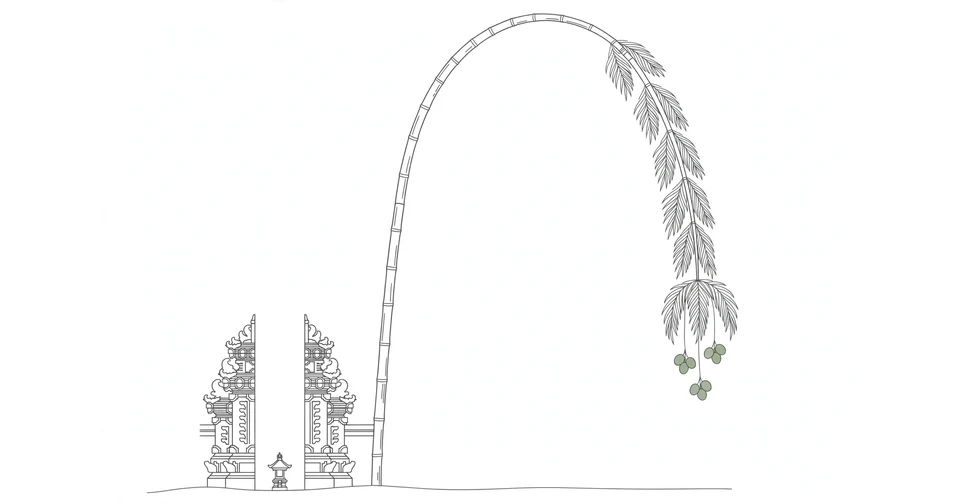
A penjor is not really a decoration, whatever it looks like. It is an offering, one of the largest a Balinese family makes, built to stand in public where everyone can see it. The family is not decorating its gate. It is putting its gratitude on a pole ten metres tall and planting it by the road, where the returning ancestors and the whole neighbourhood can read it at a glance.
That is what makes the penjor different from most offerings in Bali, which are small, private and gone within a day. A canang sari fits in one hand and is replaced every morning. A penjor takes days of work, the strength of several men to raise, and then it stays up for more than a month, slowly drying in the sun, long after the festival it was built for has ended.
What a penjor is made of
Every penjor starts with the same thing: one long, straight, strong bamboo pole, sometimes ten metres tall. The pole has to be tall enough to bend. Under the weight of what is hung on it, the top third curves over in the long drooping arc that gives the penjor its shape, somewhere between a question mark and a fishing rod.
Onto that frame goes nearly everything the land produces. There are fruits that grow hanging above the ground, called pala gantung: bananas, coconuts, oranges. There are crops that grow underground, pala bungkah: sweet potatoes, cassava, taro. There are ears of rice and rice cakes, lengths of sugar cane, and cloth, often a yellow and white cloth called kober. Nothing on a penjor is random. Each item is a gift from the earth, hung back up in the air as if to hand it back to the gods who gave it.
The rest of the decoration is leaf work. Almost all of it is cut and woven from janur, the young coconut leaf Bali folds into everything: long hanging ornaments called lamak, woven shapes called sampian, braided rings and fans, each one folded by hand in the days before the festival. Seen up close, a good penjor is mostly embroidery done in leaf.
At the base of the pole stands a small shrine, the sanggah penjor, where the family's daily offerings for it are placed. This is the detail that separates it from a flagpole. The pole has its own altar. It is prayed to, fed and thanked for as long as it stands, like a temporary temple the family built at its own gate.
Raised on Penampahan, taken down 35 days later
The penjor belongs to the Galungan cycle, the festival that returns every 210 days in the pawukon calendar, when Galungan welcomes the ancestors back to Bali and the gods are believed to descend to earth. Tradition in one old palm leaf manuscript, the Lontar Bali Dwipa, puts the first Galungan in the year 882, and the poles have been part of the festival for as long as anyone can trace.
The work starts days ahead, mostly with the leaf ornaments. Then comes Penampahan, the day before Galungan, the busiest day of the whole cycle. Families slaughter pigs, cook lawar, and in the afternoon, once the day's purification is done, the men and boys raise the pole into the ground at the right side of the house gate. One tradition explains the timing simply: it should go up after midday, as a sign that the household has already won its battle against unclean thoughts and ego before the holy day begins.
From there the pole just stands, through Galungan itself, through the visiting and feasting of the days after, and through Kuningan ten days later, when the ancestors take their leave. But the pole does not come down at Kuningan. It stays for the full length of the festive season, which closes only on Buda Kliwon Pahang, a day also called Pegatwakan, 35 days after Galungan.
On that day the pole is finally pulled up. By then the leaves and fruit have dried completely, and the decorations are burned, the ashes buried in the family courtyard. I find that ending quietly perfect. The grandest offering on the island is made entirely of things that rot, and its last act is to go back into the soil it thanked.
A mountain you can plant at your gate
Ask what a penjor means and you will get several answers, all of them held at once. The most common is that the penjor represents Mount Agung, Bali's sacred volcano, the home of the gods and the ancestors. In this reading, the tip of the pole is Agung's peak, and the decorated stem below it is the mountainside, with its rivers carrying fruit, rice and water down to the people below. A family that raises one is, in a sense, planting a small Agung at its gate for the days when the mountain's residents come visiting.
Others say it stands for the whole universe, Agung being Bali's version of Mount Mahameru, the axis of the Hindu cosmos. The straight bamboo itself is also read on its own, as a symbol of strength and of the straight, upright conduct people are supposed to aspire to. It has to stand firm in the earth for five weeks of weather. It is not a bad picture of how a person is expected to behave.
The dragon inside the bamboo
The second great reading of the penjor is that it is a dragon. Balinese tradition speaks of two cosmic nagas. Naga Anantaboga stands for the earth and the earthly needs of humankind, food, shelter, survival. Naga Basuki stands for water, prosperity and safety. The pole, in this reading, is the dragon's body laid along the bamboo.
The head of the naga sits at the base of the pole, just above the little shrine. The long decorated back of the pole is the dragon's back, and the ornaments hung along it are its scales. The tail is the thin, graceful tip that curves down at the very top, the last thing you see against the sky. The fruit and produce hung on it then become the gifts the earth dragon carries: proof that the land has fed the family, offered back in thanks.
I like that the two readings are never forced to fight. A penjor can be a mountain and a dragon in the same breath, and nobody in Bali seems to need that resolved. As Susan Ruddy, who has lived in Bali for years and written a book about penjor, puts it in her account of the pole's many meanings, people know very well when and how to make them; they only hesitate when asked to pin the symbolism down. The pole carries both the way it carries everything else, all at once, in layers.
Why the tip of the penjor bows down
There is a third layer of meaning, and it is the one people quote most often to visitors, because it turns the pole into a small sermon. Some say the straight part of the bamboo is the good in a human being, and the bent tip is the bad, which is why the curve has to be decorated the most beautifully: what is flawed in us should be covered with the best work we can do.
Others read the bowed tip as a lesson in humility. It rises higher than the house, higher than the gate, close to the sky, and then, at the very top, it bends and looks back down at the earth. The point, in this telling, is that however high a person climbs, they should end by looking down: at their roots, at their neighbours, at the people who have less.
The Balinese scholar I Gusti Nyoman Darta put it in terms of rice. When rice is young it stands up and, in his joking version, cries out about how clever it is. The riper the grain gets, the heavier the head becomes, until it bends. The pole bends the same way. Knowledge, done properly, lowers your head rather than raising it.
I have read a lot of explanations of festival symbols over the years, and this is the rare one that survives being explained. The bow is beautiful first and meaningful second, which is probably why it works. Nobody needs the lecture to feel that a ten metre pole bowing over the road is a gentle sight.
Penjor suci, penjor hias, and the modern penjor
Not every one is a Galungan penjor. Balinese usage makes a clear split between the penjor suci, the sacred penjor raised for religious occasions under inherited rules, and the penjor hias, the ornamental penjor raised to decorate, a distinction spelled out in detail in this guide to penjor and janur kuning. The sacred one is the complete one, with its shrine, its prescribed produce and its leaf work, and some of its sacred fittings are not allowed to appear on a merely decorative pole. The decorative one answers to no priest: it goes up for weddings, temple anniversaries, shop openings and events, and its maker is free to invent.
Temple festivals, called odalan, almost always line their approaches with them too, so the poles appear all year round in smaller numbers. It is only at Galungan, when every household on the island raises one at the same time, that the pole stops being a landmark and becomes a landscape.
Modern Bali has pushed the form hard. In Ubud and Canggu, makers compete with towering, elaborate constructions, some dressed with figures and woven creatures far beyond the classic pattern. In the mountain villages of the east, the poles stay simpler and stranger, made from whatever the maker has at hand. And because many Balinese now work jobs far from home and no longer have days to spend weaving, workshops along the main roads now sell ready made ornaments, some of them, controversially, made with nylon and tinsel. In recent years there has been a deliberate push back toward poles made only of natural materials, which fits the ending the tradition always intended: organic matter, burned and buried, returned to the yard.
There is a small irony in buying one, and most Balinese I have read on the subject seem aware of it. The pole is supposed to be the family's own gratitude, made by its own hands. But the island changes, the festival does not wait, and a bought one still marks a house that wanted to take part. The ancestors, one suspects, are not checking receipts.
Who makes a penjor
The making is divided, and the division is old. For days before Penampahan, the women and girls of the house do the leaf work: cutting janur, folding lamak and sampian, assembling the ornaments one by one. It is slow, social work, done sitting together, and it is where most of its beauty is decided. The men and boys handle the pole itself: cutting the bamboo, trimming it, and on Penampahan afternoon, raising it, a job that takes several pairs of hands, ropes, and one person standing back in the road shouting directions.
Children run between the two camps carrying things, which is how the skill passes down. Nobody in Bali attends a penjor course. You learn by being handed a leaf at the age of seven and corrected by your grandmother, and by holding a rope at twelve and being told to pull.
That, in the end, is what a street full of penjor actually shows. Not decoration, and not even only devotion, but an island where every household still knows how to build the same difficult, beautiful thing, and builds it on the same day, for guests who arrive from the world of the dead and are expected to find their way home by the poles. A penjor is a signpost for ancestors, an offering the size of a tree, and a reminder that bends its head. It is hard to think of another object that does all three jobs at once, and does them with nothing but bamboo and leaves.
More in Culture & Society
Latest posts
- Garuda Wisnu Kencana Rises Above Bali's Southern Cliffs
- Soba, the Buckwheat Noodles Japan Slurps on the Last Night of the Year
- Udon in Kagawa, Where Noodles Are a Way of Life
- The Pawukon Calendar Runs Bali on 210 Days
- Purnama Is the Full Moon Bali Prays By
- Galungan Welcomes the Ancestors Back to Bali
- Jatayu Flew at Ravana to Save Sita
- Kurma Held Up a Mountain So the Ocean Could Be Churned
- Yoshino Is the Mountain Shugendo Calls Home
- A Gomagi Carries Your Wish Into the Goma Fire
- Danjo Garan Is Where Koyasan's Teaching Began
- The Banryutei Turns Two Dragons Into a Rock Garden
- A Gongyo Starts the Temple Day Before Sunrise
- Shojin Ryori Is the Temple Food That Eats Like a Prayer
- Depachika and the Basement Food Halls Beneath Japan's Department Stores