Jatayu Flew at Ravana to Save Sita
· 12 min read
Jatayu, the old vulture king of the Ramayana, flew at Ravana to save Sita and lost his wings for it. His story still stands in stone at Prambanan and in a giant sculpture in Kerala.
Some heroes win. Jatayu did not. He was an old bird, past his fighting years, resting in a tree above the forest of Panchavati when he heard a woman crying out in the sky. He looked up, saw a king carrying her away, and rose to meet him anyway. That is the whole story, and it is why people still tell it today.
Jatayu is the great bird of the Ramayana who tried to save Sita from Ravana. When Ravana flew her away toward Lanka, Jatayu intercepted his chariot in the air, fought him with beak and talons, and had his wings cut off by Ravana's sword. He fell to the forest floor, lived long enough to tell Rama what had happened and which way Ravana had gone, and then died in Rama's arms. Rama himself performed the bird's funeral rites.
What makes the story last is not the fight. It is the fact that Jatayu knew he would lose. He was old, and Ravana was a king with many arms and a flying chariot. Jatayu fought anyway, because someone had to, and he was the only one there. This article follows his story through the epic, through the stone reliefs of Prambanan in Java, and to the giant sculpture of a fallen bird on a rock in Kerala.
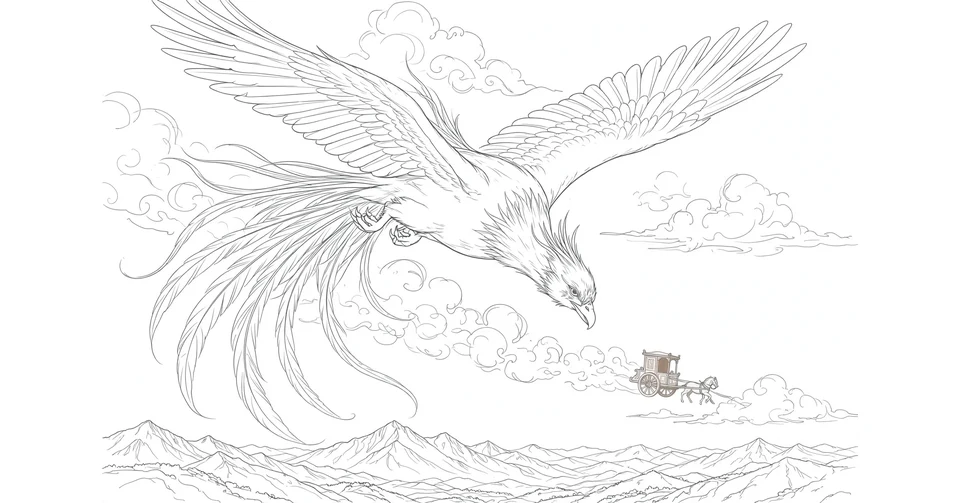
The name Jatayu belongs to the Aranya Kanda, the third book of Valmiki's Ramayana, the book of the forest. That is where Rama, Sita and Lakshmana live out their exile among trees and hermitages, and where the story turns from a family quarrel into a war. Jatayu enters the tale quietly, as a neighbour, and leaves it as the first casualty of that war.
Jatayu was an old friend of Rama's father
Jatayu was the younger son of Aruna, the charioteer of the sun, and his wife Shyeni. His elder brother was Sampati, and his uncle was Garuda, the great eagle of Hindu myth. Garuda, who once carried a mountain to the middle of the ocean, belonged to the same family of sky beings, and Jatayu grew up in that company, a king of vultures in his own right. He was also an old friend of King Dasharatha, Rama's father, and when Rama came to live in Panchavati during his exile, he lived nearby and offered to watch over Sita.
The brothers, Jatayu and Sampati, share one of the saddest stories in the epic. As young birds they flew toward the sun in a wager, and Jatayu, careless in his youth, flew too high. His wings began to burn in the heat. Sampati flew above him and spread his own wings wide to shield his younger brother, and it was Sampati whose wings were scorched away. He fell to the Vindhya mountains and spent the rest of his life there, under the care of a sage. The brothers never met again.
There is something quietly devastating about a family where one brother loses his wings saving the other, and the survivor carries that debt for the rest of his life. Jatayu's courage did not come from nowhere. It came from a life in which someone had already paid a price for him, and from a friendship with a king that had lasted longer than most human lives. When the bird tells Ravana that sixty thousand years have passed since he was born, the epic may be speaking in the language of myth, but the point is plain. This was not a young warrior in his prime. This was an old bird who had already lost more than most of us will ever own.
The morning Ravana came for Sita
The abduction was a piece of careful cruelty. Maricha, a demon in the shape of a golden deer, drew Rama away from the hut. Sita, enchanted by the deer, sent Lakshmana after him. That left her alone in Panchavati, which was exactly what Ravana had planned. He came to the door dressed as a wandering holy man, and when the moment was right he seized her and carried her to his flying chariot.
Sita cried out as the chariot rose, and Jatayu heard her. He was resting in a tree, and the sound woke him. He knew Rama, and he knew the woman in the chariot, and he understood at once what was happening. What he did next is worth noticing, because he did not attack at once. He flew up to the chariot and spoke to Ravana first. He told the king of Lanka to release her, and reminded him that stealing another man's wife was against dharma, against the order that even kings are supposed to obey. Ravana refused, and only then did Jatayu fight.
I think the warning matters. It shows that the old bird was not acting out of blind rage. He gave Ravana a chance to stop, and he gave the story a moral shape before it became a battle. A creature who warns first and fights second is a creature who still believes the world can be talked back into order. He believed it, even as the chariot kept flying south.
Jatayu fought a battle he could not win
The fight in the sky is told in the Aranya Kanda with the kind of detail that suggests the poets wanted us to see every blow. The bird attacked with his feet, his claws, his wings and his beak. He broke Ravana's bows. He smashed his armour. He wrecked the chariot and killed its driver. With his beak he tore off ten of Ravana's left arms, but new arms grew back at once, and the king of Lanka kept coming. For a little while, impossibly, the old bird seemed to be winning.
Then Ravana got to his feet and fought back with fists and feet, and at last he drew his sword. The blade cut off Jatayu's wings, and the great bird fell from the sky like a stone. Sita, still in the chariot, ran to the fallen bird and held him, and then Ravana took her away again, south, toward Lanka.
Rama and Lakshmana came back to an empty hut and followed the trail of broken branches and dropped ornaments through the forest. They found Jatayu on the ground, barely breathing, his wings gone and his body broken. At first they thought he was the one who had taken Sita. Then the dying bird spoke, and told them everything: the chariot, the fight, the name Ravana, and the direction, south. He had nothing left to give them except that one fact, and it was the fact that set the whole search in motion. Then he died, and Rama performed his funeral rites himself, with the honours due to a father.
Jatayu's defeat is the point of the story. If he had won, it would be an adventure. Because he lost, it is a lesson. Courage is not the absence of fear, and it is not the promise of victory. It is acting when the outcome is already clear, because the act itself is what is right. Jatayu could not save Sita. He could only try, and he could tell the truth before he died. In the end, that was enough to change the story, because without him Rama would not have known where to look.
Jatayu in Java, from Prambanan stone to wayang leather
The Ramayana reached Java many centuries ago, and Java made it its own. The Old Javanese Kakawin Ramayana retold the epic in the language of the island, and the builders of Prambanan carved it into stone. The Shiva temple at Prambanan, completed in the ninth century, is ringed with galleries of bas-reliefs telling the story of Rama, and the panels continue around the Brahma temple. Fifty four panels in all carry the tale from Rama's youth to the war in Lanka, and one of them shows the moment that matters here: Ravana carrying Sita away, with Jatayu on the left trying to help her.
The Javanese telling is not a copy of Valmiki's, and the differences are worth knowing. In one reading of the Prambanan panels, the dying Jatayu hands Rama the ring Sita wore, so that Rama knows for certain what happened to her. In Valmiki's version, Sita drops her ornaments from the chariot as a trail for Rama to follow. Both versions agree on what counts: the old bird spoke before he died, and his words sent Rama south. A story that travels across the sea changes its details, and that is not a flaw. It is how a story proves it is alive.
The tale also lives in Javanese performance. Wayang, Indonesia's shadow puppet theatre, has carried the Ramayana from village to village for centuries, and the Ramayana ballet at Prambanan still stages the fight in the open air, with dancers playing the bird and the demon king against the temple as a backdrop. When I think about the bird in Java, I think about how a story can belong to two places at once. The bird fell in a forest in India, and he also fell, in stone, on a temple in Java, and both falls are true in the way that stories are true.
The giant bird on the rock in Kerala
In Kerala, on the southwestern coast of India, local belief says that the wounded Jatayu fell on the rocks at Chadayamangalam, in the Kollam district, and the town's name is said to come from Jatayu-mangalam. On that rock now stands one of the largest sculptures in the world. The Jatayu Earth's Center, also called Jatayu Nature Park, holds a sculpture of the fallen bird that measures 200 feet long, about 61 metres, 150 feet wide and 70 feet tall, built from concrete and steel. It was designed by the sculptor and filmmaker Rajiv Anchal, who worked on it for nearly a decade. The park's first phase opened in December 2017, and the sculpture became accessible to visitors in August 2018. It is recognised as the world's largest bird sculpture.
The statue does not show the bird in flight. It shows him fallen, wings spread across the rock, beak open, at the end of the fight. Inside the sculpture there is a multi-level audio-visual museum and a 6D theatre, and on the rock there is a temple site with footprints believed to belong to Rama. Around it, the park offers a cable car, a walkway and an adventure park with ziplining, rock climbing and rappelling. The centre says the work commemorates the bird who fought Ravana to protect Sita, and stands for the protection of women and their honour and safety.
Honesty requires saying that the claim about the fall site is not settled. Lepakshi, in Andhra Pradesh, also says Jatayu fell there, and its position fits the route from Panchavati toward Lanka better than a hill in southern Kerala does. A historian has also pointed out that the name Chadayamangalam more likely honours Maran Chadayan, a Pandya ruler of the eighth and ninth centuries, and that the Jatayu association became popular in the 1970s, when local people resisted a plan to quarry the rock. Even the bird itself is a small puzzle: the epic calls Jatayu a king of vultures, while the sculpture looks like an eagle. The sculptor's son drew the first image of the falling bird when he was still at school, and the eagle shape seems to have come from that drawing.
None of this weakens the statue. A place can be wrong about geography and right about meaning, and the people who built it knew what they were honouring. As of November 2026 the centre is open and busy. After the release of the film Ramayana: Part 1, which shows the battle between Ravana and Jatayu, visitors have been arriving in large numbers, around 3,200 to 4,000 a day, and the centre expects the number to rise. The cable car and the walkway are running, while renovation work is under way on some of the other adventure activities. The entry ticket, priced at 640 rupees, is scheduled to be reduced to 555 rupees from 15 November. If you go, the park is open daily from 10 in the morning to 5 in the afternoon, and the best season runs from October to March.
Why a losing fight is still worth remembering
Most of us wait to be sure before we act. We want to know the odds, and we want them to favour us. The old bird is remembered precisely because he did the opposite. He was old, he was alone, and he was facing a king who could grow new arms faster than they could be torn off. He fought anyway, because a woman was crying out in the sky above him, and he was the only one who could hear her.
I keep coming back to the moment after the fall, when Rama finds him. He does not complain, and he does not ask to be saved. He tells Rama what he saw, and he points south, and then he dies. There is a kind of dignity in that which no victory could improve. He did not need to win to matter. He needed to speak, and he did.
That is why the story survives in so many forms: in the epic, in the stone of Prambanan, in the leather of a wayang puppet, and in a giant bird lying on a rock in Kerala with its wings spread wide. Every telling keeps the same shape, an old bird rising against a king, falling, and speaking before he dies. The shape is simple enough for a child to understand and serious enough for the rest of us to spend our lives trying to live up to. Jatayu lost his wings, and he lost his life, and he still changed the story, because without him Rama would not have known where to look. That is enough for a bird to be remembered for centuries. It is enough for any of us.
More in Culture & Society
Latest posts
- Soba, the Buckwheat Noodles Japan Slurps on the Last Night of the Year
- Udon in Kagawa, Where Noodles Are a Way of Life
- The Pawukon Calendar Runs Bali on 210 Days
- Purnama Is the Full Moon Bali Prays By
- Galungan Welcomes the Ancestors Back to Bali
- Kurma Held Up a Mountain So the Ocean Could Be Churned
- Yoshino Is the Mountain Shugendo Calls Home
- A Gomagi Carries Your Wish Into the Goma Fire
- Danjo Garan Is Where Koyasan's Teaching Began
- The Banryutei Turns Two Dragons Into a Rock Garden
- A Gongyo Starts the Temple Day Before Sunrise
- Shojin Ryori Is the Temple Food That Eats Like a Prayer
- Depachika and the Basement Food Halls Beneath Japan's Department Stores
- Yakitori and the Smoky Alleys Where Tokyo Learned to Love Chicken Skewers
- Okonomiyaki and the Savory Pancake Japan Cooks at the Table