Janur Is the Young Coconut Leaf Bali Folds Into Everything
· 16 min read
Janur is the young leaf of the coconut palm, and in Bali it is folded into daily offerings, festival poles, and wedding decorations. This is the story of one leaf that carries a whole island's rituals.
Walk any street in Bali in the morning and you will see janur before you see almost anything else. It is the pale yellow green leaf folded into a small square tray on a doorstep, filled with flowers and a stick of incense. It is the same leaf, cut into long ribbons, hanging from the tall bamboo poles that line the road at Galungan. One leaf, and it is everywhere.
Janur is the young leaf of the coconut palm, picked before it opens and turns dark green. While it is still soft and pale, it can be folded, woven, and pinned into shapes that a mature leaf would never hold. Bali folds it into everything because it is the one material that is always at hand, always fresh, and always ready to carry meaning.
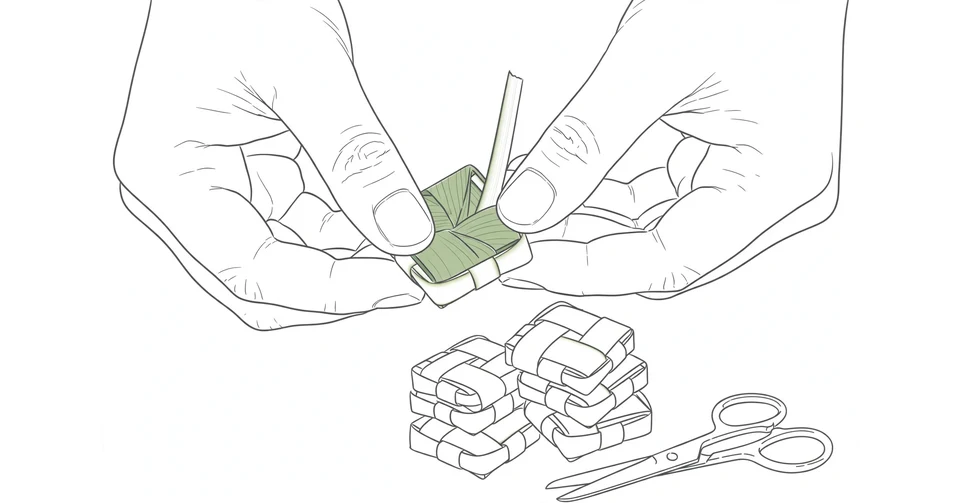
What surprises me is how little of it is about decoration. A leaf that lasts a single day is trusted with the most important jobs on the island: thanking the gods, feeding the ancestors, and marking the days when a family begins a new life. That is the paradox at the heart of this story, and it is why janur deserves a closer look.
What janur actually is
Janur is the unopened frond of the coconut palm, the spear shaped leaf that stands upright at the crown of the tree before it unfurls. While it is still closed, it is pale yellow green, soft to the touch, and flexible enough to be split into ribbons and folded without snapping. Once it opens, the same leaf turns dark green, stiffens, and becomes useful for roofing and shade, but it will never fold again.
The harvest is simple and daily. A young frond is cut from the palm while it is still closed, carried down, and used the same day. A folded leaf dries fast in the tropical sun, so the work is done fresh each morning and the result is expected to last only until the next one is made. That short life is not a flaw in the material. It is the whole point, and it shapes everything Bali does with janur.
The word itself is used across Indonesia and Malaysia for the same young leaf, and the leaf is put to work in all of those places. But Bali uses janur more widely than anywhere else. In Java it appears mainly at ceremonies, while in Bali it is an everyday material, folded every morning in ordinary households as well as at temple festivals. The leaf is the same. The difference is how much of life Bali is willing to entrust to it.
The leaf that carries the daily offering
The most common job for janur is the daily offering, and it starts with a small square tray called a ceper. Strips of janur are folded and pinned into a square about the size of a palm, and that square becomes the vessel for everything else. Balinese tradition reads the ceper as the crescent moon, and it is the first thing a visitor should learn to recognise, because once you can spot a ceper you can read half of what Bali puts on its doorsteps. The way the square is folded, with its raised edges and pointed corners, is a small piece of craft in itself, and it is described in detail in the story of how a ceper is folded from janur into a crescent moon.
On top of the ceper sits the rest of the canang sari, the daily offering of thanks. A small fold of betel leaf with lime and areca nut, called the porosan, stands for the Trimurti of Brahma, Vishnu, and Shiva. A slice of sugarcane and a piece of banana are read as the nectar of life, and a few grains of rice stand for the soul. Flowers are arranged by colour and direction with deliberate care: white to the east for Iswara, red to the south for Brahma, yellow to the west for Mahadewa, and black to the north for Vishnu, with blue or purple flowers standing in when black ones are hard to find. A round ring of woven janur, the sampian, sits on top as the base for the flowers, and a stick of incense is lit beside the offering as a witness. The full picture, and the meaning of every part, is set out in a guide to canang sari and Balinese offerings.
The making is a skill passed down through generations of Balinese women, and it is usually done by the women of the household each morning before the day begins. Each canang is made by hand in minutes, from materials gathered fresh, and it is set down with a short prayer and replaced the next morning or afternoon. Once the incense has burned, the physical object is considered spent. Nothing is kept, nothing is reused, and nothing about that bothers anyone, because the offering was never the object. It was the act of making it.
Janur also carries the larger offerings of family life. A canang genten, used at tooth filing and coming of age rites, adds kiping cakes, a small yellow banana, and red and white rice porridge rolled in young coconut leaf, asking for the gift of youth. The bigger the occasion, the more the leaf is asked to do, and it always answers the same way, by bending into whatever shape the ritual needs.
Janur on the penjor at Galungan
Twice in the Balinese ritual year, or roughly every 210 days, the whole island changes its shape, and janur is the reason it looks the way it does. The occasion is Galungan, the festival that welcomes the ancestors back to Bali, and the sign of it is the penjor, a tall curved bamboo pole that stands outside almost every family compound. A penjor is usually about ten metres high, and it is decorated with rice stalks, fruits, traditional cakes, and woven ornaments made from janur.
The janur on a penjor takes the form of long woven ribbons and hanging decorations that sway from the curved bamboo. They symbolise purity and the freshness of life, and they sit alongside rice stalks for abundance and a coconut near the top for the source of life and unity. At the base stands a small shrine called the sanggah cucuk, where the family places offerings during the festival. The poles go up the day before Galungan and stay standing for about ten days, until the end of Kuningan, so for a week and a half the whole island is lined with bamboo and pale green leaf.
Making a penjor is a full family activity that usually starts a few days before the festival. Women in the family usually prepare the janur ornaments by weaving young coconut leaves into patterns, men handle the heavier parts like tying the rice stalks, coconuts, fruits, and offerings onto the pole, and children help by cutting leaves and handing over materials. The work is divided, but the leaf is the part everyone touches, because the ornaments are what turn a bamboo pole into a penjor.
There are two kinds of penjor in Bali. The sacred penjor is used at religious occasions such as Galungan and temple anniversaries, and it follows rules passed down through generations, including which accessories belong to it and which do not. The ornamental penjor is put up more freely, for weddings and celebrations, and it carries only the decorations that are not reserved for sacred use. Both are made from natural materials, and a penjor made from factory processed ingredients would not be a penjor at all.
The symbolism runs deep, and different people read it in different ways. The tall curved bamboo is a symbol of Mount Agung, the spiritual centre of the island, and the decorations along it are sometimes read as the rivers flowing down the mountainside. Others say the penjor is a dragon, with its head at the base above the small shrine and its tail at the slender tip, its scales the woven ornaments along its back. Still others point to the shape itself: the straight part of the bamboo is the good in human nature, and the curve is the part that must be decorated beautifully to compensate. The curve bends downward to remind people that, however high they rise in life, they must never lose sight of their less fortunate fellow humans. Janur carries all of those readings at once, which is a lot to ask of a leaf, and it manages it without a word.
How a leaf becomes a fold
The craft of folding janur begins with the split. The young leaf is opened along its central rib and stripped into long ribbons, each one soft enough to bend and strong enough to hold a crease. The ribbons are folded by hand and held in place with tiny pins cut from bamboo, and the shapes they make range from the plain to the elaborate. The ceper is a square with raised edges. The sampian is a round ring, sometimes shaped into eight petals for a larger offering. Fans, crescents, and small baskets follow the same logic: fold, tuck, pin, and let the leaf remember the shape.
The more elaborate forms show how far the craft can go. In Javanese weddings, a pair of ornaments called kembar mayang is made from coconut leaves, fruits, and flowers, and four janur leaves inside it are woven to resemble a keris, the traditional dagger, as a symbol of protection and care in married life. The same leaf is folded into grasshoppers, said to keep obstacles from falling on the couple, into umbrellas for protection, and into the shape of a bird, a dove that is always loyal. A related ornament, the mayang sari, stands about 180 centimetres high and is placed in a pair on the right and left of the aisle chair, its crown of fans, fruits, and flowers rising above the seated couple. At the gate of the celebration, a curved decoration called a tarub is hung with woven leaf, flowers, and crops such as bananas and coconuts, and the bride, groom, and guests pass beneath it.
None of this is taught from a book. Girls in Bali learn to fold janur by watching their mothers and grandmothers, starting with the simplest square and working up to the harder shapes over years. The teaching is slow and patient, and it is one of the quiet ways a family passes its religion to its children. A child who can fold a ceper has already learned that devotion is something you do with your hands, not something you only think about.
Why only the young leaf will do
There is a practical reason Bali uses janur and not the mature leaf, and it is the simplest one in this story. A mature coconut leaf is dark green, stiff, and fibrous. Try to fold it and it cracks along the fold. The young leaf is soft, pale, and full of moisture, and it bends without breaking. The craft exists because the material allows it, and the material is chosen because it is the only one that works.
But the choice is also a matter of meaning. The pale yellow green colour of janur reads as youth, purity, and new life, and that is exactly what an offering is meant to carry. An old, dark leaf would say the opposite, and it would say it in the one language everyone on the island understands. This is why the colour matters as much as the flexibility, and why a leaf that has already opened and darkened is never used for the sacred work, no matter how fresh it is.
The name itself carries the same idea. Janur is often read as coming from the Javanese phrase sejatining nur, meaning light, clean, and pure, a hope for a bright and clear future ahead. The word kuning, yellow, is read from sabda dadi, the prayer that wishes from a pure and sincere heart will be granted. These are folk readings rather than settled etymology, and they should be taken as the community's own explanation of a word it loves, not as a dictionary entry. But they tell you what the leaf means to the people who fold it, and that is the kind of truth that matters here.
In weddings, the symbolism is at its clearest. Janur represents light, building a new life together, and giving birth to new life that will hopefully bring blessing to the family and to others. The leaf is young, and the marriage is young, and the wish is that both stay fresh. The flexibility of the leaf carries a lesson too: just as janur bends without breaking, people are asked to stay flexible and resilient as life changes around them, and to live side by side with nature rather than against it.
Janur beyond Bali
Bali uses janur more than anywhere else, but the leaf belongs to a much wider world. In Java, janur kuning appears at almost every ceremony, from religious blessings to secular celebrations, and it is so deeply embedded in local culture that there is a saying attached to it: before the janur kuning curves down, I will not give up on getting you. The leaf has become a measure of persistence, a small green promise that bends but does not break.
The most familiar use outside Bali is the ketupat, the rice cake cooked in a woven pouch of janur and eaten at Idul Fitri across Indonesia and Malaysia. The pouch is folded from the young leaf, filled with rice, and boiled until the rice swells into a firm cake that keeps for days. It is food and packaging in one object, and it is made from a material that costs nothing and grows on every roadside. A similar logic lies behind lepet, sticky rice wrapped in janur, and the many small packets of food that Indonesian markets sell in folded leaf.
In Javanese weddings, janur kuning is the decoration that frames the whole event. The kembar mayang stands at the edge of the ceremony as a symbol of two people becoming one household. The tarub arches over the entrance. The mayang sari rises beside the aisle chair. And in the background of all of it is an old story: that the coconut tree itself is a gift from Dewi Sri, the goddess of fertility, and that presenting janur is an act of gratitude for that gift. The story is told as tradition, not as history, but it explains why a leaf is treated with such respect. A gift is answered with a gift, and janur is the answer.
The popularity of janur kuning is not limited to Javanese areas and Bali. It is used in Malaysia as well, where the same ribbon like leaf is woven and cut into a variety of shapes, and the same ketupat appears at the same festival. The leaf travels easily because the tree travels easily, and the coconut palm grows wherever the climate allows it. The full history of the leaf, from ancient ritual use to modern celebrations, is told in a guide to penjor and janur kuning.
The tree that gives everything
Janur is only the youngest part of a tree that gives almost everything. The coconut palm is known in Indonesia as a plant of which every part is useful, from fruit and flowers to leaves, sticks, and trunk. The fruit gives food and drink. The flowers, called manggar, are used in offerings and ceremonies. The mature leaves become roofing and shade. The sticks become brooms. The trunk becomes timber. A single tree can feed a household, shelter it, and furnish its rituals, and it asks for very little in return.
That generosity is part of why janur carries so much meaning. The leaf is not a rare or precious material. It is the youngest shoot of the most generous tree on the island, and it is available to everyone, rich or poor. A family with nothing else can still make an offering, because the palm in the yard will always have a young leaf to give. There is a quiet democracy in that, and I think it is one of the reasons the tradition has survived so long. Nothing about it depends on wealth.
The daily rhythm of the offering depends on the same generosity. A canang sari is made fresh each morning and replaced the next day, and the same is true of the larger decorations at festivals. The leaf is cut, folded, offered, and left to dry in the sun, and the next day the work begins again. It is a cycle that never stops, and it is sustained by a tree that never stops growing.
A leaf that teaches patience
I keep coming back to the paradox I started with. The most durable tradition on the island is made from the most fragile material on the island. A leaf that lasts a single day is trusted with gratitude, with memory, and with the beginning of married life. Nothing about that makes sense until you see the folding itself, and then it makes perfect sense. The leaf is fragile, so the work must be done every day. The work is done every day, so the tradition never has a chance to grow stale.
There is a lesson in that for anyone who visits Bali, and it is not a lesson about religion. It is a lesson about attention. The women who fold janur each morning are not performing for an audience. They are doing a small, careful job that nobody will remember by the afternoon, and they do it with the same care they would give to something permanent. The leaf will dry and crumble by evening. The care will not, because it is carried forward into the next morning, and the next, and the next.
Janur will never be famous the way a temple or a volcano is famous. It is too small, too ordinary, and too quick to disappear. But walk any street in Bali in the morning, look down at the doorsteps, look up at the bamboo poles, and you will see it everywhere, doing the work that nothing else on the island can do. A leaf that lasts a day has carried a culture for centuries, and it will carry it for centuries more, one fold at a time.
More in Culture & Society
Latest posts
- Soba, the Buckwheat Noodles Japan Slurps on the Last Night of the Year
- Udon in Kagawa, Where Noodles Are a Way of Life
- Purnama Is the Full Moon Bali Prays By
- Galungan Welcomes the Ancestors Back to Bali
- Jatayu Flew at Ravana to Save Sita
- Kurma Held Up a Mountain So the Ocean Could Be Churned
- Yoshino Is the Mountain Shugendo Calls Home
- A Gomagi Carries Your Wish Into the Goma Fire
- Danjo Garan Is Where Koyasan's Teaching Began
- The Banryutei Turns Two Dragons Into a Rock Garden
- A Gongyo Starts the Temple Day Before Sunrise
- Shojin Ryori Is the Temple Food That Eats Like a Prayer
- Depachika and the Basement Food Halls Beneath Japan's Department Stores
- Yakitori and the Smoky Alleys Where Tokyo Learned to Love Chicken Skewers
- Okonomiyaki and the Savory Pancake Japan Cooks at the Table