Purnama Is the Full Moon Bali Prays By
· 16 min read
Purnama is the full moon day of the Balinese Saka calendar, the fifteenth day of the waxing half, when Balinese Hindus pray at family and village temples in white and temple anniversaries often fall.
Once a month, Bali turns its face to the moon. The evening fills with white clothes and the smell of incense, temple gates open wide, and families who have spent the day at work or in the fields walk together to pray. That night is purnama, the full moon of the Balinese Saka calendar, and for Balinese Hindus it is one of the holiest days of the year.
A purnama comes round every twenty nine or thirty days, once in every lunar month. It is not a festival with a single fixed date on a Western calendar, and it is not a tourist show. It is a monthly appointment between a family and its gods, kept in the family temple at home and in the village temple down the road, and it has been kept that way for centuries.
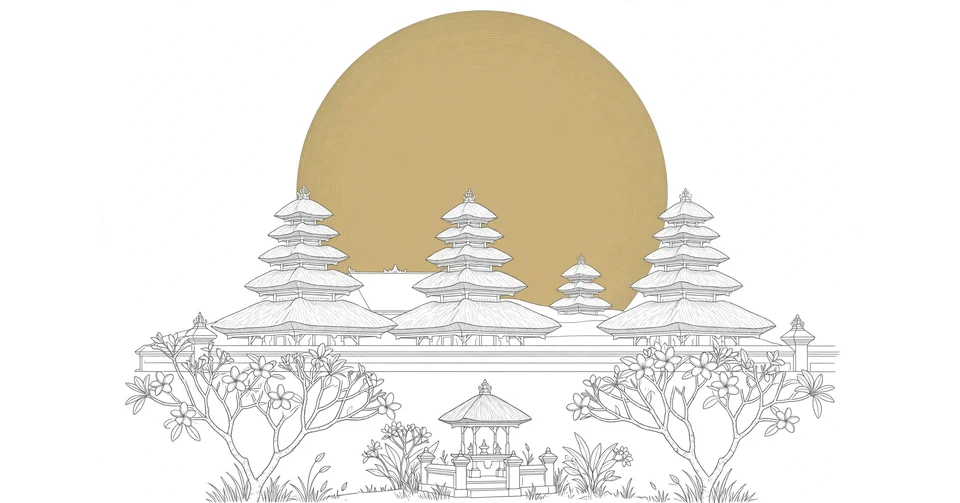
The moon looks the same everywhere, of course, but in Bali it does more work than anywhere else I know. It sets the months, it names the days, and it tells a whole island when to stop and pray. A purnama is the clearest proof of that. If you want to understand how Bali keeps time, start with the full moon.
Purnama is the fifteenth day of the waxing moon
The Balinese Saka calendar counts the moon. Each month, called a sasih, begins the day after a new moon, and it is counted in two halves of fifteen days. The first half is called penanggal, the waxing days, and it climbs from the new moon to the full moon. The full moon itself is called purnama, and it is the fifteenth day of penanggal. The second half is called pangelong, the waning days, and it falls from the full moon back to the new moon.
That simple count is the whole secret of the calendar. A Balinese date can be named by its moon day as precisely as a Western date is named by its number in the month. Purnama is not a vague season or a poetic name for a bright night. It is a numbered day, the fifteenth day of the waxing half, and it arrives once in every sasih, twelve times in a Saka year.
There are twelve sasih in the Saka year, named for the numbers one to twelve in a mixture of Old Balinese and Sanskrit: Kasa, Karo, Katiga, Kapat, Kalima, Kanem, Kapitu, Kawalu, Kasanga, Kadasa, Jyestha and Sadha. A few of the names have variant spellings in different sources. The eighth month sometimes appears as Kaulu, and the eleventh sometimes as Jiestha. The differences are small and old, the kind of variation that appears when a calendar has been copied by hand for centuries, and they do not change the count. Every one of those twelve months has its own purnama, so the full moon is named by its month: Purnama Kasa, Purnama Katiga, Purnama Sasih Kalima, and so on.
The Saka year itself is lunisolar, which is a plain idea hiding behind a long word. It counts the moon, twelve months to a year, and then it corrects itself so it does not drift away from the sun. Twelve lunar months add up to a year of 354 or 355 days, about eleven days shorter than a year on a Western calendar. Left alone, a calendar like that would slide backwards through the seasons, and its new year would eventually arrive in a different season altogether. The Saka calendar refuses to do that. Some years add a thirteenth month, repeating Jyestha or Sadha, which keeps the new year in its season. That is why Nyepi, the Saka new year, usually falls in March, and why the exact Western date of a purnama shifts from year to year.
There is one more wrinkle worth knowing. The Balinese full moon is set by a traditional reckoning, the pengalantaka, and it can differ by a day from the astronomical full moon. The moon in the sky and the moon in the calendar are not always the same moon. Bali follows its own count, worked out by hand and kept in lontar palm leaf manuscripts, and the printed Balinese calendar is the authority most families actually use. A guide to the Balinese calendar from Northbound Bali explains the two calendars, the pawukon and the Saka, and how the moon days are read, and it is worth a look for anyone who wants the mechanics behind the names.
One full moon in every sasih
Because a purnama falls once in every sasih, Bali prays by the full moon twelve times a year, and each one carries its own weight. Some are quieter than others. A purnama in an ordinary month is a family affair, kept at the family temple and the village temple. A few of them carry the great rites of the year. The Saka calendar counts about two dozen ceremonial days in a year, and most of them fall on purnama, the full moon.
That rhythm is what makes the Balinese calendar feel alive rather than administrative. The months are not just divisions on a page. Each one ends its waxing half with a night of prayer, and then the waning half begins, and the count starts again. The moon gives the year its pulse, twelve full moons, twelve chances to stop and give thanks.
The year of the Saka era is counted from Nyepi, the first day of Kadasa, the tenth month. Nyepi is the day of silence, when the whole island stops for twenty four hours, and it is the one Balinese holy day most visitors already know. But Nyepi is the exception, not the rule. The ordinary rhythm of Balinese religion is monthly, not yearly, and purnama is its heartbeat. A family that prays at every purnama has kept twelve holy days by the time the year turns, without counting Galungan, Kuningan, or any of the pawukon days that fall in between.
I find something reassuring in that. A religion that asks for a whole day of silence once a year is dramatic, and Bali does it beautifully, but a religion that asks for an evening of prayer every month is practical. It fits inside a working life. It does not demand that you stop the world. It asks only that you look up once a month and remember what the month was for.
White clothes, flowers and holy water
On a purnama, the signs are visible long before dark. Women carry tall offerings of fruit and flowers on their heads, walking in lines toward the temple. The offerings are called banten, and the small woven trays of flowers, rice and incense that appear on every doorstep and dashboard are canang sari. The temple courtyards fill with families, and the air fills with the smoke of incense and the sound of gamelan drifting from somewhere behind the shrine walls.
White is the colour of the day. Many worshippers wear white lace kebaya and white shirts, with sarongs and sashes, and the sight of a whole village dressed in white under a rising moon is one of the loveliest things Bali offers. The white is not a rule written in a book. It is a habit, kept because the day is holy and the colour suits it, and like most habits in Bali it is kept with quiet pride.
The prayers themselves are simple in shape and deep in meaning. Balinese Hindus believe that on purnama the gods descend to bless the earth, and that prayers made on the full moon are heard. Families pray for health, for success, for protection, and they give thanks for the month that has passed. A guide to the two sacred lunar phases from The Travellist Indonesia describes purnama as a time of spiritual energy, enlightenment and prosperity, and that is a fair summary of how the day feels to the people keeping it.
Some families add a purification ritual called melukat, a spiritual cleansing with holy water. A few temples are famous for it. Pura Tirta Empul in Tampaksiring, with its spring fed pools, draws large crowds on a purnama, as locals and visitors immerse themselves in the sacred waters. Goa Lawah, the bat cave temple, and Pura Luhur Batukaru see large gatherings too, as devotees come to cleanse their minds and spirits in preparation for the new lunar cycle. The water is cold, the queues are long, and nobody seems to mind. The point is not comfort. The point is to step into the new month clean.
Purnama is also said to be an auspicious day for starting new ventures, and farmers have long treated it as a good day for planting. That is the other side of the same belief: a full moon is a full blessing, and a blessing is best spent on something that needs to grow. Whether you believe in the blessing or not, there is something sensible about a calendar that ties new beginnings to the brightest night of the month.
Temple anniversaries that wait for the full moon
Every temple in Bali has an anniversary, called an odalan, and many of them are set by the moon. Some temples follow the pawukon, the 210 day cycle, and keep their odalan on a fixed combination of weekday and week. Others follow the Saka calendar and wait for a purnama. When the full moon of their month arrives, the temple celebrates, and the whole village turns out.
The pattern is easy to see once you know to look for it. Singaraja's winged lion monument, Singa Ambara Raja, keeps its piodalan on Purnama Katiga, the full moon of the third month. The village festival of Ngusaba Desa in Banyuning, a customary village in Buleleng, is held on Purnama Sasih Kalima, the full moon of the fifth month. These are not small affairs. An odalan means processions, offerings carried on heads, gamelan, dance, and a feast at the end, and the whole village is involved in making it happen.
That is why a purnama can look so different from one village to the next. In one place it is a quiet evening of prayer at the family temple. In another it is the biggest day of the year, with a temple anniversary drawing crowds from across the regency. The moon is the same, but the temple decides what the moon means, and each temple keeps the anniversary it trusts.
The odalan system is also a reminder that Balinese religion is local before it is anything else. There is no single national standard for when a temple celebrates. There is a set of agreements, village by village, and each village keeps the one it trusts. The full moon gives them all a shared clock, and then each village reads that clock in its own way.
Purnama and tilem, the two halves of the month
Every purnama has a partner. Two weeks after the full moon comes tilem, the dark moon, and together the two divide each month into a waxing half and a waning half. If purnama is the bright half of the month, tilem is the dark half, and both are holy days of prayer and offerings.
The contrast between the two is deliberate, and it is worth understanding. Purnama is a time of fullness and blessing, when the gods descend and prayers are answered. Tilem is a time of reflection and cleansing, when the darkness is at its strongest and families pray for protection and let go of the month's negativity. One is about receiving, the other about releasing, and the month needs both. You can read about the dark moon in the tilem article on this site, which follows the same calendar and the same count from the other side of the month.
The two days also divide the work of the calendar between them. Purnama opens the second half of the month, and tilem closes it. A Balinese date is read by naming its moon day, penanggal or pangelong, and its sasih, and the two moon days are the landmarks that make the count possible. Without purnama and tilem, the Saka calendar would be a list of numbers. With them, it is a story told in light and dark, twice a month, every month.
The Saka calendar itself deserves a closer look, because purnama only makes full sense inside it. The twelve sasih, the leap month, the way Nyepi is set on the first day of Kadasa, and the way the whole system is kept in step with the sun are set out in the Saka calendar article on this site, and it is the best place to see how one full moon fits into a year of twelve.
Choosing the day, and reading the calendar
In Bali, choosing the right day is part of the work itself. The knowledge of good and bad days is called wariga, and its verdict on a given day is the ala ayuning dewasa. Families consult it before a wedding, before breaking ground on a house, before a cremation, and before a farmer plants a field. The moon is the largest single input into that decision. A purnama is a good day, and a tilem is a day for care, and the days between them are read one by one.
That habit runs through ordinary work in a way that is easy to miss if you only look at the big festivals. A farmer who plants on a good day is not being superstitious. He is doing what his father did, and his father before him, and the calendar is the record of what worked. The moon is the most visible part of that record, and purnama is its brightest entry.
Reading a Balinese date is a skill, and it is not as hard as it looks. Start with the moon. Find the sasih, the month, and count the moon day: penanggal one to fifteen as the moon waxes, purnama on the fifteenth, then pangelong one to fifteen as it wanes, and tilem on the last day. Then add the pawukon half, the seven day name, the five day name and the wuku, the week. A printed Balinese calendar gives all of it at a glance, and a digital one does the same. After a little practice, the names stop looking like a code and start looking like what they are: a short description of where the day sits in two cycles at once.
Purnama is a red day on a printed Balinese calendar, a holy day, and the island marks it. Many offices and schools shorten their hours or close, and some businesses close early, so that families can pray in the late afternoon and evening. Tourist services usually keep going, and the island does not stop the way it does on Nyepi, but the rhythm of the day changes. Traffic thickens near the temples as the light fades, and the roads fill with families in white carrying offerings. If you are visiting, the best time to see a purnama is in the late afternoon or evening, when families come to pray, and the best thing to bring is a sarong and a sash, in case a ceremony invites you in.
What a visitor sees on a purnama evening
For a visitor, a purnama is the easiest Balinese holy day to witness, and the easiest to get wrong. It is easy because it happens every month, in every village, and no ticket is needed. It is easy to get wrong because it is a real religious observance, not a performance, and the people praying are not there for an audience.
The etiquette is simple and worth following. Wear a sarong and a sash if you enter a temple, and many temples lend them at the gate. Stay quiet during prayers. Do not step on the canang sari offerings laid on the ground, which are easy to miss in the dark. Ask before taking photographs, and accept it gracefully if the answer is no. Some rituals are sacred and may not allow photography at all. And if a procession crosses your path, pull over and wait for it to pass. The procession is not an interruption of your evening. Your evening is an interruption of the procession.
What you will see, if you go quietly, is worth the care. Families kneeling in prayer before shrines draped in cloth, hands folding flowers into offerings, a priest sprinkling holy water over bowed heads, and above it all the moon itself, rising over the temple roof. The moon is the reason everyone is there, and it is also the most beautiful part of the evening. Bali has many holy days, but only purnama gives you the moon as a guest of honour.
There is a temptation, when writing about a place like Bali, to treat its calendar as a curiosity, a colourful system for tourists to photograph. That would be a mistake. The calendar is not decoration. It is the way a whole island organises its spiritual life, and purnama is the proof that the system works. Twelve full moons a year, twelve evenings of prayer, twelve chances to stop and give thanks. A calendar that does that is not a curiosity. It is a discipline, and it is one that has survived centuries of change without losing its shape.
A quieter kind of holy day
Nyepi will always be the Balinese holy day the world knows, and it deserves its fame. A whole island falling silent for a day is a remarkable thing, and it is right that people travel to witness it. But a calendar made only of great days would be a thin calendar. What makes Bali's way of keeping time remarkable is not the one day of silence. It is the twelve full moons that fill the rest of the year.
Purnama is a quieter kind of holy day, and that is its strength. It does not stop the island. It does not close the airport. It asks only for an evening, a white shirt, a handful of flowers, and a prayer at the family temple. And because it asks so little, it is kept. Month after month, year after year, the moon rises, the families gather, and the island prays. That is a kind of faithfulness that does not need a grand gesture. It only needs the moon to keep its appointment, and the people to keep theirs.
More in Culture & Society
Latest posts
- Soba, the Buckwheat Noodles Japan Slurps on the Last Night of the Year
- Udon in Kagawa, Where Noodles Are a Way of Life
- The Pawukon Calendar Runs Bali on 210 Days
- Galungan Welcomes the Ancestors Back to Bali
- Jatayu Flew at Ravana to Save Sita
- Kurma Held Up a Mountain So the Ocean Could Be Churned
- Yoshino Is the Mountain Shugendo Calls Home
- A Gomagi Carries Your Wish Into the Goma Fire
- Danjo Garan Is Where Koyasan's Teaching Began
- The Banryutei Turns Two Dragons Into a Rock Garden
- A Gongyo Starts the Temple Day Before Sunrise
- Shojin Ryori Is the Temple Food That Eats Like a Prayer
- Depachika and the Basement Food Halls Beneath Japan's Department Stores
- Yakitori and the Smoky Alleys Where Tokyo Learned to Love Chicken Skewers
- Okonomiyaki and the Savory Pancake Japan Cooks at the Table