Depachika and the Basement Food Halls Beneath Japan's Department Stores
· 12 min read
A depachika is the gourmet food hall in the basement of a Japanese department store, and it may be the best dinner in Japan that nobody tells tourists about.
Walk into a Japanese department store and you will find luxury brands, perfume, and polished marble on the floors above. Take the escalator down instead, and the building changes character completely. The air smells of grilled fish, fresh bread, and sweet bean paste. Dozens of small counters crowd together, each selling one thing done very well. This is a depachika, the basement food hall, and it is one of the most quietly astonishing places to eat in Japan.
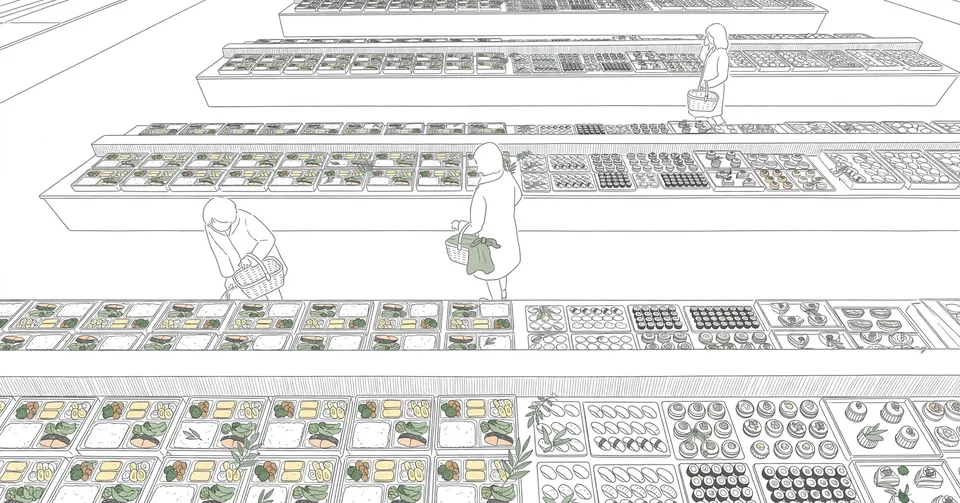
A depachika is not a food court and not a supermarket. It is a hall of specialist counters, each run like a small proud restaurant that happens to have no tables. You buy a bento at one counter, pickles at another, and a box of wagashi at a third, then carry it all home, to a park bench, or to your hotel room. A good dinner assembled this way costs around 2,000 yen, and it will often be better than a sit-down restaurant meal at twice the price.
What a Depachika Is
The word depachika is a contraction of depato, department store, and chika, basement. Most large Japanese department stores give their basement floor, sometimes two floors, to food. The layout is remarkably consistent across the country: Japanese sweets in one zone, Western cakes in another, then prepared dishes, bento, bread, tea, sake, and gift boxes, all arranged so that a slow walk through the floor becomes a tour of Japanese food culture.
Each counter is its own small shop with its own staff, its own glass case, and its own till. That matters more than it sounds. The people behind the counter are specialists, and the food on display is the whole point of their business, not a side line. A depachika counter selling tonkatsu has usually spent decades perfecting tonkatsu. A counter selling pickles sells pickles and nothing else. This is why the quality is so high. The basement is not a compromise. It is the store's showcase.
The history runs deep. Mitsukoshi in Nihonbashi, Tokyo, traces its origins to a kimono shop founded in 1673, and its basement food hall sits beneath the oldest department store in Japan. Department stores in Japan grew out of merchants who understood that food was the surest way to bring people through the door every day, and the basement hall is the modern form of that old instinct.
How the Floor Works
A first visit can feel confusing because almost nothing is sold the way a supermarket sells it. Almost everything is to take away, and you pay at each counter separately. There is no single checkout. You point, you pay, you move on. The staff are patient with a pointed finger, and almost no English is needed because everything is displayed, individually priced, and visible in the case.
Much of the prepared food, called sozai, is sold by weight. You say how many grams you want, often 100 grams, and the clerk weighs it out. Salads, fried chicken, croquettes, grilled fish, simmered vegetables, and dumplings all work this way, which means you can build a meal from five different counters in exactly the portions you want. The phrases you need at the counter, from ordering by weight to telling the clerk a purchase is for yourself rather than a gift, are covered well in this depachika guide, which takes the floor in the order you meet it. Bento boxes, by contrast, are sold whole, already composed, and many are beautiful enough to feel like gifts.
At the till, the clerk will ask a few polite questions. Is it a gift or for yourself? How long will you be carrying it? Would you like an ice pack? These questions are practical, not small talk. A cake bought for a gift gets wrapped differently from one you will eat on the train, and an ice pack keeps a cream pastry safe on a summer afternoon. Answering honestly gets you the right packaging.
One habit to learn: do not eat while walking through the hall. The food is meant to be carried out and eaten elsewhere. Some stores have a small eat-in corner, but most do not. The honest move is to buy your dinner, walk to a nearby park or back to your room, and eat it properly.
What to Buy at a Depachika
Five categories cover almost every visit, and a good first trip touches at least three of them.
Bento is the anchor. A depachika bento is not a sad desk lunch. It is a composed meal, often grilled fish or wagyu with seasonal vegetables, rice, and pickles, arranged in a box that opens like a small ceremony. Prices run from about 800 yen for a simple one to around 2,500 yen for a premium box. If you are catching a train, the bento from Daimaru Tokyo, inside Tokyo Station itself, is the classic move, and the Shinkansen-shaped bento box, around 1,480 yen, doubles as a souvenir for children.
Sozai is the freest way to eat. Buy 100 grams of potato salad here, two croquettes there, a little grilled mackerel somewhere else, and you have a dinner that no single restaurant would serve you. Prices are usually a few hundred yen per portion, and the quality of a 300 yen croquette in a good depachika can embarrass a restaurant main course.
Sushi and sashimi counters sell sets that were made that morning, and they are priced by the set, not by the piece. A set for one person runs roughly 1,000 to 2,500 yen depending on the fish. The counters near the fish section are often the busiest in the hall for a reason, and the standard is high, because sushi is the dish Japan is judged by everywhere in the world.
Sweets split into two worlds. Wagashi, the traditional Japanese sweets made from bean paste, rice, and sugar, sit in one zone, often in boxes meant as gifts. Western cakes and pastries sit in another, and a single slice of cake from a good counter is a legitimate dessert, not an afterthought. The same care that goes into kaiseki, Japan's multi-course art of dining, shows up here in miniature, a small box composed with the same attention to season and balance. Fruit counters deserve a mention of their own. A single perfect melon can cost thousands of yen, and the fruit is graded, polished, and boxed like jewellery. You do not have to buy the melon. Looking at it is free, and it tells you a lot about how Japan treats food.
Finally, there are the gift boxes. Boxed sweets with a one to three month shelf life are the standard omiyage, the souvenir food you bring home for colleagues and family, and the depachika is where most Japanese people buy them. If you need a gift that travels well, this is the place.
The Evening Discount
The most useful fact about a depachika is the clock. Fresh dishes cannot be sold the next day, so towards closing time the staff begin marking them down. The discount stickers start appearing around 18:30 to 19:00, and the half-price wave peaks between 19:00 and 19:45, just before the halls close at around 20:00. Supermarkets follow a similar rhythm, usually a little earlier, from 18:00 to 19:00.
The words on the stickers are worth learning. Hangaku means half price. Niwaribiki is 20 percent off, sanwaribiki 30 percent off, because waribiki counts discounts in tenths. A good depachika guide walks through the full vocabulary, from the words on the signs to the questions at the till. When a clerk calls out a time sale across the floor, a small crowd forms within seconds, and the best bento boxes go first. Arriving at 19:00 with a flexible appetite is the cheapest good dinner in Tokyo.
There is a catch worth knowing. The discount applies to food you take home and eat, and the tax-free scheme does not cover food eaten in Japan. Tax-free applies only to sealed souvenirs you carry out of the country, with a minimum spend of 5,000 yen before tax at one store on one day. Since 1 November 2026, Japan has used a refund-style system, so you pay the tax-included price at the register and claim the consumption tax back after customs confirms your purchases when you leave. Do not plan a depachika dinner around tax-free shopping. Plan it around the stickers.
The Best Halls in Tokyo
If you visit one depachika, make it Isetan Shinjuku. The main building basement is widely rated the finest food hall in Tokyo, and standing in it you understand why. The density of counters, the seasonality, the sheer choreography of presentation set the bar every other store is measured against. Its Tonkatsu Maisen counter is famous for the hire-katsu sando, a fillet of pork cutlet on soft milk bread with a dark sweet-savoury sauce, and it is one of the most quotable single bites in the city.
Mitsukoshi Nihonbashi is the heritage pick. The store has stood in Nihonbashi since the 17th century, the great hall and bronze lions at the entrance are worth the trip alone, and the basement holds top-tier wagashi and prepared dishes. Ginza Mitsukoshi, with two basement food floors, has the strongest Western gourmet and cheese selection of the major stores, and its ninth-floor terrace garden gives you somewhere to sit and eat what you bought below.
Daimaru Tokyo is the practical pick, especially before a train. It sits inside the Tokyo Station complex, its basement is strong on bento and omiyage, and you can shop and board a Shinkansen without stepping outside. Shinjuku Takashimaya solves the where-do-I-eat problem directly. Buy in the basement, take the elevator to the 13th-floor White Garden, and eat on an outdoor terrace with tables and benches.
Ikebukuro is where you send a hungry group loose. Tobu Department Store runs to more than 200 shops with the biggest event space of any Tokyo store, and Seibu Ikebukuro completed a major renovation in early 2026, adding 41 new shops across two basement floors. The scale absorbs a crowd, and the value for money is the best of the big halls.
Outside Tokyo the pattern holds everywhere. Hankyu Umeda in Osaka, Daimaru in Kyoto, and the department stores of Nagoya, Fukuoka, and Sapporo all run the same basement model, with local specialities on the counters. A depachika in Kanazawa sells different pickles from one in Fukuoka, and that regional difference is part of the pleasure.
Depachika, Konbini, and Supermarket
It helps to place the depachika beside its two cousins. The konbini, Japan's convenience store, is open 24 hours, sells a good onigiri and a decent sandwich at any hour, and deserves its reputation as a destination in its own right. But a konbini sells food made in a factory and shipped in. A depachika sells food made by a specialist a few metres from the counter. The difference shows in the first bite.
The supermarket is the everyday version of the same idea. Its prepared food section, also discounted in the evening, is cheaper and perfectly good for a normal night. The depachika is the special version, the one you visit when you want the best bento, the best cake, or a gift that says you cared. The three form a ladder, and knowing which rung to stand on is a small but real life skill in Japan.
That ladder is also why the depachika matters beyond tourism. For many Japanese office workers, the basement is where dinner comes from on a late night. The counters close at 20:00, the stickers come out at 19:00, and a tired commuter walks home with a proper meal for a few hundred yen. The hall is not a tourist attraction that happens to sell food. It is infrastructure, and tourists are welcome guests in it.
A Few Practical Tips
Go hungry and go late. Arriving at 19:00 gives you the discount window and the fullest counters before they start selling out. Arriving at 19:45 gives you the deepest discounts and the thinnest choice. Bring cash as a backup, though cards work at virtually every counter. Carry a small bag, because each counter hands you its own small paper bag, and five of those are awkward to manage.
Do not try to buy everything at one counter. The pleasure of a depachika is the assembly, five small purchases that add up to a meal no single kitchen would make. Watch what local shoppers buy, and buy some of it. The queue at a counter is the most honest review in Japan.
If you are staying in a hotel without a fridge, buy food you will eat within a few hours and skip the ice pack conversation. If you are on a train, choose bento and onigiri over anything with sauce. If you are buying a gift, say so, and let the clerk wrap it properly. The wrapping is part of the gift in Japan, and depachika clerks are very good at it.
Why the Basement Matters
I like the depachika because it refuses to be loud about itself. There is no sign outside promising the best food in Tokyo, no queue of influencers, no English menu board. There is a basement, a hundred small shops, and a standard of care that would be a special occasion anywhere else. It is the most Japanese thing about Japanese food culture, which is to say it is ordinary, meticulous, and quietly excellent.
A traveller who eats only in restaurants will leave Japan with a good impression and a thin wallet. A traveller who learns the basement will eat better, spend less, and understand something real about how Japan feeds itself. The depachika is not a secret, exactly. It is just downstairs, waiting, while everyone else looks up. Go down.
More in Food & Travel
- Soba, the Buckwheat Noodles Japan Slurps on the Last Night of the Year
- Udon in Kagawa, Where Noodles Are a Way of Life
- Shojin Ryori Is the Temple Food That Eats Like a Prayer
- Yakitori and the Smoky Alleys Where Tokyo Learned to Love Chicken Skewers
- Okonomiyaki and the Savory Pancake Japan Cooks at the Table
- Takoyaki and the Ninety-Year-Old Shop That Still Serves the Original
Latest posts
- A Penjor Turns a Whole Street Into an Offering
- A Mokugyo Keeps the Beat of the Chant
- Garuda Pancasila Carries Five Principles on One Bird
- Saptawara Is the Seven-Day Week Inside Every Weton
- Janur Is the Young Coconut Leaf Bali Folds Into Everything
- Petungan Counts Your Neptu Before You Choose a Day
- The Pawukon Calendar Runs Bali on 210 Days
- Purnama Is the Full Moon Bali Prays By
- Galungan Welcomes the Ancestors Back to Bali
- Jatayu Flew at Ravana to Save Sita
- Kurma Held Up a Mountain So the Ocean Could Be Churned
- Yoshino Is the Mountain Shugendo Calls Home
- A Gomagi Carries Your Wish Into the Goma Fire
- Danjo Garan Is Where Koyasan's Teaching Began
- The Banryutei Turns Two Dragons Into a Rock Garden