Danjo Garan Is Where Koyasan's Teaching Began
· 17 min read
Danjo Garan is the founding precinct of Koyasan, where Kukai laid out the teaching of Shingon Buddhism as a mandala that visitors can walk through, centred on the vermilion Konpon Daito pagoda.
Most visitors to Koyasan go straight to Okunoin, the forest cemetery where Kobo Daishi is believed to rest in eternal meditation. It is the famous half of the mountain, and it deserves its fame. But Danjo Garan is where Koyasan's teaching began, and it is the half that explains the other. Long before there was a cemetery to visit, there was a classroom built out of halls and pagodas, and Kukai designed it so that a student could walk through the teaching itself.
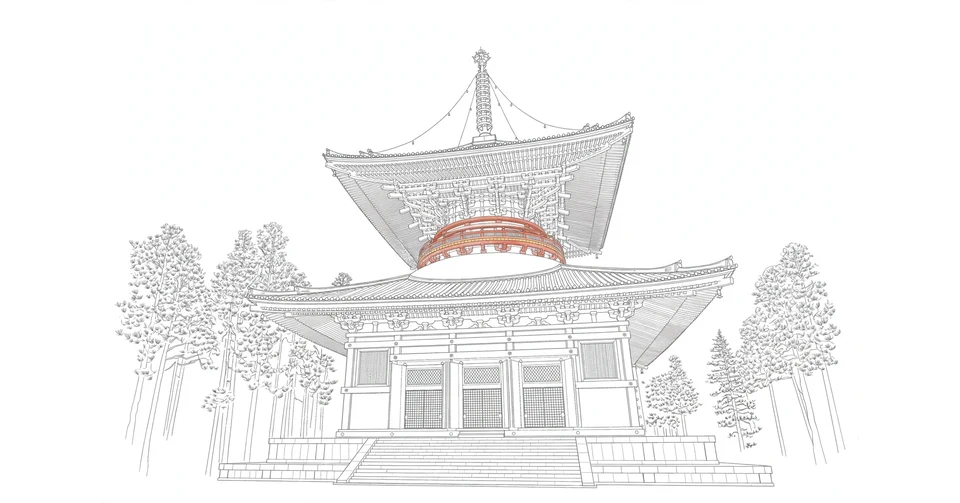
Danjo Garan sits on a wooded plateau in northern Wakayama, about two hours by train and cable car from Osaka. It is the original sacred precinct of Koyasan, laid out in the early ninth century as the ground plan of Shingon esoteric Buddhism. The halls are not arranged in a row, the way a visitor might expect. They are arranged as a mandala, a three dimensional diagram of the Buddhist cosmos, with the great vermilion pagoda at the centre and the other buildings taking their places around it like figures in a painting.
What makes Danjo Garan worth a slow morning is that it is still a working place. Monks cross between the halls at dawn, services run through the day, and the grounds are open and free to walk at any hour. The buildings you see are mostly reconstructions, because fire and lightning have destroyed the precinct again and again across twelve centuries. Yet the plan has never changed. Every rebuilding has put the same halls back in the same places, which says something about how seriously the mountain takes its founder's design.
A mandala you can walk through
The story of Danjo Garan starts in 816, when Emperor Saga granted Kukai the use of Koyasan. Kukai had travelled to China in 804 to study esoteric Buddhism in Chang'an, where his teacher Huiguo passed the teachings of Shingon to him. When he returned to Japan in 806, he searched for a place to build a centre for the teaching, and he chose this mountain basin, ringed by peaks, far from the distractions of the capital. Danjo Garan was the first ground broken on the mountain.
The name itself describes the place. Danjo means an elevated place, and garan comes from the Sanskrit sangharama, a quiet and secluded place where Buddhist monks gather and train. So Danjo Garan is, quite literally, a training ground on high ground, and that is exactly how Kukai used it. He laid the precinct out as the Womb Realm Mandala, the Taizokai, so that the arrangement of the buildings would express the cosmic order of the teaching. A student who walked the grounds was not just visiting temples. He was walking inside a diagram of the universe as Shingon understood it.
That idea still shapes how the precinct feels. The Kondo, the main hall, stands at the front of the complex. Behind it rise the great pagoda and the smaller pagodas, and around them sit the portrait hall, the sutra storehouse, the bell tower and the shrine to the mountain's guardian deities, Niutsuhime and Karibamyojin, who were enshrined here in 819. The precinct covers about 55,000 square metres and holds around nineteen structures, and the sensible way to see it is to walk it clockwise from the Kondo after passing through the Chumon gate.
I think there is a lesson in the way Danjo Garan refuses to behave like a museum. A museum preserves the past behind glass. Danjo Garan preserves a teaching by keeping it in use, which is a harder and more honest kind of preservation. The buildings have burned and been rebuilt so many times that almost nothing standing today is original, yet the place feels old in the way that matters, because the plan and the practice have never stopped.
The pagoda at the centre
The Konpon Daito is the building every photograph of Koyasan seems to contain, and it earns the attention. The vermilion pagoda stands about 48.5 metres tall at the centre of Danjo Garan, and it is treated as the symbol of Shingon itself. Kukai planned it as the first Shingon style pagoda in Japan, and the original took so long to finish that it was completed around 876, more than forty years after Kukai entered eternal meditation. Lightning destroyed it five times across the centuries, and after the great fire of 1843 only the foundation stones remained. The building that stands today was rebuilt in 1937, in reinforced concrete, and it follows the original form so closely that it looks as if it had always been there.
Inside, the pagoda is a three dimensional mandala. At its centre sits Dainichi Nyorai, the cosmic Buddha of Shingon, and around him the painted world of the two great mandalas, the Kongokai, the Diamond Realm, and the Taizokai, the Womb Realm. A long Koyasan guide describes the two mandalas as maps of the spiritual universe, used for meditation and visualisation. The Taizokai speaks of compassion and the physical world, the world as it is, full of living beings. The Kongokai speaks of wisdom and the indestructible nature of enlightenment. Together they describe one teaching from two sides, and the Konpon Daito puts that teaching into wood and paint and space, so that a visitor standing inside it is standing inside the idea.
You can step inside for a small fee, about 200 yen, and the interior is worth the price. The painted ceiling and the ring of statues are dim and close after the open air of the precinct, and the shift in scale does something to the attention. Outside, the pagoda is a landmark you look at. Inside, it is a room that looks back at you, or so it feels. The pagoda is open from about 8:30 in the morning until 5 in the afternoon, with last admission around half past four.
There is a temptation, standing in front of such a bright and perfect building, to treat it as a monument to a finished past. The history of the Konpon Daito argues the opposite. A building that has burned five times and been rebuilt five times is not a monument. It is a habit. Each generation of monks looked at the empty foundation and decided the teaching was worth building again, and that decision, repeated across a thousand years, is the real structure. The pagoda is only the visible part of it.
The hall where the mountain gathers
If the Konpon Daito is the symbol of Danjo Garan, the Kondo is its working heart. The Kondo is the main hall of the entire mountain, the place where Koyasan's principal annual rites are held and where the monks gather. It was the first hall built in Danjo Garan, raised in 819 and originally known as the Kodo, the lecture hall. It has also been called the Gogando, the hall for worship, and the Yakushido, the hall of the Medicine Buddha, at different times in its long life.
Like the pagoda, the Kondo has burned repeatedly, and the present building dates from 1932, the seventh reconstruction, built in reinforced concrete to the designs of the architect Takeda Goichi. It is a large hall, about 30 metres wide and 24 metres high, with a hip and gable roof in the irimoya style, and it has the calm weight of a building that expects to be used rather than admired. Inside, the principal image is a statue of Yakushi Nyorai, the Buddha of healing, identified in Shingon as Akshobhya Nyorai and sculpted by Takamura Koun. It is a hibutsu, a secret Buddha image not normally shown to the public, and the interior wall paintings are the work of the artist Kimura Buzan.
The Kondo is where the calendar of the mountain is kept. Major ceremonies are held here through the year, and one of the most striking is the Fudan-gyo, a week of continuous chanting that begins on 7 August and has been held since 1094. For the whole week the inside of the hall is hung with vertically written scriptures, and the chanting runs on without a break, the last scripture of each day becoming the first scripture of the next. It is the kind of practice that makes the size of the hall make sense. A building this large is not built for a quiet afternoon. It is built for a week of voices.
Standing in the Kondo during an ordinary service, with no ceremony in progress, I found the hall quiet in a different way from the pagoda. The pagoda is quiet because it is a symbol. The Kondo is quiet because it is a room where people work, and the work is prayer. That distinction runs through all of Danjo Garan. The precinct is not a display of Buddhism. It is a place where Buddhism is done, and the visitor is welcome to watch, quietly, from the edge of the room.
The rooms Kukai lived in
Behind the great halls, Danjo Garan holds the buildings that bring Kukai himself closest. The Miedo is the hall that enshrines his portrait image, and it is said to be the place where he lived and meditated. The present hall was rebuilt in 1847, and it has a different feeling from the Kondo. It is smaller and more personal, a room for one man rather than a hall for a mountain, and the portrait inside is treated with a familiarity that is touching. Monks and visitors bow to the image as they would to a teacher who has stepped out of the room for a moment, not as they would to a distant god.
The Chumon gate is the main entrance to the precinct, and its history is a small version of the history of the whole mountain. The gate was first built in 816, destroyed in the great fire of 1843, and then absent for 172 years. It was finally rebuilt in 2015, to mark the 1,200th anniversary of the founding of Koyasan, and walking through it now is walking through a gap that the mountain chose to close. The gate is not old, and nobody pretends otherwise. Its value is that it completes the plan again.
The oldest building in Danjo Garan, and one of the oldest on the whole mountain, is the Fudodo. The hall was founded in 1197 and the present structure was rebuilt in the early fourteenth century, which makes it one of the few surviving medieval buildings on Koyasan. It is a National Treasure of Japan, dedicated to Fudo Myoo, and it survived the cycle of fires that took almost everything else. You cannot go inside, but you can stand in front of it and look at a building that has outlasted every fire the mountain has thrown at it. It is the one place in Danjo Garan where the past is not a reconstruction. It is the past itself, still standing.
These three buildings, the portrait hall, the rebuilt gate and the medieval hall, tell the story of the precinct in miniature. One remembers the founder. One restores the plan. One survives. Between them they explain why Danjo Garan feels both ancient and new at the same time. It is ancient because the plan is twelve centuries old. It is new because the mountain keeps rebuilding it, and the rebuilding is part of the teaching.
A library that turns
On the southwest side of the Kondo stands one of the most charming buildings in Danjo Garan, the Rokuji-kyozo, the six cornered sutra storehouse. It is a hexagonal wooden building, first erected in 1159 at the request of Bifukumon-in, the consort of the retired Emperor Toba, to pray for the repose of her husband's soul. It once housed a complete set of Buddhist sutras copied in gold characters on indigo dyed paper, a treasure that survives today as an Important Cultural Property kept at the Koyasan Reihokan Museum. The building you see now dates from a reconstruction in 1932.
The Rokuji-kyozo is a rinzo, a revolving sutra storehouse. A large iron wheel at its base can be pushed by visitors using grip bars, and pushing it through one full rotation is said to carry the same merit as reciting the entire set of sutras housed inside. It is a practical piece of theology. Most people will never read a whole canon of scriptures, so the monks built a machine that lets a devotee gain the benefit of the scriptures by turning them instead. I like the honesty of that. It admits that devotion has limits, and it builds a small mercy into the architecture.
Near the storehouse stand the two smaller pagodas that complete the geometry of the precinct. The Saito, the West Pagoda, was built in 887 according to Kukai's wishes, and the present structure is the fifth reconstruction, completed in 1834. The Toto, the East Pagoda, was first built in 1127. Together with the Konpon Daito they form a triangle of pagodas across the grounds, and walking between them is the closest a visitor comes to reading the mandala with his feet.
There is one more small wonder in Danjo Garan, and it is a tree. The Sanko no Matsu, the three pointed vajra pine, grows near the precinct, and its needles grow in clusters of three, like the three pointed vajra ritual implement it is named after. The story says that as Kukai was leaving Tang China in 806, he threw his vajra toward Japan with the wish of finding a place to establish Shingon, and when he reached Koyasan he found the vajra lodged in this pine. Visitors today pick up fallen needles and keep them as lucky charms. It is a small, human detail in a precinct full of grand architecture, and it may be the most loved thing in the whole complex.
Danjo garan and the other heart of the mountain
Koyasan is often described as having two hearts, and the description is accurate. Danjo Garan is one heart, the teaching precinct where Kukai began, and Okunoin is the other, the cemetery and mausoleum where he is believed to rest in eternal meditation. The two are about thirty minutes apart on foot, or a short bus ride along the same route, and they fit into one unhurried day. Most visitors see only Okunoin, because the cedar lined approach and the forest of stone lanterns photograph so well. But Okunoin is where the teaching ends, in stillness. Danjo Garan is where it begins, in study and ritual, and a visitor who skips it has seen the conclusion without reading the book.
The two sites are linked by more than geography. Kongobuji, the head temple of Koyasan Shingon Buddhism, stands a few minutes east of Danjo Garan and administers the entire mountain. It was founded in 1593 by Toyotomi Hideyoshi, and its present main hall dates from 1863, a 60 by 70 metre complex with painted sliding screens and, behind it, the Banryutei rock garden, 2,340 square metres of raked gravel and granite, one of the largest rock gardens in Japan. A walk from Danjo Garan to Kongobuji and on toward Okunoin is a walk through the whole history of the mountain, from the ninth century founding to the sixteenth century head temple to the forest of the dead.
In 2004, Koyasan became part of the UNESCO World Heritage listing of the Sacred Sites and Pilgrimage Routes in the Kii Mountain Range, and Danjo Garan is one of the components of that listing. The listing recognises the mountain as a place where sacred geography and pilgrimage have shaped the landscape for more than a thousand years. It is a fitting recognition, because the landscape of Danjo Garan is not scenery. It is the teaching, laid out in stone and wood, and it has been walked by monks and pilgrims for twelve centuries.
I find the pairing of the two hearts quietly moving. A religion that builds a teaching precinct and a cemetery at opposite ends of the same mountain is saying something about the shape of a life. You begin in study, in a hall full of chanting and painted mandalas, and you end in silence, under cedar trees, among the stones of the dead. Danjo Garan is the beginning of that road, and it is worth starting there.
How to walk it slowly
Danjo Garan rewards a slow visit, and the practical details are simple. The grounds are open and free to walk at any hour, which is rare for a site of this importance. The Konpon Daito pagoda costs about 200 yen to enter and is open from about 8:30 in the morning until 5 in the afternoon. Kongobuji, a few minutes away, is open from 8:30 until 5, with last entry at 4:30, and admission is 1,000 yen for adults. Photography is restricted inside some halls, so follow the signs and the guidance of the monks.
Getting there takes about two hours from Osaka Namba station. Take the Nankai Koya Line to Gokurakubashi, the cable car up to Koyasan station, and then the local bus to Kongobuji-mae or Kondo-mae, which drops you at the edge of the precinct. A practical guide to the precinct covers the route, the bus stops and the ticket options in detail. The Koyasan World Heritage Ticket from Nankai covers the round trip train, the cable car and unlimited local buses, and it includes discounts at temple sites, so buy it before boarding at Namba. Check the time of the last cable car down when you arrive, because missing it means staying the night, and the trains from Gokurakubashi to Namba run into the evening.
Late afternoon suits Danjo Garan well. The vermilion of the pagoda reads best in low light, and the precinct empties as the last day trippers head for the cable car. If you can stay the night in a shukubo temple lodging, the Garan at dawn is the reason people come back to this mountain, cold and silent, with monks crossing between the halls in the dark. Okunoin is about thirty minutes away on foot, so the two hearts of Koyasan can be visited in a single day, but the day is better if Danjo Garan gets the morning and Okunoin gets the afternoon.
There is one rule that matters more than any timetable. Danjo Garan is an active place of worship, not a museum, and services run through the day. Speak quietly, dress modestly, and remember that the halls are rooms where people pray. The precinct is generous with visitors, and the least a visitor can do is return the courtesy.
Twelve centuries after Kukai broke the first ground on this mountain, Danjo Garan still does the job he designed it for. It teaches Shingon Buddhism not through books alone but through the arrangement of buildings, the turning of a sutra wheel, the chanting in a great hall and the silence of a portrait room. The pagoda has burned five times and been rebuilt five times. The gate was gone for 172 years and came back. The oldest hall still stands. A place that refuses to disappear, and keeps rebuilding itself around the same plan, has something to teach anyone willing to walk it slowly.
More in Culture & Society
Latest posts
- Soba, the Buckwheat Noodles Japan Slurps on the Last Night of the Year
- Udon in Kagawa, Where Noodles Are a Way of Life
- The Pawukon Calendar Runs Bali on 210 Days
- Purnama Is the Full Moon Bali Prays By
- Galungan Welcomes the Ancestors Back to Bali
- Jatayu Flew at Ravana to Save Sita
- Kurma Held Up a Mountain So the Ocean Could Be Churned
- Yoshino Is the Mountain Shugendo Calls Home
- A Gomagi Carries Your Wish Into the Goma Fire
- The Banryutei Turns Two Dragons Into a Rock Garden
- A Gongyo Starts the Temple Day Before Sunrise
- Shojin Ryori Is the Temple Food That Eats Like a Prayer
- Depachika and the Basement Food Halls Beneath Japan's Department Stores
- Yakitori and the Smoky Alleys Where Tokyo Learned to Love Chicken Skewers
- Okonomiyaki and the Savory Pancake Japan Cooks at the Table