Garuda Pancasila Carries Five Principles on One Bird
· 14 min read
Garuda Pancasila is the national emblem of Indonesia, a golden bird adopted on 11 February 1950 that carries the five principles of Pancasila on its chest and the date of independence in its feathers.
Indonesia has one national emblem, and it is a bird that never existed. Garuda Pancasila is a golden eagle with a shield on its chest, a scroll in its claws, and a date hidden in its feathers. It hangs in every classroom, stamps every government letter, and flies on the tail of the national airline, yet most people who pass it every day have never counted its feathers.
Garuda Pancasila is not decoration. Every part of Garuda Pancasila was argued over, revised, and voted on in the first months of the republic, and every part still means something. The feathers spell out 17 August 1945. The shield on its chest holds five pictures for five principles. The scroll it grips carries a motto written six hundred years before Indonesia existed.
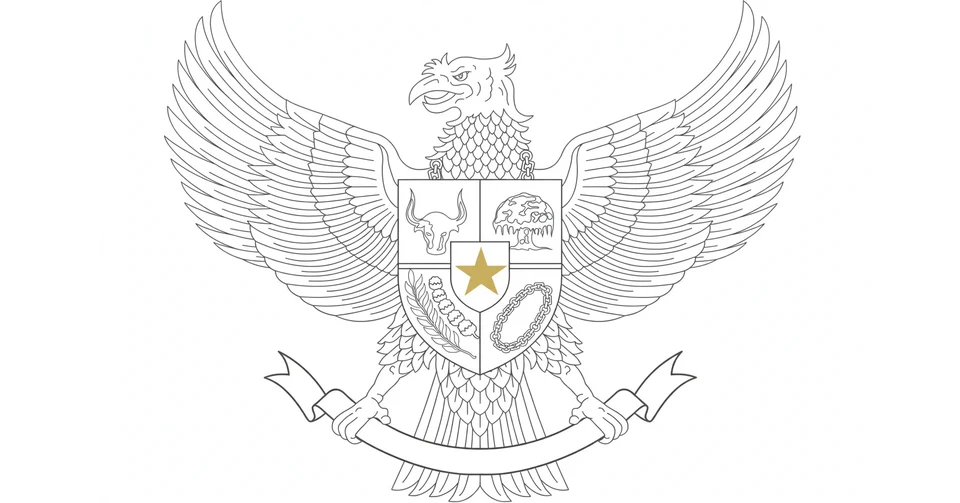
That density is what makes Garuda Pancasila worth a slow look. A coat of arms is usually a puzzle that only heraldry experts enjoy, but Garuda Pancasila was designed to be read by ordinary citizens, and once you know the code, you cannot unsee it. I first learned to read it the way most Indonesians do, by staring at the one above the blackboard, and I still find something new in it each time I look properly.
Garuda Pancasila carries the date of independence in its feathers
The most satisfying secret of Garuda Pancasila is also the easiest to check. The feathers of the bird are arranged to spell the date of the proclamation of independence, 17 August 1945. There are 17 feathers on each wing, 8 feathers on the tail, 19 feathers below the shield at the base of the tail, and 45 feathers on the neck. Read together, the numbers give 17, 8, 19, 45.
It is a neat piece of design, and it works because Garuda Pancasila is drawn in a naturalistic style that lets you count. The Garuda is golden, and the gold is not just for show. In the official reading, the Garuda symbolises strength and power, while the gold colour symbolises greatness and glory. The bird is modelled on the elang Jawa, the Javan hawk-eagle, an endangered raptor that lives only in the mountain forests of Java. Its crest is the most obvious resemblance, and the crest almost did not happen.
When Garuda Pancasila was adopted on 11 February 1950, the bird was bald. It had no crest crowning its head, and its talons gripped the scroll in a different position. A month later, on 20 March 1950, President Sukarno ordered the palace artist Dullah to make improvements, including adding the crest. The story told at the time was that the bald bird looked too much like the bald eagle on the Great Seal of the United States. Whether that was the real reason or a convenient one, the crest stayed, and it is now the feature that makes the bird unmistakably Indonesian rather than generically American.
The Javan hawk-eagle itself later received official recognition. By presidential decree in 1993, the elang Jawa was registered as the national bird of Indonesia, which gave the endangered species very high legal protection. So the emblem and the living bird protect each other: the bird gives the emblem its face, and the emblem gives the bird a reason for the state to keep it alive.
How a sultan's design became the emblem
Garuda Pancasila was designed by Sultan Hamid II of Pontianak, and its birth was a committee process in the best and worst senses. After the Dutch acknowledged Indonesian independence in 1949, the new United States of Indonesia needed a national emblem. On 10 January 1950, the Committee of State Seal was formed, with Sultan Hamid II as coordinator and Muhammad Yamin as chairman. A design competition was held, and two proposals reached the final round: one by Sultan Hamid II and one by Yamin. Hamid's design was accepted by both the parliament and the government. Yamin's was rejected because its shining sun emblem seemed too close to the flag of the Japanese Empire, a recent and painful memory.
Sukarno supervised the design, and he was not a passive supervisor. The first version of Garuda Pancasila looked very different from the bird we know. It was anthropomorphic, in the style of the ancient Javanese and Balinese depictions: a bird with a human neck and shoulders, holding the shield with both hands. The Islamic party Masyumi objected, saying the bird with human features was too mythical. Sultan Hamid II went back to the drawing board and returned with an eagle-like Garuda in a stylised naturalistic style, named Rajawali Garuda Pancasila. That version was officially adopted by the cabinet on 11 February 1950, and Sukarno introduced it to the public at Hotel Des Indes in Jakarta on 15 February 1950.
I find the history of Garuda Pancasila reassuring rather than messy. A national emblem is often presented as if it arrived fully formed from the nation's soul, but Garuda Pancasila was the product of a competition, a rejection, a religious objection, and a presidential edit. It survived because the people arguing over it cared enough to argue. The result is a symbol that belongs to no single party or faith, which is exactly what a national emblem should be.
The five pictures on the shield of Garuda Pancasila
The shield on the chest of Garuda Pancasila is where the five principles of Pancasila live. The shield is divided into quarters of red and white, the colours of the national flag, with a thick black line running horizontally across it to symbolise the equator, which passes through the Indonesian archipelago. In the centre sits a smaller black shield bearing a golden star. Each of the five sections holds one symbol, and each symbol stands for one principle.
| Position | Symbol | Principle |
|---|---|---|
| Centre, on black | Golden five-pointed star | Belief in One Supreme God |
| Bottom right, on red | Gold chain of round and square links | Just and Civilised Humanity |
| Upper right, on white | Banyan tree | The Unity of Indonesia |
| Upper left, on red | Head of the banteng, the Javanese wild bull | Democracy Guided by Wisdom in Deliberation |
| Lower left, on white | Rice and cotton | Social Justice for the Entire People of Indonesia |
The star comes first because the first principle comes first. The black of the small central shield represents the colour of nature, and the golden five-pointed star is a symbol shared by all of Indonesia's recognised faiths and by many native belief systems. The principle has been criticised for suggesting compulsory monotheism, and supporters of Sukarno's legacy have always answered that it was meant to unify a population of many beliefs, not to police them. The argument is still alive, which is perhaps the point: the first principle is a promise that has to be kept, not a fact that can be filed away.
The chain is the most human of the five symbols. It is made of 9 round links representing women and 8 square links representing men, and together they add up to 17, the day of independence again. The chain represents successive human generations, and it stands for the second principle, just and civilised humanity. Its gold colour represents the country's mineral wealth, and its shape as a necklace is an indirect reference to maritime wealth, a reminder of the pearl necklaces made from the sea pearls abundant in Indonesian waters. I like that the chain is both an abstraction and a piece of jewellery. Humanity, in this reading, is something you wear close to the body.
The banyan tree, or beringin, stands for the third principle, the unity of Indonesia. The banyan is known for its expansive above-ground roots and branches, and the republic was conceived as one country grown out of many far-flung cultural roots, millions of people from many ethnic communities, from the far west of Sumatra to the far east of Papua. The tree also represents Indonesia's indigenous flora and forests. It later became a party symbol as well, which is a reminder that a national symbol can be borrowed by politics without ceasing to be national.
The banteng, the Javanese wild bull, is the head in the upper left quarter, on a red background. It stands for the fourth principle, democracy that is guided by the inner wisdom in the unanimity arising out of deliberations amongst representatives. The banteng was chosen because Indonesians saw it as a social animal, and it is also a symbol of Indonesia's fauna and wildlife. It is a deliberately local choice: not a lion or an eagle for democracy, but an animal that lives in Indonesian forests and moves in herds.
The rice and cotton in the lower left quarter stand for the fifth principle, social justice for the entire people of Indonesia. There are 17 seeds of rice and 5 cotton buds, numbers that again echo the date and the five principles. Rice represents sustenance and livelihood, cotton represents industry. Rice is the staple food of Indonesians, while cotton-related industries form part of the country's non-food production. It is the most practical symbol on the shield, and perhaps the most honest: a nation is judged by whether its people eat and work.
What strikes me about the shield of Garuda Pancasila is that it is a constitution you can hang on a wall. Five principles, five pictures, and a schoolchild can memorise them by pointing. Other countries write their founding ideas in documents that few citizens ever read. Indonesia put its founding ideas on a bird that every citizen sees.
Bhinneka Tunggal Ika and the scroll in its claws
Garuda Pancasila grips a white scroll in its talons, and the scroll carries the national motto, Bhinneka Tunggal Ika. The words are Old Javanese, and they come from the Kakawin Sutasoma, an epic poem attributed to the 14th-century poet sage Empu Tantular of the Majapahit Empire. The full line reads, in translation, "Although diverse, both truthful to Dharma, thus there exists no duality in Truth." The official Indonesian rendering is "Berbeda-beda namun tetap satu jua", and the usual English rendering is "Unity in Diversity".
The poem was a doctrine of reconciliation between the Hindu and Buddhist faiths, and that spirit of religious tolerance was an essential element in the foundation of Majapahit and, centuries later, of the republic. The text itself had a dramatic journey: it was rediscovered by the Dutch scholar Brandes among the lontar manuscripts of the Lombok treasure, looted from the destroyed Lombok palace in 1894. A motto about unity arrived in modern Indonesia by way of a colonial looting, which is the kind of irony that history specialises in.
The motto of Garuda Pancasila matters because it is the only part of the emblem that is a sentence rather than a picture. In Garuda Pancasila, the feathers are a date, the shield is a list, but the scroll is an argument. It says that difference and unity are not opposites. That is a large claim for a small strip of paper, and Indonesia has spent seventy-five years testing it. The scroll is in the claws of Garuda Pancasila, not in its beak, as if the motto is something the nation holds on to rather than something it announces. I think that is the right image for a motto that is easy to print and hard to practise.
The bird before the emblem
Long before it became a national emblem, the Garuda was already one of the great images of the archipelago. As the vehicle of the Hindu god Vishnu, the Garuda appears in the temples of ancient Indonesia, at Mendut, Borobudur, Sajiwan, Prambanan, Kidal, Penataran, Belahan, and Sukuh. At Prambanan there is a temple dedicated to Garuda standing in front of the Vishnu temple, though no statue of the Garuda remains in its chamber today. In the Shiva temple at Prambanan there is a relief telling the Ramayana episode in which Jatayu, Garuda's nephew, tried to rescue Sita from Ravana. The most famous statue of the Garuda from ancient Java is the deified King Airlangga depicted as Vishnu mounting the Garuda, found at Belahan and now kept at the Trowulan Museum.
The full story of the bird god, from the churning of the ocean to the mountain he carried, is told in the article on Garuda, who carried a mountain to the middle of the ocean. That older Garuda is a creature of myth, a king of birds who fights serpents and carries gods. The emblem keeps that power but tames it. Garuda Pancasila does not fight anyone. It holds a shield and a scroll. It is a warrior turned into a librarian, and that transformation is the whole story of the republic in miniature: a mythological bird asked to carry a modern constitution.
In Bali, the Garuda has always been something more theatrical. Balinese tradition venerates the Garuda as the lord of all flying creatures and the majestic king of birds, portrayed with the head, beak, wings, and claws of an eagle and the body of a human, carved in intricate detail with golden and vivid colours, often shown in battle against the naga serpents. The Balinese Garuda is louder than the emblem, and it belongs to a ritual world where even feared spirits are fed rather than fought, as the island's offerings to the bhuta kala show. The national emblem borrows the Balinese bird's grandeur and leaves the battle behind.
Where you meet Garuda Pancasila every day
Garuda Pancasila is everywhere in Indonesia, and that ubiquity is part of its design. It symbolises the government and serves as the official emblem of ministries, departments, and institutions. It is displayed in state palaces, monuments, government offices, and Indonesian embassies abroad, and it is used in private offices and in the classrooms of public schools, where it hangs on the wall slightly higher than the photographs of the president and vice president that flank it. Every naval vessel carries it on the front, denoting governmental status. Every governor and head of a city or regency wears it on the badge of their headgear. The president travels with it on the plane. It appears inside the emblems of the Corruption Eradication Commission, the General Elections Commission, the House of Representatives, and the Regional Representative Council.
Garuda Pancasila also appears in places that have nothing to do with government. The national football team wears it on its uniform, which is why the team is nicknamed the Garuda Team. The airline Garuda Indonesia takes its name from the bird, though the airline and the emblem are different things, and confusing the two is a common mistake. There is even a patriotic song, the Mars Pancasila, composed by Sudharnoto, whose opening line is "Garuda Pancasila", a song most Indonesians can hum even if they cannot name its composer.
This everyday presence is Garuda Pancasila's greatest strength and its greatest risk. A symbol you see every day can become invisible, and an invisible symbol stops meaning anything. The government has issued guidelines specifying the exact proportions, colours, and details that must be followed when reproducing the emblem, to keep its integrity intact. But no guideline can force anyone to look. Garuda Pancasila only works if people stop and read it, the way you might stop and read a plaque you have walked past for years.
That is why I keep returning to the feathers. Counting them is a small act, and it takes about ten seconds, but it changes the bird from wallpaper into a message. Seventeen, eight, nineteen, forty-five. A date, a shield, a motto, and a bird that has carried all three for three quarters of a century. The Garuda Pancasila does not ask to be admired. It asks to be read, and once you have read it, the whole country fits on one bird.
More in Culture & Society
Latest posts
- Soba, the Buckwheat Noodles Japan Slurps on the Last Night of the Year
- Udon in Kagawa, Where Noodles Are a Way of Life
- Purnama Is the Full Moon Bali Prays By
- Galungan Welcomes the Ancestors Back to Bali
- Jatayu Flew at Ravana to Save Sita
- Kurma Held Up a Mountain So the Ocean Could Be Churned
- Yoshino Is the Mountain Shugendo Calls Home
- A Gomagi Carries Your Wish Into the Goma Fire
- Danjo Garan Is Where Koyasan's Teaching Began
- The Banryutei Turns Two Dragons Into a Rock Garden
- A Gongyo Starts the Temple Day Before Sunrise
- Shojin Ryori Is the Temple Food That Eats Like a Prayer
- Depachika and the Basement Food Halls Beneath Japan's Department Stores
- Yakitori and the Smoky Alleys Where Tokyo Learned to Love Chicken Skewers
- Okonomiyaki and the Savory Pancake Japan Cooks at the Table