Yoshino Is the Mountain Shugendo Calls Home
· 22 min read
Yoshino in Nara is the mountain where Shugendo began, a UNESCO-listed landscape of cherry blossoms, the sacred peak of Mount Omine, and a trail that has tested pilgrims for more than a thousand years.
In the south of Nara Prefecture, a ridge of forested peaks rises above the old capital basin, and for more than a thousand years people have walked into those mountains looking for something they could not find in the towns below. The mountain is Yoshino, and it holds two reputations that seem to belong to different worlds. In spring it is the most famous cherry blossom mountain in Japan, its slopes covered with about 30,000 trees. In every other season it is the home of Shugendo, a stern tradition of mountain training that asks its followers to climb cliffs, sit under waterfalls, and walk for days through the forest. Yoshino is both a place of beauty and a place of testing, and the two were never separate.
To understand Yoshino, it helps to forget the idea of a mountain as scenery. For the people who shaped this place, the mountain was a teacher, a temple, and a test all at once. The cherry trees were planted as an act of worship. The trail that runs south from Yoshino to the sea was built as a training ground. The great wooden hall that stands in the middle of Yoshino town exists because a mountain ascetic once carved a god out of cherry wood. Everything on Yoshino points back to the same idea: the mountain itself is holy, and the way to meet what is holy is to walk into it.
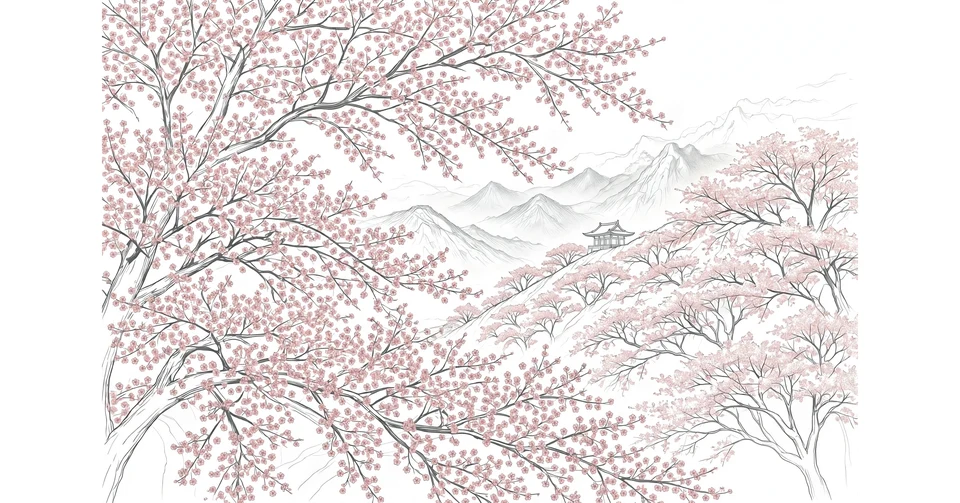
This article follows that idea through the mountain. It starts with how Yoshino became the home of Shugendo, then looks at the ascetic who founded the tradition, the sacred peak that still tests climbers, the long trail that links Yoshino to the shrines of Kumano, the cherry blossoms that made the mountain famous, the temple that guards its god, and finally the gate that women may not pass. Yoshino rewards slow attention, and the more I read about it, the more it seemed to me that the mountain has been asking the same question for thirteen centuries: what are you willing to carry up the slope, and what are you willing to leave behind?
How yoshino became the home of shugendo
Shugendo is a Japanese tradition that blends esoteric Buddhism, Shinto, and older forms of mountain worship into a single path of training. Its followers, called yamabushi, seek spiritual power by putting their bodies through hard practice in the mountains: climbing, fasting, standing under waterfalls, and walking long pilgrimage routes. The word Shugendo is often translated as the way of training and testing, and the testing is the point. The mountain is not a backdrop for prayer. It is the place where prayer happens, because hardship itself is treated as a teacher.
Yoshino became the center of this tradition because of where it sits and what it is. The mountains of Yoshino stand at the northern end of the Kii Mountain Range, a steep, densely forested range that runs south across the Kii Peninsula toward the Pacific. The range was treated as a land where gods reside long before Buddhism arrived in Japan, and when Buddhist monks came, they saw the same mountains as a pure land, a kind of paradise on earth. Yoshino, at the northern edge of that range and within reach of the ancient capitals of Nara and Kyoto, became the natural gateway. Pilgrims could leave the capital and be in the mountains within a day, and the mountains they entered were already sacred.
The story the tradition tells about itself begins with a single ascetic in the seventh century, and that story is inseparable from Yoshino. According to the tradition, En no Gyoja wandered the peaks of the Kii Peninsula, prayed under waterfalls, and met gods and demons in the forest. On Yoshino he had a vision of a fierce deity called Zao Gongen, the protector of the local mountains, and carved an image of the god from the wood of a wild cherry tree. That carving became the seed of the temple that still stands on Yoshino today, and the cherry tree became the symbol of the god. The blossoms that now cover the mountain began as offerings to that god, planted by pilgrims who believed the cherry tree itself was a form of the deity.
In 2004, UNESCO inscribed Yoshino and its southern neighbor, Mount Omine, as part of the Sacred Sites and Pilgrimage Routes in the Kii Mountain Range, a World Heritage listing that covers three sacred sites and the pilgrimage routes linking them. The inscription, dated 7 July 2004, recognized a tradition of sacred mountains that has been documented for more than 1,200 years. Yoshino is the northernmost of the three sites, and it is the one most directly tied to Shugendo. The other two, the shrines of Kumano and the monastery of Mount Koya, belong to the same mountain world, and the routes between them are part of the same story.
En no gyoja, the ascetic who founded a mountain faith
Every tradition needs a founder, and Shugendo has En no Gyoja, a seventh-century ascetic whose life is half history and half legend. The sources agree on the outline: he was a mountain hermit, diviner, and healer who was active in the Katsuragi, Yoshino, and Kumano areas of what is now Nara and Wakayama. He wandered the rugged peaks, secluded himself in caves, and prayed under waterfalls in search of spiritual power. The details of his life come from later accounts, and scholars are careful about what can be confirmed, but the shape of the story has held for thirteen centuries.
En no Gyoja is said to have founded Shugendo in the seventh and eighth centuries, and the monastery on Mount Omine is dated to the eighth century. His life also shows how dangerous it was to claim spiritual power in early Japan. In 699, he was exiled to the island of Izu Oshima, an event recorded in the court chronicle Shoku Nihongi with the date 26 June 699. The exact year of his death is uncertain, and sources give a range around 700 to 707. The uncertainty suits him. He was a man of the mountains, not of the court, and the mountains kept his secrets.
What matters more than the dates is what he left behind. The tradition he founded gave Japan a way of practicing religion with the body, not only with the mind. Yamabushi still walk the trails of Yoshino, still blow the conch shell, the horagai, before they climb, and still treat the mountain as a place where a person can be changed. For more on the founder himself, the story of En no Gyoja, the mystic Shugendo calls its patriarch follows his life in detail, and it shows how much of Shugendo can be traced back to one man walking alone into the forest.
I find something moving in that image: a single person, with no temple and no institution behind him, deciding that the mountain was enough. Religions usually begin with a building or a book. Shugendo began with a slope. That may be why it has lasted so long. Buildings burn and books are forgotten, but a mountain stays where it is, and anyone willing to climb can meet it on the same terms as the founder did.
Mount omine, the peak that tests its climbers
South of Yoshino town, the ridge rises toward the highest and most sacred peak of the range. Mount Omine, officially known as Mount Sanjo, or Sanjo-ga-take, stands 1,719 metres above sea level in the village of Tenkawa. It is the peak that gives the whole southern part of the range its name, and it is the mountain that Shugendo treats as its holiest ground. The temple at its summit, Ominesanji, is the headquarters of the Shugendo sect, and the entire mountain is a pilgrimage and training ground for the yamabushi.
The climb to the summit is not a casual walk. The usual route starts in Dorogawa, a mountain settlement at the foot of the peak, and takes about four hours on foot. From the trailhead at Omine Ohashi Bridge, the climb takes around three hours one way. The trail is steep, exposed in places, and lined with the small shrines and stone markers of a thousand years of pilgrims. The mountain is open for its religious season from the gate-opening ceremony on 3 May to the gate-closing ceremony on 23 September, and most climbers come in the warm months between those dates.
What makes Mount Omine famous, and feared, are its three tests of courage, the shugyo. The first is Byodo Iwa, the Rock of Equality, a rock tower over a deep cliff that is crossed only by special request. The second is Kanekake Iwa, the Hanging Stone, also called the Crab Rock for the position a climber must take to ascend it: a cliff of about 30 feet with an overhanging rock at the top, climbed by swinging out over the drop on an embedded chain. The third, and the most famous, is Nishi no Nozoki, the Insight from the West, a sheer cliff about 60 metres high. There, novices are held head-first over the edge, secured by a rope, and made to confess their faults and promise to follow the religious laws. Climbers who do not wish to take the tests can walk around them, and most visitors do, but the tests are there for a reason. In Shugendo, fear is not an obstacle to training. Fear is the training.
The mountain has been recognized far beyond the world of religion. In 1964, the mountaineer and author Kyuya Fukada selected Mount Omine as number 91 of his 100 Famous Mountains of Japan, chosen for grandeur, spiritual significance, and individuality. In 1980, an area of 36,000 hectares around Mount Omine and Mount Odaigahara was designated a UNESCO Man and the Biosphere Reserve. And in 2004, the mountain joined Yoshino on the World Heritage list. A peak that was once known only to ascetics is now protected by the world, and that protection has changed the debate about the mountain in ways its priests never expected.
The okugake trail and its seventy-five stopping places
From Yoshino, a trail runs south through the Omine range all the way to the Grand Shrine of Kumano Hongu Taisha, near the southern coast of the Kii Peninsula. It is called the Omine Okugakemichi, the deep inner path of the grand peaks, and it is the oldest and hardest of the pilgrimage routes in the Kii Mountains. The trail is about 170 kilometres long, and it was established, according to tradition, by En no Gyoja as a training ground for Shugendo. It was designated a National Historic Site in 2002 and included in the UNESCO World Heritage listing in 2004.
The trail begins at Yanagi-no-shuku, a former ferry station on the Yoshino River, and climbs through mountains between 1,200 and 1,900 metres high. Along the route are 75 spiritual places called nabiki, set in caves, on rocks, at waterfalls, and on mountain peaks, where pilgrims stop to pray or to perform exercises. The number is not a round figure chosen for effect. Each nabiki is a specific place with its own history, and walking the whole route means stopping at each one. A full crossing takes many days, and very few people walk it end to end. Most walk a section, often the stretch between Yoshino and Mount Omine, and that is enough to understand why the trail exists. It is not a shortcut to anywhere. It is a slow passage through a landscape that was designed, by centuries of use, to wear a person down and rebuild them.
The route also explains why Yoshino and Kumano belong to the same story. The trail links the Shugendo center of Yoshino and Omine with the shrines of Kumano, the three great shrines of the south, and the two traditions grew together along it. Pilgrims who started at Yoshino ended at Kumano, and the gods of one mountain met the gods of the other. The Kii Mountains are often described as three sacred sites joined by routes, but it is more honest to say they are one mountain world, and the Okugake trail is the spine that holds it together.
For a wider view of the tradition that built the trail, the article on Shugendo, the path that turns a mountain into a place of testing explains how the practice works and why its followers still walk these ridges. The trail itself is the best explanation, though. Walk even a small part of it, through the cedar forest with the conch shell sounding ahead, and the idea of training stops being abstract. The mountain is doing the teaching. The walker only has to keep going.
Thirty thousand cherry trees on one mountainside
For most of the year, Yoshino is a quiet mountain town of temples, inns, and forest paths. Then, in late March and early April, it becomes the most famous cherry blossom site in Japan. About 30,000 cherry trees cover the slopes of Yoshino, and they bloom in stages from the foot of the mountain to the top, so that the pink moves uphill over several weeks like a slow wave. The trees are grouped into four areas, each named for a thousand trees: Shimo Senbon, the lower thousand, at the bottom; Naka Senbon, the middle thousand; Kami Senbon, the upper thousand; and Oku Senbon, the innermost thousand, near the top. The name comes from the phrase hitome senbon, a thousand trees at a glance, and on Yoshino the phrase is literal. From the right viewpoint, a thousand blossoming trees really do fill the eye at once.
The blossoms are not an accident of nature. They were planted, over centuries, as an act of worship. The cherry tree was seen as a representation of Zao Gongen, the god En no Gyoja had carved from cherry wood, and pilgrims came to Yoshino to plant trees and to admire the blossoms. In the middle of the sixteenth century, a rich merchant gifted 10,000 seedlings to the mountain, and the tradition of planting has been kept up ever since. The trees that cover Yoshino today are mostly wild mountain cherries, yamazakura, and there are many varieties among them. The mountain that looks pink from a distance is, up close, a forest of distinct trees, each planted by someone who wanted to leave something beautiful behind.
The blossom season follows the altitude. Shimo Senbon and Naka Senbon bloom first, in early to mid April, then Kami Senbon in mid April, and finally Oku Senbon in mid to late April. The whole mountain, from Yoshino Station to the shrine of Kimpu at the top, stretches about 7 kilometres, rising from roughly 200 metres to 700 metres above sea level. That slow climb is what makes Yoshino different from a city park full of cherry trees. In a park, the blossoms open all at once and fall all at once. On Yoshino, spring arrives one slope at a time, and a visitor who comes twice in the same month sees two different mountains.
The mountain's fame even traveled into the name of Japan's most common cherry tree. The Yoshino cherry, Prunus yedoensis, is the cultivar known as Somei-yoshino, the pale pink tree planted along streets and in parks all over Japan and far beyond it. It was named in 1900 by the botanist Yorinaga Fujino, after the village of Somei, where the tree was grown, and Mount Yoshino, the famous home of wild cherry blossom. The scientific name followed in 1901. There is a gentle irony in the story: research later showed that most of the trees on Mount Yoshino itself are yamazakura, a different cherry, and the famous Somei-yoshino is a hybrid that grew up in Edo. But the name stuck, because the mountain had already given the flower its meaning. When people around the world say Yoshino cherry, they are naming a tree after a mountain they may never see, and the mountain answers by blooming every spring anyway.
I think that is the most generous thing about Yoshino. The mountain does not keep its beauty for the people who understand it. It gives the blossoms to everyone, pilgrim and tourist alike, and it lets the name of its flowers travel to places its own trees will never grow. A mountain that can do that is not only sacred. It is kind.
Kinpusen-ji and the god with the blue skin
In the middle of Yoshino town, among the inns and the souvenir shops, stands the temple that anchors the whole mountain. Kinpusen-ji is the head temple of Shugendo, and its main hall, the Zao-do, is one of the great wooden buildings of Japan. The hall is a National Treasure, about 34 metres high, and it is the second largest old wooden building in the country after the Great Buddha Hall of Todai-ji in Nara. The present hall was rebuilt in 1592. Its dark timber and steep roof dominate the town, and from the hills above, the hall is the landmark by which visitors find their way.
Inside the Zao-do are three statues of Zao Gongen, the fierce protector deity of the mountains, each about seven metres tall, with blue skin and an expression meant to frighten demons away. The three figures represent the past, the present, and the future. They are hidden statues, kept behind thick curtains for most of the year, and shown to the public only at limited times, in spring, in April and early May, and again in autumn. Photography is not allowed inside. The temple asks visitors to look with their eyes and remember what they saw, which seems fitting for a god who was first carved in a forest, far from any audience.
The story of the temple goes back to En no Gyoja and the cherry wood carving. According to the tradition, the ascetic carved statues of Zao Gongen from a cherry tree on Yoshino and housed them in two shrines. One of those shrines is said to be the origin of the Zao-do, and the beginning of the history of Kinpusen-ji. The Nio-mon gate of the temple is also a National Treasure, and the temple grounds hold other halls and treasures from a history of more than a thousand years. Four of the five guardian temples of Ominesanji, the Goji-in, stand in Yoshino itself: Tonan-in, Kizo-in, Sakuramoto-bo, and Chikurin-in, small temples along the main road where Shugendo is still practiced today.
Yoshino has also been a mountain of famous visitors. The Japan National Tourism Organization notes that the temples and shrines of Yoshino hold traces of Emperor Tenmu from the seventh century, the samurai Minamoto no Yoshitsune and his companion Shizuka Gozen from the twelfth century, the poet monk Saigyo, the fourteenth-century Emperor Go-Daigo, and the sixteenth-century warlord Toyotomi Hideyoshi. Emperors, warriors, and poets all came to the same mountain, and they came for the same reason pilgrims still come: Yoshino is a place where history feels close, because the buildings and the trees have not moved.
The Zao-do is best seen from a little distance, from the slopes above the town, where its roof rises out of the cherry blossom in spring. Up close, it is a massive wooden hall. From far away, it is a small dark shape in a sea of pink, and that may be the truer view. The temple was never meant to dominate the mountain. It was meant to belong to it, the way a shrine belongs to a forest, and the way a god carved from a cherry tree belongs to the tree it came from.
The gate women may not pass
There is one part of Yoshino that cannot be described without an argument, and it is the ban on women climbing Mount Omine. The rule is called nyonin kinsei, and it is still observed. At the main trailhead, beyond Omine Ohashi Bridge on the route from Dorogawa, a stone pillar about thirteen feet tall carries the inscription that the zone beyond is restricted to women, and beside it stands a wooden gate about eleven feet tall, topped with metal spikes, bearing the words Women's Boundary Gate. A signboard in English and Japanese states that the regulation of the holy mountain prohibits any woman from climbing farther through the gate, according to religious tradition. The mountain claims a continuous tradition of 1,300 years as a male-only sacred peak.
The ban has been challenged many times, and it has never been lifted. Supporters say that the exclusion is a religious tradition, not discrimination, and that the mountain's holiness depends on keeping the training ground as it has always been. They point to the unbroken history and to the fact that the rule is part of the faith itself, not an addition to it. Critics say that a World Heritage listing should not protect a rule that excludes half of humanity, and that the UNESCO designation in 2004 gave the ban a stamp of approval it did not deserve. The argument has run for decades, and neither side has moved. The gate is still there, the pillar is still there, and the signboard still says no in two languages.
The history behind the ban is less simple than either side sometimes claims. Most mountain bans in Japan dissolved in 1872, when the Meiji government granted women access to mountain shrine and temple lands, but Mount Omine kept its rule, and its practices continued in secret during the years when the government banned Shugendo outright. Scholars note that the origins of fixed male-only zones are debated, and that the records do not support a simple unbroken line from the eighth century to today. The exclusion grew out of Buddhist and Shinto ideas about purity and the celibate life of male practitioners, and the precise way a temporary avoidance became a permanent ban is still argued over by historians. What is not debated is that the ban is real, that it is enforced, and that it shapes every visit to the mountain.
There is also a quieter answer on the mountain itself. On the neighboring peak of Inamuragatake, 1,726 metres high, a training ground for women has existed since 1959, and it is called Women's Omine, Nyonin Omine. Women who wish to train in the Shugendo tradition climb there instead. It is not the same peak, and no one pretends it is, but it is a real place of practice, and it has its own history of more than sixty years. The existence of Women's Omine does not settle the argument. It does show that the tradition has found at least one way to make room without breaking its own rule.
I have no standing to settle this debate, and this article will not try. But I think it is worth saying plainly what a visitor feels at the gate. The pillar and the spikes are not gentle. They were built to be seen and to be obeyed, and they make the exclusion impossible to ignore. At the same time, the mountain on the other side of the gate is the same mountain that gives its cherry blossoms to everyone, and that contradiction is part of Yoshino too. A place can be generous and closed at the same time, and the honesty of a place is measured by whether it admits both facts. Yoshino admits them. The gate says no, and the blossoms say come, and the mountain holds both sentences without resolving them.
What yoshino still teaches
Yoshino is not a mountain that asks to be admired from a distance. It asks to be walked, and it rewards the walking with something that no photograph can carry home. The cherry blossoms are beautiful, and the temples are impressive, and the trail is hard, but the real gift of Yoshino is simpler than any of those. It is the feeling, after hours of climbing, that the mountain has been doing something to you, quietly and without asking permission. The legs ache, the breathing slows, and the noise of ordinary life falls away, one step at a time. That is what Shugendo has always promised, and it is what Yoshino still delivers to anyone willing to climb.
The mountain also teaches something about time. The cherry trees were planted by people who knew they would never see them in full bloom, because a cherry tree takes years to grow. The trail was walked by pilgrims who knew they would never reach the end in a single life, because the route is longer than any one journey. The temple was rebuilt by people who knew it would burn or rot again, because wood always does. Yoshino is a place built by people who worked for a future they would not live to see, and that is a rare thing in a world that wants everything now.
If there is a lesson in Yoshino for the rest of us, it may be this: a mountain does not need to be conquered, and a tradition does not need to be perfect to be worth keeping. Yoshino is imperfect. Its gate excludes people, its history is tangled, and its most famous flower does not even grow on its own slopes. Yet it has kept its faith for thirteen centuries, its blossoms for longer than that, and its trail for as long as anyone can measure. It has done so by asking very little of its visitors and giving them a great deal in return: a slope to climb, a flower to look at, and a quiet place to think about what matters.
Go in spring, if you can, when the blossoms move uphill and the town smells of cherry and wood smoke. Go in autumn too, when the statues are shown and the crowds are gone. Walk slowly, look up often, and remember that the mountain has been waiting for a very long time. Yoshino does not hurry, and that may be the most important thing it has to teach.
More in Culture & Society
Latest posts
- Soba, the Buckwheat Noodles Japan Slurps on the Last Night of the Year
- Udon in Kagawa, Where Noodles Are a Way of Life
- The Pawukon Calendar Runs Bali on 210 Days
- Purnama Is the Full Moon Bali Prays By
- Galungan Welcomes the Ancestors Back to Bali
- Jatayu Flew at Ravana to Save Sita
- Kurma Held Up a Mountain So the Ocean Could Be Churned
- A Gomagi Carries Your Wish Into the Goma Fire
- Danjo Garan Is Where Koyasan's Teaching Began
- The Banryutei Turns Two Dragons Into a Rock Garden
- A Gongyo Starts the Temple Day Before Sunrise
- Shojin Ryori Is the Temple Food That Eats Like a Prayer
- Depachika and the Basement Food Halls Beneath Japan's Department Stores
- Yakitori and the Smoky Alleys Where Tokyo Learned to Love Chicken Skewers
- Okonomiyaki and the Savory Pancake Japan Cooks at the Table