The Banryutei Turns Two Dragons Into a Rock Garden
· 15 min read
The banryutei at Kongobuji is the largest rock garden in Japan, a field of white gravel and 140 granite stones that turns two guardian dragons into a landscape you can read from a veranda.
There is a garden at Kongobuji where nothing grows and nothing moves, and it is the most visited corner of the temple. The banryutei is a rectangle of white gravel about the size of half a football field, scattered with 140 granite stones, and it holds the whole mountain still. Visitors who have just walked through halls full of gold leaf and painted sliding doors stop here, sit on the veranda, and say very little. The garden does the talking.
What it says is simple enough to read and strange enough to stay with you. The stones are arranged as two dragons rising from a sea of clouds, and the dragons are there to protect the inner hall of the temple. That is the whole design, and it has worked for forty years. The banryutei is the largest rock garden in Japan, built in 1984, and it feels older than the temple around it.
The first surprise is how young the garden is. Kongobuji has stood on Koyasan for more than a thousand years in one form or another, and the banryutei is only about forty years old. It was built for the 1,150th anniversary of Kukai entering eternal meditation, the event the whole mountain is organized around. A garden that young should feel new. Instead it feels as if it had always been there, waiting for someone to rake the gravel into waves.
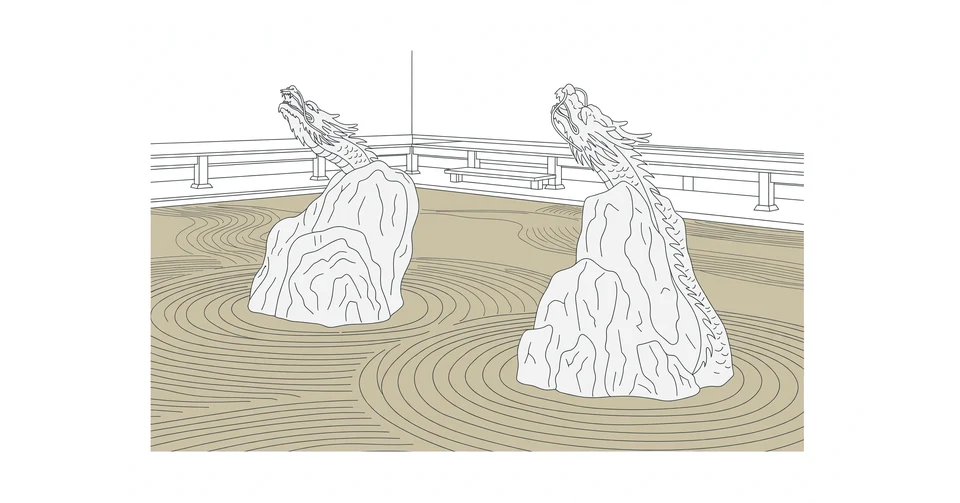
The best way to see the banryutei is from the wooden veranda that runs along its edge, shoes off, sitting low. From standing height the garden looks like a field of stones. From sitting height it changes. The white gravel becomes a sea, the stones become backs and heads breaking the surface, and the two dragons start to make sense. The garden is designed for that low angle, and the temple knows it. The veranda is wide, the benches are few, and nobody hurries you along.
Reading the two dragons in the gravel
The name gives the design away. Banryutei means coiled dragon garden, and the garden is a picture of two dragons, one male and one female, floating in a sea of clouds to protect the inner hall, the Okuden, behind it. The stones are the dragons. The white gravel is the clouds. The rest is patience.
The stones came from Shikoku, the island where Kukai was born, and the white gravel came from Kyoto. That choice is not decoration. Shikoku is where the founder of Shingon Buddhism began his life, and Kyoto is where the old court culture of Japan refined the art of the dry garden. The banryutei carries both places in its materials, the birthplace of the founder and the city that taught Japan how to look at stones.
There are 140 granite stones in the banryutei, spread over about 2,340 square metres. The number matters less than the spacing. The stones are not crowded together. They stand in loose groups with wide stretches of raked gravel between them, so the eye has to travel. The gravel itself is raked into long waves that run across the whole field, and the pattern changes with the light. In the morning the waves look shallow and calm. In the late afternoon the shadows lengthen and the stones look taller, as if the dragons were rising.
A rock garden asks something different from a visitor than a flower garden does. A flower garden shows you its beauty at once. A rock garden asks you to sit and let the picture assemble itself. The banryutei is generous about that. There is no single correct spot to stand, no plaque telling you exactly where the male dragon ends and the female dragon begins. You find your own reading, and the garden does not correct you. That openness is part of the design, and it is why people stay longer than they planned.
I think the garden works because it refuses to explain itself too loudly. Two dragons guarding a hall could have been carved in bronze and set on pedestals, and the message would have been the same. In gravel and stone, the message becomes a place instead of a monument. You can sit beside it. You can watch the light change on it. The dragons stay still, and the stillness does the work.
How the banryutei was built in 1984
The banryutei is young by temple standards, and its youth is the point. It was built in 1984, together with the Shin-Betsuden, a new reception hall raised for the pilgrims who gathered to mark 1,150 years since Kukai entered deep meditation. The hall was built to receive people. The garden was built to receive their attention. The two were planned as one project, a place to gather and a place to look.
The garden sits at the north of the new hall, between the Betsuden and the Okuden, and its position is part of its meaning. It faces the inner hall, the most private room in the temple, and the dragons in the gravel face the same way. They are not decoration for visitors. They are guards for a room most visitors will never enter. The garden lets an outsider see the protection without entering the protected place, which is a neat piece of temple design.
The size is what makes the banryutei famous. At about 2,340 square metres it is the largest rock garden in Japan, and the scale changes how the garden feels. Most rock gardens in Japan are small and enclosed, made to be seen from one room. The banryutei is big enough to walk beside for a while, big enough that the far stones look distant, big enough that the gravel sea has a horizon. It is a dry landscape garden built at the scale of a landscape, and that is rare.
The building of the garden was a deliberate act of continuity. The temple could have built something in the style of 1984. Instead it built a garden in a form that was already a thousand years old, using stones from the founder's home island and gravel from the old capital. The result is a garden that looks as if it belongs to the ninth century and behaves like a work of the twentieth. That is not a contradiction. It is the way Koyasan has always worked, keeping old forms alive by rebuilding them in the present.
It is worth remembering that the banryutei was built the same year many of its visitors were born. A garden can be younger than its audience and still feel timeless, and the banryutei proves it. What makes a garden feel old is not its age. It is the patience of its design and the weight of the story it carries.
The temple behind the garden
The banryutei belongs to Kongobuji, and Kongobuji is the head temple of Koyasan Shingon Buddhism. The temple governs the mountain, and the garden is the quietest part of its government. To understand the garden it helps to know a little of the temple, because the temple is the reason the garden exists at all.
The ground was chosen by Kukai in 816, when he founded the mountain community that became Koyasan. The temple as a building came much later. In 1593 Toyotomi Hideyoshi had a temple called Seiganji built here as a memorial to his late mother, and the main gate from that year is still the oldest structure in the temple. The hall was rebuilt in 1861, burned down two years later, and the temple received its present name in 1869, when Seiganji merged with the neighbouring Kozanji. Kongobuji has been rebuilt and renamed and rebuilt again, and each version kept the same job, running the mountain.
I wrote about the temple itself in a separate piece, and the history is worth reading in full, because the garden only makes sense inside it. Kongobuji still governs the mountain Kukai left behind tells the story of how a temple became the administration of a sacred mountain. The banryutei is the garden that administration built for itself, a place where the power of the temple is expressed as calm rather than as ceremony.
The main hall, the Ohiroma, holds sliding doors painted by Kano Tanyu and the Kano school, cranes and pines from the sixteenth century. The willow room is where Toyotomi Hidetsugu, the nephew of Hideyoshi, was ordered to take his own life in 1595 at the age of 28. The kitchen has three great stoves that could cook for around 2,000 people, and they were used to make mochi for the new year until 1975. The temple is full of rooms like these, rooms where history happened and then stayed.
The garden sits behind all of that, and the contrast is deliberate. The halls are crowded with paintings, gold leaf, and stories. The banryutei is empty on purpose. After rooms full of colour and incident, the eye reaches the gravel and rests. The temple gives you a lot to look at and then gives you a place to look at almost nothing. That rhythm, fullness and then emptiness, is the whole visit.
What the banryutei shares with older gardens
Japan has many famous rock gardens, and most of them are older than the banryutei. The garden at Ryoanji in Kyoto was built in the fifteenth century. The gardens of the great Zen temples are older still. The banryutei is a latecomer, and it knows it. It does not pretend to be ancient. It borrows the old language and speaks it in a modern voice.
The difference is mostly one of scale and openness. The old gardens are small and walled, made to be contemplated from a single veranda by a small number of people. The banryutei is large and open, made to be seen by the crowds of pilgrims who come for the memorial services. It is a rock garden built for a public temple rather than a private monastery, and that changes its character. It is less secretive and more generous. It lets many people look at once.
There is also a difference in what the garden depicts. The old gardens tend toward abstraction, a few stones suggesting islands or mountains, the meaning left open. The banryutei is more direct. Two dragons, a sea of clouds, a hall to protect. The picture is named in the design, and visitors are meant to find it. That directness suits a temple that receives pilgrims rather than monks. A pilgrim has an afternoon, not a lifetime, and the garden meets that schedule.
None of this makes the banryutei lesser than its older cousins. A garden does not have to be old to be serious, and a clear picture is not a shallow one. The dragons are a story everyone in Japan knows, and the garden tells it with stones that will outlast the people who raked them. The modern garden and the old garden are not rivals. They are two ways of saying the same thing, that a few stones and a field of gravel can hold a whole cosmology.
My own feeling, sitting on that veranda, was that the banryutei is the friendlier of the two kinds. The old gardens can feel like a test, a puzzle you are supposed to solve in silence. The banryutei feels like an invitation. It tells you what to look for and then lets you look as long as you like. There is no wrong way to see two dragons in a sea of clouds.
The banryutei through the seasons
A rock garden has no flowers to lose and no leaves to drop, so it is easy to assume it looks the same all year. The banryutei does not. The stones stay the same, but everything around them changes, and the garden changes with it.
Autumn is the season the temple recommends, and it is easy to see why. The maples around the garden turn red and gold, and the white gravel takes on a warm light. The garden is listed as a popular spot for autumn foliage, and the crowds show it. The dragons sit in their sea of clouds with a ring of colour around them, and the whole composition looks warmer than it does in summer.
Winter is the opposite and, to my mind, the better season. Snow falls on the gravel and on the stones, and the garden turns into a study in white and grey. The temple guidebooks say the snow-covered stones add a stillness to the atmosphere, and they are right. The dragons disappear a little under the snow, which makes them feel more present rather than less, as if they were resting under the surface. The main hall is the warmest place in the temple in winter, and visitors take tea there, but the garden is where the season is most visible.
Spring and summer are quieter. The green of the surrounding trees frames the white gravel, and the garden looks cooler and more spacious. The gravel is raked fresh, the stones stand out sharply, and the whole field looks newly made. There is no bad season for the banryutei, only different moods, and the garden rewards the visitor who comes twice.
The seasons also change the light on the gravel, and the light is half the garden. A rock garden is a surface, and a surface lives by light. Morning light makes the waves in the gravel look shallow. Afternoon light makes them look deep. The stones cast long shadows in the evening and short ones at noon, and the dragons seem to move with the shadows even though they never move at all.
Visiting the banryutei
The practical part of a visit is simple. Kongobuji is open from 8:30 in the morning until 5 in the afternoon, with last admission at 4:30. Entry to the main hall costs about ¥1,000 for adults in the most recent visitor guide I read, though older guides list ¥500, so the price is worth checking before you go. From Koyasan Station, take a bus toward Daimon and get off at Kongobuji-mae, right in front of the temple.
The garden is inside the temple, past the main hall, along the corridor that leads to the new annex. You do not need a separate ticket for it. The route takes you through the painted rooms first, then the corridor, then the garden, and the order is part of the experience. The paintings fill the eye, the corridor narrows it, and the garden opens it again.
Plan to spend an hour at Kongobuji, and give the banryutei at least twenty minutes of that hour. Sit on the veranda. Watch the gravel. Let the dragons assemble themselves. The garden does not reward rushing, and it does not punish slowness. It is a place built for sitting, and sitting is the whole activity.
The rest of Koyasan is close by. Okunoin, where Kukai is said to be still meditating, is the other great site on the mountain, a cemetery and forest that feels like the mirror image of the garden. Where the banryutei is open gravel and sky, Okunoin is closed cedar and stone. The two places belong together, and most visitors see both in one day. I wrote about the mountain itself, and the founder who never left it, in a piece on Koyasan, and it pairs naturally with a visit to the garden. On Koyasan, the founder is said to be still meditating follows Kukai from his arrival on the mountain to the forest where he is believed to wait.
A fuller guide to the temple, including its rooms, its kitchen, and its meditation sessions, is available from the detailed Kongobuji guide I used while writing this piece. The detailed guide to Kongobuji and the Banryutei garden covers opening hours, admission, and the buildings in order, and it is the best single source for planning a visit. For a second opinion on the garden itself, the Lonely Planet page for Kongobu-ji gives the same facts in brief: 140 stones from Shikoku, white gravel from Kyoto, two protector dragons rising from a sea of clouds.
The banryutei is a young garden with an old story, a large garden built for crowds that still manages to feel private. Two dragons made of granite guard a hall made of wood, and a sea made of gravel has protected them both for forty years. Sit on the veranda long enough and the garden stops looking like a design and starts looking like a place, a quiet field at the top of a mountain where nothing moves and everything is watched over. That is the whole of it, and it is enough.
More in Culture & Society
Latest posts
- Soba, the Buckwheat Noodles Japan Slurps on the Last Night of the Year
- Udon in Kagawa, Where Noodles Are a Way of Life
- The Pawukon Calendar Runs Bali on 210 Days
- Purnama Is the Full Moon Bali Prays By
- Galungan Welcomes the Ancestors Back to Bali
- Jatayu Flew at Ravana to Save Sita
- Kurma Held Up a Mountain So the Ocean Could Be Churned
- Yoshino Is the Mountain Shugendo Calls Home
- A Gomagi Carries Your Wish Into the Goma Fire
- Danjo Garan Is Where Koyasan's Teaching Began
- A Gongyo Starts the Temple Day Before Sunrise
- Shojin Ryori Is the Temple Food That Eats Like a Prayer
- Depachika and the Basement Food Halls Beneath Japan's Department Stores
- Yakitori and the Smoky Alleys Where Tokyo Learned to Love Chicken Skewers
- Okonomiyaki and the Savory Pancake Japan Cooks at the Table