A Gomagi Carries Your Wish Into the Goma Fire
· 13 min read
A gomagi is a thin wooden stick on which a worshipper writes a wish before a priest burns it in the goma fire, and this is how the small ritual works, what it costs, and where the fire came from.
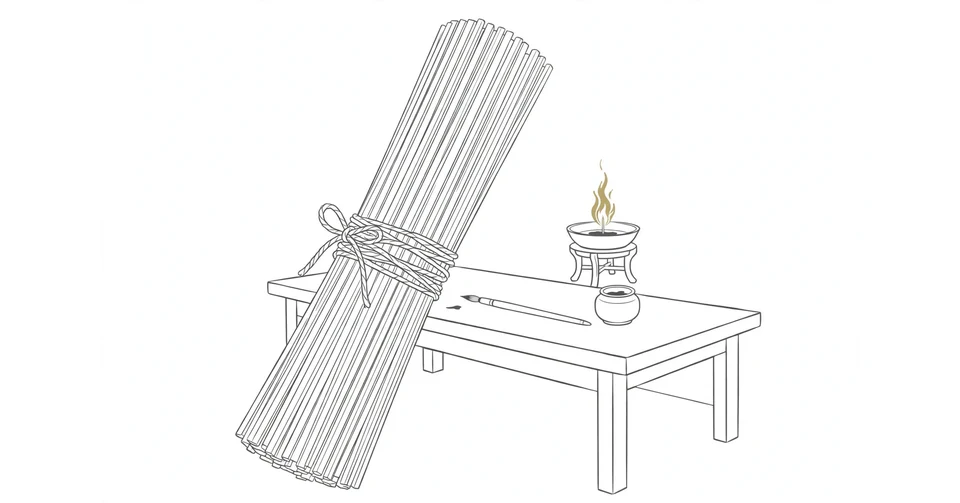
A gomagi is a thin stick of wood, about the length of a ruler, and it carries the most honest sentence you will write all year. You pick it up at a temple counter, write your name on the back and your wish on the front, and hand it to a priest. A few minutes later the gomagi is gone, turned to smoke and ash in the goma fire.
That is the whole ritual in one sentence, and it has stayed almost unchanged for more than a thousand years. The stick is small and cheap, the fire is loud and hot, and the wish is yours alone. Nobody else reads the gomagi after the flames take it, which is part of the point.
The goma fire itself belongs to esoteric Buddhism, the school of ritual and mantra that Kukai brought to Japan in the early ninth century. At its centre stands Fudo Myoo, the immovable wisdom king, whose fierce face is said to be a parent's stern love. The gomagi is how an ordinary visitor joins that old ceremony, without knowing a single mantra.
What a gomagi is
A gomagi is a thin board of wood, usually 20 to 30 centimetres long and 2 to 3 centimetres wide. Most are cut from cedar or cypress, two trees that burn clean and smell faintly sweet. Some temples print a character or a sacred syllable at the top of the gomagi before it ever reaches your hands, a small mark that says which deity the stick belongs to. Others leave the wood plain, so the whole surface is yours.
The writing follows a simple rule that holds at temples across the country. On the front, in the middle, you write your wish, usually in one short line. On the back you write your name, your counted age, and where you live. The counted age is the old Japanese way of reckoning, called kazoedoshi, in which a newborn is already one year old and everyone gains a year at New Year. If you are unsure of the number, the temple usually has a chart on the wall that converts your birth year for you.
People often reach for a four character idiom to say what they want. Good health, household safety, business prosperity, success in exams. The narrow board does not leave room for a paragraph, and that is deliberate. A gomagi forces you to choose one thing and say it plainly. The recommended pen is an oil based felt pen or a brush pen, and if your hand slips, you can ask at the counter for a fresh stick. Nobody expects calligraphy. The writing only has to be yours.
The stick is sometimes called goma ki, which means the same thing in plainer words. A gomagi is not an amulet and it is not a souvenir. You do not take it home. Its whole purpose is to be burned.
How a wish travels through fire
A goma ceremony starts quietly. Visitors check in, take their seats, and the chanting begins. Ritual instruments sound, the priest lights the fire on the altar, and then the gomagi are fed into the flames one by one. The fire rises, the chanting continues, and each stick disappears in turn. It is a slow and orderly business, nothing like a bonfire.
The ceremony is built from four things working together: mantra, hand gestures called mudra, prayer, and offerings of rice, incense, and fragrant wood. The gomagi carries the human part of that mixture. A temple in Boston that holds the same rite describes it plainly: each wish is written onto a specially prepared wooden prayer stick called a gomagi, and during the ceremony the gomagi is offered into the sacred fire, where the physical wish is transformed into energy and directed toward the world again. You can read its full account of the rite at Fudosan Kongo Ji Temple.
The deity who receives the wish is usually Fudo Myoo. Naritasan Shinshoji, one of the great centres of the rite, explains in its own question and answer pages that a goma is held before the main image of Fudo Myoo, with an altar set up and the gomagi burned as firewood while the priests pray for the fulfilment of wishes. Its full explanation is worth reading at Naritasan Shinshoji. Fudo Myoo looks angry, with bared teeth and a sword in his hand, but the temple's own answer is gentle about it: the fierce face is like a parent scolding a child out of love, meant to destroy confusion and lead people onto the right path.
Most of the time the priests do the burning, and visitors watch. At a few temples the priest may invite you to place your own gomagi into the flames, but that is the exception rather than the rule. The ordinary experience is to sit, listen, and watch your stick go in with all the others, one small flame among many.
What you do take home is usually a paper talisman called a gomafuda. Naritasan says the talisman holds the same wish you wrote, and it should be returned to the temple after about a year, or when the wish has come true, and replaced with a fresh one. The gomagi burns, the talisman stays, and the two together make a neat pair: one wish sent away, one promise kept at home.
A goma is not a show put on for tourists, though visitors are welcome at most temples. At a goma, prayers are written to be burned, and the ceremony itself is the point. The drum, the chanting, and the heat of the fire do the work that words alone cannot.
The price of a wish
A gomagi costs very little, and that is part of its charm. At large temples the added sticks, called soe gomagi, usually go for around 300 to 500 yen each. Naritasan Shinshoji and Mount Takao's Yakuoin both charge around 500 yen for a gomagi, which is roughly the price of a coffee. The money is an offering rather than a purchase, and it is called a prayer fee or a donation, not a ticket.
There is a clear difference between an added stick and a full goma service. A soe gomagi is a simple offering: you write it, hand it in, and it is burned in the next service. A full goma service, where your name is read aloud and a large wooden tablet is prepared for you, costs far more, from a few thousand yen to tens of thousands, and you take the tablet home as a talisman. At Mount Takao, for example, a goma service starts from 3,000 yen, while a single gomagi remains a few hundred yen. The two prices belong to two different kinds of prayer, and the temple makes the distinction clear at the counter.
Prices vary from temple to temple and can change, so the figures here are a guide rather than a promise. What does not change is the proportion. A gomagi is meant to be cheap enough that anyone can offer one, and expensive enough that you pause before you write on it. Five hundred yen is small money, but it is still money, and that small sting is part of the ritual. It makes you think before you ask.
Far from Japan, the same rite travels with the same logic. The Boston temple mentioned earlier asks for a donation of 25 dollars per wish, and it will burn a gomagi on your behalf even if you never set foot in the hall. The currency changes. The stick does not.
Saito goma takes the fire outside
Most goma ceremonies happen indoors, in a hall, before a small altar. The saito goma is the outdoor cousin, and it is a different spectacle altogether. Outside, the gomagi are stacked in a square pyre, layer upon layer, until the pile is taller than a person. When the fire is lit, the whole stack catches at once, and the flames rise in the open air.
The most famous saito goma in Japan happens every year at Mount Takao, west of Tokyo. On the second Sunday of March, the priests of Yakuoin hold the Hiwatari-sai, the fire walking festival. The morning begins with a great outdoor goma, the saitodai goma, and the pile of gomagi burns down to a bed of embers. Then the mountain ascetics, the yamabushi, walk across the embers in bare feet, and ordinary visitors follow if they hold a ticket.
At the Hiwatari-sai the gomagi take a special form. Visitors write their name, age, and wish on a smaller stick called a nade-ki, which costs 200 yen, and throw it into the fire themselves. Nade means to stroke or rub, and the idea is that the stick carries your troubles with it. Before the festival, a corner is even set up in a shopping centre near Hachioji station where people can write their nade-ki in advance, and the sticks are collected and burned on the day.
A saito goma burns its prayers outdoors, and the difference from the indoor rite is not only the size of the fire. Indoors, the goma is intimate and quiet, a ceremony you sit through. Outdoors, it is a festival, with crowds, drums, conch shells, and smoke drifting over the mountain. The gomagi is the same in both places. Only the stage changes.
Where the fire came from
Goma did not begin in Japan. Its roots lie in the fire offerings of ancient India, where flames were seen as a bridge between heaven and humanity, and where anything placed into the fire was believed to carry a prayer upward. The word itself comes from the Sanskrit homa, which means to burn or to offer. As Buddhism developed, these fire rites were folded into esoteric Buddhism, the school that works through mantra, gesture, ritual tools, and mandalas.
The rite reached Japan with esoteric Buddhism and became a temple ceremony. Kukai, who founded the Shingon school in the early ninth century, made the goma one of its central rites, and it has stayed central ever since. In Shingon temples the goma is the heart of the daily round, with priests chanting mantras and forming mudras before the altar. The Tendai school performs the goma too, often with a stronger flavour of mountain practice, but the core is the same in both: prayer given form through fire.
The fire itself is the point. In the goma, flame stands for purification and transformation. Delusion, attachment, fear, and hesitation are given to the fire, and the fire returns clarity and the energy to begin again. Watching the flames helps people let go of what they no longer need and concentrate on what matters. That is why the ceremony feels calming even to visitors who know nothing about Buddhism. The fire does the explaining.
What to write on a gomagi
The best advice about writing on a gomagi is also the simplest: keep it short, and pick one thing. Guides to the ritual recommend a short phrase rather than a long sentence, something like good health or academic success, and they warn against listing many wishes at once. One priority, clearly stated, makes the experience more meaningful than a shopping list of hopes.
The front of the stick is for the wish itself. The back is for the person who made it: full name, counted age, and town. The reason for the detail is simple. The stick has to say whose trouble is being burned and whose wish is being carried. A gomagi without a name is a letter without an address.
It helps to decide before you reach the counter. Temples are busy places, especially at New Year and at Setsubun, the turning of the seasons, when crowds come to pray. The writing desk is a small table with a few pens and a stack of sticks, not a place for long thought. People who have done it before say the hard part is not the writing. It is choosing. Health or work, a parent or a child, one exam or one illness. The gomagi is only 20 to 30 centimetres long, but it asks a large question.
There is no wrong wish, as long as it is honest. Temples list the usual categories: protection from misfortune, household safety, health, business success, academic achievement, and the removal of obstacles. The goma is said to suit wishes about changing direction or starting fresh at an important turning point. What it does not promise is a result without effort. The temple guides are careful about this. The fire supports the work, they say, but the work itself is still yours.
Why a stick of wood still works
I have never written a wish on a gomagi, and I am not sure what I would write if I did. That is the honest answer, and it is also the reason the ritual interests me. Most of our wishes never take physical form. They stay in our heads, vague and changeable, easy to revise and easy to forget. A gomagi does not allow that. It asks you to write the wish down, in ink, on wood, with your name on the back, and then it takes the stick away from you forever.
There is something bracing about that. An ema, the wooden plaque you hang at a shrine, stays where you left it, and you can go back and read it next year. A gomagi does the opposite. It is destroyed in front of you, and the destruction is the point. Once the stick is in the fire, you cannot edit the wish, soften it, or take it back. You have said what you wanted, and now you have to live with having said it.
I think that is why the ritual has survived for more than a thousand years, through wars, earthquakes, and every change in Japanese life. It is not the fire that keeps people coming back. It is the moment before the fire, the minute with the pen in your hand, when you have to decide what matters most. The fire only finishes what the writing started.
The gomagi is also a small reminder that prayer in Japan is often practical rather than grand. Nobody at a temple counter is asking for enlightenment in the abstract. People ask for a mother's recovery, a child's exam, a shop that stays open, a year without accidents. The wishes are ordinary, and the ritual treats them as worthy of fire. That feels right to me. A religion that takes a small wish seriously is a religion that understands daily life.
The stick burns in a minute, and the smoke rises and is gone. What remains is the sentence you chose, and the quiet that follows it. The temple does not promise that the wish will come true. It promises only that the wish was heard, and that you were brave enough to write it down. For most of us, that is enough to walk back down the mountain a little lighter than we climbed it.
More in Culture & Society
Latest posts
- Soba, the Buckwheat Noodles Japan Slurps on the Last Night of the Year
- Udon in Kagawa, Where Noodles Are a Way of Life
- The Pawukon Calendar Runs Bali on 210 Days
- Purnama Is the Full Moon Bali Prays By
- Galungan Welcomes the Ancestors Back to Bali
- Jatayu Flew at Ravana to Save Sita
- Kurma Held Up a Mountain So the Ocean Could Be Churned
- Yoshino Is the Mountain Shugendo Calls Home
- Danjo Garan Is Where Koyasan's Teaching Began
- The Banryutei Turns Two Dragons Into a Rock Garden
- A Gongyo Starts the Temple Day Before Sunrise
- Shojin Ryori Is the Temple Food That Eats Like a Prayer
- Depachika and the Basement Food Halls Beneath Japan's Department Stores
- Yakitori and the Smoky Alleys Where Tokyo Learned to Love Chicken Skewers
- Okonomiyaki and the Savory Pancake Japan Cooks at the Table