Kurma Held Up a Mountain So the Ocean Could Be Churned
· 14 min read
Kurma, the tortoise avatar of Vishnu, held Mount Mandara on his shell so the gods and demons could churn the ocean of milk for the nectar of immortality.
A mountain sank into the ocean, and a tortoise held it up. That is the whole of the Kurma story in one sentence, and it is enough to carry a whole worldview on its back. Kurma is the tortoise avatar of Vishnu, the second of the ten Dashavatara, and his moment comes during the churning of the ocean of milk, when the gods and the demons needed a mountain to stand still in water that had no floor.
The story is called the Samudra Manthana, and it is one of the most retold episodes in Hindu mythology. The gods had lost their strength, the demons wanted the nectar of immortality, and both sides agreed, for once, to work together. They would churn the ocean with a mountain as the rod and a serpent as the rope. The plan was simple. The ocean was not.
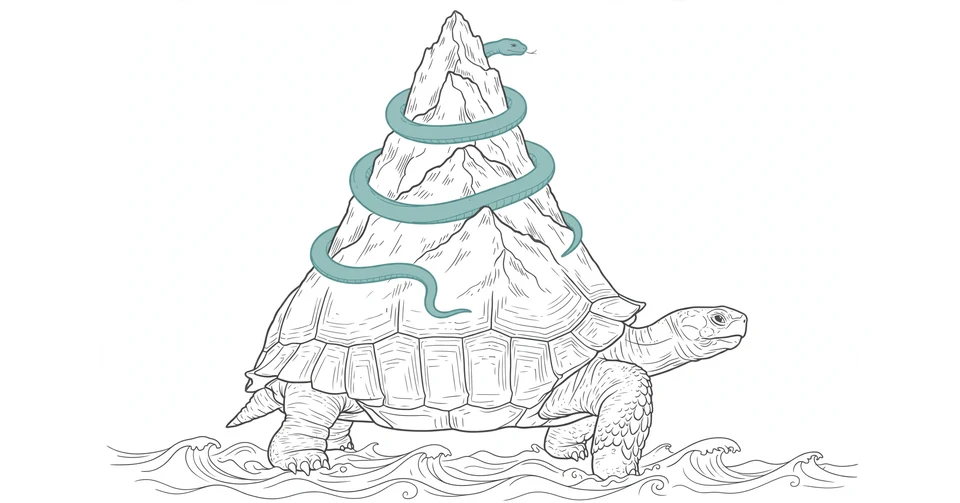
What went wrong is the interesting part. A mountain does not float. The moment the churners set Mount Mandara into the sea, it began to sink, and the whole enterprise was about to drown before it started. Vishnu, who had suggested the churning in the first place, solved the problem by becoming the foundation himself. He took the form of Kurma, a great tortoise, and let the mountain rest on his shell. I have always liked that detail more than any other in the story. The god does not arrive with thunder. He arrives as the slowest animal in the story, and he does the hardest job.
The curse that started the churning
Every version of the story begins with a loss. In the account given in the Agni Purana, the sage Durvasa cursed the gods, and the devas lost their strength. Weakened, they were defeated by the asuras in battle and went to Vishnu for refuge. Vishnu told them what to do. They would have to recover amrita, the nectar of immortality, and the only way to get it was to churn the ocean of milk.
The catch was that neither side could do it alone. The gods were too weak, and the demons were too few in skill for the task, or so the story implies. So the two enemies made a truce. They would churn together and share whatever came up. It is a strange piece of diplomacy, and it sets the tone for everything that follows. The greatest treasures in the universe would come out of a joint venture between rivals.
The gods chose Mount Mandara as the churning rod. They chose Vasuki, the king of serpents, as the rope. The plan was to wrap the serpent around the mountain and pull from both ends, spinning the mountain in the ocean until the nectar rose. It was a plan that needed three things to work: a mountain, a rope, and something solid underneath. The first two were easy to find. The third was the problem.
Kurma and the mountain that would not stay up
The mountain sank. That is the crisis at the heart of the story, and the texts agree on it even when they disagree about everything else. In the Mahabharata, the oldest version of the tale, the gods approach Kurma-raja, the king of tortoises, and ask him to support the mountain on his back. He consents. In a passage of the Ramayana, the mountain sinks down to Patala, the underworld, and Vishnu himself takes the form of the tortoise and raises it on his back. In the Bhagavata Purana, Vishnu appears as Ajita, the son of Vairaja and Sambhuti, and assumes the form of the tortoise to rescue Mandara from drowning.
The details change from text to text, and that is worth saying plainly. In some tellings Kurma is a tortoise king who agrees to help. In others he is Vishnu himself in tortoise form. In the Vishnu Purana, Vishnu takes part in many forms at once: Kurma as the base of the mountain, another form sitting on top of Mandara, and still other forms helping the gods and the demons pull the rope. The storytellers were not confused. They were describing a god who could be in several places at once, and a tortoise who could be both a creature and a god.
What never changes is the job. The mountain needs a floor, and the tortoise is the floor. Without Kurma, the churning cannot begin. With him, it can go on for ages. The Bhagavata Purana even adds a gentle detail: the tides of the ocean are the breathing of Kurma, who had grown drowsy because the mountain kept scratching his back as it turned. It is a small, almost domestic image, and it makes the cosmic scale of the story feel close. The tortoise is not only holding up the world. He is falling asleep under it.
I think that is why Kurma has lasted so long in the imagination. Most gods in most stories do their work with weapons or with words. Kurma does his work by staying put. His shell is the one thing in the story that does not move, and everything else depends on it.
The rope, the pullers and the poison
With the mountain steady on the back of Kurma, the churning could begin. Vasuki, the great serpent, was wound around Mount Mandara, and the two sides took their ends. In the Mahabharata version, the gods pulled from the tail side of the serpent and the asuras from the head side. Trees and herbs were cast into the ocean, and the churned water turned to milk. Then the treasures began to rise, one after another.
The lists differ between texts, and the common count runs to fourteen treasures. The poison Halahala came up first, and it threatened to destroy everything, so Shiva drank it to save the world, and his throat turned blue. Then came the goddess Lakshmi, the white elephant Airavata, the white horse Uchchaihshravas, the jewel Kaustubha, the cow of plenty Surabhi, the apsaras, the goddess of wine Varuni, and finally Dhanvantari, the divine physician, carrying the bowl of amrita.
The nectar was the whole point, and it nearly wrecked the truce. The asuras seized the bowl, and Vishnu took the form of the enchantress Mohini to take it back and give it only to the gods. Rahu, an asura, disguised himself as a god and drank some of the nectar, and Vishnu cut off his head with his discus, leaving the head immortal. The gods kept the amrita in the end, and Indra retained it with Nara as its guardian.
It is worth pausing on the rope itself, because Vasuki is not a minor prop. The serpent had to be strong enough to survive being pulled by two armies, and the story gives him a central role. The full tale of the serpent is told in the article about Vasuki, the rope that churned the ocean of milk, and it is worth reading alongside this one, because the rope and the tortoise are a pair. One pulls, the other holds. Neither works without the other.
The same is true of the whole episode, which is told at greater length in the article about Samudra Manthana, the churning that found the water of life. The churning is not a single story but a family of stories, told in the Mahabharata, the Ramayana, and the Puranas, each with its own order of treasures and its own emphasis. The tortoise is the one constant in all of them.
Second after the fish
Kurma is the second avatar in the Dashavatara, the ten principal incarnations of Vishnu. He comes after Matsya, the fish, and before Varaha, the boar. The sequence is often read as a story of life climbing out of the water: first a fish, then an amphibian that lives in water and on land, then a land animal. The tortoise is the hinge of that story, the creature that belongs to two worlds at once.
The roots of Kurma go back further than the Dashavatara lists. The earliest text to mention the tortoise is the Shatapatha Brahmana, attached to the Yajurveda, where the name Kurma is equated with Prajapati, the creator, and with Kashyapa, one of the seven great sages. In the Vedic imagination, the tortoise was already a creator figure. Prajapati takes the form of Kurma to create all creatures, and since he made them all, the form was called Kurma, from the root kar, to make.
The name Akupara, the world turtle, carries the same idea in another form. In the Brahmana texts, Akupara Kashyapa is described as a firm standing, the ground that lets beings cross the sea of material existence. The tortoise is not just an animal. It is the idea of solid ground itself, the thing you can stand on when everything around you is water.
That symbolism runs through the later literature as well. The tortoise was buried at the base of the sacrificial fire altar in Vedic ritual, and scholars have read that as a sign that the tortoise stood for the hidden god of sacrifice, present from the altar up to heaven. The tortoise draws in its limbs, and the texts use that as an image for withdrawing the senses and turning inward. Firmness, steadiness, patience: these are the qualities the tortoise carries, and they are the qualities the story of Kurma is really about.
A purana named after a tortoise
Few characters in Hindu literature get a whole scripture named after them. Kurma is one of them. The Kurma Purana is one of the eighteen major Puranas, and one of only four Puranas that bear the names of Vishnu's avatars. It is said to be narrated by Kurma himself, speaking to King Indradyumna, and later to the sages and the gods at the time of the Samudra Manthana.
Here is a curious detail. The detailed tale of the churning is absent from the Kurma Purana. The text only alludes to Kurma as the one who supported Mount Mandara. The scripture named after the tortoise does not retell his most famous deed at length. It assumes the reader already knows it, and moves on to other things. That tells us something about how well known the story already was when the Purana was composed. The tortoise needed no introduction.
Kurma is still worshipped. His festival, Kurma Jayanti, marks the day Vishnu is said to have taken the tortoise form. There is a temple dedicated to him at Sri Kurmam in Srikakulam, in Andhra Pradesh, where a sculpture of the Kurma avatar stands in the Kurmanatha temple. An old stone image of the tortoise incarnation survives from Garhwa in the Prayagraj district, carved centuries ago and still recognisable as the same figure: a tortoise, carrying more than its own weight.
The Agni Purana even prescribes how Kurma should be shown in art: in zoomorphic form, as a tortoise, not as a man with a tortoise shell. That rule matters, because it keeps the avatar honest. Kurma is not a man dressed as a turtle. He is a turtle, and the story asks us to take the turtle seriously.
Kurma carved in stone
The most famous image of Kurma in the world is not in India. It is in Cambodia, on the wall of Angkor Wat. The Churning of the Ocean of Milk is carved along the southern wing of the eastern gallery of the third enclosure, a relief more than forty-eight metres long. It shows the whole story at once: ninety-two asuras pulling on one side, eighty-eight devas on the other, Vasuki wound around Mount Mandara, and Vishnu at the centre in four-armed form, directing the work.
Kurma is at the very base of the pivot, small against the mountain, holding it on his shell. A close reading of the relief shows how carefully the sculptors placed him. Vishnu appears twice, once above as the director and once below as the tortoise, and the tortoise is the one doing the physical work. The centre of the carving, where the treasures would emerge, was left unfinished, and scholars have noted that the work seems to have stopped around the time of the death of King Suryavarman II, who built the temple. The churning, in stone as in story, is never quite finished.
The relief is also a piece of architecture with a purpose beyond decoration. In Hindu ritual building, the tortoise occupies the lowest layer of the altar, anchoring the cosmos. Across Cambodia, metal tortoises were buried in temple foundations to mark the centre of consecration. Kurma is not only a character in a story. He is a building principle: nothing stands unless something below it holds still.
That is why the scene keeps being carved, in stone and in wood, across South and Southeast Asia. The composition is always the same, because it has to be. A mountain in the middle, a serpent wrapped around it, two lines of pullers, and a tortoise underneath. Change any one part and the story falls apart. The tortoise is the least glamorous figure in the carving, and the whole carving depends on him.
What the tortoise still teaches
I have been thinking about why this story has survived for so long, and I keep coming back to the tortoise himself. Most myths about saving the world are about speed, strength, or cleverness. The hero arrives fast, hits hard, or outwits the enemy. Kurma does none of those things. He arrives slowly, he does not fight, and he does not speak much. He puts himself underneath the problem and stays there.
That is a strange kind of heroism, and it feels closer to ordinary life than most heroic stories do. Most of the important work in a life is not dramatic. It is holding things steady while other people pull in opposite directions. It is being the floor when the floor is the only thing missing. It is the parent who keeps a household running, the friend who listens without fixing, the worker who does the unglamorous job that lets everyone else do theirs. None of that makes a good statue, and all of it is the tortoise.
The texts seem to know this. They give the tortoise the symbolism of withdrawing the senses, drawing the limbs in, finding steadiness inside rather than chasing it outside. The Narada Purana uses the image of the tortoise pulling in its limbs as an allegory for gathering the senses and turning them inward. It is a quiet teaching, and it fits the animal. A tortoise cannot run from danger. It can only go still, and wait, and endure.
There is also something generous about Kurma. He helps both sides. The gods and the demons are pulling against each other, and the tortoise holds the mountain for both of them. He does not choose a side. He makes the work possible, and lets the outcome sort itself out. In a story full of trickery and theft, the tortoise is the one figure who is never accused of cheating. He simply holds.
The mountain is still there, in the story and on the temple wall. The serpent is still wrapped around it. The two lines of pullers are still pulling. And underneath it all, the tortoise is still holding, patient as ever, asking for nothing except to be left in place. That is the whole of the story, and it is enough.
More in Culture & Society
Latest posts
- Soba, the Buckwheat Noodles Japan Slurps on the Last Night of the Year
- Udon in Kagawa, Where Noodles Are a Way of Life
- The Pawukon Calendar Runs Bali on 210 Days
- Purnama Is the Full Moon Bali Prays By
- Galungan Welcomes the Ancestors Back to Bali
- Jatayu Flew at Ravana to Save Sita
- Yoshino Is the Mountain Shugendo Calls Home
- A Gomagi Carries Your Wish Into the Goma Fire
- Danjo Garan Is Where Koyasan's Teaching Began
- The Banryutei Turns Two Dragons Into a Rock Garden
- A Gongyo Starts the Temple Day Before Sunrise
- Shojin Ryori Is the Temple Food That Eats Like a Prayer
- Depachika and the Basement Food Halls Beneath Japan's Department Stores
- Yakitori and the Smoky Alleys Where Tokyo Learned to Love Chicken Skewers
- Okonomiyaki and the Savory Pancake Japan Cooks at the Table