Garuda Wisnu Kencana Rises Above Bali's Southern Cliffs
· 13 min read
Garuda Wisnu Kencana is a 121 metre statue of Vishnu riding Garuda on the Bukit Peninsula in southern Bali, and it took 28 years to finish.
You can see it long before you reach it. Driving south from Kuta toward the Bukit Peninsula, a shape appears on the ridge ahead, wings spread wide against the sky. It is not a temple roof or a hill. It is Garuda Wisnu Kencana, a statue of the god Vishnu riding the great bird Garuda, and it rises about 121 metres from the base of its pedestal to the tip of the wings.
That height makes Garuda Wisnu Kencana the tallest statue of a Hindu deity in the world and the tallest statue in Indonesia. The statue itself is about 75 metres tall and 65 metres wide, and it sits on a 46 metre pedestal. It weighs about 4,000 tonnes. It stands in Garuda Wisnu Kencana Cultural Park at Ungasan, on the limestone cliffs of southern Bali, and on a clear day you can spot it from beaches, roads, and rooftops across the peninsula.
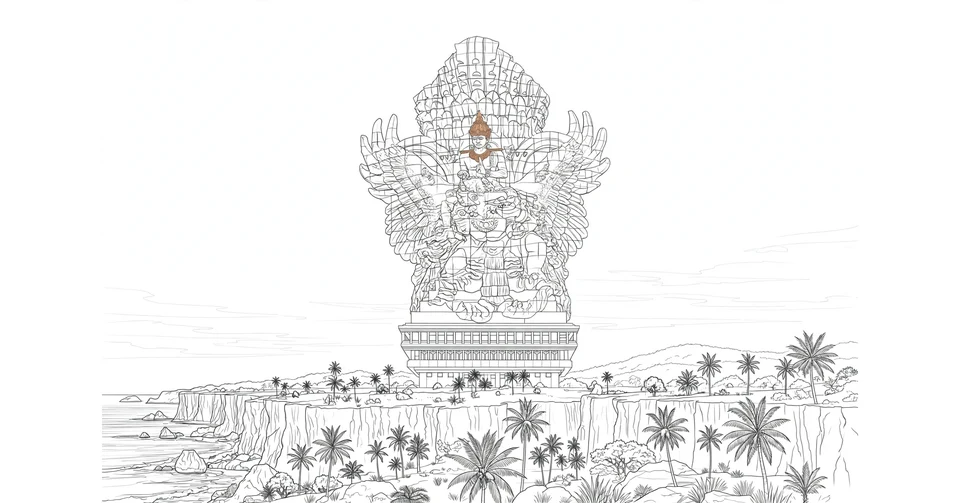
The first thing to know is that this is not an ancient monument. Garuda Wisnu Kencana was designed by the Balinese sculptor Nyoman Nuarta, and it was completed on 31 July 2018 and inaugurated by President Joko Widodo on 22 September 2018. The idea took 28 years from design to completion, with a long halt in the middle. That slow history is part of what makes the finished statue worth a visit. It is a modern work carrying a very old story, and it shows.
The myth behind Garuda Wisnu Kencana
The statue shows a moment from Hindu myth, the moment Garuda agreed to carry Vishnu. Garuda needed the amrita, the elixir of life, to free his mother Vinata from slavery to the serpent queen Kadru and her children. He flew to heaven, broke through the guards of Indra, and seized the pot of nectar. He did not drink a drop of it. He carried it home untouched, set it down on kusha grass, and told the serpents to bathe before drinking. While they bathed, Vishnu reclaimed the amrita for the gods.
Vishnu, struck by a being who could hold immortality and not drink it, offered Garuda boons. Garuda asked to be immortal without the nectar and to fly above Vishnu himself. Vishnu granted both, and Garuda offered himself in return as Vishnu's vahana, his mount and vehicle. That is the bargain Garuda Wisnu Kencana freezes in copper and brass: the bird carries the god, and the god rides higher than the bird only because the bird allows it.
Garuda had already proved his strength in an earlier story. When the gods and demons churned the ocean of milk to find the nectar, they used Mount Mandara as the churning rod and the great serpent Vasuki as the rope. The mountain was so heavy that the carriers collapsed under it on the way to the sea. Vishnu arrived on Garuda, revived the fallen carriers, and then Garuda lifted the mountain himself and flew it to the middle of the ocean. That flight is told in full in our article on how Garuda carried a mountain to the middle of the ocean, and it is the same strength the statue celebrates. A bird carried a mountain. Carrying a god was the easy part.
I find the choice of this moment for Garuda Wisnu Kencana quietly wise. The sculptor could have shown Garuda stealing the nectar, which is the most dramatic scene in his story. He could have shown the bird fighting serpents, which is his oldest enmity. Instead he chose the calm after the bargain, the bird at rest with the god on his back. Strength shown at rest is harder to carve than strength shown in battle, and it says more about the character. This is not a bird boasting. It is a bird keeping a promise.
A statue that took 28 years to finish
Garuda Wisnu Kencana was designed in 1990 by Nyoman Nuarta, under the then tourism minister Joop Ave, energy minister Ida Bagus Sudjana, and governor of Bali Ida Bagus Oka. The groundbreaking took place in 1997. Then the project stopped. The Asian financial crisis of the late 1990s halted construction, and for years only separate pieces stood around the park: the head and torso of Vishnu, the head of Garuda, and the hands of Vishnu, waiting for a project that might never resume.
Construction resumed in 2013, after a sixteen year pause, when the property developer PT Alam Sutera Realty agreed to finance the work. The statue was assembled in Bali from 754 discrete modules built in Bandung, West Java, and transported to the site. The modules were cut into 1,500 smaller pieces to fit the maximum load of the cranes. The last piece placed was at the tail, which sits at the highest point of the artwork. The completed monument was finished on 31 July 2018, and the inauguration followed on 22 September 2018.
The long pause explains something about Garuda Wisnu Kencana that a visitor might otherwise miss. Garuda Wisnu Kencana is not the product of one confident decade. It survived a financial crisis, a change of funders, and sixteen years of silence. Plenty of grand projects die in a pause like that. This one came back, which is why the finished work feels less like a boast and more like a debt finally paid. Bali waited a generation for its bird to fly, and then it did.
The idea behind Garuda Wisnu Kencana was not without controversy. Religious authorities on the island complained that its massive size might disrupt the spiritual balance of Bali, and that its commercial nature was inappropriate for a sacred image. Others argued that it would attract tourism and give the island a landmark of its own. Both sides had a point, and the argument has never quite ended. A statue this large cannot be neutral. It changes the skyline of a whole peninsula, and anyone who lives under it has a right to an opinion about that.
How big Garuda Wisnu Kencana really is
Numbers help, because the eye struggles with Garuda Wisnu Kencana. The total height of the monument, including the 46 metre pedestal, is about 121 metres, which is nearly 30 metres taller than the Statue of Liberty in the United States. One source lists the total as 122 metres, so the honest figure is about 121 metres, with a metre of disagreement between sources. The completed monument is about as tall as a 21 story building. The statue itself is about 75 metres tall and 65 metres wide, and the outer covering measures about 22,000 square metres.
The weight is harder to picture. At about 4,000 tonnes, Garuda Wisnu Kencana is the heaviest statue in Indonesia. The crown of Vishnu is covered with golden mosaics, and the statue has its own dedicated lighting arrangement, so it glows after dark. The structure is made of copper and brass sheeting over a steel frame, with a steel and concrete core column, and it was designed to withstand storms and earthquakes and to last for the next 100 years.
The engineering of Garuda Wisnu Kencana is worth a pause. Garuda's shape is so complex that engineers designed special joints in the supporting structure, with up to 11 enormous steel girders coming together at a single point, where normal construction joints have four or six girders. That detail tells you something the smooth copper skin hides. The bird looks like one flowing form, but inside it is a puzzle of steel, solved piece by piece across 754 modules. Beauty at this scale is mostly engineering that you never see.
Standing underneath Garuda Wisnu Kencana, the scale does something the myth alone cannot do. In the story, a bird carried a mountain. At the park, a bird carries a god, and the bird is the larger of the two. His wings spread wider than the figure he carries, and his body forms the base of the whole structure. The vehicle is the monument. That is not how most religious art works. Usually the god is the largest thing in the frame. Here the bird who carries the god is the frame itself.
What to see inside Garuda Wisnu Kencana Cultural Park
The statue stands inside Garuda Wisnu Kencana Cultural Park, a large cultural park on the Bukit Peninsula that treats the statue as its centrepiece rather than its only attraction. The park's own site presents it as a place for cultural performances, views from inside the statue, and events, and the map of the grounds lists plazas, an amphitheatre, a street theatre, a lotus pond, a festival park, and restaurants. You can read the current programme and ticket options on the official GWK Cultural Park site.
One of the main draws is the Top of the Statue experience, which takes visitors up inside the monument for a view over the peninsula. The park also hosts regular cultural performances in the amphitheatre and on the street theatre stage, and the open plazas fill with events through the year. The separate statues of Wisnu and Garuda that stood around the grounds during the long construction years are part of the park's landscape too, reminders of the time when the monument existed only in pieces.
A good visit to Garuda Wisnu Kencana needs no fixed route. Walk the plazas first, look up at the statue from different angles, then go inside if the Top of the Statue tour is running. The view from the base changes with every few steps. From the front, Vishnu dominates. From the side, the wings take over. From behind, the tail rises like a separate sculpture. I think the side view is the best of them, because it shows the bargain most clearly: the god seated calmly, the bird doing the work underneath him.
Come to Garuda Wisnu Kencana in the late afternoon if you can. The copper and brass catch the low sun, the crowds thin as the day cools, and the lighting arrangement takes over as the sky darkens. A statue built to last a century deserves more than a hurried photograph from a car window. Give it an hour, and let the scale settle in slowly.
Why the same bird also carries a nation
Garuda does not belong only to Bali or only to myth. The same bird stands on the national emblem of Indonesia, Garuda Pancasila, with a shield on its chest and a scroll in its talons. That emblem was designed by Sultan Hamid II from Pontianak, supervised by Sukarno, and adopted on 11 February 1950. Its shield carries five emblems for Pancasila, the five principles of Indonesia's national ideology, and the bird grips a ribbon inscribed with the motto Bhinneka Tunggal Ika, Old Javanese for Unity in Diversity.
The link between Garuda Wisnu Kencana and the emblem is not a coincidence. Both show the same idea: strength placed in service of something larger than itself. The full story of the emblem, including the feather count that spells out 17 August 1945, is told in our article on how Garuda Pancasila carries five principles on one bird. Read it after this one, and Garuda Wisnu Kencana on the hill will look a little different. It is not only a Balinese landmark. It is a national bird, shown at the largest scale anyone has ever attempted.
There is a detail in the emblem story that belongs here too. The first version of Garuda Pancasila was bald, without a crest, and in March 1950 Sukarno ordered the palace artist Dullah to add the crest, reportedly because the bald bird looked too much like the bald eagle of the United States. Indonesia wanted its bird to be unmistakably its own. The statue at Ungasan makes the same point in a different way. Its crown is covered with golden mosaics, its wings are unmistakably Balinese in their carving, and no one who sees it could mistake it for a statue from anywhere else.
Visiting the cliffs of southern Bali
Garuda Wisnu Kencana stands at Ungasan, on the Bukit Peninsula, the dry limestone headland at the southern tip of Bali. The peninsula is a different Bali from the rice fields of Ubud or the streets of Kuta. It is drier, rockier, and more open to the sky, and its cliffs drop to some of the island's best known beaches. Garuda Wisnu Kencana works in that landscape because the landscape is already monumental. A bird this large would look crowded in a valley. On a ridge above the southern cliffs, it looks like it belongs.
Plan the visit as half a day rather than a quick stop. The park is large, the walk between plazas takes time, and the heat on the limestone is stronger than it looks from the car. Bring water, wear a hat, and expect to do a lot of looking up. If you are staying in the south, combine it with a beach on the same peninsula, and let the statue be the morning or the late afternoon rather than the middle of the day.
It is worth saying plainly that a visit to Garuda Wisnu Kencana is not a temple visit. Garuda Wisnu Kencana Cultural Park is a cultural park, not a place of worship, and the statue is a work of art and a landmark, not a shrine. That distinction matters, and it is part of why the place works for so many different visitors. You do not need to share the faith behind the myth to admire the work, but you will get more from it if you know the story first. The bird, the god, the nectar, and the mountain are all in the carving if you know where to look.
For the facts and figures on Garuda Wisnu Kencana in this article, the fullest single source is the Wikipedia page on the Garuda Wisnu Kencana statue, which records the dimensions, the construction history, and the inauguration dates used here. Where sources differ by a metre on the total height, this article uses the figure of about 121 metres given in the main text of that page and in our earlier article on Garuda, and notes the difference rather than hiding it.
The bird that waited 28 years
Garuda Wisnu Kencana is a statue of a promise kept twice over. In the myth, Garuda promised to carry Vishnu, and he kept that promise without drinking the nectar he had risked everything to steal. In Bali, a sculptor promised a statue, and the island kept that promise across 28 years, a financial crisis, and a sixteen year pause. Both promises took longer than anyone planned. Both were kept.
That is the thought to carry down from the hill. Big things are rarely finished quickly, and the things worth building are often the ones that survive being stopped. The bird on the ridge waited through years when only his head and his god's hands stood in the park, and he still rose. Garuda Wisnu Kencana is still there now, wings spread over the southern cliffs, carrying his god above a peninsula that can see him from almost everywhere. He carried a mountain once, and a nation carries his name still. The statue only makes visible what the story always said: the strongest creature in the tale is the one who carries, and never the one who is carried.
More in Food & Travel
- Lawar Is the Dish Bali Serves When the Whole Village Eats
- Goma Dofu Is the Forty Minute Tofu Ground by Hand
- Soba, the Buckwheat Noodles Japan Slurps on the Last Night of the Year
- Udon in Kagawa, Where Noodles Are a Way of Life
- Shojin Ryori Is the Temple Food That Eats Like a Prayer
- Depachika and the Basement Food Halls Beneath Japan's Department Stores
Latest posts
- Wuku Gives Every Week in Bali a Name
- A Penjor Turns a Whole Street Into an Offering
- A Mokugyo Keeps the Beat of the Chant
- Garuda Pancasila Carries Five Principles on One Bird
- Saptawara Is the Seven-Day Week Inside Every Weton
- Janur Is the Young Coconut Leaf Bali Folds Into Everything
- Petungan Counts Your Neptu Before You Choose a Day
- The Pawukon Calendar Runs Bali on 210 Days
- Purnama Is the Full Moon Bali Prays By
- Galungan Welcomes the Ancestors Back to Bali
- Jatayu Flew at Ravana to Save Sita
- Kurma Held Up a Mountain So the Ocean Could Be Churned
- Yoshino Is the Mountain Shugendo Calls Home
- A Gomagi Carries Your Wish Into the Goma Fire
- Danjo Garan Is Where Koyasan's Teaching Began