Udon in Kagawa, Where Noodles Are a Way of Life
· 10 min read
Udon is Japan's thickest comfort noodle, and nowhere takes it more seriously than Kagawa, the small prefecture that calls itself the Udon Prefecture.
Udon is the thick wheat noodle that Japan eats when it wants comfort without fuss. It is flour, salt, and water, cut square and served in a clear dashi broth, and in most of Japan it is an ordinary lunch. In Kagawa, the smallest prefecture in the country, udon is something else entirely. It is a point of pride, a daily habit, and a reason to travel, and the prefecture has even branded itself the Udon Prefecture.
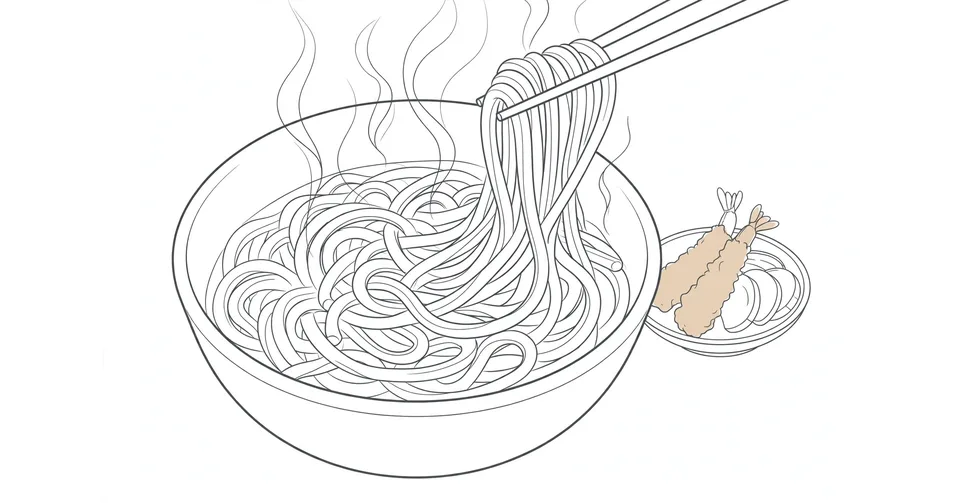
Kagawa sits on the northeastern corner of Shikoku, facing the Seto Inland Sea. Fewer than a million people live there, yet the prefecture holds roughly 600 to 800 noodle shops, and households in Kagawa eat about three times as much udon as the national average. A bowl often costs a few hundred yen, it arrives in minutes, and many locals eat it more than once a day. To understand the noodle, you have to start here, because Kagawa is where the noodle stopped being just food and became identity.
What makes udon different from other noodles
Udon is made from wheat flour, salt, and water, nothing more. The dough is kneaded, rested, rolled about three millimetres thick, and cut about three millimetres wide, so each strand comes out almost square in cross section, with clean, sharp edges. That square cut is part of what sets Sanuki udon, the Kagawa style, apart from thinner regional styles such as Inaniwa noodles from Akita or Mizusawa noodles from Gunma. Together, Sanuki, Inaniwa, and Mizusawa are known as the three great udon varieties of Japan.
The quality of a bowl is judged by three words. Hada means the smooth, almost skin-like surface of the noodle. Tsuya means its shine. Koshi means the firm, springy resistance at the centre of each strand when you bite into it. A good bowl should be soft on the outside and firm inside, glossy, and slippery enough to slide, but with enough bite to make you notice it.
The broth matters just as much. In Kagawa, the dashi is usually made with iriko, dried sardines caught in the Seto Inland Sea, which gives the soup a light, savoury depth. The toppings stay simple. Sliced green onion, grated ginger, a piece of tempura, or a soft egg are the usual companions. Nothing about the noodle shouts. Its pleasure is quiet, which is probably why it has lasted so long.
The monk who may have brought udon home
The most loved origin story for the noodle stars Kukai, the Buddhist monk also known as Kobo Daishi. Kukai was born in Sanuki, the old name for Kagawa, and he studied in Tang dynasty China in the early 800s. According to the legend, he returned around the year 806 or 807 with wheat know-how and a boiled flour dumpling that, over the centuries, became udon. The word itself is said to have shifted from konton to unton and finally to udon, though that is a story rather than a proven fact.
Historians cannot confirm the legend, and they do not need to. The firmer evidence comes later. A folding screen painting from about 300 years ago, depicting a festival at Kotohira Shrine, already shows noodle shops doing business along the road to the shrine. During the Edo period, visiting Kotohira Shrine became a popular pilgrimage, known as Kompira-mairi, and travellers needed cheap, filling food. The noodle was ready for them.
Kagawa itself helped. The prefecture has a warm, dry climate, and its soil and rainfall made rice unreliable in some years, so wheat filled the gap. Farm families turned that wheat into noodles and served it on special days. After the war, small noodle factories and self-service shops spread across the prefecture, and a nationwide Sanuki boom followed in the 1990s and 2000s, fuelled by guidebooks and road-trip culture. In 2007, the national government selected the Sanuki noodle among its 100 great regional dishes. In 2011, the prefectural government leaned into the joke and launched a tourism campaign branding Kagawa the Udon Prefecture, and the name stuck.
How a bowl of udon is actually made
Making the noodle looks simple, and that is the trap. With only three ingredients, there is nowhere to hide, so the technique carries the whole dish. The dough is kneaded from wheat flour with salt dissolved in water, and the amount of salt is adjusted by season, a little more in summer and a little less in winter.
Then comes the part that surprises first-time visitors. The dough is kneaded further using the feet. The maker steps on the dough, folds it, and steps again, in three treading sessions of about five, five, and three minutes. The pressure of a human body does what hands alone cannot, pressing the dough evenly and building the gluten structure that gives the noodle its koshi. After treading, the dough rests, then it is rolled and cut, and the noodles are boiled for about 15 minutes.
The Kagawa prefectural government even developed its own wheat variety, called Sanuki no Yume, bred for the noodle. Under the noodle industry labelling code, a product that claims the Sanuki name as a famous local specialty must be made in Kagawa, handmade or handmade-style, with at least 40 percent water and 3 percent salt by flour weight, rested for two hours, and boiled for about 15 minutes. The rules sound fussy, but they protect a taste that locals can recognise blindfolded.
For a deeper look at how a noodle can carry a whole food culture, the story of instant noodles shows what happened when Japan turned a humble bowl into a global industry. The noodle went the opposite way. It stayed local, stubbornly handmade, and that is exactly why people travel for it.
The many ways to eat udon
Part of the pleasure of the noodle is how many forms it can take. The basic choice is hot or cold, and in Kagawa both are taken seriously.
Kake udon is the simplest bowl, noodles in hot dashi with green onion, and it is the baseline against which every shop is judged. Bukkake udon pours a small amount of concentrated broth over the noodles with toppings, rather than drowning them in soup. Kama-age udon serves the noodles straight from the boiling pot, hot and unsauced, with a dipping broth on the side. Zaru udon serves them cold on a bamboo tray with a chilled dipping sauce, a summer favourite. Curry udon, a relative of the Japanese curry that became a national comfort food, pours a thick curry soup over the noodles instead of dashi.
Then there is the self-service system, which is a Kagawa institution in itself. In many shops, you take a tray, tell the cook how many balls of noodle you want, watch them boil, pour your own broth from a tap or a pot, and pick tempura from a counter. The whole meal can cost less than a coffee in Tokyo, and the line moves fast because everyone knows the routine. First-timers should watch the person ahead of them for thirty seconds. The system explains itself.
Slurping is not rude here. It cools the noodles, pulls in air that carries the aroma of the dashi, and signals enjoyment. A quiet bowl is a wasted bowl, and nobody in Kagawa will mind the noise.
Why udon stayed local while ramen went global
The noodle and ramen make an interesting pair. Ramen, as told in the story of the history of ramen, came from China, adapted fast, and spread around the world with endless regional variations. The noodle took the opposite path. It is older in Japan, simpler in construction, and far less exportable, because its quality depends on fresh dough, short boiling times, and a broth made that morning.
That is not a failure. It is the reason a trip to Kagawa feels like a pilgrimage. You cannot get the real thing from a packet, and even the best frozen version is a memory of the fresh noodle, not the noodle itself. The shops that matter most are often the plainest: a counter, a pot, a line of regulars, and a cook who has been stepping on dough for decades. The prefecture counts more than 700 noodle restaurants by some estimates, and in 2009 it produced 59,643 tons of the noodle, first in Japan and more than double the second-place prefecture.
I find something reassuring in that stubbornness. In a food world that rewards scale, franchising, and export, Kagawa chose to stay small and do one thing properly. The noodle does not need to conquer the world. It only needs to be good at noon, every day, for the people who live there, and for the visitors who make the trip to find out why.
Planning an udon trip to Kagawa
Kagawa rewards a slow visit, and the noodle is the excuse to take it slowly. Takamatsu, the prefectural capital, is the natural base, with the most shops in walking distance, and the Shikoku pilgrimage route passes through the prefecture, so a noodle stop fits easily into a longer walk.
A practical approach is to plan two or three bowls a day, not five. The noodle is filling, and the differences between shops are subtle, which means your palate needs rest between tastings. Try a plain kake udon first at each shop, before moving to topped or cold versions, because the plain bowl tells you everything about the noodle itself. Ask for a small size if you want to sample more than one shop, since many places sell half portions.
Cash helps. Many of the best shops are small, family-run places that do not take cards, and a bowl plus tempura rarely costs more than 600 or 700 yen. Go early, because popular shops sell out of noodles and close when the dough runs out, sometimes by early afternoon. And if you visit in summer, try a cold zaru udon at least once. The firm chew of a chilled noodle is the clearest demonstration of koshi you will ever taste.
Beyond the noodle itself, Kagawa has plenty to fill the hours between bowls. Kotohira Shrine, the place where the pilgrimage crowds first made udon famous, still draws visitors up its long stone stairway. The Seto Inland Sea coastline offers quiet islands and ferry rides, and Takamatsu Castle sits near the station with its seawater moat. A noodle trip is really a Kagawa trip, with noodles as the map.
What a bowl of udon teaches
There is a temptation to treat simple food as lesser food, as if complexity were the measure of worth. The noodle argues the opposite. Three ingredients, a pair of feet, a pot of water, and a bowl of broth, repeated thousands of times a day for centuries, add up to a culture that a whole prefecture is proud to be named after.
The lesson is not really about noodles. It is about paying attention to something small until you can tell the difference between good and great, and then refusing to cut corners even when nobody would notice. Kagawa noticed. It built an identity on that refusal, one bowl at a time, and it invites anyone who is curious to come and taste the difference.
So the next time a bowl arrives, steaming, square-cut, and glossy, take a moment before the first slurp. You are eating one of the oldest foods in Japan, made the way it was made a thousand years ago, in a prefecture that never stopped believing it mattered. That is a lot to fit into a bowl, and somehow, it fits.
More in Food & Travel
- Soba, the Buckwheat Noodles Japan Slurps on the Last Night of the Year
- Shojin Ryori Is the Temple Food That Eats Like a Prayer
- Depachika and the Basement Food Halls Beneath Japan's Department Stores
- Yakitori and the Smoky Alleys Where Tokyo Learned to Love Chicken Skewers
- Okonomiyaki and the Savory Pancake Japan Cooks at the Table
- Takoyaki and the Ninety-Year-Old Shop That Still Serves the Original
Latest posts
- A Penjor Turns a Whole Street Into an Offering
- A Mokugyo Keeps the Beat of the Chant
- Garuda Pancasila Carries Five Principles on One Bird
- Saptawara Is the Seven-Day Week Inside Every Weton
- Janur Is the Young Coconut Leaf Bali Folds Into Everything
- Petungan Counts Your Neptu Before You Choose a Day
- The Pawukon Calendar Runs Bali on 210 Days
- Purnama Is the Full Moon Bali Prays By
- Galungan Welcomes the Ancestors Back to Bali
- Jatayu Flew at Ravana to Save Sita
- Kurma Held Up a Mountain So the Ocean Could Be Churned
- Yoshino Is the Mountain Shugendo Calls Home
- A Gomagi Carries Your Wish Into the Goma Fire
- Danjo Garan Is Where Koyasan's Teaching Began
- The Banryutei Turns Two Dragons Into a Rock Garden