A Gongyo Starts the Temple Day Before Sunrise
· 13 min read
A gongyo is the morning service that opens the day in a Japanese Buddhist temple, a mix of chanting, bells and a wooden drum that starts before most of Japan wakes up.
Most of Japan is still asleep when a temple hall fills with sound. A bell, a drum, and then voices rising together in a slow, steady chant. The service is called a gongyo, and it is how a Japanese Buddhist temple starts its day, long before the first visitor arrives at the gate.
A gongyo is the formal morning liturgy of a temple. Monks gather in the main hall while the sky is still dark, light incense, and chant sutras in unison. It usually lasts less than an hour, and when it ends, the temple moves on to breakfast, cleaning, study, and the rest of the day. The chanting is the first task, not a break from work.
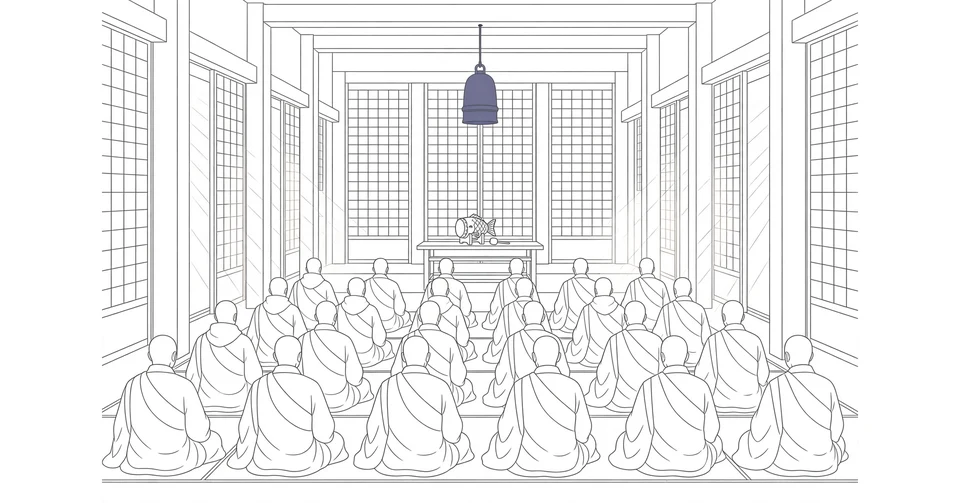
What I like about a gongyo is how unhurried it is. Nothing in it tries to be impressive. The drum keeps one steady beat, the chanting follows it, and the whole hall seems to breathe at the same pace. It is a small daily discipline, and that is exactly what makes it worth knowing about.
What gongyo actually means
The Japanese word gongyo literally means to exert oneself in practice, or assiduous practice. That is a useful definition, because a gongyo is exactly that: a set form of practice, done on purpose, at a set time, every day. It is not a spontaneous prayer. It is a service with a fixed shape, and the shape is what carries the monks through the dark hours of the morning.
In general terms, a gongyo is a formalized service built from the recitation of sutra passages, a mantra, or a combination of the two. It is performed once or more times a day, at a temple or at home, almost always in front of an object of veneration, and accompanied by offerings of light, incense, and food. It is also sometimes called otsutome, a word that simply means the service or the duty. None of these words belongs to one school alone. They are ordinary Japanese words, and nearly every Buddhist denomination in Japan uses one of them.
The important thing to understand is that a gongyo does not have one fixed text. What is chanted depends on the school. In a Zen temple, the morning service usually centers on the Heart Sutra. In a Nichiren temple, it centers on two chapters of the Lotus Sutra. In a Pure Land temple of the Jodo Shinshu school, it centers on the Shoshinge and the recitation of the Buddha's name. The word stays the same while the contents change. That is the first thing a visitor should know: when someone says gongyo, they are naming a time and a shape, not a single script.
The second thing to know is that a gongyo is not a performance. There is no audience in the ordinary sense. The monks chant whether or not anyone is listening, and the service would happen the same way on a morning when no guest is present. That is why it feels so different from a ceremony staged for tourists. A gongyo is the temple talking to itself, in the way it has talked to itself for centuries.
The sounds that keep the chanting together
A gongyo is held together by sound as much as by words. At Zen Mountain Monastery in New York, the formal morning liturgy begins at the end of the seated meditation period. The officiant enters the hall, offers incense to the Buddha and to the awakened nature of all beings, and the community makes three prostrations together. Then they chant the Heart Sutra and the Sho Sai Myo Kichijo Dharani, dedicate the merit of the service to their lineage of teachers and to sick friends of the monastery, and close with three more prostrations and a formal exit by the officiant. The whole thing is a sequence of sounds and movements, each one in its place.
The instruments do most of the keeping time. The best known is the mokugyo, a wooden drum carved to resemble a fish holding a pearl in its mouth. It is struck gently but firmly with a padded mallet, usually with a downbeat on each syllable of the chant, and its muted, earthy thud keeps the chanting solid and grounded. The fish is not a decoration. In Buddhist teaching, a fish never closes its eyes, so the drum is a reminder to stay awake, and its steady beat is the practical version of that reminder.
Next to it stands the kesu, also called the keisu or the kin, a large bronze gong cast in the shape of a begging bowl. Its deep, resounding peal initiates each chant and punctuates it at key moments. And in the hand of the officiant is the inkin, a small hand-held brass bell. Its bright, clear tone accompanies the entry of the officiant into the hall, signals the prostrations, and marks the beginning of a meditation period with three bells and the end with two. A detailed description of these instruments, written by a long-time Zen student, explains how each one is sounded and what each sound means in the course of a service, and it is worth reading for anyone who wants to understand what they are hearing in a temple hall. You can find it in this account of the living practice of liturgy.
Many temples also ring the bonsho, the large temple bell, to open the morning before the chanting starts. Its note is low and long, and it carries across the temple grounds and into the streets around them. By the time the chanting begins, the bell has already done its work: it has told everyone within earshot that the temple day has started, whether they are inside the hall or still in bed.
Taken together, the sounds of a gongyo form a kind of clock. The bell says the day has begun. The drum sets the pace. The gong marks the turning points. The small bell tells the body when to bow. A visitor does not need to know any of the words to follow what is happening. The sounds explain the service by themselves.
One word, many temples
The clearest way to see how flexible the word gongyo is, is to compare three schools.
In a Zen temple, the morning gongyo follows the seated meditation. The chanting is short and direct. The Heart Sutra, which takes only a few minutes to recite, is the center of it, and the instruments do most of the work of holding the group together. The point of the service is not to study the text. It is to sit, chant, bow, and then get on with the day.
In Nichiren Buddhism, gongyo has a different shape. Practitioners recite portions of two chapters of the Lotus Sutra, the Expedient Means chapter, which is the second chapter, and the Life Span chapter, which is the sixteenth, and they chant Nam-myoho-renge-kyo, the daimoku. The chanting of the daimoku is called the primary practice. The recitation of the sutra is called the supplementary practice. The two are done together, morning and evening, in front of the Gohonzon, the object of devotion. Nichiren himself recommended the two chapters but did not lay down a fixed format, and the format has changed over the centuries. For many years, the Soka Gakkai practiced a five and three prayers format, repeating the sutra recitation five times in the morning and three times in the evening. In September 2004, the format was revised to a single recitation of the two chapters with the chanting of Nam-myoho-renge-kyo, and in 2015 it was simplified again, so that the morning and evening formats became the same. The history of these changes is laid out in this explanation of what gongyo means in daily practice.
In the Jodo Shinshu Otani school, the morning gongyo follows yet another pattern. Practitioners put their palms together in gassho, make an act of adoration, chant the Buddha's name, and recite verses from a book of gongyo texts. The morning service includes the Shoshinge, a hymn written by the school's founder Shinran. It is also called otsutome, and its purpose, according to the school's teaching, is gratitude for the Buddha's grace, not the accumulation of merit. The service is an act of thanks, and the thanks are the point.
Three schools, three different texts, one word. That is why it is misleading to describe a gongyo as a single ceremony. It is better to think of it as a container. Each school fills it with its own words, but the container itself is the same: the same early hour, the same hall, the same daily repetition. The shared part is the discipline, not the text.
The 2:30 am service at the foot of Mount Fuji
If most gongyo services start before sunrise, one famous service starts in the middle of the night. The Ushitora Gongyo is held at 2:30 in the morning at Taisekiji, the head temple of Nichiren Shoshu, on the lower slopes of Mount Fuji in Fujinomiya, Shizuoka Prefecture. The name comes from the traditional Japanese time system. Ushitora is the stretch between the hour of the ox and the hour of the tiger, between 1 and 3 in the morning, and the service is timed to fall inside it.
The ceremony takes place in the Kyakuden, the Grand Reception Hall, and it is officiated by the High Priest of Nichiren Shoshu, or by a senior priest standing in for him. Taiko drums are beaten very loudly to open the solemn atmosphere. The High Priest is ushered in by six child priests carrying lanterns, and after the service he moves to a window that looks toward the hall where the Dai Gohonzon is kept, to give a short talk. It is one of the High Priest's first duties of the day. His working day, by this measure, begins at midnight.
The sect claims that this service has been observed without fail for more than 700 years, since the death anniversary of Nikko Shonin on 7 February 1333. That claim belongs to the sect, and it should be read as a statement of faith rather than a fact a historian could check. What is documented is that the timing has not always been 2:30. In the 1970s, the service was moved to between midnight and 1 in the morning at the request of the Soka Gakkai. After the Soka Gakkai was expelled in 1991, the 67th High Priest, Nikken Shonin, restored the original 2:30 time. Even inside a tradition that prizes unbroken continuity, the hour itself has been argued over.
The Ushitora Gongyo is the extreme end of the idea that a temple day starts before sunrise. Most temples are gentler. A service at 6 in the morning is early enough for most monks and most guests. But the 2:30 service makes the point in its sharpest form. For the monks at Taisekiji, the day does not begin when the sun comes up. It begins in the dark, hours before, and the sun catches up later.
What a guest hears at dawn in a shukubo
For most visitors, the closest they will come to a gongyo is a night in a temple lodging. About fifty temples on Mount Koya take guests, and the morning service is the heart of the stay. The town was founded by the monk Kukai in 816, and its head temple, Kongobuji, was built in 1593. The whole mountain has been a UNESCO World Heritage site since 2004, but the morning service has nothing to do with that status. It is simply what the monks do, and guests are invited to sit in on it.
The service usually starts between 6 and 7 in the morning, and the exact time depends on the temple and the season. At Eko-in, the service is at 7, followed by a goma fire ritual at 7:30. At Daiein-in, it starts at 5:50 in summer and 6:20 in winter. Other temples fall somewhere in between. Guests sit at the back of the main hall while the monks chant sutras by candlelight, and the only thing asked of them is to sit quietly. There is no need to chant, and no need to know the words. Breakfast follows the service, and checkout is usually around 10.
A night in a temple lodging changes the service from something you read about into something you wake up inside, and a shukubo lets you sleep inside a working temple in a way no ordinary hotel can match. The hall is cold in the early morning. The candles are the main light. The smell of incense is already in the air when you sit down. The chanting starts, the wooden drum sets the pace, and for half an hour the temple belongs to the sound. Then breakfast arrives, the sun comes over the mountain, and the day begins for everyone else. If you want to understand why the mountain draws people back, that half hour is a good place to start, and on Koyasan the founder is said to be still meditating in the forest cemetery a short walk from the hall.
It is worth saying plainly that a guest is a guest. The monks do not chant for the visitors, and the service would happen with or without them. That is part of what makes it worth attending. You are not watching a show. You are sitting at the edge of someone else's daily practice, and the politeness of the whole arrangement is that nobody asks you to do anything except be quiet and stay until it ends.
Why the morning matters
The point of a gongyo is not the early hour. It is the order of things. Practice comes first, and everything else follows. In Nichiren teaching, the morning service is described as starting the engine for the day, and the image is a good one. An engine that starts well runs well. An engine that starts badly spends the day catching up. The monks are not trying to be heroic by waking early. They are trying to start the engine properly, before the day has a chance to decide things for them.
I think about that when I think about my own mornings. Most of my days are decided by the first thing I reach for, and the first thing I reach for is usually a screen. A temple decides its first thing the night before, and it is always the same thing. The same hall, the same drum, the same words. There is something honest in that repetition. It does not promise a better day. It only promises a day that starts on purpose.
That is the quiet lesson of a gongyo. You do not need a temple to borrow its shape. One quiet, repeated act before the noise of the day is enough. A temple just does it with a drum, a bell, and a hall full of voices, before the sun has finished rising.
More in Culture & Society
Latest posts
- Soba, the Buckwheat Noodles Japan Slurps on the Last Night of the Year
- Udon in Kagawa, Where Noodles Are a Way of Life
- The Pawukon Calendar Runs Bali on 210 Days
- Purnama Is the Full Moon Bali Prays By
- Galungan Welcomes the Ancestors Back to Bali
- Jatayu Flew at Ravana to Save Sita
- Kurma Held Up a Mountain So the Ocean Could Be Churned
- Yoshino Is the Mountain Shugendo Calls Home
- A Gomagi Carries Your Wish Into the Goma Fire
- Danjo Garan Is Where Koyasan's Teaching Began
- The Banryutei Turns Two Dragons Into a Rock Garden
- Shojin Ryori Is the Temple Food That Eats Like a Prayer
- Depachika and the Basement Food Halls Beneath Japan's Department Stores
- Yakitori and the Smoky Alleys Where Tokyo Learned to Love Chicken Skewers
- Okonomiyaki and the Savory Pancake Japan Cooks at the Table