The Pawukon Calendar Runs Bali on 210 Days
· 19 min read
The pawukon is Bali's 210 day ritual calendar, ten weeks of different lengths turning at once, and it sets Galungan, Kuningan and most temple anniversaries. Here is how the ten weeks fit together and how to read a day in them.
Bali keeps two calendars at once. One follows the moon and counts the years. The other follows nothing in the sky at all. It is a fixed wheel of 210 days, and it is called the pawukon.
The pawukon is the calendar that decides when the island celebrates. Galungan falls on it. So does Kuningan, ten days later. So do the six Tumpek days, most temple anniversaries, and the birthday a Balinese person celebrates every 210 days. If you want to know why a village road is suddenly lined with tall bamboo penjor, or why the temple at the end of the street is full on a Tuesday, the answer is usually written in the pawukon.
It is also, by a long way, the strangest calendar I have ever tried to understand. It has ten weeks, not one, and they all turn at the same time. A single day can have ten different names, one from each week. And yet the whole thing is so regular that it can be carved into a board of wood and used forever, because it never needs adjusting. This is how the pawukon works, and how to read a day in it.
What the pawukon actually is
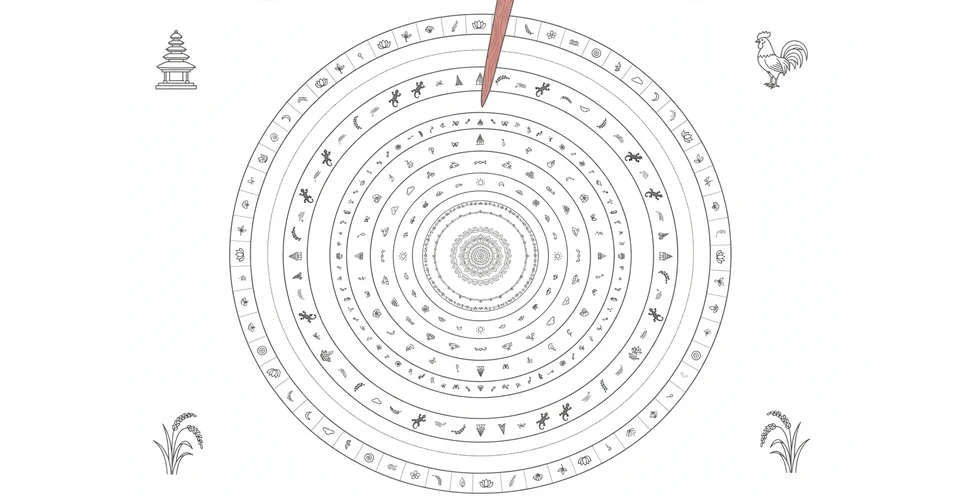
The pawukon is a 210 day cycle. When the 210 days are done, it starts again from the beginning, with no year number attached. The cycles are not numbered, so the pawukon has no epoch and no year count. It simply turns, and has turned for centuries.
That makes it different from almost every calendar a visitor knows. The Gregorian calendar counts the sun. The Saka calendar, Bali's other calendar, counts the moon. The pawukon counts neither. It is entirely rule based, a fixed pattern of weeks laid over one another, and because it has no relation to the sun or the moon it never drifts and never needs a leap day. A printed pawukon never goes out of date, which is why the old wooden boards that carry it, called tika, are still usable today.
The name comes from the wuku. The cycle is made of thirty seven day weeks, and each of those weeks has a name. The first is Sinta and the last is Watugunung, and the thirty weeks together add up to exactly 210 days. Pawukon is the name of the whole 210 day round.
To understand the pawukon, it helps to forget what a week is. In Bali, a week is not seven days. A week is a cycle of any length, and the pawukon has ten of them running side by side.
Ten weeks at once, and why 210 is the number
Inside the pawukon, ten weeks turn at once. There is a week of one day, a week of two days, a week of three, and so on up to a week of ten days. All ten start together on the first day of the cycle, and each one ticks forward at its own pace.
The number 210 is not an accident. It is the smallest number that all the week lengths can divide into, almost. It divides evenly by one, two, three, five, six, seven and ten. It does not divide by four, eight or nine, and that is the one wrinkle in the system. For the four, eight and nine day weeks, extra days are added at fixed points so that they still fit inside the 210 days. In the nine day week, for example, the first day is repeated three times in the first week of the cycle. In the four and eight day weeks, the second to last day is repeated in the week that would otherwise end on the 72nd day. It sounds fiddly, and it is, but the result is a pattern that repeats exactly, cycle after cycle, with nothing left over.
Each of the ten weeks has its own name and its own set of day names. Added together, the ten weeks hold 55 day names, and every day of the pawukon carries one name from each week, so a single date can be described in ten parts. In practice, only a few of the weeks matter in daily life, and the rest run quietly in the background, consulted when a priest or a calendar reader needs them.
| Week | Length | Day names |
|---|---|---|
| Ekawara | 1 day | Luang |
| Dwiwara | 2 days | Menga, Pepet |
| Triwara | 3 days | Pasah, Beteng, Kajeng |
| Caturwara | 4 days | Sri, Laba, Jaya, Menala |
| Pancawara | 5 days | Paing, Pon, Wage, Kliwon, Umanis |
| Sadwara | 6 days | Tungleh, Aryang, Urukung, Paniron, Was, Maulu |
| Saptawara | 7 days | Redite, Soma, Anggara, Buda, Wraspati, Sukra, Saniscara |
| Astawara | 8 days | Sri, Indra, Guru, Yama, Ludra, Brahma, Kala, Uma |
| Sangawara | 9 days | Dangu, Jangur, Gigis, Nohan, Ogan, Erangan, Urungan, Tulus, Dadi |
| Dasawara | 10 days | Sri, Pati, Raja, Manuh, Duka, Manusa, Raksasa, Suka, Dewa, Pandita |
Three of the ten weeks do most of the work. The seven day saptawara is the one closest to a familiar week, and its days run from Sunday to Saturday as Redite, Soma, Anggara, Buda, Wraspati, Sukra and Saniscara. The five day pancawara sets the market rhythm and the day names a visitor hears most often. The three day triwara, with its days Pasah, Beteng and Kajeng, marks the short cycle that villages once used for their markets. When two of these cycles meet, the day becomes special, and the pawukon is largely a machine for producing those meetings.
The ten week structure is what makes the pawukon feel so foreign at first, and it is also what makes it elegant once you see it. Nothing is observed and nothing is adjusted. The whole calendar is arithmetic, and arithmetic does not change.
The wuku give every week a name
The thirty seven day weeks of the pawukon are called wuku, and each one has a name of its own. The cycle opens with Sinta and runs through Landep, Ukir, Kulantir, Taulu, Gumbreg, Wariga, Warigadian, Julungwangi, Sungsang and Dunggulan, on through Kuningan and the rest, until it closes with Watugunung. Then Sinta begins again.
The wuku are the part of the pawukon that people actually live by. A day is rarely given by its date alone. It is given by its seven day name, its five day name and its wuku, all three together. Galungan, for instance, is not a date on a wall calendar. It is Buda Kliwon Dungulan, a Wednesday, in the week of Dungulan, and that name returns every 210 days.
The wuku names come from an old cycle of stories about Watugunung, the figure whose name closes the list. I will not retell the myth here, except to say that it is a tangled family story of the kind old calendars often carry, and that the names have outlived the storytelling. What matters for the calendar is simpler: thirty named weeks, seven days each, 210 days in all, and a name for every week that lets a priest, a farmer or a family say exactly which week they mean.
A Balinese birthday is measured in the same way. The otonan, or pawukon birthday, falls every 210 days, on the day of a person's birth as counted by the five day and seven day conjunction in its wuku. A child born on Soma Pon Kelawu, for example, celebrates that same combination again 210 days later, and then again, for life. It is a birthday that ignores the year entirely, which is a strange and rather lovely idea once you sit with it. Your birthday is not a date. It is a pattern, and the pattern comes back.
How to read a pawukon day
Reading a pawukon day means stacking the weeks on top of one another and taking one name from each. The short form most people use takes three names: the seven day name, the five day name and the wuku.
Take the first day of a cycle. In the seven day week it is Redite, a Sunday. In the five day week it is Paing. In the wuku it is Sinta. So the day is Redite Paing Sinta, and everything else in the ten weeks follows from the counting. The next day is Soma Pon Sinta. The day after that is Anggara Wage Sinta. The names walk forward together, each at its own speed, and because 210 is the common meeting point, the whole pattern lines up again exactly 210 days later.
Some days are more important than others because the cycles meet. When the three day and five day weeks land on Kajeng and Kliwon together, the day is Kajeng Kliwon, and it comes round every fifteen days. When the seven day and five day weeks land on Saniscara and Kliwon together, the day is a Tumpek, and it comes round every 35 days. There are six Tumpek days in each pawukon cycle, falling in the weeks of Landep, Wariga, Kuningan, Krulut, Uye and Wayang, and each one honours a different class of valued things. Tumpek Landep blesses sharp tools and metal objects, and in recent years motorbikes and cars as well. Tumpek Uye is the day for animals. Tumpek Wayang is for musical instruments.
Behind the day names sits a small piece of arithmetic called urip, or ritual value. Each day of the five, seven and ten day weeks carries a fixed number. In the five day week the values run 9, 7, 4, 8 and 5. In the seven day week they run 5, 4, 3, 7, 8, 6 and 9. In the ten day week they run 5, 2, 8, 6, 4, 7, 10, 3, 9 and 1. To find a day's place in the one, two and ten day weeks, you add the urip of its five day name to the urip of its seven day name, add one, and subtract ten if the sum is more than ten. If the result is even, the day is Pepet in the two day week and Luang in the one day week. If it is odd, the day is Menga, and it is not a Luang day at all. The day in the ten day week is the one whose urip matches the result.
It is worth doing once, because it shows how the pawukon thinks. The first day of the cycle is Paing in the five day week, with an urip of 9, and Redite in the seven day week, with an urip of 5. Nine plus five plus one is fifteen, minus ten is five, and five is the urip of Sri, the first day of the ten day week. So the first day of the pawukon is Sri in the ten day week, and the whole system clicks into place from two numbers and a rule. Nobody in a village does this sum by hand any more, but the sum is still there underneath, holding the ten weeks together.
The same combination of a seven day name and a five day name is what makes a weton, the 35 day cycle that Java and Bali share, and it is the weton that fixes a person's character and good days in the old reckoning. The full story of that cycle is in our article on weton, which starts from the same two weeks and follows them somewhere else.
The holy days the pawukon sets
The pawukon is a ritual calendar first and a timekeeper second. Nearly every festival that is fixed to it is fixed by a conjunction of weeks, which is why the holy days never land on the same Gregorian date twice.
Galungan is the great example. It falls on Buda Kliwon Dungulan, a Wednesday, and it marks the victory of dharma over adharma, the day the deified ancestors come home to visit their families. Ten days later comes Kuningan, on Saniscara Kliwon Kuningan, a Saturday, when the gods and the ancestral spirits descend only until midday, so the prayers of that day are finished by noon. Before Galungan, villages raise tall penjor, arching bamboo poles hung with palm leaves and offerings, along the roads. Because the pawukon is 210 days long, Galungan comes round about every seven Western months, and some Western years hold two of them.
Pagerwesi falls on Buda Kliwon Sinta, the Wednesday of the first week of the cycle, and it honours knowledge and the strength of learning. In the north of the island, around Buleleng, it is kept on something close to the scale of Galungan. Saraswati, the day of knowledge itself, falls at the very end of the cycle, and the morning after it, Banyu Pinaruh, is a day of purification in spring water. The turn of the pawukon is itself a festival, which seems right for a calendar with no new year of its own.
The six Tumpek days are smaller, but they are the ones a visitor is most likely to stumble into. A Tumpek is always a Saturday, Saniscara, meeting Kliwon, and each one is a day of thanks for something people depend on. Tools and vehicles on Tumpek Landep, animals on Tumpek Uye, musical instruments on Tumpek Wayang, and the rest for plants, rice and the arts of the hand. Offerings appear on things that are not usually offered to: a motorbike with a small palm leaf basket on its seat, a gamelan with flowers laid across its keys. It is a practical kind of gratitude, and I find it hard not to like a calendar that schedules it six times in every 210 days.
Temple anniversaries work the same way. A temple's odalan, or piodalan, is fixed to a point in the pawukon, not to a date in the year. Pura Ulun Danu Beratan holds its anniversary on Anggara Kliwon Julungwangi, a Tuesday. Other temples keep theirs by the moon instead, which is where the island's second calendar comes in. The fullest guide to how the two calendars divide the work between them is the Northbound Bali explainer on the Balinese calendar, which lays out the pawukon and the Saka side by side with the dates worked through.
The pawukon and the Saka side by side
Bali runs on two calendars because one calendar cannot do both jobs. The pawukon is fixed and rule based, and it is good at setting festivals that must return on a pattern. The Saka is lunar, and it is good at counting the year and the moon. Together they give every day a full name, half from each calendar.
The Saka year has twelve months, called sasih, running from Kasa to Sadha. Each sasih begins the day after a new moon. Its first fifteen days, the penanggal, wax toward the full moon. Its next fifteen days, the pangelong, wane toward the dark moon. The full moon is purnama and the dark moon is tilem, and each falls once in every sasih. The dark moon is the subject of our article on tilem, which follows the moon half of the Balinese year through its fifteen nights.
Twelve lunar months fall short of a solar year, so some Saka years add a thirteenth month, repeating Jiestha or Sadha, the eleventh or twelfth, to keep the new year in its season. The Saka year number runs 78 years behind the Western one. Its new year is Nyepi, the Day of Silence, which falls on the first day of Kadasa, the tenth month, just after the new moon of Kesanga. Nyepi usually falls in March, and on that day the whole island stops for 24 hours. It is the one date in Bali that changes a trip, and it comes from the Saka half of the calendar, not the pawukon.
A full Balinese date is read in two halves. Take a day that is Wraspati Kliwon Kelawu in the pawukon, the first day of the waxing moon in the Saka, in the month of Kadasa, in the Saka year. Written the Balinese way, the day is Wraspati Kliwon Kelawu, penanggal 1 sasih Kadasa. The pawukon half of that name returns 210 days later, on the same weekday. The Saka half does not, because the moon will have moved on. That is the whole system in one sentence: the pawukon repeats, and the Saka revolves.
The two calendars also split the festivals between them. The pawukon sets Galungan, Kuningan, Tumpek, Kajeng Kliwon, Pagerwesi and most temple anniversaries. The Saka sets Nyepi, purnama and tilem, and Siwaratri, the night of Shiva on the eve of the dark moon of the seventh month. A visitor who learns only one of them will keep being surprised by the other.
The tika, a calendar carved in wood
The pawukon is so regular that it can be drawn once and used forever. The Balinese proved it with the tika, a chart carved into a board of wood or painted on cloth, with the thirty wuku running across it and the days of the weeks running down it. Each square of the board holds the symbols for one day: its place in the weeks, its urip, and the marks that say whether the day is good or bad for a particular act.
The tika is a supreme example of a rule based calendar. Having no relation at all to the movements of the sun or the moon, it never needs adjusting and remains forever stable. One has only to carve it into a piece of wood, and it is permanently useful. Tika vary in their codes and even in the particular weeks they show, but several important conjunctions are almost always marked on them, above all Kajeng Kliwon and the Tumpek days.
I like the tika because it makes the abstract concrete. The pawukon is easy to describe as ten weeks turning at once, and hard to hold in your head all at once. The tika holds it for you. It is a calendar you can hang on a wall, and in the Saka Museum in Ubud you can still see old boards on display, their grids of symbols worn smooth by generations of fingers tracing the same 210 days.
The printed Balinese wall calendar that hangs in homes and offices today is the tika's descendant. Its small print is full of the same information: the wuku, the day names, the conjunctions, and the daily list of good and bad acts, the ala ayuning dewasa, which says whether a day suits a wedding, a house raising, a hair cutting ceremony or tuning a gamelan. The knowledge behind that list is called wariga, and it is the practical end of the pawukon: not astronomy, but advice.
A calendar that came from Java and stayed in Bali
The pawukon is not, strictly speaking, a Balinese invention. It belongs to the old Hindu calendar tradition that Java and Bali share, and the Balinese form of it seems to be of Javanese origin. Java still keeps traces of the same system in the old Hindu kingdoms of the island, above all among those who follow the Kejawen beliefs, and the five day pasaran cycle that sets market days in Java is part of the same family of weeks. The difference is that in Java the market cycle is five days, while in Bali it is three, and in Bali the system grew to the full ten weeks.
One tradition holds that the pawukon came to Bali with the court of Majapahit in the 14th century, when the Hindu Javanese kingdom fell and its priests, scholars and nobles crossed to Bali, bringing their books, their rituals and their calendar with them. Whether the crossing happened in one wave or over a longer time, the result is not in doubt. The pawukon thrived in Bali in a way it never did in Java, and it became a cornerstone of the island's religious life, shaping ceremonies, market days and personal anniversaries alike.
There is a pleasing irony in that. The calendar that Java largely set aside became the calendar that Bali kept most carefully, and today it is Bali, not Java, that a visitor associates with the 210 day cycle. The rice helps explain why it stayed. The old strain of rice grown in Bali has a growth cycle of about 210 days, and until the Green Revolution of the 1970s the pawukon was a reference tool for coordinating planting among the subak, the water sharing associations that run the island's irrigation. A calendar that matched the rice was a calendar worth keeping.
The full table of the pawukon, with every one of its 210 days laid out week by week, is set out on Wikipedia's Pawukon calendar page, which is the clearest single reference I found for the day names and the urip arithmetic. It is worth opening beside this article if you want to follow a day through all ten of its names.
What the pawukon still decides today
It would be easy to assume the pawukon is a museum piece, something kept for ceremonies and otherwise ignored. It is not. It still decides a surprising amount of ordinary life in Bali.
It decides when temples hold their anniversaries, and therefore when whole villages dress up and process to the temple with offerings on their heads. It decides the six Tumpek days, when tools, animals and instruments are blessed. It decides Kajeng Kliwon, every fifteen days, when offerings are laid at crossroads and shrines. It decides the otonan, the 210 day birthday that returns through a person's whole life. And through wariga, the knowledge of good and bad days, it advises on weddings, house raisings, tooth filings, cremations and the start of new work.
For a visitor, the pawukon is mostly something to notice rather than something to follow. If a temple is busy on a Tuesday, or a road is lined with penjor, or a motorbike is wearing a small offering, the pawukon is usually the reason. The practical advice is simple: check the Balinese calendar for the days around your trip, not only for the big festivals but for the small ones, because the small ones are the ones that will cross your path without warning.
What stays with me about the pawukon is not its complexity, though the complexity is real. It is the idea underneath it. Most calendars measure the sky, and the sky does not care about us. The pawukon measures nothing but its own rules, and its rules exist only to tell people when to gather, when to give thanks and when to begin. It is a calendar built for ceremony rather than for astronomy, and after 210 days it starts again, as if to say that the important things are worth repeating. Bali has kept it turning for centuries, and the wheel shows no sign of stopping.
More in Culture & Society
Latest posts
- Soba, the Buckwheat Noodles Japan Slurps on the Last Night of the Year
- Udon in Kagawa, Where Noodles Are a Way of Life
- Purnama Is the Full Moon Bali Prays By
- Galungan Welcomes the Ancestors Back to Bali
- Jatayu Flew at Ravana to Save Sita
- Kurma Held Up a Mountain So the Ocean Could Be Churned
- Yoshino Is the Mountain Shugendo Calls Home
- A Gomagi Carries Your Wish Into the Goma Fire
- Danjo Garan Is Where Koyasan's Teaching Began
- The Banryutei Turns Two Dragons Into a Rock Garden
- A Gongyo Starts the Temple Day Before Sunrise
- Shojin Ryori Is the Temple Food That Eats Like a Prayer
- Depachika and the Basement Food Halls Beneath Japan's Department Stores
- Yakitori and the Smoky Alleys Where Tokyo Learned to Love Chicken Skewers
- Okonomiyaki and the Savory Pancake Japan Cooks at the Table