A Mokugyo Keeps the Beat of the Chant
· 10 min read
A mokugyo is the hollow wooden fish drum whose steady beat holds a whole hall of chanting monks together. This is where the fish came from, why it never sleeps, and how one drum sets the pace from a palm sized home drum to a temple giant.
Walk into a Japanese temple while a service is under way and, before you see anything, you hear it. Pok. Pok. Pok. A dry, hollow knock, regular as a heartbeat, under the rise and fall of chanting voices. The sound comes from a mokugyo, a drum carved from a single block of wood, and it is the metronome of the hall.
A mokugyo is not struck for decoration. Chanting a long sutra together is harder than it sounds, because dozens of voices drift apart within a page or two, some hurrying, some dragging. The drum gives every voice the same pulse to hold on to, and the chanting settles into one body of sound.
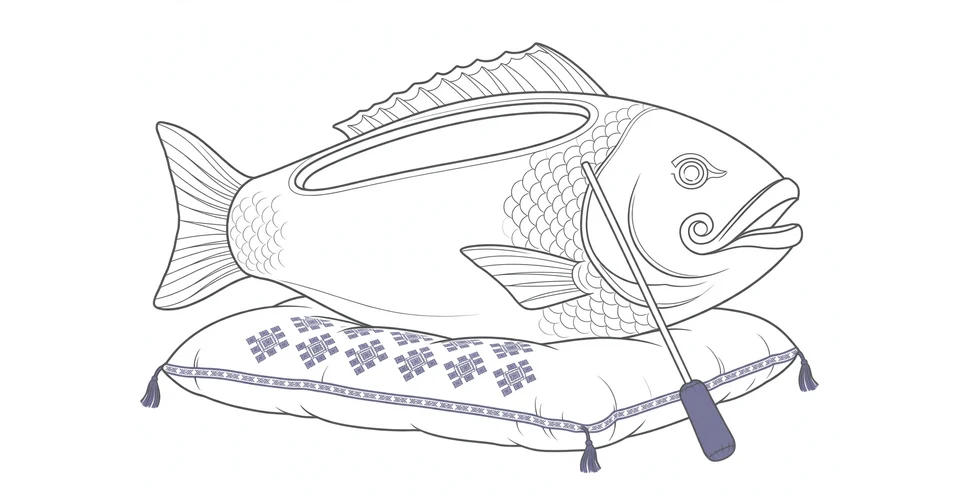
The instrument has been doing this job for a very long time. It began in China, travelled with Mahayana Buddhism across East Asia, and arrived in Japan early enough to become part of the furniture of temple life. Almost every school that chants aloud still keeps one, and the smallest ones sit on cushions in ordinary homes.
What a mokugyo actually is
A mokugyo is a percussion instrument made from one piece of wood, hollowed out from inside until the shell resonates. The outside keeps the memory of the fish it is named after. On the round drums used in most Japanese temples today, you can still find carved scales across the top, a pair of fish heads worked into the design, and a ball or pearl held between them.
The drum is made the slow way. A carver starts with a single block of wood, hollows it out from inside, smooths it, cuts the scales and symbols into the surface, and finishes it with lacquer. Modern makers sometimes use composite materials, but the principle never changes: a hard shell, an empty space inside, and a raised ridge on the outside where the striker lands. That hollow is the instrument. Everything else is decoration, however beautiful.
The drum is played with a single striker, a wooden stick whose head is padded or tipped with cloth or rubber so the blow lands soft and woody instead of sharp. A big mokugyo rests on a stand in front of the altar, while a small one sits on an embroidered cushion, partly to protect the wood and partly to stop it rattling against the table or floor.
The tone is the whole point. A mokugyo does not ring like a bell or boom like a drum skin. It knocks. The sound is hollow, dry and short, with just enough body to carry across a hall, and it changes with the size of the instrument and the size of the hollow inside it. Practitioners sometimes call it penetrating, and that is fair: a steady mokugyo beat gets into your head and stays there, which is more or less the intention.
Why the drum is a fish
Of all the shapes a drum could take, Buddhism chose a fish, and the reason is simple. A fish never closes its eyes. In the old understanding, the fish never sleeps, so it became a symbol of wakefulness, of a mind that stays alert through the whole practice instead of drifting off.
That symbolism is the drum's second job. Every knock of the mokugyo is a small reminder to the chanters to come back to the text in front of them. Writers on Buddhist practice even call the instrument the wakeful drum, because its sound is meant to keep meditators attentive rather than lulled. The fish also stands for abundance in Buddhist symbolism, one of the eight auspicious symbols, so the drum carries a blessing as well as a beat.
The pearl between the two fish heads on the carving stands for unity. I like that detail. The object that holds a roomful of separate voices together is decorated with a symbol of things joined into one, which is either a coincidence or a quiet joke by some long forgotten carver.
From muyu in China to mokugyo in Japan
The wooden fish started in China, where it is called muyu. The same instrument answers to moktak in Korea, mo in Vietnam and shingnya in Tibet, and it turns up wherever Mahayana chanting is practised. In Zen and Chan temples it keeps the rhythm of sutra recitation, and in Pure Land Buddhism it is beaten while chanting the name of Amitabha Buddha.
Its cousins show how one idea adapts to different hands. In Korea the small handheld version, carried by a handle and used on the move, is called moktak, while mogeo is the full sized fish, often hung up and played with two sticks struck into its hollowed underside. Same fish, same job, different furniture.
The oldest wooden fish were not round at all. They were carved as long dragon and fish creatures and hung in front of monasteries, where a monk struck them to call the community to meals, lectures and work. Manpukuji in Uji still keeps one of these original hanging fish, a reminder that the round drum on the cushion began life as something closer to a temple bell in fish form. Over the centuries the shape softened and rounded until the mokugyo became the plump, almost abstract fish most people know today. The wooden fish article on Wikipedia traces that long evolution, from signalling board to chanting drum.
In Japan the mokugyo settled in deeply. Some temple specimens grew enormous, weighing more than 300 kilograms, and the drum became so familiar that its knock is now one of the sounds people most associate with a Japanese temple, up there with the great bell.
The legend of the monk, the river and the fish
Like many old instruments, the mokugyo has an origin story, and it is a good one. A monk travelled to India to fetch sutras and spent 17 years on the quest. On the way home, a wide flooded river blocked his path, and a great fish offered to carry him across. The fish had been human once and had a crime to atone for, so it asked one favour: that the monk ask the Buddha how the fish could reach enlightenment.
The monk agreed, then forgot. On the return crossing the fish asked whether he had made the request, heard that he had not, and in fury splashed him into the river. A fisherman saved the monk, but the hard won scriptures were lost in the water. Back home, still angry, the monk carved a wooden fish head and beat it with a wooden hammer whenever his temper rose.
Then the story turns. Each time he struck the wooden fish, its mouth produced the sound of a character of the lost text. He kept beating it, patiently, for years, and character by character the drowned scriptures came back out of the fish's mouth. As legends go, it is a neat explanation for why Buddhists beat a fish to recover the words of the sutra, and it has the right moral for a chanting drum: nothing comes back all at once, only beat by beat.
Who keeps the beat, and when
In a group service, one person plays the mokugyo for everyone. The drum usually sits at the front of the hall, and the practitioner in charge of it sets the tempo of the chant and holds it steady from the first line to the last. If the chanting needs to slow down for a difficult passage or rise toward a climax, it is the hand on the mokugyo that decides. Everyone else simply follows the knock, and the raps punctuate the chant phrase by phrase, like a slow clock the whole room agrees to live by.
The mokugyo also has a fixed place in the room. In Chinese temples it traditionally rests on the left of the altar beside a metal bell bowl, the two instruments forming a pair, wood answering metal. In group practice sessions smaller drums are set out on the mats for practitioners as well, so a room can hold one leading mokugyo and a soft chorus of followers, all knocking in the same time.
The sound travelled beyond Buddhism, too. Confucian ceremonies adopted the wooden fish and strike it at set intervals to mark the stages of a rite, and Taoist and Shinto practitioners have taken it up as well. An instrument this simple, a hollow fish and a stick, tends to escape the walls of any one tradition.
You hear it most clearly at the start of the temple day. The dawn service called gongyo is built around chanted sutras, and the mokugyo is the sound that gathers sleepy voices into line before the sun is properly up. Guests who overnight in a shukubo, a temple lodging, usually meet the drum there first, half awake on a cushion while the beat does the work of waking them fully.
The mokugyo works outside the morning service too. It accompanies mantras and the nembutsu, the chanting of Amida's name in Pure Land practice. Funeral processions walk to its slow rhythm, and it has traditionally been beaten in prayers for rain. A long essay on the instrument at Buddha Weekly describes how that single repetitive knock anchors the mind during practice, which matches what you feel in the hall: the beat is monotonous on purpose, and the monotony is the medicine.
From a cushion at home to a temple giant
Size is where the mokugyo gets surprising. The smallest drums, made for laypeople chanting at home, measure about 150 millimetres across, small enough to hold in one hand and keep on a household altar. Ordinary temple drums are bigger, and the range tops out at instruments around 1.2 metres wide.
At the far end of the scale are the giants. Hasedera in Kamakura keeps a wooden fish counted among the largest in the world, the kind of mokugyo that needs a stand, a serious striker and a hall big enough to deserve it. The huge Japanese specimens of over 300 kilograms are less instruments you play than furniture you visit, and yet the job is unchanged: one hollow knock, repeated, to keep the chanting honest.
What changes with size is mostly the voice. A small mokugyo ticks along brightly under one person's chanting. A temple giant speaks more slowly and deeply, and a whole congregation can lean on it. Between the two extremes there is a drum for every hall in Japan, each tuned by nothing more technical than the thickness of its shell and the size of the hollow its carver left inside.
The quietest job in the hall
The mokugyo never gets the glory. The bell is grander, the chanting is the point, and nobody leaves a temple humming the drum part. But sit through one long service without it, voices fraying at the edges, and you understand what the fish was doing all along.
There is something honest about an instrument whose whole purpose is to keep other people together and awake. The monk in the legend got his scriptures back one character at a time, and a hall of chanters gets through the Heart Sutra the same way, one knock at a time. For an object carved to look like a fish that never sleeps, it is a fitting career.
More in Culture & Society
Latest posts
- Soba, the Buckwheat Noodles Japan Slurps on the Last Night of the Year
- Udon in Kagawa, Where Noodles Are a Way of Life
- The Pawukon Calendar Runs Bali on 210 Days
- Purnama Is the Full Moon Bali Prays By
- Galungan Welcomes the Ancestors Back to Bali
- Jatayu Flew at Ravana to Save Sita
- Kurma Held Up a Mountain So the Ocean Could Be Churned
- Yoshino Is the Mountain Shugendo Calls Home
- A Gomagi Carries Your Wish Into the Goma Fire
- Danjo Garan Is Where Koyasan's Teaching Began
- The Banryutei Turns Two Dragons Into a Rock Garden
- A Gongyo Starts the Temple Day Before Sunrise
- Shojin Ryori Is the Temple Food That Eats Like a Prayer
- Depachika and the Basement Food Halls Beneath Japan's Department Stores
- Yakitori and the Smoky Alleys Where Tokyo Learned to Love Chicken Skewers