Wuku Gives Every Week in Bali a Name
· 15 min read
A wuku is one of the thirty named seven day weeks of the Balinese pawukon calendar, and together the wuku turn an ordinary week into a name that fixes festivals, birthdays and temple days.
In Bali, a week has a name. Not a number, and not a date on a wall, but a name that people use the way other places use Monday or the third of the month. That name is a wuku, and there are thirty of them, each seven days long, turning one after another through a 210 day cycle called the pawukon.
Ask a Balinese priest when a temple festival falls and the answer will often come back as a named week first and a weekday second. Galungan is not a date. It is Buda Kliwon Dungulan, a Wednesday in the wuku Dungulan. The wuku is the part of the name that says which week you mean, and without it the day is only half named.
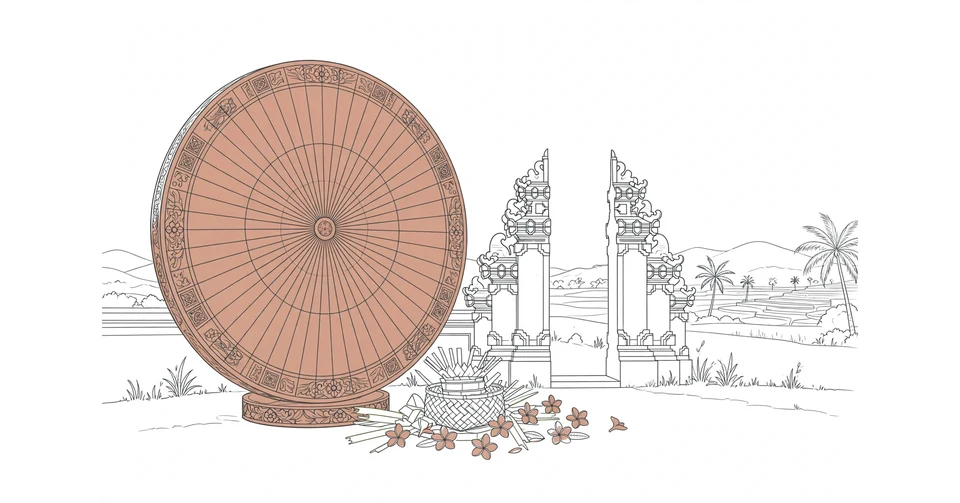
This article follows the wuku themselves: the full list in order, how each one names the days inside it, and which weeks carry the great festivals. The wider calendar behind them is set out in our article on the pawukon.
What a wuku is
A wuku is one seven day week of the pawukon. There are thirty of them, and thirty times seven is 210, the full length of the cycle. The first is Sinta and the last is Watugunung. When Watugunung ends, Sinta begins again, and the round starts over with no year number attached, because the pawukon has no year to count.
That simple fact is worth sitting with. Most calendars measure the sky. The pawukon measures nothing but its own rules, and the named weeks are the largest named part of those rules. Each one is a container of seven days, and the name is what makes one week different from the next. A Wednesday in Sinta is not the same day as a Wednesday in Landep, even though the weekday is the same, because the named week has changed. The name gives the week its identity, and the days inside it borrow that identity for seven days before handing it on.
The wuku are also the part of the pawukon that ordinary people actually live by. The pawukon holds ten weeks at once, of one day, two days, three days, and so on up to ten, but most of those run quietly in the background, consulted when a priest or a calendar reader needs them. The thirty named weeks are different. They are spoken aloud, written on printed calendars, and used to fix the dates that matter: festivals, temple anniversaries, and the birthday that returns every 210 days. If the pawukon is the machine, the named weeks are its dial, the part with names on it that a person can read. There is a quiet wisdom in naming weeks rather than numbering them: a number tells you where you are in a count, while a name tells you where you are in a story, and a name is easier to remember and to pass on to a child.
The thirty named weeks in order
The thirty wuku run in a fixed order that never changes. The list below follows the full 210 day table of the pawukon, which is set out day by day on Wikipedia's Pawukon calendar page. Every named week holds exactly seven days, so the first covers days 1 to 7 of the cycle, the second covers days 8 to 14, and so on until the thirtieth closes the cycle on day 210.
| Week | Wuku |
|---|---|
| 1 | Sinta |
| 2 | Landep |
| 3 | Ukir |
| 4 | Kulantir |
| 5 | Taulu |
| 6 | Gumbreg |
| 7 | Wariga |
| 8 | Warigadian |
| 9 | Julungwangi |
| 10 | Sungsang |
| 11 | Dunggulan |
| 12 | Kuningan |
| 13 | Langkir |
| 14 | Medangsia |
| 15 | Pujut |
| 16 | Pahang |
| 17 | Krulut |
| 18 | Merakih |
| 19 | Tambir |
| 20 | Medangkungan |
| 21 | Matal |
| 22 | Uye |
| 23 | Menail |
| 24 | Parangbakat |
| 25 | Bala |
| 26 | Ugu |
| 27 | Wayang |
| 28 | Kelawu |
| 29 | Dukut |
| 30 | Watugunung |
A small note on spelling is honest here. The names are written slightly differently from one source to another, because they come from an old spoken tradition and were only later written down in Latin letters. Kelawu, the 28th week, is also spelt Kulawu, and a few of the other names carry similar small variations. The list above follows the spellings in the Wikipedia table, and the order is the same in every source I checked. What matters is the order, because the order is the calendar: each name is where it is in the list, and its neighbours never change. Read the list slowly and a shape appears. The first eleven weeks lead up to Dunggulan, the week of Galungan, and the twelfth, Kuningan, closes the great ten days that begin with Galungan, while the last weeks gather the closing ceremonies of the cycle.
How one wuku names seven days
A day in the pawukon is rarely given by its date alone. It is given by three names together: its seven day name, its five day name, and its wuku. Take the first day of a cycle. In the seven day week it is Redite, a Sunday. In the five day week it is Paing. In the named week it is Sinta. So the day is Redite Paing Sinta, and everything else in the ten weeks follows from the counting.
Inside a single wuku, the days walk forward in step. The seven day names run from Redite to Saniscara, Sunday to Saturday, and the five day names run through Paing, Pon, Wage, Kliwon and Umanis. By the time the week ends, each of its seven days has carried a different combination, and the next wuku begins with the combinations picked up where the last one left off. The named week is the frame, and the day names are the picture that changes inside it.
This is why the wuku matters so much in practice. The seven day and five day names repeat often. A Buda Kliwon, a Wednesday meeting Kliwon, comes round every 35 days, six times in every cycle. But a Buda Kliwon Dungulan comes round only once in 210 days, because only one of those six falls inside the wuku Dungulan. The named week is what turns a recurring combination into a single, unrepeatable day. Without it, the calendar would be a blur of Wednesdays. With it, every day has an address that belongs to it alone. I find that oddly moving: a modern calendar gives every day a number, and numbers are cheap and forgettable, while the pawukon gives every day a name, and the name is the part that says, this week, and no other.
The weeks that carry the great days
Not every wuku carries a great festival, and that is part of the point. The weeks that do carry one stand out precisely because most weeks pass quietly, and when a festival week comes round the whole island can feel it.
Sinta, the first wuku, opens the cycle with Pagerwesi, which falls on Buda Kliwon Sinta, the Wednesday of the first week. Pagerwesi honours knowledge and the strength of learning, and in the north of the island, around Buleleng, it is kept on something close to the scale of Galungan. A cycle that begins by honouring knowledge sets its tone early, and I like that the first thing the calendar asks of a new round is not celebration but study.
Dunggulan, the eleventh wuku, carries the greatest day of all. Galungan falls on Buda Kliwon Dungulan, a Wednesday in the week of Dungulan, and it marks the victory of dharma over adharma, the day the deified ancestors come home to visit their families. Our article on Galungan follows the festival itself, from the penjor raised along the roads to the offerings of the closing days. What belongs here is simpler: Galungan is a named week day before it is anything else, and the wuku Dungulan is the reason it returns every 210 days instead of drifting with the moon.
Kuningan, the twelfth wuku, closes the ten days that Galungan opens. Kuningan Day falls on Saniscara Kliwon Kuningan, a Saturday, ten days after Galungan, when the gods and the ancestral spirits descend only until midday, so the prayers of that day are finished by noon. The same Saturday is also counted among the six Tumpek days, as Tumpek Kuningan, and the two names are worth keeping apart. Kuningan is the twelfth named week. Kuningan Day is the festival that falls on the Saturday of that week. Tumpek Kuningan is the name the same Saturday carries as one of the six Tumpek days, which always fall on a Saniscara Kliwon. One day, three names, and each name says something different about it.
The other five Tumpek days fall in their own weeks: Landep, Wariga, Krulut, Uye and Wayang. Each one is a day of thanks for something people depend on. Tumpek Landep blesses sharp tools and metal objects, and in recent years motorbikes and cars as well. Tumpek Uye is the day for animals. Tumpek Wayang is for musical instruments. The rest are for plants, rice and the arts of the hand. Six times in every cycle, a named week brings a Saturday on which offerings appear on things that are not usually offered to: a motorbike with a small palm leaf basket on its seat, a gamelan with flowers laid across its keys.
Julungwangi, the ninth wuku, holds one of the island's best known temple anniversaries. Pura Ulun Danu Beratan holds its odalan on Anggara Kliwon Julungwangi, a Tuesday, and the temple's anniversary is fixed to that point in the pawukon rather than to a date in the year. A temple anniversary that returns by named week rather than by year is a good test of how the system thinks: the temple does not celebrate on the same Western date each year, because the pawukon is not a Western year, and nobody in the village expects it to be.
Watugunung, the thirtieth and last wuku, closes the cycle. Saraswati, the day of knowledge itself, falls at the very end of the cycle, and the morning after it, Banyu Pinaruh, is a day of purification in spring water. The turn of the pawukon is itself a festival, which seems right for a calendar with no new year of its own. The same closing week also holds a village Nyepi of its own in Banyuning, a customary village in Buleleng, where the four restraints are kept on Buda Pon Watugunung, after a purification offering made the day before. The cycle ends, in other words, with silence and with water, and then Sinta begins again.
A wuku birthday returns every 210 days
The wuku also measure a person's life, and this is where the calendar stops being a curiosity and starts being personal. A Balinese birthday is measured in the pawukon, not in the year. The otonan, or pawukon birthday, falls every 210 days, on the day of a person's birth as counted by the five day and seven day conjunction in its wuku. A child born on Soma Pon Kelawu, for example, celebrates that same combination again 210 days later, and then again, for life.
That means a person can have a birthday twice in a Western year, or a birthday that never falls on the same Western date twice. It also means a birthday is not a date but a pattern, and the pattern comes back. The named week is what makes that possible. The five day and seven day names alone would repeat every 35 days, far too often to be a birthday. Add the named week, and the combination returns only once in 210 days, which is rare enough to be worth celebrating and regular enough to be counted on. There is something gentle in that idea. A birthday in the Western sense marks the passing of a year, and years pass whether we are ready or not. An otonan marks the return of a pattern, and a pattern does not judge how much you have achieved since it last came round. It only says, here you are again, in the same week, on the same kind of day.
Where the names come from
The names of the thirty wuku come from an old cycle of stories about Watugunung, the figure whose name closes the list. I will not retell the myth here, except to say that it is a tangled family story of the kind old calendars often carry, and that the names have outlived the storytelling. What matters for the calendar is simpler: thirty named weeks, seven days each, 210 days in all, and a name for every week that lets a priest, a farmer or a family say exactly which week they mean.
There is a fitting shape to that, and it is worth noticing. The list opens with Sinta and closes with Watugunung, and the stories the names come from are Watugunung's stories. The calendar ends with the name of the figure its stories are about, as if the whole round were a story told from beginning to end, and the ending were a name rather than a moral. It is also worth saying plainly that the names are older than the explanations of them. Nobody alive chose these thirty names, and nobody can say with certainty what every one of them once meant. The calendar keeps them because they work, not because they can be fully explained, and that is a good rule for old things generally.
The named weeks on wood and paper
The pawukon is so regular that it can be drawn once and used forever, and the Balinese proved it with the tika, a chart carved into a board of wood or painted on cloth, with the thirty named weeks running across it and the days of the weeks running down it. Each square of the board holds the symbols for one day: its place in the weeks, its ritual value, and the marks that say whether the day is good or bad for a particular act. Having no relation at all to the movements of the sun or the moon, the tika never needs adjusting and remains forever useful.
The printed Balinese wall calendar that hangs in homes and offices today is the tika's descendant. Its small print is full of the same information: the named weeks, the day names, the conjunctions, and the daily list of good and bad acts, the ala ayuning dewasa, which says whether a day suits a wedding, a house raising, a hair cutting ceremony or tuning a gamelan. The knowledge behind that list is called wariga, and it is the practical end of the pawukon: not astronomy, but advice. The fullest modern guide to how the two Balinese calendars divide the work between them is the Northbound Bali explainer on the Balinese calendar, which lays out the pawukon and the Saka side by side with the dates worked through. I like the tika because it makes the abstract concrete: thirty named weeks are easy to describe and hard to hold in your head all at once, and the tika holds them for you.
Why thirty named weeks still matter
It would be easy to assume the wuku are a museum piece, something kept for ceremonies and otherwise ignored. They are not. They still decide a surprising amount of ordinary life in Bali. They decide when temples hold their anniversaries, and therefore when whole villages dress up and process to the temple with offerings on their heads. They decide the six Tumpek days, when tools, animals and instruments are blessed. They decide the otonan, the 210 day birthday that returns through a person's whole life. And through wariga, the knowledge of good and bad days, they advise on weddings, house raisings, tooth filings, cremations and the start of new work.
For a visitor, the wuku are mostly something to notice rather than something to follow. If a temple is busy on a Tuesday, or a road is lined with penjor, or a motorbike is wearing a small offering, a named week is usually the reason. The practical advice is simple: check the Balinese calendar for the days around your trip, not only for the big festivals but for the small ones, because the small ones are the ones that will cross your path without warning.
What stays with me about the wuku is not their number, though thirty named weeks is a lot of names to keep. It is the idea underneath them. Most calendars measure the sky, and the sky does not care about us. The named weeks measure nothing but their own order, and their order exists only to tell people when to gather, when to give thanks and when to begin. A week with a name is a week with a character, and thirty named weeks are thirty small promises that the important things will come round again. Bali has kept them turning for centuries, and the wheel shows no sign of stopping.
More in Culture & Society
Latest posts
- Lawar Is the Dish Bali Serves When the Whole Village Eats
- Goma Dofu Is the Forty Minute Tofu Ground by Hand
- Garuda Wisnu Kencana Rises Above Bali's Southern Cliffs
- Soba, the Buckwheat Noodles Japan Slurps on the Last Night of the Year
- Udon in Kagawa, Where Noodles Are a Way of Life
- The Pawukon Calendar Runs Bali on 210 Days
- Purnama Is the Full Moon Bali Prays By
- Galungan Welcomes the Ancestors Back to Bali
- Jatayu Flew at Ravana to Save Sita
- Kurma Held Up a Mountain So the Ocean Could Be Churned
- Yoshino Is the Mountain Shugendo Calls Home
- A Gomagi Carries Your Wish Into the Goma Fire
- Danjo Garan Is Where Koyasan's Teaching Began
- The Banryutei Turns Two Dragons Into a Rock Garden
- A Gongyo Starts the Temple Day Before Sunrise