Galungan Welcomes the Ancestors Back to Bali
· 19 min read
Galungan is the Balinese Hindu festival when deified ancestors return to their family temples, and the whole island prepares with penjor poles, temple prayers and ten days of welcome.
Galungan is the day Bali opens its doors to the dead. For ten days, the island believes its ancestors come home, walking back into the family compounds they left behind, to be fed, prayed for and thanked. Then, on the tenth day, they leave again, and life returns to normal until the cycle turns once more.
It is the most important recurring festival in Balinese Hinduism. Galungan does not follow the Gregorian calendar, so it never lands on the same date twice in a row. It follows the pawukon, the 210 day ritual calendar of Bali, and it arrives roughly every seven months. Some years hold two Galungan celebrations. The festival always falls on a Wednesday, on a day called Buda Kliwon Dungulan, and it always ends on a Saturday, ten days later, with Kuningan.
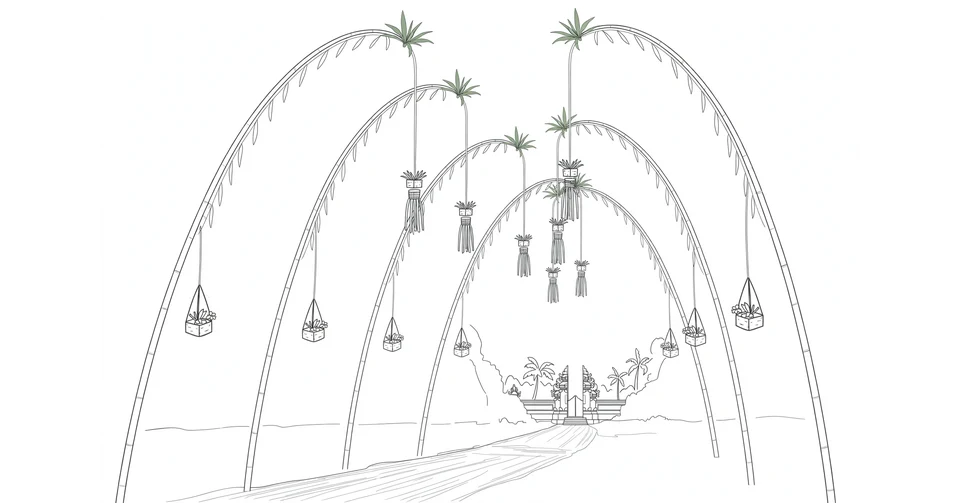
What makes Galungan different from an ordinary holiday is that it is a family event before it is a public one. The prayers begin at home, at the family temple in the corner of the compound, where the ancestors are believed to rest. Only after that do people walk to the village temple, and only then does the island start to look like a celebration, with tall bamboo poles bending over every road and the smell of cooking drifting out of every kitchen.
Galungan and the 210 day calendar
To understand Galungan, you have to understand that Bali runs on two calendars at once. The Saka calendar is lunar, and it sets the date of Nyepi, the famous day of silence. The pawukon is different. It is a fixed cycle of 210 days, divided into 30 weeks of seven days, and it sets Galungan, Kuningan and most temple anniversaries. A day in the pawukon is named by its position in several overlapping cycles at once, so a holy day always falls on the same combination of day and week.
Galungan always falls on Buda Kliwon Dungulan, which means Wednesday in the week of Dungulan, the eleventh week of the cycle. Kuningan always falls ten days later on Saniscara Kliwon Kuningan, a Saturday in the week of Kuningan. Because the cycle is only 210 days long, Galungan comes back about every seven months, and in some Gregorian years it appears twice. The contrast with Nyepi is a useful one: Nyepi stops an entire island for a day because the Saka calendar says so, while Galungan fills the island with guests and food because the pawukon says so. Two calendars, two kinds of holy day, one island that keeps both.
The pawukon has its own way of counting time. Balinese tradition often counts a ritual month as 35 days, the time it takes the five day cycle and the seven day cycle to meet again in the same combination. Six of those 35 day periods make 210 days. So Galungan does not return every six Gregorian months, but every 210 days, which works out to roughly every six months in the pawukon sense and about seven months on a wall calendar. The distinction matters to people who plan around it, because a festival that follows the pawukon can never be booked a year ahead by looking at a normal calendar. You have to count.
That counting is itself part of the festival. Long before Galungan arrives, the island starts preparing in stages. Tumpek Kandang falls 130 days before Galungan and honours the livestock that support the household. Tumpek Uduh falls 25 days before and honours the trees, plants, fruits and flowers that provide the ingredients for offerings. Fifteen days before, on Anggara Kasih Julungwangi, families clean their household altars and sacred spaces, scrubbing moss from stone shrines and washing the cloths. Then come the two Sugihan days, six and five days before Galungan, for cleansing the outer world and then the inner self. By the time the final three days arrive, the whole island is already in motion.
The story of Mayadenawa and the victory of dharma
Every Balinese festival has a story, and Galungan has one of the best. Long ago, in the highlands near the sacred waters of Lake Batur, there ruled a king named Mayadenawa. The stories describe him as a king with extraordinary magical powers, able to change his shape and deceive anyone who tried to catch him. He ruled from the region of Balingkang, and many feared him.
At first Mayadenawa was known for his power. Slowly, that power turned into pride. He began to believe that he was greater than the gods, and he ordered the people of Bali to stop making offerings, stop performing ceremonies and stop worshipping at the temples. He forbade them from honouring the divine and demanded that they worship him instead. The people obeyed because they had no choice. The temples grew quiet, offerings were no longer placed before the shrines, and the daily relationship between human beings, nature, ancestors and the gods was broken. In Balinese understanding this was not only a social problem. It was a disturbance of cosmic balance. When dharma is forgotten, the world itself begins to fall out of harmony.
Seeing the suffering of the people, the divine forces responded. Bhatara Indra, the king of the gods, came down with his celestial army to confront Mayadenawa. A great battle followed. Mayadenawa fought fiercely, but Indra's forces were stronger, and the king fled with his loyal minister, Kala Wong. As he escaped, Mayadenawa used all his magic to avoid capture, changing his form again and again. In different retellings he became a great bird, a fruit, young coconut leaves and other forms in order to hide himself. These transformations are remembered in the names of places around Tampaksiring, turning the landscape itself into part of the story. One famous moment explains the name Tampaksiring: as Mayadenawa ran, he tried to hide his footprints by walking sideways, with his feet slanted, so the place became known as the place of slanted footprints.
That night, Mayadenawa made one final attempt to defeat Indra. Near the place where Indra's soldiers were resting, he created a poisonous spring. In the morning the soldiers drank the water and became sick. Seeing his army weakened, Bhatara Indra struck the earth and brought forth a new spring of holy water. The water healed his soldiers and restored their strength. That sacred spring became known as Tirta Empul, which remains one of Bali's most important places of purification today.
Mayadenawa could not run forever. At last he and Kala Wong tried to hide by turning themselves into stone, but Indra saw through the illusion, shot the stone with his arrow, and Mayadenawa was finally defeated. His blood is said to have flowed into the Petanu River, leaving another part of the Balinese landscape marked by the memory of the story. The defeat of Mayadenawa is remembered as the victory of dharma over adharma, and this is why the story is so closely connected with Galungan.
The story comes down to us through religious and poetic manuscripts such as the Lontar Usana Bali and the Kakawin Mayadanawantaka. These are not historical texts in the modern sense. They are sacred and literary works, filled with symbolism, moral lessons and spiritual imagination. Through them, Balinese tradition explains not only what happened in the mythic past, but what human beings must continue to remember today. There is also a second story attached to Galungan, about King Jaya Kasunu, who once meditated to understand why suffering and disorder had fallen upon his kingdom. In his meditation he received guidance from the goddess Durga, who revealed that the people had forgotten to properly celebrate Galungan. Because the connection between humans, ancestors and the divine had been neglected, balance had been disturbed, and the king was instructed to restore the celebration so families could once again honour their ancestors.
What I find most honest about the story is that it does not stop at the battle. Galungan is not only about a god defeating a king. It is also about the battle within every human being. Mayadenawa represents arrogance, ego and the desire to place oneself above the sacred order of life. Bhatara Indra represents clarity, divine strength and the restoration of balance. The festival reminds people that dharma must be renewed again and again, and that the greatest victory is not only the defeat of evil outside us, but the overcoming of pride, greed and confusion within ourselves. That is a message that survives perfectly well outside Bali, and it is probably why Galungan keeps its hold on people who have never seen a penjor in their lives.
Penjor poles turn the roads into a festival
The most obvious sign of Galungan is the penjor. These are tall bamboo poles with offerings suspended at the end, installed by the side of roads, and they appear almost overnight. Every house, business and shrine erects one on the right side of its entrance. Some are brutally simple and some are huge, decorated with coconut leaves, rice paddy husks, fruits and a prayer flag, and in recent years some even carry lights and moving figures. The penjor is said to mimic the tail of the great dragon Anantaboga, a symbol of nature's bounty, and the bamboo pole offerings are a way of showing gratitude for the gifts of nature: the rice, the coconut, the bamboo and the fruits that make it.
A penjor is not decoration in the ordinary sense. Every element of it means something, and the whole pole is an offering in itself. The bamboo is the backbone of the offering. The coconut leaves, woven into shapes at the tip, carry the prayer upward. The rice, the fruit and the cakes at the end are the harvest itself, given back in thanks. Families spend real money and real time on their penjor, and the quality of a village's penjor is a quiet matter of pride. Walking a Balinese road in the days before Galungan, under a corridor of bending bamboo, is the closest the festival comes to a public spectacle, and it is free to anyone who happens to be there.
The penjor go up on Penampahan, the day before Galungan, and they stay up through the whole ten day period until after Kuningan. That timing is part of their meaning. They are not put up for a single day of celebration. They mark a stretch of time, a season of welcome, during which the ancestors are understood to be present in the family compound. When the poles finally come down, the festival is truly over, and the roads go back to being roads.
There is a small detail worth noticing. The penjor is often compared by visitors to a Christmas tree, and the comparison is not entirely wrong: both are a tall decorated object that appears in the home at a fixed season and marks a festive mood. But the penjor is not brought inside and it is not about the household alone. It stands at the gate, facing the road, where everyone can see it. It is a public statement that this family is keeping the festival, and that the ancestors are welcome here. I think that outward facing quality is what makes Galungan feel different from a private holiday. The whole island agrees, at the same time, to make itself beautiful for guests who cannot be seen.
Three days of cooking before the feast
Galungan is prepared in the kitchen as much as in the temple. Three days before the festival, on Penyekeban, families begin by covering green bananas in clay pots to hasten their ripening. These bananas will later be used in ceremonial offerings. Symbolically the day also reminds people to begin controlling their desires and preparing themselves inwardly for the sacred days ahead. Two days before, on Penyajaan, the household makes jaja, colourful traditional cakes made from glutinous rice dough. These sweet treats are used as offerings and shared among family members during Galungan, and the making of them brings the household together, turning the kitchen into part of the sacred preparation.
The day before Galungan is Penampahan, and it is the busiest day of the whole period. Families prepare food for the celebration. Pigs and chickens are blessed and ceremonially prepared to make traditional dishes such as lawar, a spicy minced meat and vegetable dish, and sate. Most families look forward to this day the most, as it is the preparation for the famed Balinese suckling pig, the babi guling. Penampahan is also a reminder to slaughter the negative qualities within the self before entering Galungan. The word carries both meanings at once, and Balinese tradition does not seem to mind the double meaning. The cooking is real and the symbolism is real, and they happen on the same day in the same kitchen.
The division of work on Penampahan follows old patterns. The men of the household often wake well before dawn to prepare the meat, finely dicing pork and mashing it with a grinding stone, moulding it onto sate sticks whittled from bamboo, while chickens from the compound are chosen for the feast. The women spend the days before weaving banten, offerings made from young coconut fronds, and preparing the many small offerings that will be presented at the family temple on the day of Galungan. By mid morning, once the cooking is done, it is time for the first of a series of satisfying feasts from what has been prepared. Then the men have one more job: a long bamboo pole, the penjor, is made to decorate the entrance to the family compound.
Food is the festival's other language. Lawar, jaja, sate and babi guling are not restaurant dishes during Galungan. They are ceremonial food, made at home, in quantities meant for offerings first and feasting second. The order matters. The ancestors are served before the living eat, and the best of what is cooked goes to the family temple. Only after that does the household sit down together. It is a small discipline, and it is repeated in thousands of compounds on the same day, which is what makes it a festival rather than a dinner.
Galungan day itself
Galungan day begins early. Families rise before dawn, dress in their finest traditional attire, and gather at the family shrine to pray. The prayers start at home, at the pemerajan, the family temple where the ancestors are believed to rest, and only then do people walk to the village temple and sometimes on to a regional temple. The temples are crowded all day with people coming and going, bringing the offerings that have been prepared since Penyekeban. By noon, most families feast and socialise. In the afternoon, consecrated temple objects such as barong masks, keris daggers and pratima, the images of deities, are carried through the streets in a ceremonial procession to bless the people.
The day has a particular rhythm that visitors often miss. The morning is solemn and formal. The middle of the day is for eating together. The afternoon is for procession and blessing. There is no single climax to point at, because the whole day is the climax. That is also why Galungan can be hard for an outsider to watch. Much of it happens inside family compounds, behind gates, at shrines that belong to one family. The public part, the penjor on the roads and the processions in the afternoon, is only the visible edge of a festival that is mostly private.
The day after Galungan is Manis Galungan, and it is deliberately lighter. It is dedicated to family gatherings and visiting relatives across the island. Roads fill with people travelling, spending time together and enjoying outings. After the solemn prayers of Galungan, Manis Galungan brings a more joyful atmosphere, allowing families to celebrate together and strengthen social bonds. If Galungan is the day the ancestors come home, Manis Galungan is the day the living go out to see each other, and the two days balance each other nicely.
There is a lesson in that balance that I keep coming back to. Galungan does not ask people to choose between the solemn and the joyful. It schedules both, on consecutive days, and treats both as sacred. The prayers come first and the visiting comes second, but neither is presented as more important than the other. A festival that only prayed would be exhausting. A festival that only feasted would be empty. Galungan does both, and it does them in that order.
Kuningan says goodbye at noon
Ten days after Galungan comes Kuningan, the closing day of the festival. On this sacred day, the ancestral spirits and divine beings who were welcomed during Galungan are believed to return to the heavenly realm. Families make special offerings, often including yellow rice, since kuning means yellow, symbolising prosperity, gratitude and blessings. The day's name is also understood to relate to kauningan, the receiving of awareness. Prayers are usually completed earlier in the day, because it is believed that the ancestors return to their heavenly abodes at noon, so all prayer must be completed by late morning. Kuningan is understood as the moment of farewell and return.
The yellow rice is the signature of the day. Nasi kuning, rice cooked yellow with turmeric and coconut milk, appears in Balinese life only at genuinely significant moments, and Kuningan is one of them. The colour is not incidental. Yellow is the colour of prosperity and blessing, and the rice carries the wish that the departing ancestors leave behind good fortune for the household. Other offerings on Kuningan include small effigies made of young coconut leaves, believed to house the departing ancestral spirits, and the woven shields called tamiang. Everything is prepared with the same care as on Galungan day, but the mood is different. The welcome has become a farewell.
For a fuller account of what happens on that final day, the site's own article on the subject is worth reading: On Tumpek Kuningan Bali Feeds Its Ancestors. That piece follows the Kuningan rituals in detail, from the yellow rice to the rule that the ceremonies finish before noon. The two festivals are inseparable, and it makes sense to read them as a pair. Galungan is the arrival, Kuningan is the departure, and neither one makes full sense without the other.
The day after Kuningan is Manis Kuningan, a day of celebration and rest. The penjor come down, the offerings are cleared away, and the island returns to its ordinary rhythm. The ancestors have gone home, and the living go back to work. The cycle is complete, and the next one is already being counted. That is the quiet genius of a 210 day calendar. There is always another Galungan coming, and the waiting is part of the festival.
Why Galungan still matters
It is easy to describe Galungan as a beautiful tradition and leave it at that, but that would miss why it has survived. Bali has changed enormously in the last fifty years. Tourism has remade the south of the island, young people leave their villages for work in the cities, and the old rhythms of farming life no longer govern the year. A festival that depended on the agricultural calendar would have faded by now. Galungan has not faded, and I think the reason is that it does not depend on farming at all. It depends on family, and family has not gone away.
Galungan asks every household to do the same things, at the same time, for the same reason: clean the shrine, cook the food, raise the pole, pray together, feed the ancestors, and then say goodbye. The tasks are simple enough that a child can help with them and serious enough that an elder still leads them. The festival is a piece of social technology that keeps a family in the same room, doing the same work, twice a year, for as long as anyone can remember. That is a rare thing, and it is worth more than any single ritual in it.
There is also something in Galungan that speaks to people who do not share its beliefs. The idea that the dead are not gone but visiting, that they deserve hospitality, and that the living have a responsibility to be good hosts, is not a uniquely Balinese idea. Most cultures have some version of it. What Bali has done is to give that idea a calendar, a set of tasks and a visible sign in the penjor, so that it cannot be forgotten or postponed. The ancestors arrive on a Wednesday and leave on a Saturday, ten days later, whether the living are ready or not. The festival does not wait for anyone, and that is exactly the point.
The last thing worth saying about Galungan is that it ends gently. There is no dramatic finale, no burning of effigies, no closing ceremony that the whole island watches together. The ancestors leave at noon on Kuningan, the penjor come down the next day, and life goes on. The festival trusts people to remember it without a spectacle to close it. That quiet ending feels right for a festival about family. The guests have gone home, the house is tidy again, and the next visit is already on the calendar. For more on how the day is understood by those who celebrate it, the account at Bali Spirit describes the homecoming, the penjor and the ten day cycle in the words of people who live it, and the encyclopedia entry at Wikipedia gives the plain facts of the calendar and the days around the festival.
More in Culture & Society
Latest posts
- Soba, the Buckwheat Noodles Japan Slurps on the Last Night of the Year
- Udon in Kagawa, Where Noodles Are a Way of Life
- The Pawukon Calendar Runs Bali on 210 Days
- Purnama Is the Full Moon Bali Prays By
- Jatayu Flew at Ravana to Save Sita
- Kurma Held Up a Mountain So the Ocean Could Be Churned
- Yoshino Is the Mountain Shugendo Calls Home
- A Gomagi Carries Your Wish Into the Goma Fire
- Danjo Garan Is Where Koyasan's Teaching Began
- The Banryutei Turns Two Dragons Into a Rock Garden
- A Gongyo Starts the Temple Day Before Sunrise
- Shojin Ryori Is the Temple Food That Eats Like a Prayer
- Depachika and the Basement Food Halls Beneath Japan's Department Stores
- Yakitori and the Smoky Alleys Where Tokyo Learned to Love Chicken Skewers
- Okonomiyaki and the Savory Pancake Japan Cooks at the Table