Shojin Ryori Is the Temple Food That Eats Like a Prayer
· 16 min read
Shojin ryori is the vegetarian food of Japan's Buddhist temples, cooked without meat, fish, or the five pungent roots, and eaten as a form of Zen practice. This is what eight centuries of temple cooking tastes like.
There is a meal in Japan that begins before anyone picks up a chopstick. The cook has already prayed over it, in a sense, by the way the vegetables were washed and the rice was measured. Shojin ryori is the vegetarian cuisine of Japan's Buddhist temples, and it treats cooking and eating as one continuous act of attention.
The food itself is quiet. A bowl of clear soup, a block of sesame tofu, a few small dishes of seasonal vegetables arranged in lacquered bowls. Nothing shouts. And yet people who eat shojin ryori often describe the meal as one of the most memorable of their lives, not because it was rich, but because it was so completely itself.
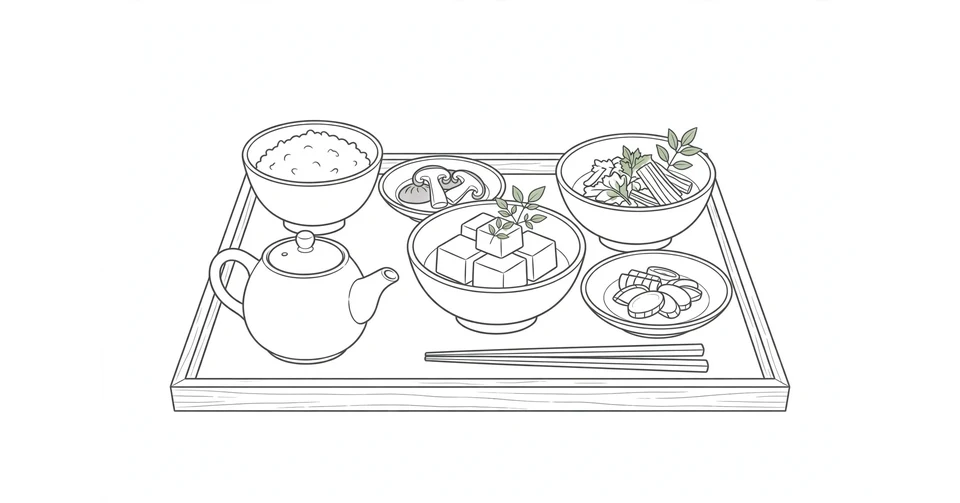
That quiet quality is the point. Shojin ryori was never designed to impress a diner. It was designed to train a monk. Every rule in it, from the banned ingredients to the five colors on the tray, exists to keep the mind clear enough for meditation. The surprise is how good the food tastes anyway, and how much of ordinary Japanese cooking it quietly shaped over eight centuries.
What shojin ryori actually means
The name breaks into two parts. Ryori means cooking or cuisine, which is straightforward. Shojin is harder to translate, and the difficulty matters, because it carries the whole idea. It means devotion, diligence, and the steady effort of following a spiritual path. Food prepared without that commitment would not count as shojin ryori, even if every ingredient on the plate were plant based.
That distinction is the first thing to understand about shojin ryori. Vegetarian food is defined by what it leaves out. Shojin ryori is defined by the quality of attention brought to every step of its making and eating. The vegetables, the tofu, and the grains of the temple kitchen become shojin ryori through the mind that selects, prepares, and serves them. A meal of identical ingredients, made without that intention, would be something else entirely, ordinary food that happens to contain no meat.
The tradition is most closely tied to Zen Buddhism, and it is still served in temple restaurants across Kyoto, Wakayama, and Kamakura. It has been prepared by monks as part of their spiritual practice for more than eight hundred years. In that time it moved from the monastery into the wider culture, into teahouses and memorial services and, eventually, into some of the finest restaurants in Japan. Yet its center of gravity never moved. It is still temple food first.
A cook who was also a Zen master
The defining figure of shojin ryori is Dogen Zenji, who lived from 1200 to 1253. Dogen traveled to China in the early 13th century to study Zen, and when he returned to Japan he brought back not only the practice of seated meditation but a fully developed philosophy of the kitchen. In 1237 he wrote a short text called the Tenzo Kyokun, or Instructions for the Cook. It contains no precise measurements and no recipes. It contains a philosophy instead: that preparing food and pursuing enlightenment are not two different activities but one.
In 1244 Dogen founded Eiheiji temple in what is now Fukui Prefecture. It became one of the two head temples of the Soto school of Zen Buddhism, and it remains one of the primary centers of living shojin ryori practice today. The text he wrote there has guided temple kitchens ever since.
At the center of Dogen's teaching stands the tenzo, the monk in charge of the temple kitchen. This was not a servant assigned to a mundane task. The tenzo held a position of high spiritual responsibility, chosen for maturity, experience, and quality of mind. Dogen wrote that the tenzo should approach rice and vegetables with the same care that a great Zen master gives to the finest ingredients for a feast, not because the ingredients demand reverence, but because full attention is the point, whatever it is applied to.
Dogen described three qualities of mind that the tenzo must cultivate. Kishin is a joyful heart that takes pleasure in cooking for others. Roshin is a caring, parental heart that tends to each ingredient with attention. Daishin is a generous heart without bias or attachment. Without what Dogen called the way seeking mind, he wrote, cooking is nothing but a vain struggle and hardship, without benefit in the end. A guide to Japan's Zen temple cuisine recounts how this short text became the foundation of the tradition, and how Dogen's kitchen philosophy still shapes temple cooking eight centuries later.
I find that idea strangely comforting. Most of us cook in a hurry, half thinking about something else, and then wonder why the food tastes flat. Dogen's answer, written eight centuries ago, is that the food was never the problem. The attention was. Shojin ryori makes that claim testable at every meal, and it has been testing it, in the same kitchens, for longer than most countries have existed in their current form.
What the temple kitchen refuses to use
The rules of shojin ryori start with what is excluded. No meat, no fish, no shellfish, no eggs, and no dairy. The prohibition follows directly from ahimsa, the Buddhist principle of non harm, the refusal to take life. That part is familiar to anyone who knows vegetarian cooking. The part that surprises most people comes next.
Shojin ryori also forbids five pungent vegetables, known as the gokun: garlic, onions, green onions, Chinese chives, and rakkyo, a kind of Chinese scallion. Food in Japan's overview of shojin ryori lists the same five and notes that the exact list varies slightly between Buddhist sects and historical periods, but the reasoning stays consistent. Buddhist teaching holds that these vegetables overstimulate desire and anger when eaten cooked, and diminish vitality and spiritual clarity when eaten raw. Their strong odors also disturb the meditative state in a shared practice space. A vegan dish built on garlic roasted vegetables would not qualify as shojin ryori at all, despite containing no animal products.
The ban on the gokun is what makes the cuisine remarkable as cooking. Nearly every food tradition on earth builds flavor on garlic and onion. Shojin ryori gives up that foundation entirely and still produces meals of real depth. The constraint forces invention, and the invention is where the cuisine earns its reputation.
Dashi, the stock that underpins almost all Japanese cooking, is remade to fit the rules. Ordinary dashi is built on katsuobushi, dried bonito flakes, or niboshi, dried sardines, both animal products. Shojin dashi uses kombu, dried kelp steeped in cold water, and dried shiitake mushrooms instead. The resulting stock is lighter and more restrained than fish based dashi, but its umami, drawn from the glutamates naturally present in kombu and shiitake, is substantial. It supports the vegetables rather than competing with them.
The principle of not wasting is equally fundamental. Dogen was explicit: every part of every ingredient must be used. The outer leaves of a cabbage, the scraping from the inside of a sesame mortar, the trimmed ends of vegetables, none of it is discarded. Skins are cooked as a separate component, trimmings become stock or seasoning, and what is left after one dish finds its way into the next. It is a cuisine that treats ingredients with a thoroughness that modern restaurant cooking often lacks, and it did so centuries before waste became a fashionable concern.
The rule of five
Shojin ryori is built on a structural framework called the rule of five, which guides how a meal is composed across its courses. The framework operates on three axes at once: color, flavor, and cooking method. Together they aim to produce what the tradition calls perfect nutritional and sensory harmony, developed without modern nutritional science but producing, in practice, meals that a contemporary dietitian would recognize as comprehensive.
The first axis is goshoku, the five colors. Every shojin ryori meal aims to include white, black, red, green, and yellow. White is rice, tofu, and daikon, representing purity and clarity. Black is sesame, seaweed, and shiitake, representing depth and grounding. Red is pickled plum, carrots, and azuki beans, representing vitality and warmth. Green is leafy vegetables, edamame, and matcha, representing growth and renewal. Yellow is pumpkin, yuzu, and miso, representing earth energy. This is not decoration. The Buddhist understanding is that visual harmony supports physical and spiritual health, and in practice the rule functions as a nutritional guide that produces broad variety without any explicit calculation.
The second axis is gomi, the five flavors: sweet, sour, salty, bitter, and umami. All five must be present across the courses of a meal, with no single flavor dominating. Running through the tradition is an ideal called tanmi, light flavor, the idea that the natural taste of each ingredient is the standard, not the intensity of the seasoning applied to it. A carrot properly prepared expresses its sweetness. A well made kombu dashi expresses its umami. Shojin ryori does not use strong seasonings or heavy sauces that override the true flavors of individual ingredients.
The third axis is goho, the five cooking methods: raw, simmered, grilled, steamed, and fried. A complete meal uses all five across its courses, which guarantees textural variety and shows the cook's skill in drawing different qualities from the same limited ingredients. The same piece of tofu can be silken and cold in one course, lightly grilled in another, and crumbled and simmered in a third. The technique is the variable, the ingredient is the constant, and the variation is the point.
What strikes me about shojin ryori is how practical its rule of five is beneath the philosophy. Five colors, five flavors, five methods: fifteen elements, and a cook who follows them will almost automatically serve a balanced meal. There is no calorie counting and no nutritional spreadsheet, just a framework old enough to have been tested by thousands of kitchens over hundreds of years. Modern diet advice keeps rediscovering the same ideas, usually with more jargon and less beauty.
The dishes that define the table
The standard format of a shojin ryori meal is ichiju sansai, one soup and three side dishes, served with rice and pickles. For special occasions the format expands to one soup and five dishes, though the organizing principles stay the same. Each course is served in its own vessel, chosen with the same care given to the food, because the selection of tableware follows the same seasonal logic as the cooking itself.
The soup is almost always kenchinjiru, a clear kombu based broth with root vegetables, mushrooms, and tofu, seasoned with soy sauce and mirin. Tradition traces it to Kenchoji temple in Kamakura, one of Japan's most important Zen monasteries, where it was said to have developed from the practice of using broken tofu, pieces too imperfect for other preparations, in a vegetable soup. That origin story is probably legend, but it reflects the waste nothing principle of shojin ryori so precisely that the legend itself feels like part of the teaching.
The most iconic dish of shojin ryori is goma dofu, sesame tofu. Despite its name it contains no soy at all. Ground sesame paste is mixed with kuzu starch and water, set into a firm custard, and served chilled with wasabi and soy sauce, usually as the opening dish of a formal meal. The flavor is nutty and rich, the texture smooth and dense. Making authentic goma dofu requires grinding the sesame by hand in a mortar for thirty to forty minutes, an act that is itself a form of meditation. I have never made it, and I am not sure I have the patience, which may be exactly why the dish is the way it is. The patience is an ingredient.
Around these centerpieces sit the dishes that show off the temple kitchen's range. Yuba, the skin that forms on heated soy milk, is lifted and served fresh with its delicate sweetness intact, or dried and used as a wrapping material. Koya dofu, freeze dried tofu, is rehydrated in seasoned dashi until it turns spongy and deeply absorbent. Namafu, fresh wheat gluten made by washing the starch from wheat dough, takes on a tender, slightly chewy texture and absorbs flavors with efficiency. Inari sushi, vinegared rice tucked into sweet seasoned pouches of fried tofu, needs no rare ingredients and shows how much can be done with restraint.
The meal is eaten in silence, or in the attentive near silence of a community that understands eating as practice. Before eating, the traditional five part reflection, the gokan no ge, is recited or contemplated: considering how the food arrived, whether one's own virtue merits it, releasing the mind from greed, receiving the food as medicine for the body, and dedicating oneself to the path. The recitation takes less than a minute. The phrase itadakimasu, which Japanese people say before every meal, is said to come from this reflection. What the ritual establishes is an orientation: this meal is not a break from practice. It is practice.
Where to taste it today
Shojin ryori is still served in active Zen monasteries across Japan, where monks prepare it daily in temple kitchens and eat in the same style they have for centuries. The most historically significant place to experience it is Eiheiji in Fukui Prefecture, the temple Dogen founded in 1244 and still one of Japan's most important Zen training monasteries.
For most visitors, the easiest way in is a temple stay. Mount Koya in Wakayama Prefecture, the mountain complex that is the center of Shingon esoteric Buddhism, offers overnight stays in temple lodgings where the morning meal is shojin ryori. A shukubo lets you sleep inside a working temple, and the food is part of the stay rather than an add on. The meal arrives in the quiet of the morning, after the monks have already been up for hours, and eating it there, in the place where it was made, is a different experience from ordering it in a city restaurant.
That mountain is governed from Kongobuji, the temple Kukai left behind, and a stay on Koyasan puts the food in its full context: the cedar forest, the cemetery paths, the morning chanting. The cuisine makes more sense there than anywhere else, because the whole mountain is organized around the same idea that the kitchen is, that attention is a form of devotion.
In Kyoto, several temple restaurants and secular establishments serve shojin ryori in settings designed to communicate the spirit of the tradition as well as its flavors. Tenryuji's Shigetsu restaurant in Arashiyama, overlooking a famous garden, is one of the most accessible, and the Daitokuji temple complex in northern Kyoto offers one of the most complete traditional experiences. In Tokyo, restaurants such as Soko in Roppongi serve shojin courses at a high level, with menus that change every few weeks to follow the seasons, and complete courses require advance reservation.
A practical note for anyone planning a visit: many temple restaurants and high end shojin courses require booking ahead, and some serve shojin menus only on request. The cuisine is seasonal by design, so the meal you eat in spring will not be the meal you eat in autumn. That is not a limitation. It is shojin ryori keeping its promise that the food follows the year.
What eight centuries of temple cooking left behind
The influence of shojin ryori on Japanese food as a whole is difficult to overstate. The cuisine arrived at a moment when Japan had no systematic tradition for plant based cooking, and over eight centuries it produced techniques, ingredients, and aesthetic principles that spread far beyond the monastery walls.
The development of tofu cuisine in Japan is almost entirely a product of temple cooking. The dozens of tofu preparations that now make up ordinary Japanese home cooking were developed by monks seeking variety within constraint. Even tempura, the technique of coating vegetables in light batter and frying them briefly, was partly refined by temple cooks producing vegetable tempura within shojin precepts, after the basic technique arrived with Portuguese missionaries in the 16th century. The seasonal structure of Japanese cuisine, its emphasis on the intrinsic flavor of individual ingredients rather than the masking effect of strong sauces, and its integration of aesthetic consideration into everyday cooking all reflect principles that shojin ryori articulated most clearly and practiced most consistently.
Kaiseki, the haute cuisine of Kyoto and the tea ceremony, shares with shojin ryori its seasonal framework, its rule of five, and its conviction that the vessel and the presentation are as much a part of the meal as the food itself. Both share an emphasis on seasonality and presentation, but their purposes differ: kaiseki aims to delight, while shojin ryori aims, first and last, to awaken.
The cuisine's spread followed a slower path than its influence. During the Muromachi period, from 1336 to 1573, shojin ryori was refined alongside the development of the tea ceremony, whose aesthetic overlapped substantially with the temple kitchen's emphasis on simplicity and seasonal awareness. By the Edo period, from 1603 to 1868, it had moved well beyond the monastery walls and become conventional at Buddhist memorial services and funerary rites, where it remains common across Japan today. That means most Japanese people have encountered shojin ryori at some point in their lives, typically at a ceremony honoring the dead, whether or not they ever set out to eat it.
In recent years the tradition has attracted international attention from chefs, nutritionists, and anyone interested in plant based eating, drawn to a cuisine that solved centuries ago the challenge of making plant based food not merely adequate but genuinely profound. The principles behind it, waste nothing, use everything, attend to what is in front of you, let the ingredient speak, are as useful in a contemporary kitchen as they were in Dogen's temple.
Shojin ryori never really belonged only to monks. It was always about what cooking is when it is done with full attention. Eight centuries of practical exploration produced a cuisine of radical simplicity and genuine depth, food that does not try to overwhelm or impress, but arrives at the table carrying the same quality of attention it was prepared with. That, in the end, is what the food tastes like, and it is a flavor no amount of seasoning can imitate.
More in Food & Travel
- Soba, the Buckwheat Noodles Japan Slurps on the Last Night of the Year
- Udon in Kagawa, Where Noodles Are a Way of Life
- Depachika and the Basement Food Halls Beneath Japan's Department Stores
- Yakitori and the Smoky Alleys Where Tokyo Learned to Love Chicken Skewers
- Okonomiyaki and the Savory Pancake Japan Cooks at the Table
- Takoyaki and the Ninety-Year-Old Shop That Still Serves the Original
Latest posts
- A Penjor Turns a Whole Street Into an Offering
- A Mokugyo Keeps the Beat of the Chant
- Garuda Pancasila Carries Five Principles on One Bird
- Saptawara Is the Seven-Day Week Inside Every Weton
- Janur Is the Young Coconut Leaf Bali Folds Into Everything
- Petungan Counts Your Neptu Before You Choose a Day
- The Pawukon Calendar Runs Bali on 210 Days
- Purnama Is the Full Moon Bali Prays By
- Galungan Welcomes the Ancestors Back to Bali
- Jatayu Flew at Ravana to Save Sita
- Kurma Held Up a Mountain So the Ocean Could Be Churned
- Yoshino Is the Mountain Shugendo Calls Home
- A Gomagi Carries Your Wish Into the Goma Fire
- Danjo Garan Is Where Koyasan's Teaching Began
- The Banryutei Turns Two Dragons Into a Rock Garden