Why Kagami Mochi Is Never Cut With a Knife
· 13 min read
Kagami mochi, the stacked mirror rice cakes of the Japanese New Year, are opened by hand or with a wooden mallet, never with a blade. This is the samurai era reason behind the rule, and what becomes of the pieces afterwards.
In the second week of January, Japanese households take down a pair of stacked rice cakes that has been sitting on the family altar since the end of December, and they do something that looks like vandalism to an outsider. They smash it. The kagami mochi is pulled apart by hand or struck with a small wooden mallet until it cracks into pieces, and one tool is never, ever used for the job. Nobody reaches for a kitchen knife.
The rule is not about the mochi, which by then has dried so hard that a blade would mostly skid across it anyway. It is about what the kagami mochi has been doing for the past two weeks. Kagami mochi is not a decoration that happens to be edible. It is an offering, a temporary seat for the god of the New Year, and you do not put a blade into a god.
So the family does not cut the kagami mochi, and strictly speaking they do not even break it. They open it. The word chosen for the ceremony, biraki, comes from a verb that means to open, and the care taken over that single word tells you almost everything about how Japan handles this small, hard, round piece of rice.
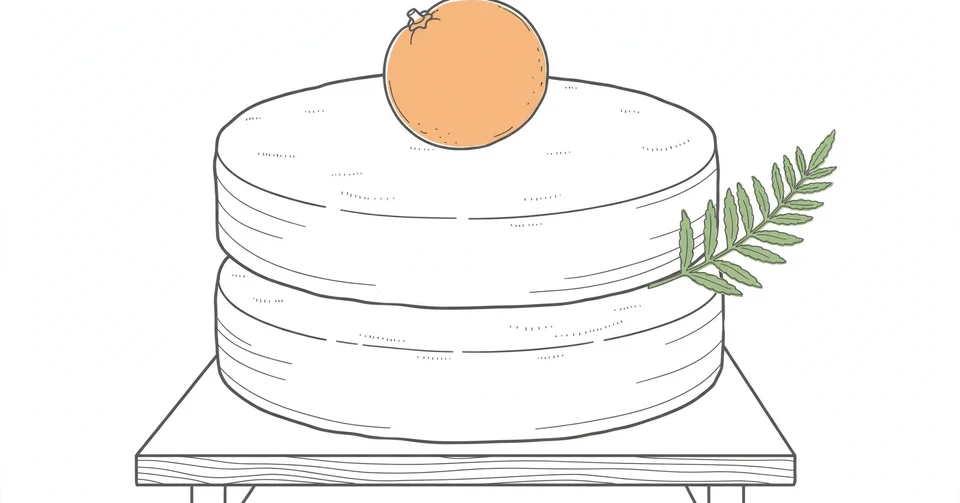
Look at a kagami mochi closely and every part of it is doing a job. Nothing on the stand is there by accident, and almost every element is a small wish for the year ahead, stacked in edible form.
Reading a kagami mochi from the top down
Start at the top, with the fruit. Traditionally it is a daidai, a Japanese bitter orange that is far too sour to eat and is chosen for everything except its flavour. The daidai is a stubborn fruit that can stay on the tree for years without falling, growing alongside newer fruit, and its name is a gift to anyone who loves wordplay. Written one way it names the orange, and written another way the same sound means generation after generation. A fruit that refuses to drop, carrying a name that means the family continues. As wishes go, it is a tidy one. Many households today quietly substitute a small mikan mandarin, which looks the part and can at least be eaten afterwards, but the name daidai and its meaning stay attached to whatever orange sits on top of the kagami mochi.
Below the fruit are the two rice cakes themselves, one large disc with a smaller disc resting on it. Kagami means mirror, and the round flattened shape copies the old bronze mirrors of ancient Japan, objects that were sacred long before they were useful for checking your hair. A mirror was one of the treasures of the imperial regalia and a fitting shape for something meant to receive a god. The doubling of the kagami mochi discs is read in several ways, and Japanese sources happily list more than one meaning without insisting on a winner. The pair can stand for the sun and the moon, for yin and yang, or for the years themselves, one going and one coming. There is also a simpler reading that I find the most touching. Stacking is what a long life looks like. The years pile up, one on top of another, and the wish is that they keep piling.
Around the base of the kagami mochi you will often find a frond of urajiro, an evergreen fern whose leaves are green on top and white underneath. Ferns stay green through winter, which makes them natural symbols of endurance, and the white underside turning silver with age gets read as a promise of growing old gracefully. Beside the cakes hang shide, zigzag streamers of white paper folded into lightning shapes, the same paper you see at Shinto shrines marking a place where a spirit is welcome. Some fuller traditional arrangements add a sheet of konbu kelp and a skewer of dried persimmons beneath the cakes, each with its own hopeful pun attached.
The whole kagami mochi arrangement stands on a sanpo, a small wooden offering stand with openings on three sides, of the kind used for gifts to the gods in shrines. Under the cakes lies a sheet of white paper with red edges called a shiho beni, which tradition says guards the house against fire in the year to come. Even the furniture under the rice is on duty.
A seat for the god of the New Year
Kagami mochi exists because of a visitor. Toshigami, the deity of the New Year, is believed to come down to each household at the turning of the year, bringing the raw material of good fortune with him: health, a good harvest, a year that behaves itself. An honoured guest needs somewhere to sit, and across late December, Japanese homes prepare seats. Pine decorations stand at the gate, and the kagami mochi waits inside as the god's resting place, usually on the kamidana, the household Shinto altar, or in the tokonoma alcove of the main room.
The custom in roughly its current form dates to the Muromachi period, between the 14th and 16th centuries, when the stacked mirror cakes settled into the shape we still recognise, as reference summaries of kagami mochi and its history record. In earlier centuries and in grander houses, kagami mochi were placed in several rooms rather than in one spot, and some families still put small ones in more than one place around the house. However the details shift, the logic stays the same. For the first days of January the cake is occupied, in the polite theological sense, and it is treated with the care you would give anything a god has touched.
This is also why the kagami mochi is not eaten during the New Year holidays themselves, however fresh and soft it looks on January 1st. Eating it early would be eating the seat from under your guest. It stays in place through the first week of the year, slowly drying in the winter air, its smooth surface crazing into fine cracks. By the time it comes down, it has usually gone thoroughly hard, which turns out to matter for what happens next.
Why the knife stays in the drawer
The New Year season in Japan runs on two tracks at once. At home there is the altar and the drying kagami mochi, and out in the world January is a month of fresh starts at work, including the shinnenkai parties where companies drink to the year beginning again. The home track ends with the ceremony of taking the mochi down, and that ceremony has one famous rule. The cake must not be cut.
The reason usually given reaches back to the samurai. Cutting, in the world the samurai left behind, had a specific and dreadful association: seppuku, the ritual suicide by disembowelment that a disgraced warrior was expected or ordered to perform. A blade drawn across a belly was the most dishonourable and unlucky image the culture could produce, and the kagami mochi ceremony grew up in samurai households, where the association was impossible to ignore. To slice into the round white kagami mochi with a knife looked, to the people who formalised this custom, far too much like that act. The resemblance alone was enough to ban the knife from the job.
There is a second layer to it, less gruesome and maybe more fundamental. A god has been sitting in this kagami mochi. In the older logic of offerings, food given to a deity absorbs something of the divine, and eating it afterwards transfers that blessing to the family, which is the entire point of eating it. But you approach such an object with respect, and a knife is an instrument of violence and severing. Cutting suggests endings, broken ties, things divided that should stay whole. Everything about the New Year season leans the other way, toward continuity, connection and things opening up. A blade simply speaks the wrong language for the occasion.
And then there is the practical truth that tradition rarely mentions but every family discovers. A kagami mochi that has sat out for two weeks in dry winter air is not food in any state a knife understands. It is closer to a white brick. Dried mochi does not slice; it shatters, chips and resists, and pushing a sharp edge into something that hard and smooth is a good way to hurt yourself in the first fortnight of the year, which is hardly the fresh start anyone is praying for. Hands and a wooden mallet suit the material far better. The mallet taps and cracks, fingers work into the cracks and pull, and the cake comes apart along the fault lines it made for itself while drying. I have come to think this is part of the design, whether anyone designed it or not. The rule forces you to handle the thing slowly, with your hands, feeling how the weeks have changed it. A knife would be quicker and would miss all of that.
Opened, not broken
The ceremony itself is called kagami biraki, and I have written before about kagami biraki as Japan's wider ceremony of breaking things open, from sake barrels at weddings to the first practice of the year at martial arts dojos. The kagami mochi version is the original domestic form, and its name is a small lesson in how seriously Japan takes the wording of luck. Kagami is the mirror. Biraki comes from hiraku, to open. Nobody in the tradition calls it kagami wari, mirror breaking, even though breaking is plainly what happens to a hardened cake under a mallet.
The avoided words are precise. Kiru, to cut, is out. Waru, to break or split, is out too. Both carry the smell of misfortune, of severed relationships and cracked luck. Hiraku, to open, carries the opposite cargo: doors opening, flowers opening, opportunities opening up at the start of a year. So the language is steered until even an act of smashing a rice cake with a wooden hammer can be described, honestly enough, as an opening. The mirror opens, the blessing stored inside is released, and the family eats it. It is a lovely piece of verbal craftsmanship, and it costs nothing.
The date has its own story. In most of Japan, kagami biraki, the opening of the kagami mochi, falls on January 11th. It was not always so. The ceremony once sat on January 20th, until the third Tokugawa shogun, Iemitsu, died on January 20th in 1651, and marking a celebration on the anniversary of a shogun's death became unthinkable. The day moved to the 11th, helped by the fact that odd numbers are considered auspicious. The martial arts world adopted the ritual with enthusiasm after Kano Jigoro, the founder of judo, brought it into his dojo in 1884, which is why so many dojos still open their training year by breaking kagami mochi, or at least a symbolic stand in for it, on a January weekend. A household rite became a national habit without ever quite losing its household scale.
What the pieces become
Nothing of the kagami mochi is wasted, which is also part of the point. An offering that carried a god and a family's wishes does not go in the bin. The cracked pieces go back into the kitchen and into some of the most comforting food of the Japanese winter.
The classic destination is zoni, the New Year soup of dashi broth, vegetables and mochi, which many families simply extend into a second life for the broken pieces, and guides to the kagami biraki ceremony and its recipes point to the same comforting destinations. The other is sweet: shiruko, a warm soup of azuki red beans with pieces of mochi melting into it, eaten as a dessert and about as far from austere temple food as a god's leftovers can get. Pieces that are too small or too ragged for soup get dried further and fried or roasted into kaki mochi, crisp little rice crackers that keep for weeks in a tin, so the New Year is still being snacked on well into February. Before cooking, the hard shards are often softened in water or warmed gently, since mochi straight from two weeks on an altar would defeat most teeth and all patience.
There is a small modern irony here. Most kagami mochi sold today is a plastic shell in the traditional shape, opened to reveal neat, individually wrapped rectangular mochi inside, factory made and hygienic. Nobody has to fight a rock hard cake or pick at cracks. It is convenient, it keeps, and it completely sidesteps the knife question, because there is nothing to cut and nothing to break. Something is gained and something is quietly lost, and families arguing both sides of that trade over the New Year table is, I suspect, now part of the tradition too.
The same mirror, looked at from different regions
Travel a little and the kagami mochi changes its clothes. Japan is one country with one New Year, but the details of the offering are local property, and regions defend their versions with the mild stubbornness reserved for food customs. In some areas the kagami mochi stack has three tiers instead of two, set on the Buddhist family altar or the kamidana. The date moves as well. Kyoto and its surroundings have traditionally held kagami biraki on January 4th, while parts of western Japan keep January 15th, close to the old twentieth that the shogun's death anniversary pushed aside elsewhere.
The most striking variation is probably in Kanazawa, the old castle town in Ishikawa prefecture, where the pair of kagami mochi cakes is not white on white. There, the lower cake is tinted a pale pink red and the upper one stays white, the red and white pairing that Japan reads as celebration and good fortune. The custom is traced back to the Edo period, when cakes in that colouring were presented to the lords of the Kaga domain who ruled from Kanazawa, and it spread from the castle down into ordinary homes. The toppings differ a little too, with dried persimmons and local seaweed joining the fern and the daidai. The mirror is the same mirror. It just reflects a different town.
A rule worth keeping
Strip away the theology and the samurai history, and the no knife rule is a small piece of table manners aimed at the year itself. Begin gently. Do not start the year by cutting anything. Handle the food that carried your wishes with your hands, share it out in soup and sweet beans, and let nothing be wasted. A household that still does this in January is not necessarily religious in any formal sense. It is just keeping faith with a rhythm older than anyone at the table.
The kagami mochi will keep getting more plastic, more convenient and easier to open, and the mallet will keep getting harder to justify on purely practical grounds. But the rule was never really about the practical grounds. It is about remembering that some things are opened, not cut, and that the difference is worth two weeks of patience and one small wooden hammer.
More in Food & Travel
Latest posts
- Loma Linda's Long Lives Run on Saturdays
- Half the Old Springs in Japan Thank Kobo Daishi
- Konyoku Is Still Out There, Past the Last Train Station
- Karo Is the Tengger's Other Great Gathering
- Dry January Lasts a Month on Purpose
- Urashima's Dragon Palace Had a Name, Ryugu
- Petruk's Nose Arrives Before He Does
- Ikaria Runs on Island Time
- Why Nicoya Cooks Its Corn in Lime
- A Ngaben Can Take a Village Years to Prepare
- Juryo Is Where Sumo Starts Paying
- Nobody Eats the Daidai, and That Is the Point
- There Are Only 105 Toshiyori Shares in All of Sumo
- Kasuzuke Pickles Almost Anything in Sake Lees
- The Usho Answers to the Imperial Household