Akari Lamp Is the Paper Lantern a Sculptor Turned Into Light
· 27 min read
The Akari lamp began on a river in Gifu in 1951, when sculptor Isamu Noguchi turned a fading paper lantern craft into a glowing sculpture for ordinary homes.
An Akari lamp looks simple at first glance. It is a soft globe of paper, warm from within, resting on thin legs or hanging quietly from a ceiling. That object, the Akari lamp, rewards a closer look. Yet that simplicity hides a deliberate act of rescue. In the spring of 1951, a sculptor watched fishermen work by lantern light on a river in Japan, and he decided that a dying craft deserved a second life.
The Akari lamp is the result of that decision. The Akari lamp is not a traditional lantern with a new label, and it is not a modern lamp dressed up in paper. It is a piece of sculpture that happens to give light, made by hand in Gifu from bamboo and Mino washi paper, and it has been loved in homes and museums for more than seventy years.
To understand why an Akari lamp still matters, it helps to start on the water. The story begins not in a design studio but on the Nagara River, on a night when the river itself seemed to glow. A sculptor who had spent his life working in stone and bronze found himself looking at paper, bamboo, and fire, and seeing a future in them.
A night on the Nagara River
In the spring of 1951, Isamu Noguchi was travelling through Japan on his way to Hiroshima. He was going there to work on a memorial cenotaph for Kenzo Tange's Peace Memorial Park, a solemn commission that placed him at the centre of Japan's postwar reckoning. Before he reached Hiroshima, he stopped in Gifu, a city in central Japan known for its lantern makers.
On that visit, Noguchi watched ukai, the traditional cormorant fishing practised on the Nagara River. The scene has been described many times since, and it is easy to see why it stayed with him. Each fishing boat carried a chochin paper lantern, and the lanterns floated above the dark water like small moons. The fishermen worked by that soft, flickering light, and the whole river seemed to belong to another century.
Noguchi was not a tourist collecting pretty scenes, and the Akari lamp shows how closely he looked. He was a sculptor, and he looked at objects the way a sculptor looks at them, asking what they were made of, how they were put together, and what they could become. The chochin he saw that night was a practical object, made to be carried, folded, and used. It was also, in his eyes, a form waiting to be set free.
The context mattered too. Gifu had once been Japan's dominant producer of paper lanterns, but the industry was in trouble. Cheap lanterns made in Japan and abroad had flooded the market, and the war years had left the trade stagnant. Many of the lanterns still being made in Gifu were decorations or advertising signs, not the living craft they had once been. A beautiful tradition was drifting toward becoming a souvenir.
That is the moment when the story turns. Noguchi was introduced to the mayor of Gifu, and the mayor made a direct appeal. He asked Noguchi to help revitalize the town's failing lantern industry and offered him a commission. It was a practical request, not a romantic one. A city needed work for its craftspeople, and a famous sculptor was standing in front of its mayor.
Noguchi accepted, and he worked fast. The following day he sketched two designs for new lanterns. A local newspaper, unimpressed by the unfamiliar shapes, described the prototypes as deformed. That word, harsh as it sounds, tells us something important. Noguchi was not copying the lanterns he had seen on the river. He was changing them, and the change was visible enough to startle people who knew the old forms by heart.
What he had seen on the Nagara River was not the end of the story of the Akari lamp. It was the beginning of a design that would travel from a small city in Gifu to living rooms and museums around the world. The Akari lamp began as a local rescue effort, and it became something larger because Noguchi treated a humble craft object with the seriousness he gave to sculpture.
What an Akari lamp actually is
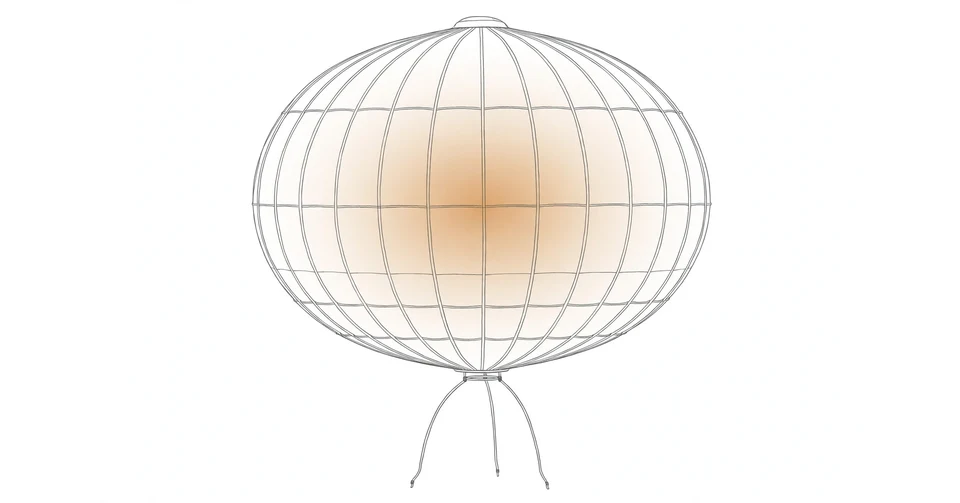
An Akari lamp is a light sculpture made from bamboo ribbing, Mino washi paper, and metal fittings. The paper is stretched over a bamboo frame, and a light bulb sits inside. When the lamp is switched on, the paper does not simply let the light through. It becomes luminous itself, glowing evenly across its whole surface, so that the lamp looks less like a container for a bulb and more like a solid piece of light.
Noguchi made two decisive changes to the traditional chochin when he designed the Akari lamp. First, he replaced the candle with an incandescent light bulb. That single change made the lantern safe and practical for a modern home, and it changed the quality of the light from a flickering flame to a steady glow. Second, he replaced the accordion silhouette of the traditional lantern with rounded, organic volumes drawn from his own sculpture. The shapes curve, swell, and taper in ways that feel carved rather than folded.
The materials of the Akari lamp stayed close to the tradition. The bamboo ribbing gives the lamp its structure and its rhythm, a set of thin lines that show faintly through the paper when the light is on. The Mino washi paper, made from kozo, or paper mulberry, gives the lamp its skin. It is strong and durable, which is why Noguchi could experiment with shapes that a weaker paper would not hold. The metal fittings, the base, the stand, and the hardware, hold the whole thing together without drawing attention to themselves.
Noguchi called the result Akari, a word meaning light in the sense of illumination, and carrying an implication of weightlessness. The name was a choice, not an accident. He could have called his lamps chochin, the ordinary word for a paper lantern, but he wanted a name that pointed to what the object did rather than what it had been. Light, and the feeling of lightness, were the whole idea.
He also designed a logo for the lamps, combining a stylized sun and crescent moon from the character for light. The mark appeared on early packaging and as a small red stamp at the base of each lamp. It was a quiet signature, a reminder that this was not a factory product but a sculptor's work, made to be recognised and remembered.
There is a temptation to describe an Akari lamp as a lamp that looks like art, but the Akari lamp reverses that idea. That gets the order wrong. Noguchi conceived the Akari lamp as sculpture from the very beginning, and the fact that it also lights a room was part of the sculpture, not an addition to it. The paper becoming a luminous surface, the light spreading without a hard edge, the shape holding its own in a room even when switched off, all of that was the point. An Akari lamp does not decorate a room. It changes how the room feels.
The partnership that kept the Akari lamp handmade
A good design means little if no one can make it well, and Noguchi knew that from the start of the Akari lamp. He entered into a partnership with the Ozeki family workshop, Ozeki and Co., a firm founded in 1891 and one of the survivors of Gifu's lantern trade. Ozeki would oversee the construction of wooden molds on which each Akari lamp would be handbuilt, both for stringing the bamboo ribbing and for adhering strips of washi paper.
That partnership is still the heart of the story of the Akari lamp. Akari lamps are still handmade in Gifu by Ozeki today, more than seventy years after the first prototypes. Each lamp is built by hand on a mold, the bamboo ribs are placed one by one, and the washi paper is applied in strips. It is slow work, and it is the reason no two examples of the Akari lamp are perfectly identical. The slight unevenness of the paper, the small variations in the ribbing, are not flaws. They are the marks of a hand at work.
The arrangement also says something about how Noguchi saw craft. He did not arrive in Gifu, take what he needed, and leave the makers behind. He worked with a local workshop, used local materials, and built a product that kept local skills alive. The mayor had asked him to help revitalize an industry, and the partnership with Ozeki was the practical answer to that request. Design, in this story, was not a rescue performed from above. It was a collaboration, and it lasted.
It is worth pausing on that point, because it runs against the usual story of modern design. The usual story is about a famous name and a factory, about a sketch that becomes a product line. The Akari lamp is different. Its value comes from the fact that it is still made by hand, in the same city, by the descendants of the same workshop. When you switch on an Akari lamp, you are not just turning on a light. You are keeping a small piece of Gifu's craft economy alive, and that is a quieter and more honest kind of luxury than most designer objects offer.
Noguchi set up a Tokyo office and showroom for Akari and Associates, with help from a small group of friends, including his half brother Michio, the film producer Kiichi Ichikawa, the printmaker Ansei Uchima, and the sculptor Tsutomu Hiroi. The business side mattered, because a lamp that cannot reach buyers cannot save a workshop. But the centre of the work stayed in Gifu, where the hands that knew the craft did the making.
The paper that makes the light
No account of the Akari lamp is complete without its paper, because the Akari lamp is, in a real sense, a paper object first. The lamp uses Mino washi, a handmade paper from the Mino region of Gifu Prefecture, made from kozo, the bark of the paper mulberry. Washi has been made in Japan for more than a thousand years, and Mino washi is one of its most respected forms. It is thin, strong, and translucent, which makes it ideal for a lamp. It lets light through while softening it, so the glow is gentle rather than harsh.
The craft behind the paper is as demanding as the craft behind the lamp. Mino washi is made by hand, sheet by sheet, from fibres that are soaked, stripped, beaten, and formed in water. The process takes skill, patience, and clean water, and the result is a paper that can last for centuries if it is cared for. That durability mattered to Noguchi. He wanted a lamp that would age gracefully, not a disposable object, and the strength of washi let him experiment with shapes that would have torn a weaker material.
In 2014, the traditional craft of making washi paper, including Mino washi, was inscribed by UNESCO as Intangible Cultural Heritage. That recognition came decades after Noguchi's first lamps, but it confirms what he saw in 1951. The paper was not a cheap substitute for glass or plastic. It was a material with a history, a technique, and a value of its own. If you want to understand the deeper tradition behind this lamp, the story of washi paper and the thousand year craft behind Japan's toughest sheets traces how that paper is made and why it lasts.
There is also a detail in the making that Noguchi valued and that most buyers never notice. The bamboo ribs of an Akari lamp are not always evenly spaced. In many models, Noguchi used a random wound, spiralled ribbing that exposed larger areas of paper and created an irregular, organic density. The effect is subtle. Light escapes unevenly, the surface seems to breathe, and the lamp feels less like a manufactured object and more like something grown. In the 1960s, he went further, experimenting with models that did away with ribbing altogether and draped washi over wire armatures instead.
Even the slow degradation of washi was part of his thinking. An Akari lamp that is collapsed and reinstalled many times will take on a wrinkled character, and Noguchi treated that as a feature, not a defect. Paper ages, and the lamp records that ageing in its surface. A plastic lamp stays the same until it breaks. An Akari lamp changes with its owner, and that change is honest.
That honesty is, to my mind, the most quietly radical thing about the Akari lamp. We live surrounded by objects designed to hide their age and their making, to look new forever and then to be thrown away. An Akari lamp does the opposite. It shows its ribs, it shows its paper, it wrinkles with use, and it asks to be kept. There is an ethical lesson in that, small but real. To choose an object that ages well is to choose a slower relationship with the things we own, and a slower relationship is often a kinder one, to the maker, to the material, and to ourselves.
Folding flat, travelling far
One feature of the traditional chochin survived intact in the Akari lamp, and it turned out to be one of the most practical virtues of the Akari lamp. The lamps keep the collapsible construction of chochin. They fold flat for storage and shipping, packed in an envelope or a shallow box, and they spring back into shape when they are unpacked and installed in a home.
Noguchi emphasized this feature from the beginning, and the Noguchi Museum's history of the lamps notes that he saw it as central to the design. A sculpture that folds flat is a strange and wonderful thing. It means the lamp can travel cheaply, be stored easily, and be sent to buyers far from Gifu without a crate. It also means the lamp belongs to a tradition of portable, practical objects, not to the world of heavy, fixed sculpture.
That portability helped the Akari lamp spread, and each Akari lamp that travelled carried the idea with it. The first Akari exhibitions were held in Tokyo and Osaka in 1952, only a year after the first prototypes. The first New York exhibition followed in April 1955, at Bonniers, and the lamps began to appear in design magazines and shops. Noguchi registered patents in Japan and the United States, not for the paper shapes themselves but for the hardware, the stretchers, harps, and fittings that made the lamps work. He knew that imitations would follow, and he wanted to protect the craft that made the real lamps possible.
By the late 1960s, the practical work of running the venture was delegated to his manager and publicist Priscilla Morgan and his friend and collaborating architect Shoji Sadao in the United States, and to his half brother Michio in Japan. Noguchi continued to pass through Gifu on most trips through Japan, adding new variations to the catalogue until his death in 1988. The lamps outlived him, and they are still in production today, which is a rare fate for a design object. Most lamps are forgotten within a decade. An Akari lamp is still being made, still being bought, and still being switched on in homes that were not built when it was designed.
The folding construction also carries a small lesson about design itself. The best solutions are often the ones that were already there, waiting to be noticed. Noguchi did not invent collapsibility. He inherited it from the chochin makers, recognised its value, and kept it. Good design is not always about adding something new. Sometimes it is about refusing to throw away something wise.
The many shapes of an Akari lamp
Over the decades, the Akari lamp grew into a large family of forms. Ozeki lists more than one hundred works in the series, and counting every size variation pushes the total higher, with some accounts describing more than two hundred iterations in different shapes, sizes, and colours. The conservative count, more than one hundred distinct designs, is already remarkable for a single lamp concept. The higher figure, which includes variations in size and colour, shows how far one idea can stretch without breaking.
The early models of the Akari lamp, made between the first prototypes in the spring of 1951 and an exhibition in August 1954, already numbered nearly thirty. Some were variations in size based on a particular shape. Early models such as the 7A retained the wooden rim of traditional chochin and occasionally used coloured designs on the paper. Noguchi added colour and script in part because, in Japanese culture, white lamps are associated with death and veneration, and he wanted his lamps to feel alive in a home.
The series that followed gave buyers a clear set of choices, and each series has its own character. The STAND series uses a slender three or four legged iron wire base and ranges from small table lamps to large floor lamps. The base is deliberately light, reflecting Noguchi's determination to make the form as light as possible in every detail. The PENDANT series hangs from the ceiling in many sizes, and even the models that look like simple spheres are shaped with curves that Noguchi developed by hand carving the molds and making full scale three dimensional models.
The BB series pairs a bamboo support with a cast metal base, a distinctly Japanese approach to materials that lets the bamboo do the visual work while the metal provides the weight. The LONG series is a large suspended series, made with the idea of floating within expansive spaces such as atriums, and it can also be displayed close to the floor as a floor stand when combined with a cast metal base. The UF series, which appeared in the 1980s, has spider like legs, an evolution of the earlier stand structure, with a central plate that houses the socket and legs that splay outward to lift large shades higher from the ground.
There is something generous about this variety. Noguchi did not design one perfect lamp and stop. He kept returning to the idea, testing new shapes, new stands, and new scales, from a small lamp for a bedside table to a great glowing form for a public hall. The Akari lamp is not a single object. It is a language, and Noguchi spent nearly forty years learning how many sentences it could speak.
For readers who want the fuller context of the lantern tradition that Noguchi encountered on the Nagara River, the story of the chochin paper lantern Japan folds away and brings back to life traces that craft from its origins to its modern uses, and it shows how much of the old lantern survived inside the new design.
From Gifu to the museum wall
The Akari lamp was designed for homes, but museums claimed the Akari lamp early, and that double life is part of its interest. A lamp that belongs in a living room and in a museum collection is a rare thing. Most objects choose one world or the other. The Akari lamp refused to choose.
The exhibitions came steadily. After Tokyo and Osaka in 1952 and New York in 1955, the lamps were shown at the Cordier and Ekstrom Gallery in New York in 1969, in an exhibition called Shapes of Light. In November 1977, the Museum of Modern Art in New York held Noguchi, Sculptor as Designer, an exhibition that featured many Akari works. Later shows included a fiftieth anniversary exhibition at the Noguchi Museum in New York in 2001, and a large exhibition at the National Museum of Modern Art in Tokyo in 2003.
Today, Akari works are held by the Museum of Modern Art and the Metropolitan Museum in New York, the Musee des Arts Decoratifs in Paris, and the Victoria and Albert Museum in London. The lamps have also received the Good Design Award in Japan, a recognition that sits comfortably alongside their museum presence. The award honours good design for everyday life, and the museum collections honour the lamps as art. Both honours are deserved, and neither cancels the other.
That double recognition raises a question worth sitting with about the Akari lamp. What makes an object art, and what makes it a useful thing? The Akari lamp suggests that the line is thinner than we think. A well made lamp that gives beautiful light, that is made by hand from honest materials, that ages gracefully and folds flat for travel, is already doing the work that art does. It changes how we see a room, how we feel in it, and how we think about the hands that made it. The museum did not make the Akari lamp important. It recognised an importance that was already there, in the paper and the bamboo and the light.
Noguchi himself was clear about the stakes. He described the Akari lamp as elegant people's art, a phrase that captures his ambition exactly. He wanted to bring sculpture into a more direct involvement with the common experience of living. A sculpture in a gallery is seen by visitors. A lamp in a home is lived with, switched on every evening, and folded away when a family moves. That everyday contact, repeated thousands of times, is a deeper kind of encounter than a single museum visit, and Noguchi knew it.
The official history kept by the Noguchi Museum tells this story in full, from the night on the Nagara River to the later exhibitions and the lamps' continuing production, and it is the best single place to read the account in Noguchi's own institutional voice. The history of Akari light sculptures from the Noguchi Museum traces the prototypes, the partnership with Ozeki, and the decades of new models that followed.
The sculptor behind the light
Isamu Noguchi was born in 1904 in Los Angeles, California, to a Japanese father, the poet Yonejiro Noguchi, and an American mother, the writer and educator Leonie Gilmour. He was raised in the United States and Japan, moving between the two countries and the two cultures that shaped him. By the late 1940s, he was a well respected sculptor, known for public works, gardens, and stage designs as well as for gallery sculpture.
That background matters, because the Akari lamp is a work of translation, and the Akari lamp could only have come from someone who belonged, in part, to both worlds. Noguchi understood Japanese craft from the inside, through his father and his time in Japan, and he understood Western modernism from the inside too, through his training and his career in the United States and Paris. He could see the chochin both as a Japanese person might see it, as a familiar object with a history, and as a modern sculptor might see it, as a form with possibilities no one had yet explored.
In 1949 and 1950, just before the Gifu visit, Noguchi had travelled on a Bollingen Foundation fellowship to study the role of sculpture in the public sphere throughout the ages, visiting France, Italy, Greece, Egypt, India, Sumatra, and Japan. He looked at religious and civic sculpture, public spaces, fountains, architectural follies, and local handcrafts. He was thinking, in other words, about how sculpture lives in the world, not just in galleries. The Akari lamp was the practical answer to that question. It was sculpture that lived in a home, that was used every day, and that anyone could own.
Noguchi's earlier experiments with light point in the same direction. In the 1930s, he made a prototype called Musical Weathervane, meant to glow when activated. In the late 1930s and early 1940s, he worked with magnesite, an industrial plaster, to create larger interior environments with concealed coloured light elements. He gave these experiments the catchall name Lunars. Later, in the mid 1940s, he made a cylinder lamp with a polyvinyl shade wound around three upright mahogany posts as a gift for his sister, a prototype for a model later put into production. Step by step, he was moving toward the idea that light itself could be a sculptural material. Gifu gave him the craft, the paper, and the makers to realise it.
There is a humility in this part of the story that deserves notice. Noguchi was already famous when he went to Gifu. He could have treated the commission as a minor side project, a favour to a small city. Instead, he gave it decades of attention, returning to the designs again and again, defending them against imitations, and placing them at the centre of major exhibitions late in his life. In 1985, working with the architect Arata Isozaki, he placed Akari at the centre of an exhibition at the Yurakucho Cultural Forum in Tokyo, in one instance propping an Akari lamp directly on top of a basalt sculpture. The following year, when he represented the United States at the Venice Biennale, he again put Akari at the heart of his installation, designing thirteen new models for the occasion. He defended that choice by saying that, in three decades of work, the Akari project was perhaps the one chapter of his career that brought him joy.
That joy is worth remembering. Artists are often portrayed as solitary figures, wrestling with grand ideas in isolation. Noguchi's joy came from collaboration, from a river, a mayor, a workshop, and a paper maker, and from the knowledge that his sculpture would be switched on in ordinary rooms. There is something deeply hopeful about that. It suggests that art does not have to stand apart from life to matter. It can be the light above a table, doing its quiet work every evening.
A pad and a light
Noguchi once said that all a young couple needed in starting life together was a futon and an Akari above, a pad and a light. That single Akari lamp, hanging over a new home, was enough. The line is quoted in the Noguchi Museum's history of the lamps, and it is worth reading slowly. He was not talking about minimalism as a style. He was talking about what a home actually needs to begin.
A futon is a place to sleep. An Akari lamp is a place to gather. Together, they make a room into a home, not because they are expensive or impressive, but because they answer real needs with grace. The lamp gives light, but it gives more than light. As Noguchi put it, the paper of the Akari lamp becomes luminous as a result of the light inside, so that the whole surface glows, however distant the light may be from the bulb. It is lighting itself, not just a device for lighting a room.
That idea, that a lamp can be lighting itself, is the heart of the Akari lamp. Most lamps hide their light source behind a shade and throw light onto the walls. An Akari lamp becomes the light. The paper glows, the room softens, and the boundary between the object and its effect disappears. It is a small piece of poetry, made from paper and bamboo, and it works every time it is switched on.
Ozeki's own account of the lamps makes the same point in plainer language. The company describes the Akari lamp as a sculpture of light, made by drawing on the quality of washi paper that softly diffuses light and by stretching the bamboo ribs in a rough and irregular manner, so that the natural shrinkage and wrinkles of the paper are preserved. The official AKARI page from Ozeki gives the full history of the series, the different models, and the workshop that still makes them by hand in Gifu.
There is a lesson in the futon and the Akari lamp that goes beyond design. A young couple starting life together does not need much, and what they need most is not things but conditions, a place to rest and a light to live by. Noguchi understood that a home is made from a few good things, chosen well and kept for a long time, rather than from many things bought quickly and replaced often. In a world that sells us more of everything, that is a calm and countercultural idea, and it is one worth keeping.
I think about that line whenever I see a room lit by a single warm lamp rather than by a ceiling full of harsh white bulbs. The single lamp asks less of us. It does not flood the room or demand attention. It gathers the people in the room toward it, softens the edges of the evening, and lets conversation happen. That is what light is for, not to expose everything, but to make a space where people can be together. An Akari lamp does that work with unusual grace, and it does it with materials that a child could name, paper, bamboo, and a bulb.
Why the Akari lamp still glows
More than seventy years after that night on the Nagara River, the Akari lamp is still in production, still handmade in Gifu, and still finding new homes, and the Akari lamp still earns that place. That longevity is not an accident. It comes from a combination of things that are hard to fake, honest materials, a clear idea, a skilled workshop, and a design that was never about fashion.
The lamp also survives because it answers a need that has not gone away. We still want our homes to feel warm. We still want objects that are made by hand and that show the hand in their making. We still want light that is soft rather than harsh, and we still want to own fewer, better things. The Akari lamp offers all of that, and it offers it without shouting. It does not need to announce itself as sustainable or artisanal or timeless. It simply is those things, quietly, in paper and bamboo.
There is also a broader lesson here about how traditions survive. The chochin makers of Gifu were not saved by nostalgia, and they were not saved by a museum. They were saved, in part, by a sculptor who took their craft seriously enough to change it, and by a workshop that was willing to learn new shapes while keeping old skills. Traditions do not survive by staying exactly the same. They survive by finding new forms that let old knowledge live in a new world. The Akari lamp is proof of that, and it is a hopeful proof. It says that a craft can be both old and new, both local and universal, both useful and beautiful, all at once.
If you ever stand in a room lit by an Akari lamp, take a moment to look at the paper, not just the glow. The ribs show through faintly. The surface has a slight texture, a small wrinkle here and there. The light is even, but it is not flat. It has depth, the way a paper lantern on a river must have had depth on that night in 1951. That depth is the work of many hands, a paper maker in Mino, a bamboo worker in Gifu, a sculptor who saw a future in a fading craft, and a family that kept making the lamps long after the sculptor was gone.
An Akari lamp is, in the end, a simple thing. Paper, bamboo, metal, and light. But simplicity, when it is earned by attention and care, is not simple at all. It is the hardest thing to make, and the most lasting. That is why a lamp designed in a day, from a sketch made after a night on a river, is still glowing in homes and museums today, and why it will probably still be glowing long after the lamps we buy now have been forgotten.
More in Culture & Society
- Chochin Is the Paper Lantern Japan Folds Away and Brings Back to Life
- Odalan Is the Birthday Bali Gives Every Temple
- Japanese Mythology and the Gods Who Shaped an Island Nation
- Mepeed Is the Slow Walk That Carries Bali to the Temple
- Gebogan Is the Tower of Fruit Bali Carries to the Temple
- Banten Are the Offerings Bali Makes Out of Almost Nothing
Latest posts
- Amado Are the Storm Shutters That Close Japan for the Night
- Tama Nuki Is the Rite That Lets a Sacred Object Rest
- Japanese Noh Theatre and the Slowest Drama on Earth
- Tamashii Ire Invites a Soul Into a Sacred Object
- Kaigen Kuyo Is the Ceremony That Wakes a Sacred Object
- Ihai Are the Lacquered Tablets That Keep a Name Alive
- A Butsudan Keeps the Dead Close in a Japanese Home
- An Engawa Is Neither Inside nor Outside, and That Is the Point
- Nikko and the Shrines Hidden in the Cedar Forest
- Minka Are the Folk Houses Japan Built Around the Hearth
- Miyadashi Is the Moment the God Leaves Home
- Otabisho Is Where the God Rests on the Way Through Town
- Mikoshi Are the Portable Shrines Japan Carries on Its Shoulders
- Sanja Matsuri Turns Asakusa Into Tokyo's Loudest Weekend
- The Orangutan and the Vanishing Forests of Borneo