Chochin Is the Paper Lantern Japan Folds Away and Brings Back to Life
· 14 min read
A chochin is a Japanese paper lantern built to fold flat, and for centuries it has lit streets, shrines, festivals, and family altars across Japan.
Walk through Asakusa after dark and the first light you notice is rarely electric. It is the warm, uneven glow of a chochin, a folding paper lantern hanging outside a shrine gate, a noodle shop, or a festival stall. The lantern looks simple, almost too simple to deserve a second look, and that is the trick. Inside that paper shell sit five centuries of engineering, craft, and daily habit.
A chochin is a paper lantern built around a spiral of split bamboo and covered in washi, the paper made from the inner bark of the mulberry tree. Its defining property is not that it gives light. It is that it collapses. Folded, it becomes a flat disc you can carry in one hand. Opened, it becomes a glowing sphere, and the largest examples stand taller than a person and weigh as much as a small car.
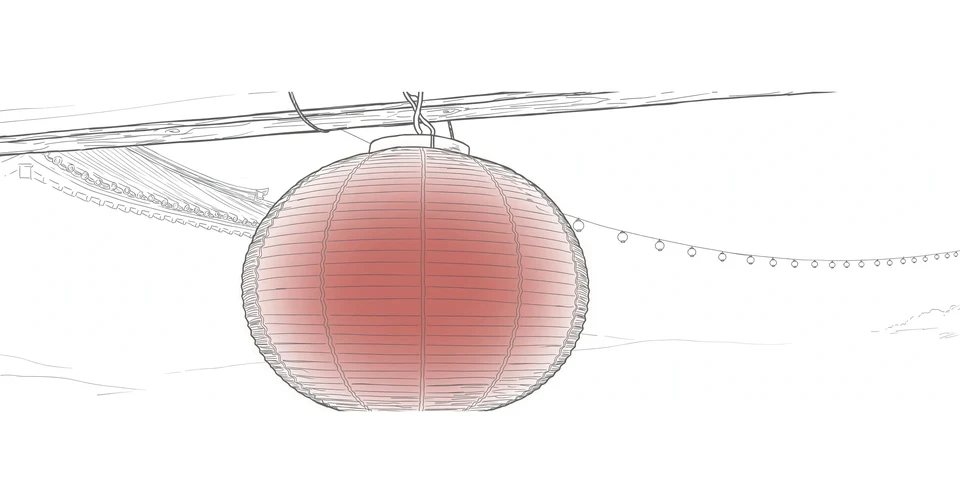
The name itself says what the object is for. The characters read chochin, and they combine the ideas of carrying and light, a lamp you take with you. That is the whole story in two strokes. Japan did not invent the paper lantern, but it invented the version that folds away, and that one small change turned a fragile light into something a traveler, a shopkeeper, and a whole festival could rely on.
What a chochin is, and why it folds
Look inside a chochin and you will not find a series of hoops. You will find a single continuous strip of split bamboo, wound in a spiral from the bottom ring to the top. That spiral is the mechanism. It has spring in it, and it lets the whole body compress into the space between the two wooden rings at either end. The paper is glued to the outside of that skeleton over a sectional wooden mould, which is then dismantled and pulled out through the opening once the glue is dry. The lantern is, in effect, a moulded object with no mould left inside it.
Before electricity, a lantern was equipment. A traveler carried one, a night watchman carried one, and a shopkeeper hung one out at dusk and took it in at closing time. Something you carry needs to fold, and something a merchant hangs out every day needs to store flat for the other twenty hours. The practical requirement produced an object with no fixed volume, a thing that is a sphere when lit and a disc when it is not, and it explains why the format survived long after the candle inside it stopped being necessary.
I like that the design solves a storage problem rather than a lighting problem. Most beautiful objects ask you to make room for them. A chochin asks for almost nothing when it is not working, and then it opens up and does its job.
From China to the streets of Edo
The ancestor of the chochin arrived from China around the sixteenth century, in a form that had no folding mechanism at all. It was a light you carried in something that would not blow out, and that was enough for its time. Japan's own record picks the thread up a little later. The earliest confirmed evidence of hand-painted chochin in Tokyo dates to the Bunki era, from 1501 to 1504, still within the Muromachi period, and it describes the object as a kago-chochin, a lantern held inside a rigid bamboo basket rather than a pleated, self-supporting shell. Its older relative, the andon, is a fixed lamp with a rigid frame, a piece of furniture that stands on a floor or a table and never folds. The caged, non-folding form came first, and the now-familiar folding version did not yet exist.
The pleating breakthrough is generally traced to Odawara, a post-station town on the Tokaido road between Edo and Kyoto. An artisan there built a portable lantern for travelers passing through, light enough to carry and collapsible enough to pack away between stops. As ordinary travel along the Tokaido grew more common in the Edo period, before electric lighting existed, this Odawara chochin became one of the era's essential travel items. From that traveler's lantern, the shape multiplied into box styles, home variants, bow-strung yumihari-chochin, and signboard chochin, the kind outside restaurants today.
The exact date of the folding breakthrough is not settled. The honest version of the story is a slow shift rather than a single invention, as a lighting tool for the privileged became, within a couple of centuries, an object every household and festival stall owned.
The spiral inside the paper
The paper a chochin wears matters as much as its frame. The workshops that still paint lanterns by hand often use Nishinouchi washi, made in the Mito area of Ibaraki Prefecture. The paper has roughly 350 years of history behind it, and it is made from Nasu kozo, mulberry fiber grown around Hitachiomiya and Daigo, prized for being lightweight, durable, and resistant to both water and folding. That last quality is the one that counts, because a chochin is folded and opened hundreds of times in its life.
Why a chochin is never painted like calligraphy
The lettering on a hand-painted chochin has its own name, kago-moji, and its own logic, and it runs in the opposite direction from ordinary Japanese calligraphy. Calligraphy is written in a single continuous motion, the brush loaded once and drawn through the whole character. A chochin painter reverses that entirely. There is a pencil sketch first, then a black outline, what the trade calls sobyo, around each character, and only afterward is the interior filled in. The reason is not stylistic preference. It is physics. A chochin surface is never flat, since it is pleated paper over a coiled frame, ridged wherever the folds sit, and a single unbroken brushstroke simply breaks apart on it. Outlining first and filling second is how you write legibly on something that is not a page. A printed lantern applies flat artwork to a flat sheet before it is assembled into shape, while a hand-painted chochin is written after assembly, directly onto a surface that already curves and folds, which is precisely the surface no printer is built to handle. A full account of the craft, told through one Tokyo workshop, shows how stubbornly that hand-painted tradition survives in a printed age.
That workshop is Namidabashi Oshimaya, near the Namidabashi intersection in Tokyo, and its owner, Kenichiro Murata, is the fourth generation of his family to run it. The shop was founded in 1913, in the second year of the Taisho era, which makes it 113 years old. The division of labor follows the same outline-then-fill logic as the lettering itself. Murata and his father handle the outlining, the step that requires reading the character correctly and placing it on a curved, uneven surface, while the filling in of color can be handed off once that outline exists. As Murata puts it, once the two of them have done the outlining, honestly, even his mother can handle the filling in, since the difficulty sits not in applying paint, but in deciding, correctly, where the paint goes.
The writing is the whole point
Every serious chochin carries characters, and almost none of them are decorative. A lantern outside a bar carries the name of the bar. A lantern at a shrine carries the name of the person or company who paid for it. A lantern at a festival carries the name of the neighborhood association fielding the float. A lantern in a noodle shop may carry a single word, ramen, oden, or sushi, because that is all a passer-by needs at eye level in the dark.
A plain red chochin outside a small establishment is a signal every Japanese adult reads instantly. The red lantern is the ordinary word for the kind of no-frills, loud, smoky drinking place where grilled skewers arrive on the counter and nobody books a table. The lantern is not advertising the bar. It is the category. Most writing about paper lanterns treats them as ambience, but they are not. A chochin is a signboard that happens to glow, and it is one of the oldest continuously used forms of outdoor advertising anywhere. Understanding the characters painted on them turns a row of pretty lights into a street directory.
At shrines and temples, the rows of lanterns flanking an approach are a subscription list. Each one records a donation, and the size and position reflect the sum, so a visitor walking that avenue at night is reading, without realizing it, the ledger of who funded the place. The light is the receipt.
The giant chochin at the Thunder Gate
Ask most visitors to picture a chochin and one lantern comes to mind, the giant red one at Kaminarimon, the outer gate of Senso-ji in Asakusa. It is the giant red lantern, the chochin, that hangs under the center of the roof, and it is 3.9 meters tall and 3.3 meters wide, weighing about 700 kilograms, roughly as much as a small car, hung from a wooden beam above the heads of everyone who passes. Its front carries the gate's name in bold black characters, and its back carries the formal name, Furaijinmon. Underneath, carved into the metal base, is a dragon, a small work of art that rewards anyone who stops and looks up.
The lantern is not permanent. Paper and bamboo do not last forever, especially outdoors, so the great lantern is remade roughly every ten years by Takahashi Chochin, a Kyoto workshop that has made the lantern for generations. The current lantern is the sixth of its line, and each new one is built to the same measurements as the last, so the Kaminarimon never changes even as its most famous part is renewed. There is something reassuring about that. The lantern is rebuilt on purpose, before it fails, and the gate goes on looking exactly as it always has.
What surprises most people is where the lantern is actually made. Despite standing at the gate of one of Tokyo's most photographed landmarks, the giant chochin is made in Kyoto, not Tokyo. The gate itself burned down in 1865 and was rebuilt in 1960 with a donation from Konosuke Matsushita, founder of the company now called Panasonic. The full story of the gate, from its tenth-century beginnings to the festival that folds its lantern, is told in Kaminarimon Is the Thunder Gate That Opens Asakusa to the World.
Once a year, the lantern does something surprising. During the Sanja Matsuri, the great festival of Asakusa, the lantern is folded up and raised so that the tall portable shrines, the mikoshi, can pass through the gate. For a few days the Kaminarimon stands without its most famous feature, and the gate looks strangely bare. Then the festival ends, the lantern comes down again, and the gate is itself once more. I find that detail touching. Even the most photographed object in Asakusa steps aside when the festival needs the road, and the gate proves that it is still a working gate, not a museum piece. The largest chochin in the country obeys the same rule as the smallest.
A second giant at the Hozomon
The Kaminarimon is not the only giant at Senso-ji. Walk on through the temple grounds and you reach the Hozomon, the gate that guards the treasure house behind the main hall, and it is also a gate of lanterns. The largest is a red chochin paper lantern that hangs under the centre of the gate's opening, above the heads of the people passing through. It is 3.75 metres tall and 2.7 metres wide, and it weighs about 400 kilograms. It carries the name of Kobunacho, a town in the old merchant district of Tokyo, whose people donated it. The current lantern dates from 2003, when the people of Kobunacho gave money to mark the 400th anniversary of the start of the Edo period. The full story of that gate and its treasure house is told in Hozomon Guards the Treasure House Behind Senso-jis Main Hall.
Gifu, Noguchi, and the lamp in your living room
Gifu, in central Japan, has made lanterns for centuries, using mulberry-bark paper and local bamboo. By the mid-twentieth century the industry was in bad shape. Mass-produced imitations had flooded the market before the war, and the war finished the job. Then, in the spring of 1951, the sculptor Isamu Noguchi passed through Gifu on his way to Hiroshima and watched the cormorant fishing on the Nagara River at night, each boat lit by chochin. The mayor, learning that Noguchi was in town, asked him whether he could do something for the failing lantern trade. Noguchi had two designs sketched the following day.
He called the result Akari, a word meaning light in the sense of illumination, and carrying an implication of weightlessness. He replaced the candle with an electric bulb, and he replaced the accordion silhouette with rounded organic volumes drawn from his own sculpture. He entered into a partnership with the Ozeki family workshop, and Akari lamps have been made there, by hand, ever since. A detailed history of the lantern, from its folding frame to its festival and Obon roles, sets out how that Gifu tradition survived into the modern living room.
The lanterns that are not decoration
For three days in mid-August, Japanese households mark Obon, when the dead are held to return to their families. The chochin has a job in this. A mukaebi, a welcoming fire, is lit at the start so that the returning spirits can find the house, and an okuribi, a sending-off fire, closes the festival. Where an open fire is impractical, which is most of urban Japan, a bon-chochin does the work, hung at the entrance or beside the household altar for the duration. Some regions end Obon with toro nagashi, floating paper lanterns released onto a river or the sea to carry the spirits back out. The rounder bonbori belongs to the Hina Matsuri doll display and to shrine paths at dusk, made for softness rather than for reading, while the tall pole-mounted takahari-chochin is raised high enough to be seen across a crowd at festivals and funerals.
Paper, vinyl, and what changed
Walk a Japanese street tonight and most of the lanterns you pass are not paper. They are vinyl, printed by machine, lit by a low-energy bulb or an LED strip, and they will survive rain that would destroy a washi lantern in an afternoon. This is not a decline story, or not only one. A bar owner needs a sign that lasts through a typhoon season and costs what a sign should cost. Vinyl does that. What it does not do is age. A washi lantern yellows, softens, and eventually tears at the folds, and a shop that has hung the same paper lantern for thirty years is displaying its own longevity along with its name.
A ghost story, not the object
One piece of folklore is worth clearing out of the way, since it crowds every search on this word. A chochin-obake, a one-eyed, long-tongued yokai said to haunt an old, discarded lantern, is a ghost story, not a craft object. It tells you nothing about how a lantern is made, who paints it, or why it folds. The real object needs no ghost to be interesting.
The quiet lesson of a folding lantern
A chochin is a small argument for a way of living. It does not insist on taking up space when it is not needed. It folds for the traveler, folds for the shopkeeper at closing time, folds for the festival that needs the road, and folds for the family that brings it out once a year. Then, when it is wanted, it opens again, and it is exactly as bright as it was before. Nothing about it is wasted, and nothing about it is loud.
Most of the objects we live with do the opposite. They stay the same size whether we need them or not, and they ask us to build our rooms around them. A chochin asks for a flat shelf and a little patience, and in return it gives a street its glow, a shrine its name, and a family its welcome home. That is a fair trade, and it has held for five hundred years.
More in Culture & Society
- Odalan Is the Birthday Bali Gives Every Temple
- Japanese Mythology and the Gods Who Shaped an Island Nation
- Mepeed Is the Slow Walk That Carries Bali to the Temple
- Gebogan Is the Tower of Fruit Bali Carries to the Temple
- Banten Are the Offerings Bali Makes Out of Almost Nothing
- Tama Nuki Is the Rite That Lets a Sacred Object Rest
Latest posts
- Amado Are the Storm Shutters That Close Japan for the Night
- Japanese Noh Theatre and the Slowest Drama on Earth
- Tamashii Ire Invites a Soul Into a Sacred Object
- Kaigen Kuyo Is the Ceremony That Wakes a Sacred Object
- Ihai Are the Lacquered Tablets That Keep a Name Alive
- A Butsudan Keeps the Dead Close in a Japanese Home
- An Engawa Is Neither Inside nor Outside, and That Is the Point
- Nikko and the Shrines Hidden in the Cedar Forest
- Minka Are the Folk Houses Japan Built Around the Hearth
- Miyadashi Is the Moment the God Leaves Home
- Otabisho Is Where the God Rests on the Way Through Town
- Mikoshi Are the Portable Shrines Japan Carries on Its Shoulders
- Sanja Matsuri Turns Asakusa Into Tokyo's Loudest Weekend
- The Orangutan and the Vanishing Forests of Borneo
- Waraji Straw Sandals Walked Japan for a Thousand Years