The Andon Lantern Lit Edo Homes With Oil and Paper
· 15 min read
The andon lantern was the standing oil lamp of Edo period homes, a box of washi paper around a small oil flame that lit dinners, reading, and bedtime.
Before the electric bulb, most Japanese homes went dark early, or they did not. They lit a lamp that stood still. The andon lantern was that lamp, a small box of paper and wood that turned a spoonful of oil into a warm, steady glow for the whole room.
Unlike the lanterns carried through the streets, the andon lantern stayed indoors. It stood on the floor or on a low table, close to the people sitting around it, and it did its work quietly for hour after hour. For most of the Edo period, from 1603 to 1867, it was the light ordinary families ate by, sewed by, read by, and fell asleep beside.
That modest box tells a larger story about how a society with little fuel and no electricity still made its evenings livable, and how a simple lamp became part of the language itself. The andon lantern did not hang in a temple or parade through a festival. It belonged to the home, and the home is where its story starts.
What an andon lantern actually is
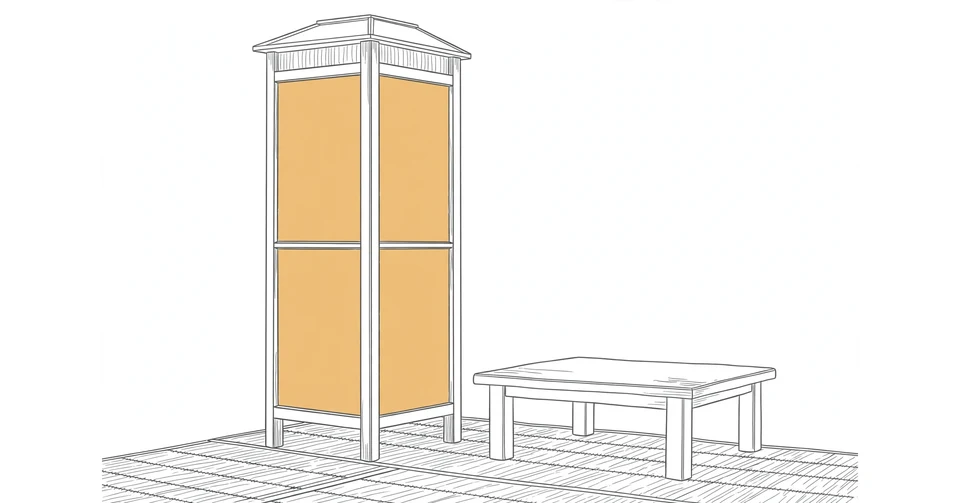
An andon lantern is a lamp made of paper stretched over a frame of bamboo, wood, or metal. Inside the frame sits a small holder of oil with a wick of cotton or plant pith, and the paper shields the flame from draughts. The lamp is usually open at the top and the bottom, and one side can be lifted away so the owner can reach in to light it, trim the wick, or refill the oil. That is the whole machine, and its simplicity is the point.
The frame gives the andon lantern its shape. Most indoor andons were upright boxes, taller than they were wide, with a handle on top so they could be carried from room to room. The paper was washi, the tough handmade paper that Japan had been making for centuries, and the light inside turned the whole box into a glowing panel. The government publication Highlighting Japan describes it plainly: the oil dish was surrounded by a fire box called a hibukuro, and washi was attached to that box, so the entire box shone as the light reflected on the paper. The result, the same source notes, was a lamp that seemed brighter than an open oil stand, and whose warm, gentle light gave people a sense of security.
It helps to picture the room it stood in. Before the Meiji period, which began in 1868, most Japanese people sat on tatami or wooden floors rather than on chairs. An open light stand with a tall pillar could not light the space in front of a person sitting on the floor, so lower lamps came into use, and the andon lantern was the natural answer. It put the flame at sitting height, behind paper, where it could light a book, a sewing basket, or a bowl of rice without blinding anyone or catching a draught.
Oil was the fuel, and the choice of oil said something about the household. Rapeseed oil was the most popular, pressed from seed and burned with a clean, steady flame. Candles were also used, but they cost more, so they were less common in ordinary homes. A cheaper alternative was sardine oil, which burned less sweetly but cost far less. Every family balanced brightness, smell, and price, and the andon lantern accepted all three fuels without complaint.
The andon lantern was a lamp any village could build and repair, and that self-reliance is part of its charm. It asked for nothing a community could not supply for itself, and in return it gave light every night for generations.
How oil, wick, and paper worked together
The working heart of an andon lantern was the oil dish and its wick. A shallow saucer held the oil, and a wick of cotton or of igusa rush pith lay across it, soaking up fuel until one end could be lit. The flame was small, and deliberately so. A large flame would have smoked, scorched the paper, and wasted expensive oil. A small flame, sheltered inside the hibukuro, burned steadily and threw its light outward through the washi.
The hibukuro, the fire box, is the part that makes the andon lantern different from an open oil stand. Earlier lamps, the todai light stands, held an oil dish on top of a pillar and left the flame exposed to every breeze. The andon lantern wrapped the flame in a box and covered the box in paper, which blocked the wind and spread the light at the same time. The paper did two jobs at once, and that double duty is the clever part of the design. It protected the flame and it became the lampshade.
Keeping the lamp going was a small daily ritual of filling the dish, trimming the wick, and wiping soot from the paper. The most common indoor type, the okiandon, often had a drawer at the bottom to make refilling and lighting easier, which shows how much the makers thought about the daily user rather than the occasional visitor.
The light itself was dim by modern standards, and honesty demands saying so. A single andon lantern gave a soft glow, enough to read by if you sat close and enough to eat by, but not enough to flood a house the way a ceiling bulb does. Families placed the lamp where the work was and moved it when the work moved. There is an intimacy in that arrangement that a bright ceiling light can never reproduce, and I suspect that is why the glow of an andon lantern still feels comforting in photographs and museum displays today.
The family of andons
Not every andon lantern looked the same, because not every room needed the same lamp. Over the Edo period, makers shaped the basic box into several distinct types, each fitted to a place and a purpose.
The okiandon was the common indoor type, a standing box lamp placed on the floor. Many had a vertical box shape with an inner stand for the light, a drawer at the bottom for refilling, and a handle on top for carrying. This was the workhorse of the household, the lamp that lit the evening meal and the sewing after it.
The ariake-andon was a bedside lamp, and it was the cleverest of the family. Its name comes from ariake, the moon still visible at daybreak, and the design lived up to the name. The hibukuro sat inside a wooden box with cut-outs in the shape of full and crescent moons. During waking hours the fire box could be lifted out and set on top of the box to light the room brightly. At bedtime it went back inside, and light escaped only through the moon-shaped cut-outs, dimming the room to a sleepy glow. The user could adjust the light simply by moving the box. I admire that kind of design intelligence, a lamp that changes its character without a switch, a dial, or a second device. It solved a real problem, how to keep a flame burning all night without keeping a sleeper awake, with nothing more than a box and a few holes.
The kakeandon was the hanging type, often seen under the eaves of a shop, frequently bearing the name of the merchant. It turned a lamp into a sign, announcing the shop after dark and guiding customers to the door. An andon lantern of this kind worked outdoors but belonged to a building, fixed in place like a nameplate that happened to glow.
The Enshu andon was a tubular variety, named in one explanation for Kobori Enshu, the tea master and garden designer of the late Azuchi-Momoyama and early Edo periods. Unlike the boxy okiandon, it had an opening instead of a drawer, and its slim cylinder gave it a different silhouette. The name alone shows how the lamp had entered the world of taste and tea culture, where even a household light could carry the name of a famous aesthete.
These types show that the andon lantern was not one object but a small family, adapted by use. A floor lamp, a bedside lamp, a shop sign, and a tea room lamp all shared the same principle, paper around a small oil flame, and each bent that principle to a different need.
Hiru andon, the lamp that became an insult
A lamp that every household knew could also become a figure of speech, and the andon lantern did. The expression hiru andon means a daytime lamp, an andon burning in broad daylight, and it came to mean a person or a thing that serves no purpose. A lamp is only useful in the dark, so a lamp lit at noon is a lamp wasted, and by extension a person described that way is someone who contributes nothing.
The phrase is tied to one of Japan's most famous stories. In dramatizations of the tale of the forty-seven ronin, Oishi Yoshio, the leader of the loyal retainers, is often described as a hiru andon, as Wikipedia's overview of traditional Japanese lighting notes. After the death of their lord, Oishi pretended to have given up, drinking and idling in public while he secretly planned the revenge that would make the ronin legend. To onlookers he looked like a useless man, a lamp burning pointlessly in daylight, and the insult was exactly the cover he needed. The story may be dramatized, but the insult survives because the image is so clear. Everyone who had ever trimmed an andon wick knew at once what a daytime lamp meant.
There is a warning in that phrase that still applies. We are quick to call someone useless when we cannot see what they are for, and slow to ask whether we are looking at them in the wrong light, at the wrong hour. Oishi was not useless. He was waiting, and the people who mocked him had mistaken patience for idleness.
The andon lantern beside the chochin
Every Japanese paper lantern is not the same, and the andon lantern is best understood next to its more famous relative, the chochin. The two lamps shared paper and flame, but they were built for opposite lives.
The chochin is the folding lantern. Its frame is a spiral of thin bamboo strips, its paper fixed to that spiral, and a candle burning inside. Because the spiral collapses, the whole lantern folds down into the basket at its base, which made it easy to carry on the road. The chochin was the outdoor lamp, carried in the hand or hung outside a house, and travelers on the Tokaido road between Edo and Kyoto relied on it after dark. The Odawara chochin, one of the most famous types, was made so that pushing the lids at the top and bottom together folded the fire box in like an accordion.
The andon lantern, by contrast, never folds. Its frame is rigid, its shape fixed, and it stays where it is put. The source article that inspired this one puts it well: the andon is a fixed lamp with a rigid frame, a piece of furniture that stands on a floor or a table and never folds. One lamp travels, the other stays home, and the pair between them covers the whole of Edo period life after dark. If you want the full story of the traveling half of that pair, the chochin lantern folds away when the journey ends, while the andon lantern keeps burning where it stands.
The difference also shows in the fuel. The andon lantern burned oil in a dish, the cheap everyday fuel of the household, while the chochin burned a candle, which cost more. The home lamp ran on the cheaper fuel because it burned every night, while the travel lamp could afford the dearer fuel because it burned only on the road.
Both lamps depended on the same craft, and that craft deserves its own mention. The paper that shielded both flames was washi, handmade from plant fiber, strong enough to hold its shape around a flame and translucent enough to glow. Without washi there is no andon lantern and no chochin, only an open flame in the wind. The lamp and the paper belong to the same story, and the paper makers of Japan made the light of Edo possible.
Why the andon lantern faded
The andon lantern did not disappear because it failed. It disappeared because the world around it changed, and changed fast. The Meiji period, which began in 1868, brought Western technology to Japan at remarkable speed. The first gas light in Japan was installed in Yokohama in 1872. In 1882, the first arc lamp lit up Ginza in Tokyo. Kerosene lamps spread through homes because they were brighter and easier to use than andons and chochins. Then, with electricity offered to general consumers in Tokyo in 1887, incandescent bulbs began to replace oil lamps in homes and on streets alike.
Each new light solved a problem the andon lantern could not solve. Gas and electricity were brighter, they did not need daily trimming and refilling, and they did not carry an open flame into a wooden house. Anyone who has ever worried about a candle near a curtain will understand the relief. A wooden house full of paper screens and tatami mats is a house that lives with fire risk every day, and a flame you can switch off from the doorway is simply safer than one you must tend by hand.
But something was lost in the exchange, and it is worth naming. The andon lantern gave a warm, low, local light, and the electric bulb gave a bright, high, general light. Rooms became easier to see and harder to feel. I do not think we should trade the bulb back for the oil dish, and I do not think nostalgia is a good engineer. I do think we should notice what we gave up, because the qualities we miss in modern light, warmth, softness, a sense of evening, are qualities we can still design for, if we remember to ask for them.
Where the andon lantern survives today
The andon lantern did not vanish entirely. It survives in the places where the old way of lighting still makes sense, or where people keep it alive on purpose.
Craftspeople still make andons, and museums keep fine examples on display, including the ariake-andon held by the Musashino Art University Museum and Library. The shapes and the techniques are preserved there, where a visitor can see the moon cut-outs and the drawer and the handle and understand the object as a piece of design rather than as a curiosity.
The lamp also survives in the living settings that still value its glow. Traditional inns, restaurants, and tea houses use andon-style lamps to set a mood that a ceiling bulb cannot set, and festivals still line paths with paper lanterns whose light owes everything to the same tradition. A modern andon lantern in a ryokan corridor is not a working tool in the old sense, but it is also not a mere decoration. It is a continuation, a way of keeping a particular quality of evening alive.
The modern descendant is worth a glance as well. The Akari lamp, designed by Isamu Noguchi in the twentieth century, took the same idea, washi paper around a light, and remade it for the electric age. It is not an andon lantern, and it would be wrong to call it one, but it is the same idea finding a new form. The paper still glows, the light is still soft, and the room still gathers around it. Good ideas do that. They outlive their fuel.
A small light worth remembering
The andon lantern was never grand. It did not hang in a palace or mark a festival. It stood on a floor, burned a spoonful of oil, and gave a family enough light to eat, to sew, to read, and to sleep. That modesty is exactly what makes it worth remembering.
Its story runs from the oil stands of the Asuka period, when oil lighting first took hold in Japan, through the Edo period when the andon lantern became the lamp of ordinary homes, and into the Meiji period when gas, kerosene, and electricity pushed it aside. Along the way it taught its makers to protect a flame with paper, to fit a lamp to a room and a purpose, and to dim a light for sleep with nothing more than a box and a few moon-shaped holes. That is a large legacy for a small box.
The next time you see a paper lamp glowing in a restaurant or an inn, look at it for a moment longer than you otherwise would. Behind that glow is a long history of oil, paper, and patient design, and a reminder that the best light is not always the brightest. Sometimes it is the one that gathers people close, burns quietly, and makes an ordinary evening feel like enough.
More in Culture & Society
- Akari Lamp Is the Paper Lantern a Sculptor Turned Into Light
- Chochin Is the Paper Lantern Japan Folds Away and Brings Back to Life
- Odalan Is the Birthday Bali Gives Every Temple
- Japanese Mythology and the Gods Who Shaped an Island Nation
- Mepeed Is the Slow Walk That Carries Bali to the Temple
- Gebogan Is the Tower of Fruit Bali Carries to the Temple
Latest posts
- Banten Are the Offerings Bali Makes Out of Almost Nothing
- Amado Are the Storm Shutters That Close Japan for the Night
- Tama Nuki Is the Rite That Lets a Sacred Object Rest
- Japanese Noh Theatre and the Slowest Drama on Earth
- Tamashii Ire Invites a Soul Into a Sacred Object
- Kaigen Kuyo Is the Ceremony That Wakes a Sacred Object
- Ihai Are the Lacquered Tablets That Keep a Name Alive
- A Butsudan Keeps the Dead Close in a Japanese Home
- An Engawa Is Neither Inside nor Outside, and That Is the Point
- Nikko and the Shrines Hidden in the Cedar Forest
- Minka Are the Folk Houses Japan Built Around the Hearth
- Miyadashi Is the Moment the God Leaves Home
- Otabisho Is Where the God Rests on the Way Through Town
- Mikoshi Are the Portable Shrines Japan Carries on Its Shoulders
- Sanja Matsuri Turns Asakusa Into Tokyo's Loudest Weekend