Babi Guling Turns a Whole Pig Into a Balinese Feast
· 16 min read
Babi guling is Bali's spit-roasted suckling pig, stuffed with base genep spices and slow-roasted over coconut husks until the skin shatters, then served with rice, lawar and sate lilit at ceremonies and warungs across the island.
Babi guling is a whole young pig, stuffed with a dense Balinese spice paste, skewered on a spit and turned slowly over a wood fire for hours until the skin turns to golden crackling and the meat falls apart. It is the dish Bali serves when the occasion is too big for an ordinary meal, and it is also the dish Bali serves on an ordinary Tuesday, in a roadside warung, to anyone hungry enough to queue for it. That double life, ceremony food and everyday lunch at the same time, is what makes babi guling worth understanding.
The first thing to know is that babi guling is not simply roast pork with a Balinese name. The spice paste goes inside the pig as well as on it, the roasting takes hours of hand turning, and the plate that arrives is not one thing but a small collection of things: slices of meat, a shard of crackling skin, rice, lawar, sate lilit, a vegetable salad and a spoonful of sambal, with a bowl of soup on the side. You do not order a cut of pork. You order the whole idea of a feast, reduced to a single plate.
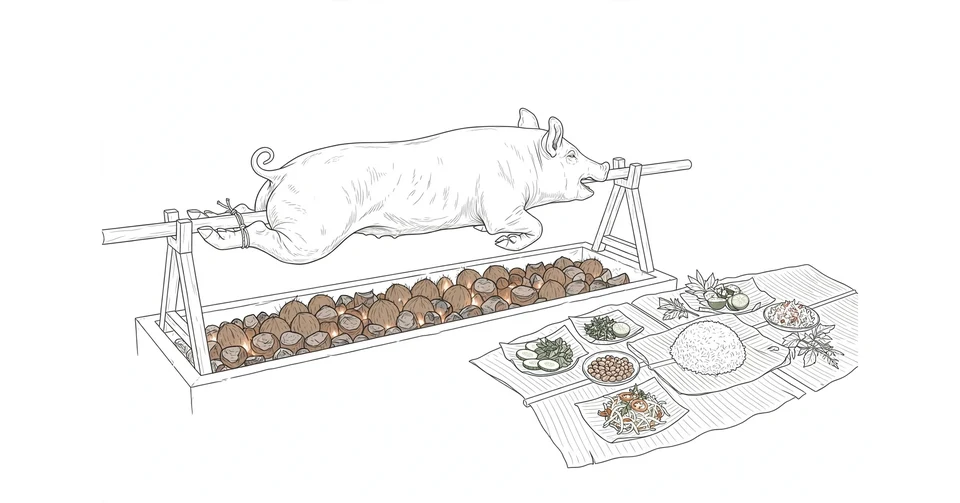
If you have never eaten babi guling, the honest answer to the question of whether it is worth seeking out is yes, with one condition. It is pork, cooked whole and served with its skin, its offal and sometimes its blood sausage, and it is not for everyone. People who do not eat pork, for faith or for conscience, should skip it without apology, and Bali offers plenty of other food. For everyone else, a plate of babi guling is one of the most direct ways to taste how Bali thinks about food: generously, communally, and with very little fuss about presentation.
What babi guling actually is
The name is plain. Babi means pig, and guling means to roll or to turn, which is exactly what happens to the animal over the fire. The pig is preferably a young one, around three to six months old, because a younger pig has tender meat and the right balance of skin and fat for the crisp, glass-like crackling that is the dish's signature. The animal is cleaned, stuffed with spice paste, sewn shut, and mounted on a long wooden spit.
That simplicity is deceptive. A roast pig exists in many food cultures, from Filipino lechon to the suckling pigs of Spain, and the Balinese version of babi guling earns its reputation not from the idea but from the execution. The spice paste is the difference. It is rubbed over the skin, packed into the cavity, and left to work its way into the meat through hours of slow heat. By the time the pig comes off the spit, the flavour is not sitting on the surface. It has soaked through the whole animal, so that even a plain slice of lean meat tastes of turmeric, lemongrass and chilli.
Babi guling began as ceremonial food. It was reserved for temple ceremonies, village feasts and grand celebrations, when a whole pig was roasted as an offering to the gods before it became food for very hungry guests. That origin still shows in how the dish is treated. Even now, when it is sold by the plate in a warung, it carries a sense of occasion that a plate of fried rice never will. Eating it feels like being let in on something, and in a small way it is: you are eating the food of a festival, on an ordinary day, for the price of lunch.
Base genep, the paste that does the work
The heart of babi guling is base genep, the complete Balinese spice paste, and it is worth knowing what is in it, because the same paste shows up across Balinese cooking. It is ground from shallots, garlic, red chilli and bird's eye chilli, galangal, kencur, turmeric, ginger, candlenuts, coriander, lemongrass and shrimp paste. That is a long list, and it is long for a reason. No single flavour is meant to win. The paste is savoury, spicy, a little sour and a little bitter all at once, and its job is balance rather than heat.
For babi guling, the paste is used generously. It is rubbed into the skin and packed inside the body cavity, where the slow heat melts the fat and carries the spices through the meat. Some cooks add a little coconut water or oil to the paste as it is worked in. The result is a flavour that builds in layers rather than arriving all at once: first the warmth of turmeric and ginger, then the citrus lift of lemongrass, then the slow burn of chilli, then the deep savoury note of shrimp paste underneath it all.
I have come to think of base genep as the clearest argument Bali makes for taking spices seriously. In much of the world, a spice paste is a shortcut, something to add flavour quickly. In Bali, the paste is the cooking. The pig is the vehicle, and the hours over the fire are the method, but the paste is the idea. It is also why two plates of babi guling can taste so different from each other. Every warung grinds its own paste, adjusts the chilli to its own taste, and keeps its own proportions, so the dish is never exactly the same twice. That variety is not a flaw in the tradition. It is the tradition, and it rewards anyone willing to try the dish in more than one place.
Hours on the spit over coconut husks
The roasting of babi guling is the slow part, and it cannot be hurried. Once the pig is on the spit, it is roasted over an open wood fire, often fuelled with coconut husks, for several hours. Someone stands there the whole time, turning the spit by hand, keeping the rotation steady so that no part of the skin burns while another part stays soft. The pig is basted as it turns, with coconut water and oil, which is what helps the skin crisp so dramatically.
This is skilled, tiring work, and it is part of why a warung that roasts its own babi guling is worth seeking out. A pig that has been turning since dawn tastes different from one that was roasted elsewhere and reheated. The skin is the test. When it is fresh from the spit, it should shatter audibly when you bite it, crisp as glass and then gone, melting into the fat beneath. If it has gone soft, the pig has been resting too long, and the moment has passed. Good warungs know this, which is why they open late in the morning and close when the pig runs out, usually by mid afternoon. They would rather sell out than serve a soft-skinned pig.
There is something quietly impressive about a cooking method that refuses to be industrialised. A whole pig on a spit cannot be cooked in a batch, cannot be held for hours without losing its best quality, and cannot be made by a machine. It demands a person, a fire and a morning of attention. In a food culture that increasingly runs on speed, babi guling runs on patience, and the patience is visible in the result. The skin tells you everything about how the morning went.
What lands on the plate
A plate of babi guling is a small feast in miniature, and it helps to know what you are looking at before you start eating. The standard plate comes with steamed rice and several cuts of roasted pork, usually lean meat plus a portion of ribs or belly, and a section of crackling skin. Beside the meat sits lawar, the Balinese mix of minced meat, vegetables and grated coconut bound with base genep. If you have not met lawar before, the site's own guide to lawar is the dish Bali serves when the whole village eats explains how it is made by many hands for ceremonies, and why it appears on almost every festive plate.
The rest of the plate is just as considered. There is sate lilit, minced meat moulded onto a bamboo stick, and urap, a crunchy vegetable salad in a coconut and chilli dressing. A spoonful of sambal adds heat, and a small bowl of soup, often a clear broth with bone and green vegetables, comes on the side. Some warungs add urut, a Balinese pork sausage, and the offal preparations, heart and intestine, are considered delicacies by locals and are worth trying if you are adventurous. The full anatomy of the plate, and what to ask for if you are given a choice of cuts, is set out clearly in the complete guide to babi guling, which recommends asking for a mix of skin, belly and ribs.
The way to eat babi guling is to mix. Take a little rice, a little meat, a little lawar and a little sambal in the same bite, and let the flavours meet. The rice is not a neutral base. It is the thing that carries the heat and the fat and the spice together, and the plate is designed around that meeting. Locals often eat with their hands, tearing into the pork and mixing it with rice and sambal, and there is no shame in doing the same. A spoon works too, but hands are faster, and the crackling is easier to manage that way. Eat the skin first if you want it at its best, while it is still crisp.
Babi guling at Galungan and weddings
Babi guling belongs most of all to the days when Bali cooks for its ancestors and its guests. On Penampahan, the day before Galungan, families prepare the food for the festival, and a whole pig roasted for the occasion is the centrepiece of the cooking. Pigs and chickens are blessed and prepared, and the men of the household often wake well before dawn to get the meat ready, while the women weave offerings from young coconut fronds. The cooking is done by mid morning, and then the first feast begins. The full story of that day, and of the ten day festival it opens, is told in Galungan Welcomes the Ancestors Back to Bali, where babi guling appears alongside lawar and sate as one of the dishes made on Penampahan.
The same role repeats at weddings, tooth-filing ceremonies and odalan, the temple anniversaries that fill the Balinese calendar. A whole pig is roasted and shared among the community, and the sharing is the point. A pig is too much food for one family, so it is, by its nature, a dish for a crowd. It turns a celebration into a meal and a meal into a celebration, and everyone present eats from the same animal. That is a small thing, but it is also the whole idea of a feast: one thing, made large, divided among many people.
This is why the warung plate of babi guling, for all its convenience, is only half the experience. The other half is the ceremony, where the pig is roasted in the family compound, carved on a tray in the open air, and served to people who helped make it. If you are ever invited to such a meal, go. It is the rarest version of the dish, and the one that explains everything else about it. The warung exists because the ceremony exists, not the other way around.
Where to eat babi guling in Bali
The most famous place to eat babi guling is Warung Babi Guling Ibu Oka in Ubud, a short walk from the Ubud Palace on Jl. Tegal Sari No. 2. The family-run eatery has been passed down for three generations, and it became internationally known after Anthony Bourdain visited and called it the best pig he had ever eaten. It opens around 11:00, the tables fill quickly after opening, and the warung serves around five to six pigs a day, staying open only until the pig runs out, usually by about 15:00. The honest assessment is that it is very good without always living up to the legend that surrounds it, and the mild spice level may surprise visitors who expect more heat. That is a fair trade for the experience of eating in the place that put the dish on the world map.
Ubud has plenty of other options for babi guling, and the guide to where to eat the best babi guling in Ubud lists several worth knowing. Gung Cung, on Jl. Suweta No. 23 near the palace, is a budget-friendly alternative whose flavour is often compared to Ibu Oka's, with a complete set starting from around IDR 35,000. Ibu Gendut in Pengosekan is loved by locals for its richer, spicier flavour and generous portions, especially the special menu with extra crispy skin. Pande Egi, out in the rice fields of Beng in Gianyar, offers the same dish with a rural view and a spacious setting that suits families. Prices vary widely across the island: a plate at a local warung usually costs around IDR 25,000 to IDR 45,000, mid-range spots charge IDR 45,000 to IDR 60,000, and the premium Ubud restaurants can reach IDR 65,000 to IDR 85,000 or more.
Outside Ubud, Pak Malen on Sunset Road in Seminyak is the coastal favourite, a no-frills roadside warung that is usually busy and offers consistent quality in a more accessible location for travellers based in the south. Warung Babi Guling Sanur, opposite the McDonald's on the bypass, goes through about three pigs a day and is worth the walk from the main tourist drag. Sari Organik in Ubud takes a different approach, sourcing from sustainable local farms, which suits travellers who want to eat the dish with a cleaner sourcing ethos. The pattern is the same everywhere you look for babi guling: look for the busy warung, the fast turnover, and the pig roasted on the premises. A crowd usually means the food is fresh, and a stall that sells out is a stall that made it properly that morning.
What a first timer should know
A few practical notes will make the first plate of babi guling much better. First, go early. Warungs open around 11:00 and the best cuts go first, so arriving before noon matters more than choosing the perfect restaurant. Second, order the mixed or special plate. It gives you the full experience, tender meat, crispy skin, lawar, sausage, broth and sambal, all the elements that make the dish what it is. A plain plate of meat and rice misses the point.
Third, think about the heat. The base seasoning is already rich and flavourful, so if you do not handle spicy food well, ask for the sambal to be served separately. That lets you adjust the heat to your comfort without losing any of the flavour. Fourth, ask what is on your plate. The lawar may be the red version, made with fresh blood, and the sausage may be blood sausage too. A good warung will tell you happily, and the white version of lawar is the easy place to start if you are unsure. Asking is not rude. It is what the sellers expect, and they answer the question every day.
Fifth, bring cash. Most traditional spots only accept cash, so make sure to have some even if you are used to paying by card. Sixth, and most important, remember that babi guling is pork, whole pig, skin and offal included. If you do not eat pork, do not eat it out of politeness or curiosity. Bali has no shortage of other food, and nobody at a warung will think less of you for ordering something else. A dish that means this much to the people who make it deserves to be eaten by people who actually want it, not by people who feel obliged.
Why the whole pig matters
Babi guling matters because it refuses to be reduced to a single flavour or a single cut of meat. It is a whole animal, cooked whole, served with a whole set of accompaniments, and shared by a whole community. The pig is stuffed with a paste made of a dozen ingredients, roasted for hours over a fire that someone has to tend by hand, and then divided among people who may have helped make it. Nothing about that process is efficient, and that is the point. The dish is a reminder that some food is worth doing slowly, and that slowness is not a defect to be engineered away but a quality to be protected.
It also matters because it has not been flattened into a single standard. Every warung grinds its own paste, every village roasts its pig a little differently, and every plate arrives with its own balance of meat, skin, lawar and sambal. The dish stays alive precisely because nobody has written its final form. Traditions that survive are usually the ones that leave room for the people who keep them, and babi guling leaves a lot of room: room for a famous warung in Ubud and a nameless stall in Sanur, room for a wedding feast and a Tuesday lunch, room for the mild version and the fiery one.
So if you find yourself in Bali in the late morning, with the smell of roasting pork drifting out of a warung and a queue forming at the door, join it. Order the mixed plate, eat the skin while it is still crisp, mix everything together with the rice, and save a little room for the soup. That is babi guling at its most honest: a whole pig, turned slowly over a fire, divided among strangers and neighbours alike, and gone by mid afternoon, as it should be.
More in Food & Travel
- Sambal Matah Wakes Up Every Balinese Plate Raw
- Sate Lilit Wraps Bali's Feast Around a Lemongrass Stick
- Lawar Is the Dish Bali Serves When the Whole Village Eats
- Goma Dofu Is the Forty Minute Tofu Ground by Hand
- Garuda Wisnu Kencana Rises Above Bali's Southern Cliffs
- Soba, the Buckwheat Noodles Japan Slurps on the Last Night of the Year
Latest posts
- Shinran Turned Chanting Into Gratitude
- The Javanese of Suriname and the Language They Kept Alive
- Nembutsu Is the Name Japan Calls Out to Amida
- Konpon Daito Towers Over Koyasan in Vermilion and Gold
- Wuku Gives Every Week in Bali a Name
- A Penjor Turns a Whole Street Into an Offering
- A Mokugyo Keeps the Beat of the Chant
- Udon in Kagawa, Where Noodles Are a Way of Life
- Garuda Pancasila Carries Five Principles on One Bird
- Saptawara Is the Seven-Day Week Inside Every Weton
- Janur Is the Young Coconut Leaf Bali Folds Into Everything
- Petungan Counts Your Neptu Before You Choose a Day
- The Pawukon Calendar Runs Bali on 210 Days
- Purnama Is the Full Moon Bali Prays By
- Galungan Welcomes the Ancestors Back to Bali