Goma Dofu Is the Forty Minute Tofu Ground by Hand
· 15 min read
Goma dofu is sesame tofu with no soy in it at all, a chilled custard of ground sesame and kuzu starch that takes thirty to forty minutes of hand grinding in a mortar. This is the story of Japan's slowest tofu.
Goma dofu is the only tofu in Japan that contains no soy. It is made from three things: sesame seeds ground to a smooth paste, water, and kuzu starch. The paste is heated and stirred until it sets into a cool, dense custard, then served chilled with wasabi and soy sauce, usually as the opening dish of a formal temple meal.
The name is a small trick. Goma means sesame, and tofu is used by extension for any dish that sets into a similar curd, even when no soybean is involved. What arrives on the plate looks like a pale block of tofu. What it tastes like is something else entirely: nutty, rich, and smooth in a way that soy tofu never is.
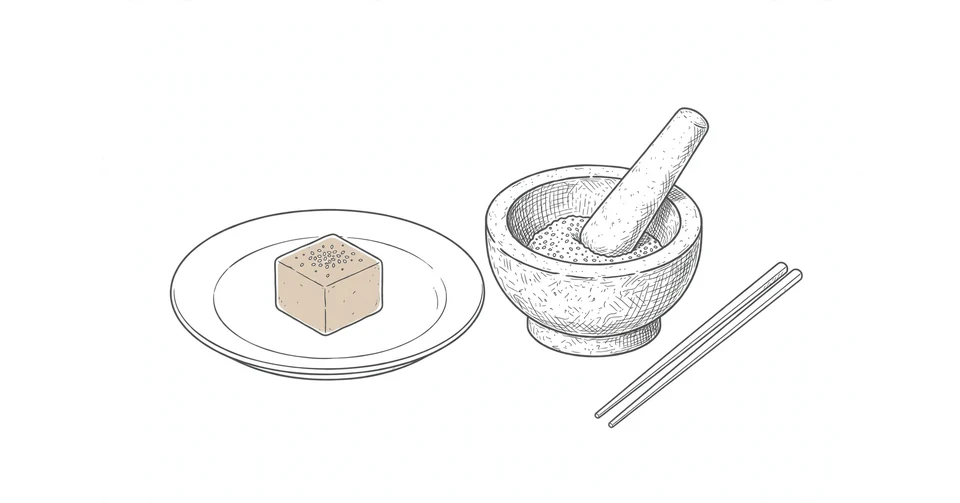
The dish earns its place on the table the slow way. Making authentic goma dofu requires grinding the sesame by hand in a mortar for thirty to forty minutes, and some temple recipes ask for a full hour. That time is not a flaw in the recipe. It is the recipe. The grinding is the dish, and the dish is the grinding.
Goma dofu is not tofu at all
The first thing to understand about goma dofu is that the name is doing two jobs at once. It tells you what the dish looks like and it hides what the dish is. A block of goma dofu sits on the plate like tofu, cuts like tofu, and is eaten with chopsticks like tofu. But there is no soy milk, no nigari, and no curdling of bean protein anywhere in its making. The set comes from kuzu, the starch of the kudzu root, which thickens the sesame liquid into a gel as it is heated and stirred.
That difference matters for more than accuracy. Soy tofu is mild and takes on the flavor of whatever surrounds it. Goma dofu has a flavor of its own, and it is not shy about it. The sesame is intense, nutty, and almost creamy, with a natural sweetness that sits underneath the richness. Food in Japan describes the taste as deeply nutty and surprisingly rich, and notes that the texture is closer to panna cotta or a very soft pudding than to any soy tofu. Food in Japan's guide to goma tofu walks through the whole dish, from its name to its texture, and it is worth reading before you order it, because knowing what to expect changes how you taste it.
The texture is the part that surprises people most. Press a spoon into a block of goma dofu and there is barely any resistance. It is not jiggly like gelatin and not crumbly like pressed tofu. It yields, holds its shape for a moment, and then melts on the tongue. The kuzu starch is responsible for that mouthfeel, a smooth, stable creaminess that no soy product can imitate. I have eaten a lot of tofu in Japan, and nothing else in the cuisine feels quite like this. It is the one dish where I stop trying to compare it to something I already know and just pay attention to what is in front of me.
Goma dofu belongs to shojin ryori, the temple food that eats like a prayer, the vegetarian cuisine of Japan's Buddhist temples. It is one of the best known dishes of that tradition, and it is usually served near the start of the meal, when the palate is clean and the flavors can register fully. That placement is deliberate. A dish this quiet would be lost after a rich soup or a fried course. Served first, it sets the tone for everything that follows.
Where goma dofu was born
The dish is tied to Mount Koya, the mountain sanctuary in Wakayama Prefecture that has been the center of Shingon Buddhism for about twelve centuries. Theories about its origin agree on the shape of the story even when they differ on the details. Kobo Daishi, also known as Kukai, founded the training on Mount Koya about 1,200 years ago, and sesame was part of the food that sustained monks through rigorous practice. Sesame had long been used as medicine in China, and Kukai is said to have brought it back from his mission there and begun cultivating it on the mountain.
The logic of the dish follows directly from the rules of temple eating. Shojin ryori uses no meat or fish, so the monks' diet tended to run short on protein. Sesame is dense with it, and goma dofu was a way to take that nutrition in a form that worked as a standalone dish rather than a garnish. The monks removed the raw skin from the sesame, ground it without roasting, mixed it with the mountain's water and kudzu powder, kneaded it in a mortar, and cooked it. The result was food that was practical, filling, and entirely within the temple's rules.
Another theory traces a dish called ma tofu to a cookbook published in 1697, the Wakan Shojin Ryori Sho, a Japanese and Chinese temple cuisine manual. Whether or not that is the same dish, the date gives a sense of how long goma dofu has been written down and passed along. It became widely known as a souvenir of Mount Koya during the Showa era, and it remains one of the standard dishes served at Zen temple meals on the mountain today.
The mountain itself is worth understanding as the dish's home. Mount Koya is governed from Kongobuji temple, and its two sacred sites, Danjogaran and Okunoin, anchor a complex that became a World Heritage Site in 2004. The same mountain that shaped goma dofu also hosts the goma fire ritual, where prayers are written to be burned. The shared sound is a coincidence worth noting honestly: the goma of sesame and the goma of the fire ritual are different words with different roots. But they belong to the same mountain, the same temples, and the same idea that a slow, deliberate act can carry meaning. Eating goma dofu on Mount Koya puts the food in its full context, and the context makes the food taste better.
Forty minutes at the mortar
The heart of goma dofu is the grinding, and it is the part that modern shortcuts cannot honestly replace. The sesame must be ground until it is totally smooth, until the oil comes out and the paste turns silky. In the shojin ryori tradition that takes thirty to forty minutes of steady work in a suribachi, the ridged Japanese mortar, with the pestle moving in slow circles. NHK's Nun's Cookbook, filmed with the nuns of Otowasan Kannonji Temple in Nara, puts the time at a full hour for its version, made with yoshino kudzu, the prized starch of Nara Prefecture. NHK's goma dofu episode is blunt about the cost: the preparation is lengthy, it says, but it will reward your patience with rich and delicious flavor.
That gap between thirty minutes and an hour is not a contradiction. It is a range, and it tells you something about the dish. The exact time depends on the sesame, the mortar, the strength of the arm, and how smooth the cook insists on being. The honest statement is that hand ground goma dofu takes the better part of an hour, and anyone promising it in five minutes is selling something else.
There is a reason the grinding was traditionally assigned to novice monks, and the reason was not efficiency. The work was slow, repetitive, and impossible to rush, which made it a form of training in itself. You cannot grind sesame quickly by pushing harder. You can only keep going, in circles, until the seeds give up their oil. I think about that whenever I am tempted to treat cooking as something to get through as fast as possible. The temple kitchen's answer is that the time is not wasted. The time is the point, and the flavor is the proof that the time was spent well.
Modern home cooks take two shortcuts, and both are honest ones if you name them. The first is ready made kuzu powder, which spares you the difficult work of processing kuzu roots. The second is pre ground sesame paste, sold in Japan as nerigoma, or tahini elsewhere, which spares you the mortar entirely. A tahini based goma dofu is still very good, and freshly toasted sesame ground at home is more fragrant, but the difference is one of degree. The dish survives the shortcuts. What it does not survive is impatience at the stove, which is where the second act of slowness begins.
Three ingredients and one pot
Once the paste is ready, the making of goma dofu is almost comically simple. Three ingredients, one pot, and a wooden spoon that does not stop moving. Food in Japan lays out the traditional steps plainly: roast the sesame seeds, grind them, add water, strain the liquid through a cloth, then combine it with kuzu starch dissolved in water and cook it over medium heat for seven to eight minutes, stirring patiently the whole time.
The stirring is the part that decides the dish. As the mixture heats it thickens, turns lumpy, then slowly smooths into a thick pudding that pulls away from the sides of the pan. Stop stirring and the kuzu seizes unevenly into lumps that cannot be whisked smooth again. Keep stirring and the mixture turns from milky to slightly translucent, the sign that the starch has fully cooked. Then it is poured into a mold moistened with water, left to cool, and chilled until it sets firm.
The proportions are forgiving in the way that simple recipes are. A common home ratio is roughly one tablespoon of kuzu per 200 milliliters of sesame liquid, and a small batch uses about 70 grams of sesame paste to 50 grams of kuzu powder. The numbers matter less than the feel of the mixture in the pan. A cook who has made goma dofu a few times stops measuring the starch and starts watching the spoon. When the paste folds over itself instead of running, it is ready. That is not vagueness. It is the kind of knowledge that only comes from standing at the stove and paying attention, which is the same lesson the mortar teaches, just faster.
The finished block is cut into squares and served cold. It keeps only briefly, which is why the best goma dofu is eaten where it is made, or bought the same day from a shop on the mountain. That perishability is part of its character. A dish that cannot be stored cannot be mass produced, and a dish that cannot be mass produced stays close to the hands that make it.
How to eat goma dofu
The classic way to eat goma dofu is the simplest: a square in a small bowl, a little soy sauce spooned over it, a dab of wasabi paste at the side. The wasabi matters more than it seems. Its sharpness cuts through the richness of the sesame and resets the palate between bites, so each spoonful tastes as nutty as the first. Without it the dish can feel heavy by the third bite. With it, the richness stays interesting to the end.
But the classic way is not the only way, and the variations show how flexible the dish is. Poured over with kuromitsu, the dark sugar syrup, and dusted with kinako, roasted soybean flour, goma dofu becomes a dessert, sweet and nutty in a way that feels entirely natural. It also pairs well with sweet miso, which leans into the savory side of the sesame instead of away from it. The black sesame version, made with toasted black seeds, is darker, slightly more bitter, and just as good.
What I like about these variations is that none of them tries to hide what the dish is. The dessert version does not pretend goma dofu is a cake. It lets the sesame stay the flavor and simply changes the company it keeps. That restraint is the shojin ryori way, and it is why the dish has lasted. A food that knows what it is does not need to dress up.
There is also a practical point for anyone ordering it for the first time. Goma dofu is filling in a way its size does not suggest. Sesame is roughly half fat and rich in protein, and a small block carries more substance than it looks like. Eat it slowly, the way it was made slowly, and let the richness arrive in its own time. Rushing it misses the point twice over.
Where to find the real thing
The best place to eat goma dofu is still Mount Koya, where shops have been making it the traditional way for generations. Kadohama Goma Dofu Sohonpo, founded in 1890, still manufactures its sesame tofu without additives using the traditional method from the time of its founding, and its raw sesame tofu, sold only at the main store, is the one regulars recommend. Hamadaya, which opened around the tenth to twentieth years of the Meiji era, once made cotton tofu and now makes only sesame tofu. Morishita Shoten sells nothing but raw and packed goma dofu, and its raw version often sells out by the afternoon, so the advice is to go early.
The detail that stays with me is the cooler bag. Several of these shops warn that you cannot take goma dofu home without one, or an ice pack, and some will prepare one for a fee. A food that needs a cooler bag to survive the trip down the mountain is a food that is still alive, still fresh, still close to the kitchen. The souvenir version exists, and it is fine, but the raw version at the shop is the dish as it was meant to be eaten, cool, soft, and faintly warm with the smell of toasted sesame.
Outside Wakayama, the dish appears in temple restaurants in Kyoto and in shojin courses in Tokyo, where restaurants such as Kurama in Kachidoki and Bonmi in Nihonbashi serve handmade versions. Kurama makes its sesame tofu by carefully kneading sesame and kudzu, and customers describe a smooth texture, a melty mouthfeel, and a rich sesame flavor served with seasonal vegetables. Bonmi removes the skin from raw white sesame seeds, squeezes and kneads the pure white sesame tofu, and finishes it with a roasted white sesame sauce. These are not cheap meals, and they are not trying to be. They are the city version of a mountain dish, made by cooks who learned the slow way and kept it.
If you cannot get to Japan, the home version is worth trying, with store bought kuzu powder and pre ground sesame paste. It will not be the same as the block from a Koyasan shop, and it should not pretend to be. But it will teach you the two things the dish has to teach: that three ingredients can be enough, and that stirring a pot for eight minutes without stopping is a small discipline of its own. That is a fair trade for an afternoon in the kitchen.
Why the slow version matters
Goma dofu is a small dish, and it would be easy to treat it as a curiosity, a footnote in a temple meal. But it holds the whole philosophy of shojin ryori in a single block. Nothing wasted, nothing rushed, nothing added that the dish does not need. The sesame is ground until it gives up its oil. The kuzu is stirred until it gives up its thickness. The cook gives the dish time, and the dish gives the time back as flavor.
I keep coming back to the forty minutes. In a food culture that now measures cooking in seconds, a dish that asks for forty minutes of grinding before the cooking even starts feels almost defiant. It refuses to be hurried, and it refuses to apologize for that. The monks who made it were not inefficient. They simply believed that the way you make food is part of the food, and that a dish made in a hurry tastes like hurry.
That belief is the real inheritance of goma dofu, more than the recipe itself. Anyone can buy kuzu powder and tahini and make a decent version in half an hour. But the dish is at its best when it is made the slow way, by hand, in a mortar, with attention that does not wander. The forty minutes are not the price of the dish. They are the dish, and the block of sesame tofu on the plate is just the part you can eat.
More in Food & Travel
- Babi Guling Turns a Whole Pig Into a Balinese Feast
- Lawar Is the Dish Bali Serves When the Whole Village Eats
- Garuda Wisnu Kencana Rises Above Bali's Southern Cliffs
- Soba, the Buckwheat Noodles Japan Slurps on the Last Night of the Year
- Udon in Kagawa, Where Noodles Are a Way of Life
- Shojin Ryori Is the Temple Food That Eats Like a Prayer
Latest posts
- Konpon Daito Towers Over Koyasan in Vermilion and Gold
- Wuku Gives Every Week in Bali a Name
- A Penjor Turns a Whole Street Into an Offering
- A Mokugyo Keeps the Beat of the Chant
- Garuda Pancasila Carries Five Principles on One Bird
- Saptawara Is the Seven-Day Week Inside Every Weton
- Janur Is the Young Coconut Leaf Bali Folds Into Everything
- Petungan Counts Your Neptu Before You Choose a Day
- The Pawukon Calendar Runs Bali on 210 Days
- Purnama Is the Full Moon Bali Prays By
- Galungan Welcomes the Ancestors Back to Bali
- Jatayu Flew at Ravana to Save Sita
- Kurma Held Up a Mountain So the Ocean Could Be Churned
- Yoshino Is the Mountain Shugendo Calls Home
- A Gomagi Carries Your Wish Into the Goma Fire