the-javanese-of-suriname-and-the-language-they-kept-alive
· 9 min read
title: The Javanese of Suriname and the Language They Kept Alive description: The Javanese of Suriname crossed an ocean as contract laborers more than a century ago, and their descendants still speak a Javanese shaped by Java, Dutch, and Sranan Tongo. date: 2026-11-12 category: culture-society image: /assets/img/the-javanese-of-suriname-and-the-language-they-kept-alive-line-art.png
In a market in Paramaribo, the capital of Suriname, you can hear a language that sounds like Java and yet is not quite Java. The words are Javanese, the rhythm is familiar to anyone from Central or East Java, but listen closely and you will catch Dutch words for modern things and Sranan Tongo phrases woven between the sentences. This is the living speech of the Javanese of Suriname, a community that crossed an ocean more than a century ago and never came back.
The Javanese of Suriname are the descendants of about 32,956 contract laborers who were brought from the Dutch East Indies to the Dutch colony of Surinam between 1890 and 1939. Today they number between 82,000 and 90,000 people of pure descent, and up to 126,500 when mixed ancestry is counted, making them roughly 13 to 15 percent of the population of Suriname and the third largest ethnic group in one of the most diverse countries on earth. Their story is a story of migration, of a language carried across the Atlantic in the luggage of plantation workers, and of how that language survived a century of separation from Java.
What makes the Javanese of Suriname remarkable is not only that they kept their language, but what the language became. Cut off from Java for more than a hundred years, their Javanese grew in a different direction, shaped by the plantation, by Dutch, and by the creole language of their neighbors. It is a language that tells the history of its speakers in every sentence, and it is now at a turning point, spoken warmly by the older generation and less and less by the young.
How Java reached South America
The journey began with the end of slavery. When slavery was abolished in the Dutch Caribbean in 1863, the sugar plantations of Suriname lost their workforce, and the Dutch colonial government looked for labor in its other colony, the Dutch East Indies. The first experiment came in 1890, when the Netherlands Trading Society, which owned the Marienburg sugar plantation, sent the steamship SS Koningin Emma from Batavia carrying 94 Javanese laborers. The ship left on 21 May 1890 and arrived in Paramaribo on 9 August 1890, after a voyage of almost three months.
Over the next five decades, between 34 and 77 ships carried Javanese workers across the Atlantic. The laborers who became the Javanese of Suriname signed five year contracts and were put to work on sugar cane and rice plantations, many of them in the district of Commewijne, across the river from Paramaribo. The work was hard and the conditions were often harsh, but when the contracts expired, most stayed. Some returned to Indonesia, and some later moved on to the Netherlands, but the majority built their lives in Suriname, and their descendants are still there today.
The Javanese of Suriname did not arrive as a single village. They came from different parts of Java, mostly Central and East Java, and they came as peasants, not as aristocrats or officials. That detail matters, because it shaped the language their descendants speak today.
A language that lost its high register
Javanese in Java has a famous system of speech levels. The same sentence can be said in ngoko, the low everyday register, or in krama, the high polite register, and choosing the wrong one can offend. The Javanese of Suriname speak a language that is based almost entirely on ngoko, and the reason is simple: the people who crossed the ocean were peasants, and in the plantation world they built together, the social world that needed krama simply did not exist.
On the plantations, everyone was in the same position. There were no Javanese courts to address in high language, no aristocrats to honor with careful words. The language flattened into an egalitarian grammar, where the low register became the default for almost everything. Linguists call the result Surinamese Javanese, or Tyoro Jowo-Suriname, and it is now recognized as a distinct variety of the language, different enough from the Javanese spoken in Indonesia to be studied on its own terms.
A century of separation did the rest. The community was geographically isolated from Java, and its language absorbed words from the languages around it. Dutch, the language of administration, schools, and government, contributed loanwords for modern life, technology, and official business. Sranan Tongo, the creole lingua franca of Suriname, contributed words for everyday things and local life. The result is a Javanese that a visitor from Yogyakarta can mostly follow, until a Dutch word for a bus ticket or a Sranan word for a local fruit stops the conversation cold.
What the language of the Javanese of Suriname sounds like today
The language of the Javanese of Suriname is spoken by roughly 10 percent of the population of Suriname, mostly within the community and at home, while Dutch is used in education, government, and public life. Most speakers of the Javanese of Suriname today are bilingual or multilingual, switching between Javanese, Dutch, and Sranan Tongo, sometimes within a single conversation, and often adding Indonesian or Hindi depending on who is in the room.
The language has also drifted in sound and grammar. A hundred years of contact and isolation have produced morphological and phonological differences from standard Indonesian Javanese, and the changes are not random. They reflect the life of the community: words for plantation work, for the river and the coast, for the religions the community practices, and for the Dutch institutions that governed their lives. In a real sense, the language is a record of the migration itself, written not in books but in the mouths of its speakers.
This is what makes the Javanese of Suriname so interesting to linguists and to anyone who cares about how languages live and change. A language is not a museum object. It is a tool that people bend to fit the life they actually live, and the Surinamese variety of Javanese shows that bending clearly, in a single century, across an ocean.
Faith, food, and the arts that crossed too
Language was not the only thing the Javanese of Suriname carried with them. The Javanese of Suriname kept much of their culture alive, and the pieces that survived tell the same story of adaptation. Jamu, the herbal medicine of Java, is still prepared and used in Suriname, and researchers have documented the medicinal plants the community kept in use for generations, a tradition that goes back to the Mataram Kingdom era more than a thousand years ago.
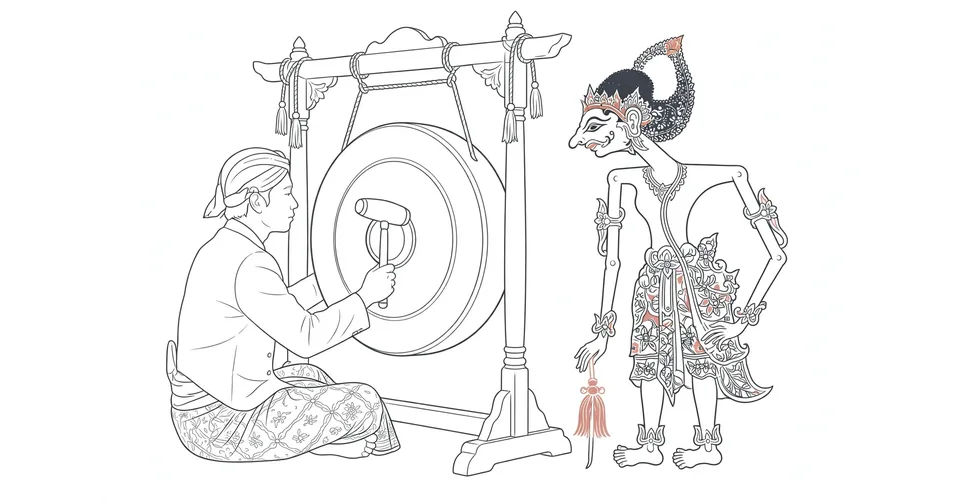
The arts crossed too. Gamelan music and wayang shadow puppet theatre are still performed at community celebrations, and the Javanese dance and music of Suriname remain a visible part of the national culture. The food did as well: Javanese dishes blended with African and other traditions into an Indo-Surinamese cuisine that is now a core part of Suriname's identity, and batik cloth still appears at festivals and family ceremonies.
Religion shaped the community in a deeper way. The Javanese of Suriname practice Islam and Hinduism, and the move to South America created a real theological crisis for the Muslim community, known as the Qibla controversy: in Java, the direction of prayer pointed west, but from Suriname, across the Atlantic, the direction to Mecca was different, and the community had to work out, together, what faith meant in a new hemisphere. That argument, settled over generations, is a reminder that migration is never only about work. It rearranges everything, even the direction a person faces to pray.
A language under pressure
For all its resilience, the language of the Javanese of Suriname is now under pressure. Younger generations show signs of language attrition, speaking Dutch more and Javanese less, and using the language mainly with grandparents rather than with their own children. The pattern is familiar from diaspora communities everywhere: the first generation keeps the language, the second speaks it at home, and the third understands it but answers in the language of school and work.
There are reasons for hope. The community of the Javanese of Suriname is large, proud, and organized, and its cultural life is visible in Suriname in a way that smaller diasporas rarely achieve. Festivals, music, food, and religious life all keep the language in daily use, and the existence of a distinct Surinamese Javanese, studied by linguists and written about by its own speakers, gives the language a standing that helps it survive. The history of the community is now well documented, and the research on its traditions, from jamu to music, gives younger Surinamese Javanese a record of what their grandparents carried across the ocean.
I find something quietly moving in the way this community held on to its language without freezing it. The Javanese of Suriname did not preserve their speech by refusing to change it. They preserved it by letting it change, by letting Dutch words in for new things and Sranan words in for neighbors, while keeping the core of the language, its sounds, its jokes, its way of speaking to family, intact. That is how a language survives a century away from home: not as a relic, but as a living thing that bends and keeps going.
The Javanese of Suriname began as a labor experiment on a sugar plantation. They became a people with their own language, their own music, their own food, and their own way of being Javanese in a country their ancestors had never heard of. A hundred and thirty six years after the Koningin Emma docked in Paramaribo, you can still hear Java in the markets of Suriname, changed by the journey, and still unmistakably itself.
More in Music & Entertainment
Latest posts
- Kanban and the Japanese System That Organized Work
- Shichi-Go-San and the Day Japan Dresses Its Children in Kimono
- Desa Pakraman Is the Name the Law Gave the Old Village
- A Primbon Reads Your Life From the Day You Were Born
- Pasaran Is the Five-Day Week Java Never Gave Up
- A Ceper Folds a Coconut Leaf Into a Crescent Moon
- Your Neptu Is the Number Hidden Inside Your Birthday
- Tilem Is the Dark Moon Bali Counts Its Year By
- The Saka Calendar Sets Nyepi on a Different Date Every Year
- On Tumpek Kuningan Bali Feeds Its Ancestors
- Garuda Carried a Mountain to the Middle of the Ocean
- Vasuki Was the Rope That Churned the Ocean of Milk
- En No Gyoja, the Mystic Shugendo Calls Its Patriarch
- A Saito Goma Burns Its Prayers Outdoors
- Kongobuji Still Governs the Mountain Kukai Left Behind