Shinran Turned Chanting Into Gratitude
· 13 min read
Shinran, the disciple of Honen who founded Jodo Shinshu, taught that the nembutsu is not a way to earn salvation but a thank you for salvation already given.
Shinran changed the meaning of a prayer without changing a single syllable of it. The nembutsu, the chanting of Namu Amida Butsu, sounded exactly the same in his mouth as it did in the mouth of his teacher Honen. What changed was the direction of the heart behind it. For Honen, the chant was a road toward the Pure Land. For Shinran, the chant was what you say when you realise you are already held, and gratitude is the only honest reply.
That small turn matters more than it first sounds. Most religions ask you to do something in order to be saved, and then quietly ask you to do a little more. Shinran looked at that bargain for twenty years on a mountain, tried it with all his strength, and concluded that it did not work, at least not for him, and probably not for most ordinary people either. His answer was not to try harder. His answer was to stop trying to earn what he believed had already been given.
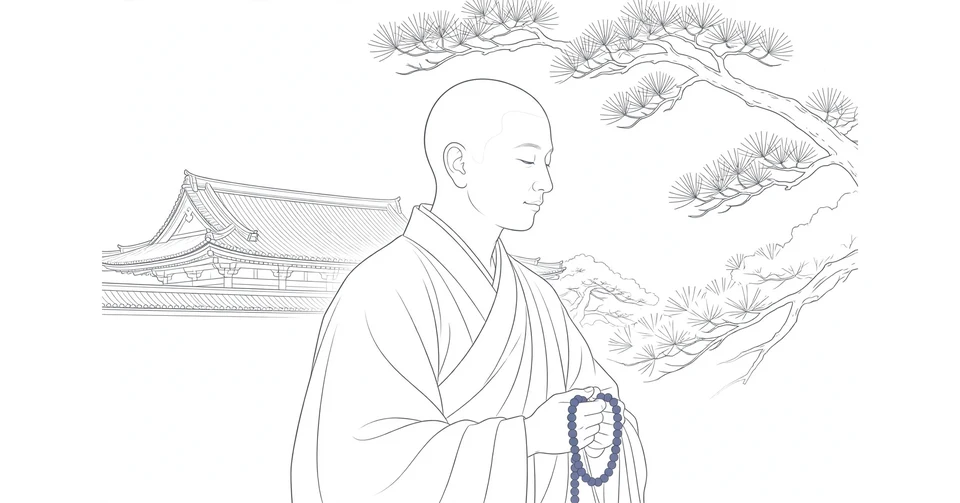
Shinran lived from 1173 to 1263, in a Japan that was changing violently around him. The old court aristocracy was losing power to warrior clans, temples had become wealthy and political, and ordinary people lived with war, famine, and the fear that the age itself was broken. Into that uncertainty, Shinran carried a teaching of radical simplicity. Say the name of Amida Buddha, trust the vow behind it, and let gratitude do the rest. The school he founded, Jodo Shinshu, the True Pure Land School, grew from that simplicity into the largest Buddhist tradition in Japan, and it still shapes how millions of Japanese families pray at home, at funerals, and at the family altar.
Shinran spent twenty years looking for peace on Mount Hiei
Shinran was born in Kyoto near the end of the Heian period, into the Hino family, a family of low ranking court aristocrats. His mother died when he was young, and tradition says his father and brothers all became monks. At the age of nine, Shinran was sent to Mount Hiei, the great Tendai monastery northeast of Kyoto, where he was ordained and given the name Hanen. He stayed there for about twenty years, practising the severe ascetic life of the Tendai school, including the demanding disciplines of walking meditation and long chanting.
In 1201, at the age of twenty nine, Shinran left Mount Hiei. He went down to Kyoto and shut himself in the Rokkaku-do, the Hexagonal Temple, for one hundred days of prayer and meditation, asking for an answer to the question that the mountain had not answered. According to the traditional biography written by his great grandson Kakunyo, a figure appeared to him in a dream on the ninety fifth day and told him to go to the monk Honen. Whether we read that dream as history or as legend, the next step is not in doubt. Shinran met Honen, listened to him, and became his disciple. He had found a teacher who spoke about salvation in a language he could finally hear.
Shinran learned the nembutsu from Honen, then heard it differently
Honen lived from 1133 to 1212, and he had already broken with the Tendai establishment to teach that the nembutsu alone, the recitation of Amida Buddha's name, was enough for rebirth in the Pure Land. His great work argued that Amida had chosen the vocal nembutsu as the practice of the Eighteenth Vow, the Primal Vow in the Larger Sutra, in which Amida promises that beings who sincerely entrust themselves to him and call his name even ten times will be born in his land. No temple building, no carved image, and no scholarly achievement was required. Only the name, said with simple faith.
The relationship between the two men is the hinge of this whole story, and the earlier article on the nembutsu, the chant Japan calls out to Amida puts it plainly. Their names are Honen and Shinran, and the difference between them is the difference between two ways of hearing the same six syllables. Honen taught his followers to chant earnestly, again and again, trusting the vow. Shinran took that teaching and followed it to a place Honen himself had not quite reached.
Shinran founded the Jodo Shinshu school, and in it the meaning of the nembutsu turns around completely. That sentence, too, comes from the same account, and it deserves to be read slowly. For Shinran, the moment a person feels the urge to chant Namu Amida Butsu, Amida's salvation is already accomplished. The chant is therefore not a means to get saved. It is an expression of gratitude for already being saved. This is the nembutsu of gratitude, and once you have heard it that way, it is hard to hear it the old way again.
Exile to Echigo broke Shinran, and then remade him
The new teaching did not stay unchallenged for long. In 1207, the established Buddhist schools in Nara and on Mount Hiei used a court scandal to move against Honen's movement. Two ladies in waiting at the court of the retired emperor Gotoba had attended a nembutsu service and become nuns, and the retired emperor was furious. Honen and his leading disciples were defrocked and exiled, and two other disciples were executed. Honen was sent to Shikoku. Shinran was sent to Echigo Province, on the coast of the Sea of Japan, in what is now Niigata Prefecture.
Exile was meant to end the movement. For Shinran, it became the second great turning point of his life. Stripped of his monk's status and given a lay name, he was no longer a priest in any formal sense. He took the humble name Gutoku, which means foolish bald headed one, and he lived as an ordinary man among ordinary people. The authorities may have intended humiliation. What they produced was a teacher who finally lived the teaching he preached, not above daily life but inside it.
It was in Echigo that Shinran married Eshinni, the daughter of a local aristocrat, in about 1210. The marriage broke the ancient Buddhist rule of clerical celibacy, and it was a deliberate break, not an accident. Together they raised six children, and Eshinni's letters later became a key source for his life. Shinran called himself neither monk nor layman, a phrase that captures his whole position. He was not pretending to be a monk while living as a layman, and he was not a layman who had abandoned the Dharma. He was something new, a religious teacher who insisted that family life, work, and daily trouble were not obstacles to the path but the very place where the path is walked.
The nembutsu ban was lifted in 1211, and Shinran was pardoned, but he did not return to Kyoto and resume a monastic career. He stayed in the east, moving with his family to the Kanto region, the plains north of present day Tokyo, where he spent about twenty years teaching farmers, labourers, and small traders. Shinran told them that they, of all people, were the very ones Amida wanted to save.
Tariki and jiriki, or why Shinran stopped trusting his own effort
At the centre of Shinran's teaching stands a pair of words that every student of Japanese Buddhism learns early. Jiriki means Self Power, reliance on your own effort, your own discipline, your own moral achievement, to reach enlightenment. Tariki means Other Power, reliance on the power of Amida Buddha, made real in Amida's Primal Vow, to carry you where your own power cannot reach. Shinran taught that in the present age, an age his contemporaries called mappo, the last days of the Dharma, when human beings could no longer free themselves through their own effort, only tariki was honest.
A biography of Shinran explains the distinction in plain terms, noting that Shinran conceived Other Power as the authentic Buddhist path and rejected the idea that salvation could be calculated from the amount of effort made. That rejection is the key to his whole system. If you could earn liberation by chanting sixty thousand times a day, as some of Honen's followers were urged to do, then liberation would be a wage, and Amida would be an employer. Shinran refused that arithmetic. For him, shinjin, true entrusting, was not a technique you perform but a settling of the heart, a moment when you stop negotiating with the Buddha and simply receive.
The nembutsu of gratitude changes what the chant is for
The practical difference between Honen and Shinran shows up most clearly in how each school treats the chant itself. In Jodo Shu, Honen's school, the nembutsu is a practice aimed at rebirth in the Pure Land, and the frequency and continuity of chanting tend to be emphasised. You chant earnestly, again and again, trusting the vow that those who call the name will be saved. In Jodo Shinshu, Shinran's school, the nembutsu is the natural overflow of shinjin, the entrusting heart. You chant because you are already assured of birth in the Pure Land, and the chant expresses the gratitude that follows.
This also explains why Shinran's teaching travelled so well among people who had nothing to offer a temple. A farmer in Kanto, a fisherman on the Echigo coast, a mother with six children and no time to sit in meditation, none of them needed to become someone else before they could pray. They only needed to hear the name and let gratitude answer it. The chant fits into a minute at the family altar, between the ringing of a small bell and the start of the working day. The rhythm of that minute is kept, in many halls, by the mokugyo, the wooden drum whose steady knock holds a group together. The drum's role is described in an article about the mokugyo that keeps the beat of the chant, and the connection is worth noticing. A chant of gratitude still needs a pulse, and the drum gives it one, the same steady beat whether the person striking it is a monk or a farmer.
Shinran wrote the Kyogyoshinsho, his great work of self examination
Shinran was not only a preacher. He was a scholar who spent decades gathering, reading, and reinterpreting the Pure Land scriptures, and his great work is the Kyogyoshinsho, a title often translated as The True Teaching, Practice, Faith and Attainment of the Pure Land Way. He began writing it in 1224, in the Kanto region, and he continued revising it for the rest of his life, completing its six volumes after his return to Kyoto in the early 1230s.
The Kyogyoshinsho is not an easy book, and Shinran knew it. It is built largely from quotations from sutras and from the writings of the Pure Land patriarchs, with Shinran's own comments woven between them, and it is written in a learned style that ordinary readers of his day would have struggled to follow. Its central move is bold. Of the three Pure Land sutras, Shinran chose the Larger Sutra, the Infinite Life Sutra, as his foundation, and within its forty eight vows he placed the Eighteenth Vow, the Primal Vow, above all the rest. Everything in his teaching flows from that single promise, that beings who entrust themselves to Amida and call his name will be born in his land.
Why Jodo Shinshu became the largest Buddhist school in Japan
Shinran died in Kyoto in 1263, at the age of ninety, after spending his last decades writing in borrowed rooms, supported by friends and disciples, while his wife and children remained in the east. He left no great temple, no institutional headquarters, and no formal organisation. What he left was a teaching, a book, a set of hymns, and a community of ordinary followers scattered across the Kanto plain. On the face of it, that is not much to build an empire on. Yet the school he founded became the largest Buddhist tradition in Japan, and the reasons are worth tracing.
The first reason is the one Shinran intended. His teaching asked for almost nothing that ordinary people did not already have. No monastery, no long retreat, no scholarly training, no wealth to donate, and no lifetime of perfect conduct. A person needed only to hear the teaching, entrust themselves to Amida, and say the name. A religion that fits into a minute fits into a life, and a life that includes work, children, ageing parents, and grief needs a practice that can survive all of those things without breaking.
The second reason is the one Shinran embodied. By marrying and raising a family, he closed the distance between clergy and laity that had defined Japanese Buddhism for centuries. In Jodo Shinshu, priests marry, have children, and live in the community they serve. An introduction to Jodo Shinshu from the tradition itself makes the point directly, describing Shin Buddhism as a non-monastic, family friendly path, founded by Shinran, and noting that Shin is the largest tradition of Buddhism in Japan.
The third reason belongs to the generations after Shinran. His descendants preserved his writings, his great grandson Kakunyo wrote the biography that kept his memory alive, and in the fifteenth century his descendant Rennyo revived and organised the Honganji community, building the temple network that carried Jodo Shinshu across Japan. Rennyo is often called the restorer of the school, and without him Shinran's teaching might have remained a scattered memory of the Kanto plain. With him, it became an institution, with the great Honganji temples in Kyoto at its heart, later dividing into the Nishi Honganji and Higashi Honganji branches that still exist today.
Shinran turned chanting into gratitude, and gratitude turned out to be something people could carry anywhere. It needs no temple, no special clothes, and no free afternoon. It needs six syllables, a moment of honest entrusting, and the willingness to say thank you for what you did not earn. Eight centuries after a monk left a mountain because effort had failed him, that thank you is still being said in temple halls and living rooms across Japan, by people who may know nothing of the Kyogyoshinsho and everything about what it means to be held. That is a long life for a small turn of the heart, and it suggests that Shinran understood something his century, and ours, keeps forgetting. The prayer was never the price of salvation. It was the sound of someone who had already received it, saying so.
More in Culture & Society
- Bonsho Is the Bell That Wakes a Japanese Temple
- Prajnaparamita Is the Wisdom Behind the Heart Sutra
- A Lamak Turns a Coconut Leaf into a Hanging Prayer
- The Heart Sutra Fits the Whole of Buddhism on One Page
- The Javanese of Suriname and the Language They Kept Alive
- Nembutsu Is the Name Japan Calls Out to Amida
Latest posts
- Sambal Matah Wakes Up Every Balinese Plate Raw
- Sate Lilit Wraps Bali's Feast Around a Lemongrass Stick
- Babi Guling Turns a Whole Pig Into a Balinese Feast
- Konpon Daito Towers Over Koyasan in Vermilion and Gold
- Lawar Is the Dish Bali Serves When the Whole Village Eats
- Goma Dofu Is the Forty Minute Tofu Ground by Hand
- Garuda Wisnu Kencana Rises Above Bali's Southern Cliffs
- Wuku Gives Every Week in Bali a Name
- A Penjor Turns a Whole Street Into an Offering
- A Mokugyo Keeps the Beat of the Chant
- Soba, the Buckwheat Noodles Japan Slurps on the Last Night of the Year
- Udon in Kagawa, Where Noodles Are a Way of Life
- Garuda Pancasila Carries Five Principles on One Bird
- Saptawara Is the Seven-Day Week Inside Every Weton
- Janur Is the Young Coconut Leaf Bali Folds Into Everything