Lawar Is the Dish Bali Serves When the Whole Village Eats
· 13 min read
Lawar is Bali's ceremonial mix of minced meat, vegetables, grated coconut and base genep spices, made together by the whole village and served at Galungan, temple feasts and everyday nasi campur.
Lawar is the dish Bali makes when the whole village eats together. It is a mix of finely minced meat, vegetables and grated coconut, bound together with base genep, the complete Balinese spice paste, and it appears wherever people gather to cook for a ceremony: at Galungan, at temple anniversaries, at weddings and at the long table after a harvest. It is not restaurant food that happens to be Balinese. It is village food, made by many hands, for many mouths, and it tastes of the occasion as much as of the ingredients.
What makes the dish different from an ordinary salad or side dish is that it is never really about one cook. A single family can make a small bowl of it, but the dish only makes full sense at scale, when a pig or a few chickens have been prepared for a feast and the whole neighbourhood has turned up to chop, mix and taste. The mixing itself is the point. Many things are folded together by hand in a wide basin until they become one dish, and nobody can say afterwards where one ingredient ends and another begins.
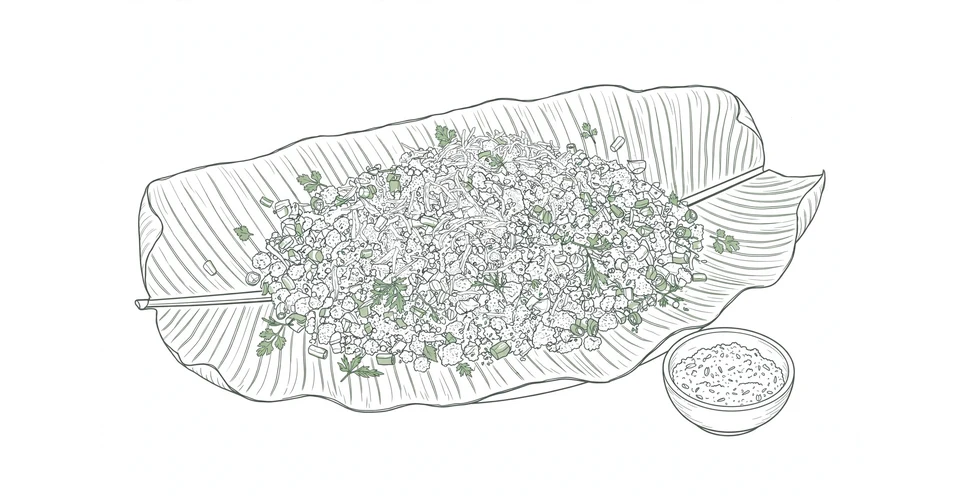
If you have eaten nasi campur in Bali, you have almost certainly eaten lawar already, probably without knowing its name. It sits quietly on the plate beside the rice, the sate and the shredded chicken, easy to mistake for a simple vegetable side. That modesty is part of its charm. It does not announce itself. It waits to be noticed, and once you know what to look for, you start seeing it everywhere, from the morning market stall to the temple feast.
What goes into a bowl of lawar
At its simplest, it is four things in one bowl: minced meat, vegetables, grated coconut and base genep. The meat is usually pork in Hindu Bali, though chicken and duck are common too, and beef appears in some areas. The vegetables change with the season and the village: long beans, ferns, cassava leaves, young starfruit leaves, young jackfruit, young papaya, bitter melon, winged beans and klungah, the flesh of a young coconut. The coconut is mature and freshly grated, often toasted until it turns golden and nutty, and it gives the dish its body. Without it, lawar would be a different dish entirely.
Base genep is what makes it taste the way it does. The name means the complete spice base, and the paste is ground from shallots, garlic, red chilli and bird's eye chilli, galangal, kencur, turmeric, ginger, candlenuts, coriander, lemongrass and shrimp paste. That list sounds long, and it is, but the point of it is balance rather than heat. A good lawar is savoury, spicy, a little sour and a little bitter all at once, and no single flavour is allowed to win. I have eaten versions that were fiery and versions that were gentle, and both were recognisably the same dish, because the spice paste holds the same shape in both.
There is no fixed recipe for the dish, and that is worth saying plainly. The dish has been passed down through generations without a written standard, so every family and every village makes its own version. Some chop the meat fine, some leave it coarse. Some use more coconut, some use more vegetables. A visitor who asks for the authentic recipe will get a different answer in every compound, and every answer will be correct. That looseness is not a flaw in the tradition. It is the tradition. It is a method and a moment, not a formula, and it bends to whatever the garden and the ceremony provide.
Lawar merah and lawar putih
The dish is classified two ways, by ingredient and by colour. By ingredient there is lawar babi for pork, lawar ayam for chicken and lawar nangka for jackfruit, among many others named after their main vegetable or meat. By colour there are two great families: lawar merah, the red version, and lawar putih, the white version. A mix of the two is called lawar padamare.
The difference between the two is fresh blood. Traditional lawar merah is bound with the fresh blood of the animal prepared for the ceremony, which gives it its red colour and a richer flavour. Lawar putih leaves the blood out. This is the part of the dish that surprises outsiders most, and it deserves a straight answer rather than a dodge. Blood has always been part of ceremonial cooking in Bali, where a pig prepared for a feast is used in full: the meat is minced, the skin becomes cracklings, and the blood goes into the red lawar. Nothing is wasted, and every part of the animal has a place at the table. At the same time, many Balinese households today make lawar putih by choice, and plenty of warung serve only the white version. Both are the real thing, and neither needs the other to justify itself.
The two colours also have different jobs in ritual life. Lawar putih is favoured in religious ceremonies because it is considered pure, while lawar merah is more often offered to guardian spirits when protection is asked for. The full account of the two types, and the symbolism behind them, is set out clearly in the guide to lawar at Merah Putih, which also explains how the dish fits into a plate of nasi campur. For a visitor, the practical point is simple: if you are unsure what you are eating, ask. A good warung will tell you happily, and the white version is the easy place to start.
Ngelawar is a job for many hands
The word for making it together is ngelawar, and it is a social event before it is a cooking task. During Galungan and Kuningan, women traditionally prepare lawar together, and the work is divided by habit rather than by instruction: some chop the meat, some grate the coconut, some grind the spices, some mix the wide basin by hand. The Balinese account of the tradition at Budaya Bali describes how each family member has a role, and how laughter and stories are shared through every session, strengthening the bonds between the people doing the work.
I think this is the part of the dish that matters most, and it is the part a recipe can never capture. A dish that takes many hands to make also takes many hands to finish, and the cooking becomes a reason for people to be in the same room. The Balinese word for that spirit is gotong royong, mutual help for the good of the community, and the dish is one of its most edible expressions. When the mixing is done, some of the food is shared with neighbours in a gesture called jotan, a small gift of cooked food that keeps kinship warm between households. The dish leaves the kitchen before it is eaten, and that is the point.
There is a lesson in that for anyone who cooks alone in a small kitchen, as I often do. Cooking is usually treated as a private task that ends with a private meal, but lawar treats it as a public one. The food is better for the company, and the company is better for the food. You do not need a ceremony to borrow that idea. Cooking a big dish with friends, dividing the chopping and the mixing, and sending some of it home with your neighbours will teach you most of what the dish has to teach, even if your spice paste comes from a shop.
Lawar at Galungan and the feast before it
The dish belongs most of all to Penampahan, the day before Galungan, when families prepare the food for the festival. Pigs and chickens are blessed and ceremonially prepared, and the men of the household often wake well before dawn to prepare the meat, finely dicing it and moulding sate onto bamboo sticks, while the women spend the days before weaving offerings from young coconut fronds. The cooking is done by mid morning, and then the first feast begins. The full story of that day, and of the ten day festival it opens, is told in Galungan Welcomes the Ancestors Back to Bali, where the dish appears alongside sate and babi guling as one of the dishes made on Penampahan.
The same day, the penjor poles go up at the gates of the family compounds, and the roads fill with bending bamboo. The poles stay up through the whole festival, and a penjor turns a whole street into an offering for as long as the ancestors are understood to be present. Food and decoration arrive together, and neither makes sense without the other. The pole says the household is keeping the festival. The cooking says the household is ready to feed its guests.
The order of serving matters, and it is the same order at every ceremony. The ancestors are served before the living eat, and the best of what is cooked goes to the family temple first. During Galungan, the dish is part of the saiban offerings, small portions of rice and side dishes placed on banana leaves in thanks for what has been given. Only after the offerings are made does the household sit down together. It is a small discipline, repeated in thousands of compounds on the same day, and it is what turns a meal into a festival. The food is not only for the people in the room. It is for the people who are no longer in the room, and for the gods who are believed to be watching over both.
Four colours on one plate
The dish carries a philosophy in its colours, and it is worth understanding even if you never cook it. The white of the grated coconut stands for the goddess Iswara in the east. The red of the blood stands for Brahma in the south. The yellow of the base genep stands for Mahadewa in the west. The black of the shrimp paste stands for Vishnu in the north. Four directions, four deities, four colours, one plate. The flavours of lawar follow the same pattern: the sweetness of coconut, the saltiness of salt, the bitterness of lime, the spiciness of the Balinese spices, the sourness of tamarind and the pungency of shrimp paste, all combined so that no single taste dominates.
That balance is not an accident. It reflects Tri Hita Karana, the Balinese philosophy of harmony between human beings and the divine, between human beings and nature, and between human beings and each other. Many also believe that the blend of flavours is a metaphor for how leaders should unite diverse people into one harmonious community. I am cautious about reading too much into a side dish, and a plate of it will not teach you Balinese philosophy on its own. But there is something honest about a dish that refuses to let one flavour win. It is a small, edible argument for balance, and it is hard to disagree with it while you are eating it.
The same idea shows up in the names of the seasoning styles. Some versions are made fiery with chilli, some are made peppery, some are made salty, and each style has its own name in Balinese. The dish does not pretend that everyone likes the same thing. It makes room for different tastes inside one tradition, and the village eats all of them. That tolerance, cooked into the food itself, is probably why the dish has survived every change Bali has been through. It does not need to be modernised. It already contains its own variety.
Where to taste lawar without a ceremony
You do not need an invitation to a temple feast to eat it. It is part of everyday Bali too, and the easiest place to find it is on a plate of nasi campur at a warung or a morning market stall. A spoonful of lawar sits beside the rice, the sate, the shredded chicken and the vegetables, and it is usually the part of the plate that makes people ask what they just ate. Lawar nangka, the jackfruit version, is the most approachable for visitors who do not eat meat, and many stalls make it fresh each morning.
A few practical notes help. Lawar is mixed fresh and eaten the same day, so the best time to find it is in the morning, when the warung have just finished their cooking. By the afternoon it is often gone, and that is a good sign rather than a bad one: a stall that sells out of it is a stall that made it properly that morning. Ask what is in the version you are being served, especially if you want the white version rather than the red one. The sellers will understand the question. They answer it every day.
If you are staying in Bali for a while, try lawar in more than one place. A stall in Ubud will make it differently from a stall in Gianyar or a family compound in a mountain village, and the differences are the point. One may be heavier on coconut, another sharper with lime, another hotter with chilli. Tasting those differences is the cheapest possible education in Balinese cooking, and it costs no more than a plate of rice. I have never met a version I regretted trying, including the ones that were hotter than I expected.
Why lawar still matters
Lawar matters because it is a dish that cannot be made properly alone, and Bali has kept it that way. The ingredients are simple and local: meat, vegetables, coconut and spices from the garden and the market. The technique is old and requires no equipment beyond a knife, a grinding stone and a wide basin. The meaning is carried in the colours and in the company, not in anything expensive. It is a dish that proves a good meal does not need luxury, only care and people to share it with.
It also matters because it has not been flattened into a single standard. Every village keeps its own version, every family argues gently about the right balance of coconut and spice, and the dish stays alive precisely because nobody has written its final form. Traditions that survive are usually the ones that leave room for the people who keep them, and the dish leaves a lot of room. The basin is wide enough for many hands, and the recipe is loose enough for many tastes.
So if you find yourself in Bali on a festival morning, with the smell of cooking drifting out of every compound and the penjor bending over the road, look for the wide basin and the many hands around it. That is lawar being made, and it is Bali at its most honest: a whole village cooking one dish together, feeding its ancestors first, its neighbours second, and itself last, and finding that the order makes the food taste better.
More in Food & Travel
- Babi Guling Turns a Whole Pig Into a Balinese Feast
- Goma Dofu Is the Forty Minute Tofu Ground by Hand
- Garuda Wisnu Kencana Rises Above Bali's Southern Cliffs
- Soba, the Buckwheat Noodles Japan Slurps on the Last Night of the Year
- Udon in Kagawa, Where Noodles Are a Way of Life
- Shojin Ryori Is the Temple Food That Eats Like a Prayer
Latest posts
- Konpon Daito Towers Over Koyasan in Vermilion and Gold
- Wuku Gives Every Week in Bali a Name
- A Penjor Turns a Whole Street Into an Offering
- A Mokugyo Keeps the Beat of the Chant
- Garuda Pancasila Carries Five Principles on One Bird
- Saptawara Is the Seven-Day Week Inside Every Weton
- Janur Is the Young Coconut Leaf Bali Folds Into Everything
- Petungan Counts Your Neptu Before You Choose a Day
- The Pawukon Calendar Runs Bali on 210 Days
- Purnama Is the Full Moon Bali Prays By
- Galungan Welcomes the Ancestors Back to Bali
- Jatayu Flew at Ravana to Save Sita
- Kurma Held Up a Mountain So the Ocean Could Be Churned
- Yoshino Is the Mountain Shugendo Calls Home
- A Gomagi Carries Your Wish Into the Goma Fire