Konpon Daito Towers Over Koyasan in Vermilion and Gold
· 21 min read
Konpon Daito is the great vermilion pagoda at the centre of Danjo Garan on Koyasan, a three dimensional mandala in wood, lacquer and gold that Kukai planned in the ninth century and that monks have rebuilt five times.
The first thing you notice about the Konpon Daito is not its height, though it is the tallest building on Koyasan. It is the colour. The great pagoda stands at the centre of Danjo Garan in a vermilion so bright that it seems to hold the light even on a grey mountain morning, with gold at the spire catching whatever sun there is. It looks less like a building that was put there and more like a building that grew there, which is fitting, because the idea behind it has been growing for more than twelve centuries.
The Konpon Daito is the Great Pagoda, the fundamental pagoda, of Koyasan, the mountain monastery in Wakayama that Kukai, known after his death as Kobo Daishi, founded in the ninth century. It is not a relic storehouse and it is not a lookout tower. It is a mandala you can walk into, a diagram of the Buddhist universe built at full size, with the cosmic Buddha Dainichi Nyorai at its centre and the painted world of Shingon Buddhism arranged around him. To understand the Konpon Daito is to understand what Koyasan is for, and to visit it properly is to slow down and let a building do some teaching.
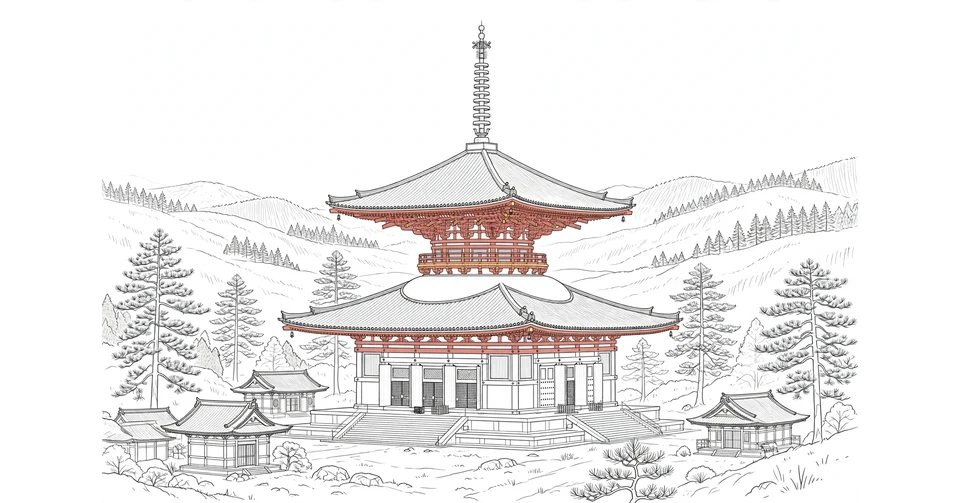
That is the honest answer to the question most visitors ask when they first see it, which is what the bright red tower is and why it matters. The short version is that the Konpon Daito is the centrepiece of the teaching precinct of Koyasan, planned by Kukai as the first pagoda of its kind in Japan, finished by his successors, burned five times, and rebuilt in 1937 in the form it keeps today. The longer version is worth the walk, because the Konpon Daito rewards attention in a way that a photograph never quite captures.
A vision drawn in vermilion
Kukai was granted the use of Koyasan by Emperor Saga in 816, and he set out to build the first monastic complex in Japan devoted entirely to esoteric Buddhism. He had studied in Chang'an in China, where his teacher Huiguo passed the Shingon teaching to him, and he returned to Japan in 806 with a clear idea of what a mountain monastery should be. Danjo Garan, the precinct at the heart of Koyasan, was laid out as the Womb Realm Mandala, the Taizokai, so that the arrangement of its halls would express the order of the cosmos. The Konpon Daito was placed at the centre of that plan, and everything else in the precinct takes its meaning from its position around the pagoda.
The name itself is a statement of intent. Konpon means fundamental, or principal, and daito means great pagoda. Kukai also called the Konpon Daito Hokkai Taisho-to, a tower representing the fundamental nature of the universe and ultimate Buddhist truth. That is a large claim for a single building, and the Konpon Daito was designed to carry it. It was not meant to be admired from a distance only. It was meant to be a training place, a three dimensional mandala that Shingon priests could use for meditation and visualisation, a tool for study as much as a place of worship.
Building it was an enormous undertaking, and Kukai did not live to see it finished. He entered eternal meditation in 835, and his successor Shinzen Daitoku, who lived from 804 to 891, oversaw the remaining work. The Japan Tourism Agency records that construction began in 816 and was completed in 876, more than forty years after Kukai's death. The head temple's own guide gives a slightly different span, from 816 through 887, and other guides repeat the later date. The honest thing to say is that the sources differ by about a decade on the finishing year, which is a small disagreement across twelve centuries, and that either way the Konpon Daito took roughly seventy years from first stone to completion. A building that takes that long to finish is not a project. It is a promise kept by people who never met the man who made it.
What they built was new in Japan. The Konpon Daito is a tahoto, a pagoda form with a square lower storey and a circular upper chamber, topped by a tall spire, and it is believed to be the first two storied pagoda of its kind in Japan. Later tahoto pagodas across the country took their model from this one, which makes the bright tower on Koyasan the ancestor of a whole family of buildings. It stands about 48.5 metres tall, according to the most detailed guides, and it remains the tallest building on the mountain. One popular guide gives a lower figure of 45 metres, so the exact height depends on what is being measured and when, but no source disputes the plain fact that the Konpon Daito dominates its precinct and can be seen from well beyond it. The lower storey is square, wrapped in a pent roof, and the round upper chamber rises above it, so the whole building reads as a square becoming a circle, earth becoming heaven, in a single silhouette.
I find something quietly instructive in the fact that Kukai planned a building he knew he would not finish. Most of us plan only what we can complete and take credit for, and we call that realism. Kukai planned a universe in wood and lacquer and left the finishing to his students, which is a different kind of realism, one that trusts the next generation to carry a good idea further than its author could. The Konpon Daito is still standing because that trust was repaid, again and again.
Five fires and a concrete heart
If the Konpon Daito has a second story, after its founding, it is fire. Lightning struck the Konpon Daito five times across the centuries, and each time the pagoda burned and was rebuilt. Powerful figures supported the rebuilding in different eras, including Taira no Kiyomori in the Heian period, and later Toyotomi Hideyoshi and Tokugawa Iemitsu contributed to the restoration of the mountain. The cycle became part of the building's identity. It was not a pagoda that happened to burn. It was a pagoda that kept coming back.
The worst fire came in 1843, when a great fire destroyed many of the buildings of Danjo Garan and burned the Konpon Daito down to its foundation stones. For nearly a century the centre of the precinct stood empty, marked only by the stones of the original base. Then, in 1937, the Konpon Daito was rebuilt as part of a project marking the 1,100th anniversary of Kukai's entry into eternal meditation. The new building followed the original form so closely that it looks as if it had always been there, and that is the point. The monks did not build a modern tower in an old style. They built the old tower again, with new means.
Those means were deliberately modern. The present Konpon Daito looks like a traditional wooden Buddhist structure from the outside, but inside it has a steel reinforced concrete core, designed with the involvement of Goichi Takeda, one of the leading architects of modern Japan, and the architectural historian Shunichi Amanuma. The concrete was a practical answer to a real problem. A wooden pagoda on a mountain ridge, with a tall spire, is a lightning rod by design, and the monks had watched it burn five times. Giving the Konpon Daito a concrete heart was not a betrayal of tradition. It was a way of making sure the tradition would survive the next storm, and it is hard to argue with the result. The building has now stood for nearly ninety years, longer than several of its wooden predecessors managed.
There is a temptation to be disappointed when you learn that the bright pagoda is not nine hundred years old, and I think that temptation misses what is valuable here. A building that has burned five times and been rebuilt five times is not a fake. It is a habit, repeated by generation after generation of people who decided that the teaching the building expressed was worth building again. The Konpon Daito standing today is a 1937 building in a ninth century form, and both dates matter. One tells you when the idea was born. The other tells you that the idea is still alive.
Inside the Konpon Daito, the mandala stands up
Step inside, and the Konpon Daito changes completely. Outside it is bright, open and vertical, a landmark you look up at. Inside it is dim, close and circular, a room that surrounds you. The shift is deliberate. Most mandalas are paintings or tapestries, flat diagrams of the Buddhist cosmos. The Konpon Daito turns the diagram into architecture, so that a visitor standing inside it is standing inside the idea. The Japan Tourism Agency describes the interior as a rare three dimensional representation of the Womb Realm Mandala, a ritual visualisation of the metaphysical universe and an important part of Shingon practice, and that description is exact. You do not look at this mandala. You enter it.
At the centre sits a large gilt wood statue of Dainichi Nyorai, the cosmic Buddha of the Womb Realm, known in Sanskrit as Mahavairocana. Around him stand the four Buddhas of the Diamond Realm: Akshobhya, Ratnasambhava, Amitabha and Amoghasiddhi. Their arrangement expresses the Shingon teaching that the two great mandalas, the Womb Realm and the Diamond Realm, are ultimately one. The Womb Realm speaks of compassion and the physical world, the world as it is, full of living beings. The Diamond Realm speaks of wisdom and the indestructible nature of enlightenment. Together they describe one teaching from two sides, and the interior of the Konpon Daito puts that teaching into statues, paint and space.
Sixteen vermilion pillars stand inside the Konpon Daito, each decorated with paintings of the Sixteen Great Bodhisattvas. The paintings were created by Insho Domoto, one of Japan's renowned modern painters, and their colour and energy fill the dim interior with a warmth that the plain wooden structure alone could never provide. In the four corners of the interior walls are portraits of the Eight Patriarchs who transmitted esoteric Buddhism from India through China to Japan. Among them are Kukai himself and his teacher Huiguo, known in Japanese as Keika, the Chinese monk who taught Kukai in Chang'an. The lineage is painted into the room, so that a visitor is surrounded not only by Buddhas but by the teachers who carried the teaching across three countries and many centuries.
The interior is a place for quiet attention rather than sightseeing. Photography inside is not allowed, and that rule is a gift as much as a restriction. Without a camera to hide behind, you have to look with your own eyes, and the room rewards that. The gold of the central statue, the red of the pillars, the painted figures turning slowly around you as you walk the circular chamber, all of it works on the attention in a way that a photograph flattens. I think there is a wider lesson in that small rule. Some experiences are diminished by the attempt to record them, and the Konpon Daito is one of them. The monks are not keeping the beauty from you. They are asking you to meet it directly.
The Konpon Daito is open from about 8:30 in the morning until 5 in the afternoon. Admission is charged for the interior, and a current guide lists it at 500 yen, with a combination ticket covering the pagoda, the Kondo Hall and other sights on Koyasan listed at 2,500 yen. Older guides list a lower figure, so the price has evidently risen over the years, and it is worth checking the current figure when you arrive. Either way the fee is small for what is inside, and the grounds of Danjo Garan themselves are free to walk at any hour, which is rare for a site of this importance.
What the vermilion is for
It is worth asking why the Konpon Daito is painted so brightly, because the colour is not decoration. Vermilion lacquer is a protective coating as well as a colour, and it has long been used on sacred buildings in Japan to mark them out from ordinary structures and to protect the wood beneath. On Koyasan, where the mountain air is damp and the winters are cold, that protection matters. But the colour also does theological work. Red is the colour of life and of sacred power in Japanese Buddhism, and a vermilion building announces itself as a sacred place before you have read a single sign. The Konpon Daito does not whisper. It declares.
The gold of the spire completes the statement. From a distance the Konpon Daito reads as two colours only, red below and gold above, and that simplicity is part of its power. The lower storey, square and solid, is the world we live in. The upper chamber, round and lighter, is the world of the Buddhas. The spire reaches up from the round chamber toward the sky, and in wind or rain the dozens of bronze wind bells hung from the spire ring out across the precinct. The Japan Tourism Agency notes the sound of those bells, and it is one of the small details that stays with visitors. A pagoda that rings in the wind is not a silent monument. It is a building that answers the weather.
The colour also changes with the light, which is why the time of day matters. In the morning the vermilion is sharp and clear against the green of the cedars. In late afternoon it deepens and warms, and the gold of the spire catches the low sun. After dark, when Danjo Garan is illuminated, the Konpon Daito takes on a different character altogether, glowing softly out of the darkness. Each version is the same building, and each version teaches something slightly different about it. A building that changes with the light is a building that rewards returning to it, and the monks who placed it at the centre of the precinct understood that.
I have come to think that the brightness of the Konpon Daito is a kind of honesty. A sacred building that pretended to be modest would be lying about its purpose, because its purpose is to be seen, to orient the whole precinct around it, and to remind everyone on the mountain what the mountain is for. The vermilion is not showing off. It is showing the way, the way a lighthouse is not showing off when it is painted in stripes. You are meant to find it, and you are meant to walk toward it.
The bell, the bells, and the sound of the mountain
Near the Konpon Daito stands a massive bell known as the Great Bell of the Konpon Daito. The present bell was cast in 1547 and weighs approximately six tons. Because of its size it is traditionally known as Koya Shiro, meaning the Fourth of Koya, a reference to its status among the great bells of Mount Koya. It is rung at designated times, and its deep sound spreads through the quiet surroundings of Danjo Garan. In Buddhist tradition the sound of a temple bell is associated with dispelling worldly attachments and calming the mind, and standing near it when it rings is an experience that the eyes alone cannot give you.
The great bell and the small wind bells of the pagoda make a pair, and the contrast between them is worth noticing. The great bell is rung by human hands at chosen times, a deep note that marks the hours of the mountain. The wind bells ring when the wind chooses, a light sound that no one controls. Between them they describe the two kinds of time that run through Koyasan: the time of the monks, measured in services and ceremonies, and the time of the mountain itself, measured in wind and weather. A visitor who hears both has heard something true about the place, and it costs nothing.
Sound matters on Koyasan in a way that is easy to overlook. The mountain is quiet, especially in the early morning, and the quiet makes every sound count. Monks cross the precinct in the dark, gravel crunches underfoot, a bell rings, and then the quiet returns. The Konpon Daito contributes to that soundscape without dominating it, and I think that restraint is part of its character. It is the tallest and brightest building on the mountain, and yet it does not shout. It rings, softly, when the wind moves it, and otherwise it stands still and lets the mountain speak.
How to stand in front of the Konpon Daito
The practical part of a visit is simple, and it is worth getting right. Danjo Garan sits in the centre of the town of Koyasan, about a five minute walk from the Senjuinbashi intersection and a few steps from Kongobuji, the head temple that administers the whole mountain. The grounds are open and free to walk at any hour. The pagoda and the neighbouring Kondo Hall are open from about 8:30 until 5, and photography is restricted inside the halls, so follow the signs and the guidance of the monks.
The best way to see the Konpon Daito is to walk the precinct slowly, and to let the building reveal itself in stages. Come through the Chumon gate and past the Kondo Hall, and the Konpon Daito appears over the roofline, bright against the trees. Walk closer and the scale of it settles in, the square lower storey, the pent roof, the round chamber above. Walk around it and the building turns with you, showing a different face from each side. Then go inside, pay the small fee, and let the dim interior do its work. The whole visit takes less than an hour, but it is an hour that stays with you, because the building is designed to be experienced in sequence, from the outside in, from the bright world to the painted one.
A few practical notes will make the visit easier. Wear shoes that are easy to slip off, because you will remove them to enter the halls. Dress modestly and speak quietly, because the precinct is an active place of worship and services run through the day. Bring cash for the admission fee, since small temple charges are not always payable by card. Check the time of the last cable car down the mountain when you arrive, because missing it means staying the night, and while a night in a temple lodging is a fine thing, it is better chosen than forced. If you can stay the night, do, because Danjo Garan at dawn, cold and silent with monks crossing between the halls in the dark, is the reason people come back to this mountain.
Late afternoon suits the Konpon Daito well. The vermilion reads best in low light, and the precinct empties as the last day trippers head for the cable car. The grounds at that hour belong to the monks and to the few visitors who stayed, and the Konpon Daito stands in the middle of it all, bright and still. It is a good time to stand in front of it and do nothing for a while, which is a rarer skill than it sounds. Most of us visit a famous building the way we read a sign, quickly and for information. The Konpon Daito asks for something slower, and it repays slowness.
A building that keeps being rebuilt
The Konpon Daito belongs to a larger story, and it is worth seeing it in that context. It stands at the centre of Danjo Garan, the founding precinct of Koyasan, where Kukai laid out the teaching of Shingon Buddhism as a mandala that visitors can walk through. The precinct covers about 55,000 square metres and holds around nineteen structures, and the sensible way to see it is to walk it clockwise from the Kondo after passing through the Chumon gate. The Konpon Daito is the centre of that walk, and every other building takes its meaning from its distance from it.
In 2004, Koyasan became part of the UNESCO World Heritage listing of the Sacred Sites and Pilgrimage Routes in the Kii Mountain Range, and Danjo Garan is one of the components of that listing. The listing recognises the mountain as a place where sacred geography and pilgrimage have shaped the landscape for more than a thousand years. The pagoda is a large part of the reason the listing makes sense. It is not only an old building. It is a building that embodies an idea about the shape of the universe, and that idea has been walked, chanted, painted and rebuilt by generations of monks.
The head temple's own guide to the mountain describes the pagoda as the central training place of the Shingon sect, a building that Kukai called a representation of the universe. That description is worth holding on to, because it explains why the pagoda has been rebuilt so many times. A building that is only beautiful is rebuilt when there is money and time. A building that is a tool for training, a room where priests learn to visualise the cosmos, is rebuilt because the teaching needs a room to happen in. The difference matters. The Konpon Daito has survived because it is useful, not only because it is loved, though it is certainly loved as well.
The sources for the pagoda's history are worth naming, because they disagree on small points and agree on large ones. The Japan Tourism Agency's page on the Great Pagoda gives the clearest account of the interior as a three dimensional mandala and records the completion of the original building in 876. The head temple's guide to the highlights of Koyasan gives the longer construction span, from 816 through 887, and describes the sixteen pillars and the eight patriarchs in the interior. The disagreement on the finishing year is a reminder that ninth century dates are rarely exact, and that the honest answer is sometimes a range rather than a single year. What the sources agree on is the shape of the story: a pagoda planned by Kukai, finished by his successor, burned five times, and standing today in its 1937 form.
That shape is the real subject of the pagoda. Most buildings tell you when they were built. The Konpon Daito tells you how many times it has been built, and that is a more interesting fact. It was built in the ninth century, and it was built again after each fire, and it was built again in 1937, in concrete and wood, by people who had never seen the original and yet knew exactly what it looked like. Each rebuilding was an act of memory and an act of faith, and the building that stands today is the sum of all of them. It is not the original pagoda. It is the pagoda as it has been remembered, which may be the more durable thing.
Stand in front of it at dusk, when the vermilion has deepened and the wind bells are ringing softly, and the history stops feeling like a list of dates. It feels like a single continuous decision, made by different people in different centuries, to keep this bright tower at the centre of the mountain. Kukai made the decision first, in 816. Shinzen made it again when he finished the pagoda. The monks who rebuilt it after each fire made it again. The architects who gave it a concrete heart in 1937 made it again. The pagoda is still standing because enough people, across twelve centuries, decided that it should be. That is not a bad definition of a sacred place, and it is not a bad way to think about anything worth keeping.
More in Culture & Society
Latest posts
- Sambal Matah Wakes Up Every Balinese Plate Raw
- Sate Lilit Wraps Bali's Feast Around a Lemongrass Stick
- Babi Guling Turns a Whole Pig Into a Balinese Feast
- Lawar Is the Dish Bali Serves When the Whole Village Eats
- Goma Dofu Is the Forty Minute Tofu Ground by Hand
- Garuda Wisnu Kencana Rises Above Bali's Southern Cliffs
- Soba, the Buckwheat Noodles Japan Slurps on the Last Night of the Year
- Udon in Kagawa, Where Noodles Are a Way of Life
- Garuda Pancasila Carries Five Principles on One Bird
- Saptawara Is the Seven-Day Week Inside Every Weton
- Janur Is the Young Coconut Leaf Bali Folds Into Everything
- Petungan Counts Your Neptu Before You Choose a Day
- The Pawukon Calendar Runs Bali on 210 Days
- Purnama Is the Full Moon Bali Prays By
- Galungan Welcomes the Ancestors Back to Bali