Sate Lilit Wraps Bali's Feast Around a Lemongrass Stick
· 14 min read
Sate lilit is Bali's minced meat satay, wrapped around a lemongrass stalk with base genep spices and grilled over charcoal, and it carries the island's feast culture in a single skewer.
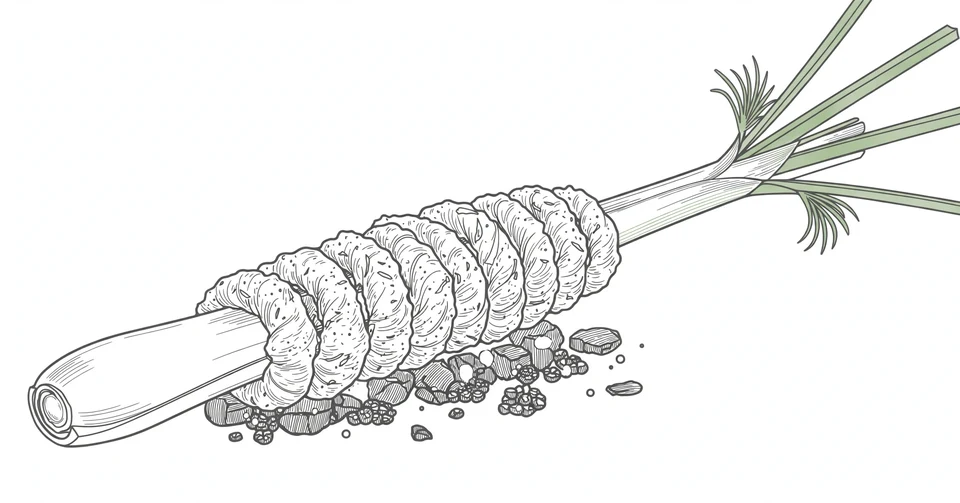
Most satay arrives threaded onto a stick. Sate lilit arrives wrapped around one. The meat is minced fine, mixed with grated coconut and a dense Balinese spice paste, then pressed by hand around a stalk of lemongrass and grilled over charcoal until the outside browns and the lemongrass perfumes the meat from the inside. It looks like a small sausage on a green handle, and it tastes like the whole island in one bite: savoury, spicy, smoky and faintly sweet, with a citrus note that no other satay in Indonesia can copy.
The first thing to understand is that sate lilit is not a variation on ordinary satay. It is a different idea of what a skewer can do. Ordinary satay threads cubes of meat onto bamboo and lets the fire do the rest. Sate lilit turns the skewer itself into an ingredient, and turns the cook's hands into the shaping tool. The result is softer, juicier and more fragrant than cubed satay. You will find it at temple anniversaries, at weddings and on the plate of rice that Bali calls nasi campur. It is ceremony food that also happens to be street food, and that double life is the point of it.
If you have eaten a babi guling plate in Bali, you have almost certainly eaten sate lilit already, probably without knowing its name. The plate arrives as a small collection of things, slices of roast pork, a shard of crackling skin, rice, a vegetable salad and a spoonful of sambal, and the sate lilit sits quietly among them, easy to mistake for a garnish. That modesty is misleading. The little wrapped skewer is one of the oldest and most deliberate dishes on the plate, and once you know what to look for, you start seeing it everywhere, from the morning market stall to the temple feast.
What sate lilit actually is
At its simplest, sate lilit is minced meat mixed with grated coconut and base genep, the complete Balinese spice paste, pressed around a lemongrass stalk or a flat bamboo skewer, and grilled over hot coals. The meat is most often fish, and mackerel is the favourite because its soft flesh takes the spices well and stays moist over the fire. Chicken is common too, lighter in flavour and popular with children, and pork appears in Hindu Bali with a richer taste and a denser texture. Beef is rarer and usually reserved for large family gatherings, and vegetarian versions made from tofu, tempeh or mushrooms work because the spice paste carries the dish even when the meat is absent.
The mixture is what makes sate lilit different from a meatball on a stick. The minced meat is combined with grated coconut, a little coconut milk for richness, and an egg to bind it, then the ground spice paste is folded through until the whole mass turns yellow and sticky. The cook takes a small handful and moulds it around the stalk with wet hands, pressing firmly so that no air is trapped inside and the meat holds its shape over the fire. Press too hard and the meat goes dense. Press too lightly and it slides off into the coals.
The grilling is the last part and the most forgiving one. The skewers go over charcoal, in Bali often coconut husk charcoal, the same fuel that roasts the pigs for babi guling, and they are turned often so that the outside browns evenly without drying the inside. The lemongrass stalk does its work during those few minutes on the grill, releasing its citrus oil into the meat as it heats. When the sate lilit comes off the fire it smells of smoke and lemongrass at once, and you eat it with your fingers, pulling the meat off the stalk or biting it straight from it.
The name tells you how to make it
The name of the dish is also its recipe. Sate means skewered meat, and lilit means to wrap, in Balinese. The meat is wrapped, not skewered, and the name has survived because the technique has survived. Every Balinese food writer I read agrees on this point, and it is the one fact about sate lilit that nobody argues about. The wrapping is the dish.
That matters because the wrapping is also what makes sate lilit practical. Mincing the meat means that cheaper cuts and smaller fish can be used, and that nothing is wasted. A whole fish can be deboned and ground, a whole chicken can be minced, and the coconut that grows in every Balinese garden stretches the mixture further. One food history account suggests the dish emerged from the royal kitchens of the Balinese kingdoms during the 17th century, and that mincing was a practical choice for making the most of what was available. The exact origins are uncertain, and the dish has been passed down mostly through oral tradition, so that date should be read as a story the island tells about itself rather than a settled fact.
I think there is something honest about a dish whose name is a verb. It does not describe a flavour or a place or a person. It describes an action, and the action is the whole point.
Base genep, the paste that does the work
No account of sate lilit makes sense without base genep, the complete spice paste that gives Balinese cooking its character. The name means the complete base, and it is ground from shallots, garlic, red chilli, turmeric, galangal, ginger, kencur, coriander, lemongrass, candlenuts and shrimp paste. That list sounds long, and it is, but the point of it is balance rather than heat. A good sate lilit is savoury, spicy, a little sour and a little sweet all at once, and no single flavour is allowed to win.
The paste is prepared before the meat is ever touched. The spices are ground smooth, then fried in a little oil until fragrant and the oil separates slightly, a step that cooks off the raw edge of the garlic and chilli and deepens the whole mixture. The fried paste is left to cool, then folded into the minced meat with the grated coconut. One detailed Balinese cooking guide describes the coconut taking on a yellowish hue as the paste is mixed through, and that colour is a useful sign for the cook. When the mixture is evenly yellow, the spices are evenly spread, and every bite will taste the same.
There is no fixed recipe for sate lilit. The dish has been passed down without a written standard, so every family makes its own version, more coconut here, more chilli there, and every answer is correct. That looseness is not a flaw in the tradition. It is the tradition.
Fish, chicken, pork, and the old turtle version
The fish version is the one most visitors meet first, and it is the version most Balinese cooks consider the classic. Mackerel, known in Indonesian as ikan tenggiri, is the usual choice because its flesh is soft, oily enough to stay moist on the grill, and mild enough to let the spices lead. Snapper and other white fish appear too. The fish is ground until smooth but not too fine, so that a little texture survives, and the mixture is wrapped around lemongrass stalks. It grills in minutes and it is eaten hot, often with sambal matah, the raw shallot and chilli relish that Bali serves with almost everything grilled.
Chicken sate lilit is the gentler sibling. It tastes lighter, it is less fishy, and it is the version most often offered to children and to visitors who are cautious about seafood. The spices are the same, so it is still recognisably the same dish, just quieter. Pork sate lilit is the richest of the common versions, with a denser texture and a deeper flavour, and it is often found in local warungs in Hindu Bali. Beef is the rarest, usually made for large family gatherings.
Older accounts mention a turtle version, made when sea turtle meat was still part of ceremonial cooking in some coastal villages. That practice has faded as sea turtles became protected, and no honest cook in Bali will offer it today. It is worth mentioning only because it shows how the dish has always followed what the sea and the ceremony provided, and how it has changed when the rules around those ingredients changed. Sate lilit survived the loss of that version without losing its shape, which tells you that the wrapping and the spice paste matter more than any single meat.
How the wrapping is done
Making sate lilit well is a matter of hands, not equipment. The meat is cut small and minced, either by hand or in a food processor, until it is fine but still holds a little texture. The spice paste is ground, fried until fragrant, and cooled. Then everything is mixed by hand in a wide bowl, the minced meat, the fried paste, the grated coconut, the coconut milk and the egg, worked together until the mass is sticky and mouldable. One recipe advises mixing with warm hands, because the warmth helps the mixture bind, and that small detail tells you how physical the dish is. It is not assembled. It is handled into shape.
The lemongrass stalks need preparing too. The outer layers are peeled away and the white part is gently pounded, which opens the fibres so the aroma can escape during grilling. A small amount of mixture is pressed around the stalk and smoothed into a neat shape, tight enough to hold but not so tight that it turns dense, with the stalk left bare at one end as a handle. Bamboo skewers work the same way, but lemongrass adds flavour that bamboo cannot.
Grilling takes only a few minutes. The skewers are laid over hot coals and turned often, and a little butter or oil can be brushed on as they cook to help them brown. A pan-fried version works too, cooked for about two minutes per side, but the grilled version is better, and the difference is the smoke. Over charcoal the outside crisps slightly while the inside stays tender, and the lemongrass has time to perfume the meat. If you are making sate lilit at home and you have no grill, a hot pan and a little patience will get you most of the way there. If you have a grill, use it.
Sate lilit at ceremonies and on the feast plate
Sate lilit belongs most of all to the ceremony, and understanding that is the key to understanding the dish. In Bali, food is not only for eating. It is also for offering, and sate lilit is often prepared as part of banten, the religious offerings made to ancestors and deities. It appears at odalan, the temple anniversary, at Galungan and Kuningan, and at Melasti, served alongside other dishes on the offering tray. Because it is made from many ingredients mixed together, it is read as a symbol of abundance and unity, many things folded into one.
The cooking itself is communal. In the days before a major ceremony, the residents of a banjar, the neighbourhood community, or an extended family gather to cook together. The work is divided by habit rather than by instruction. Some grind the meat, some grind the spices, some grate the coconut, some wrap the mixture onto the stalks. The work is done with conversation and laughter, and it strengthens the bonds between the people doing it. Sate lilit is a dish that takes many hands to make properly at feast scale, and Bali has kept it that way.
That communal spirit is visible on the plate too. A plate of babi guling arrives with rice, lawar, sate lilit, a vegetable salad and a spoonful of sambal, and the sate lilit is there because the feast is a collection of small dishes made by many hands, not one dish made by one cook. Lawar is made the same way, mixed together by the whole village for the whole village. The two dishes belong together, and they tell the same story in different forms. One is wrapped around a stalk. The other is mixed in a basin. Both are made by many hands for many mouths, and both taste of the occasion as much as of the ingredients.
I find that the most moving thing about sate lilit is not the flavour, good as it is, but the fact that it refuses to be made alone at scale. A feast needs a hundred skewers, and a hundred skewers need a room full of people wrapping them together. That is a small discipline, repeated in thousands of compounds, and it is what turns cooking into community.
Where to eat sate lilit without a ceremony
You do not need an invitation to a temple feast to eat sate lilit. It is part of everyday Bali too, and the easiest place to find it is on a plate of nasi campur at a warung or a morning market stall. A skewer or two sits beside the rice, the shredded chicken, the vegetables and the lawar, and it is usually the part of the plate that makes people ask what they just ate. Fish sate lilit is the most common version at stalls, and many make it fresh each morning.
A few practical notes help. Sate lilit is grilled fresh and eaten the same day, so the best time to find it is in the morning, when the warung have just finished their cooking. By the afternoon it is often gone, and that is a good sign rather than a bad one. A stall that sells out is a stall that made it properly that morning. Ask what meat is in the version you are being served, especially if you do not eat pork or fish. The sellers will understand the question. They answer it every day.
If you are staying in Bali for a while, try sate lilit in more than one place. A stall in Ubud will make it differently from a stall in Gianyar or a family warung in a mountain village, and the differences are the point. One may be heavier on coconut, another sharper with lime, another hotter with chilli. Tasting those differences is the cheapest possible education in Balinese cooking, and it costs no more than a plate of rice.
Why a wrapped satay still matters
Sate lilit matters because it is a dish that turns its tools into flavour. The lemongrass stalk is not packaging. It is an ingredient, and it does work that no bamboo skewer can do. The wrapping is not decoration. It is the technique that lets minced meat, coconut and spices become one thing instead of a pile of separate things. And the communal cooking is not a side effect. It is the reason the dish exists at the scale it does.
It also matters because it has not been flattened into a single standard. Every village keeps its own version, every family argues gently about the right balance of coconut and spice, and the dish stays alive precisely because nobody has written its final form. Traditions that survive are usually the ones that leave room for the people who keep them, and sate lilit leaves a lot of room.
So if you find yourself in Bali on a festival morning, with the smell of cooking drifting out of every compound and the smoke of coconut husk charcoal in the air, look for the people sitting together with a basin of minced meat and a pile of lemongrass stalks. That is sate lilit being made, and it is Bali at its most honest: a whole community wrapping its feast around a stalk of lemongrass, feeding its ancestors first, its neighbours second, and itself last, and finding that the order makes the food taste better.
More in Food & Travel
- Sambal Matah Wakes Up Every Balinese Plate Raw
- Babi Guling Turns a Whole Pig Into a Balinese Feast
- Lawar Is the Dish Bali Serves When the Whole Village Eats
- Goma Dofu Is the Forty Minute Tofu Ground by Hand
- Garuda Wisnu Kencana Rises Above Bali's Southern Cliffs
- Soba, the Buckwheat Noodles Japan Slurps on the Last Night of the Year
Latest posts
- Shinran Turned Chanting Into Gratitude
- The Javanese of Suriname and the Language They Kept Alive
- Nembutsu Is the Name Japan Calls Out to Amida
- Konpon Daito Towers Over Koyasan in Vermilion and Gold
- Wuku Gives Every Week in Bali a Name
- A Penjor Turns a Whole Street Into an Offering
- A Mokugyo Keeps the Beat of the Chant
- Udon in Kagawa, Where Noodles Are a Way of Life
- Garuda Pancasila Carries Five Principles on One Bird
- Saptawara Is the Seven-Day Week Inside Every Weton
- Janur Is the Young Coconut Leaf Bali Folds Into Everything
- Petungan Counts Your Neptu Before You Choose a Day
- The Pawukon Calendar Runs Bali on 210 Days
- Purnama Is the Full Moon Bali Prays By
- Galungan Welcomes the Ancestors Back to Bali