Nembutsu Is the Name Japan Calls Out to Amida
· 14 min read
The nembutsu, the chanting of "Namu Amida Butsu," is the simple six-syllable prayer at the heart of Japanese Pure Land Buddhism, and it has carried ordinary people through eight centuries of mornings, funerals, and quiet evenings at home.
Six syllables carry more of Japan than almost any other sound. Namu Amida Butsu. Spoken slowly in a temple hall at dawn, whispered at a family altar, or murmured beside a hospital bed, the phrase is the heart of the nembutsu, the chanting of Amida Buddha's name in Pure Land practice. It means, in plain English, I take refuge in Amida Buddha. For more than eight centuries it has been the simplest prayer Japan knows, short enough for a child and deep enough for a lifetime.
The nembutsu asks nothing complicated of the person who says it. There is no posture to master, no text to memorise, and no test to pass. You say the name, and the saying itself is the practice. That simplicity is the whole point, and it is why the chant spread from mountain temples to market streets, from monks to farmers, and from medieval Japan into the daily life of millions of people today.
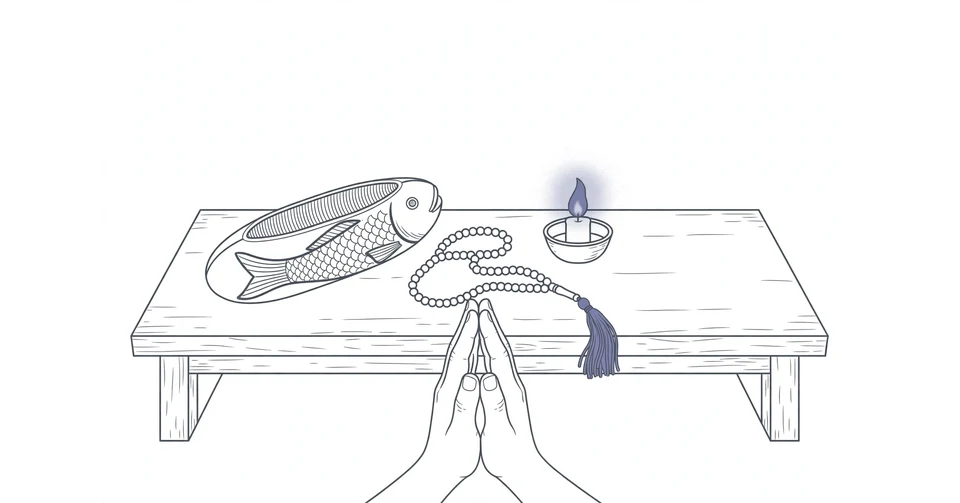
To hear the nembutsu is to understand something about Japan that guidebooks rarely capture. The country is often described through its shrines and its silence, its gardens and its trains, but underneath all of that runs a sound, quiet and steady, of ordinary people calling on a Buddha of infinite light and asking, in six syllables, to be held. The nembutsu is that sound, and this article follows where it came from, what it means, and why it has never faded.
What the six syllables of the nembutsu actually say
The phrase breaks into two parts, and each part carries a meaning that the chant never lets you forget. "Namu" comes from the Sanskrit word "namas," which means to take refuge, to bow down and entrust yourself completely. "Amida Butsu" is the name of the Buddha Amida, drawn from the Sanskrit Amitabha, infinite light, and Amitayus, infinite life. Put together, as the Japanese temple guide Temple Notes explains, the full phrase means "I take refuge in and entrust myself to Amida Buddha, who possesses infinite light and life." That is the whole theology of the nembutsu in a single breath, and it is worth pausing over, because most prayers ask for something specific, while this one asks only to be received.
Counted in Japanese, the phrase is six syllables: na, mu, a, mi, da, butsu. Six sounds, and nothing else is required. The word nembutsu itself comes from the Chinese nianfo, which means mindfulness of the Buddha, and the Japanese reading kept that double sense. At its root, nembutsu is not only a sound made with the mouth. It is the act of keeping the Buddha in mind.
In practice, the tradition recognises two forms of nembutsu. The first is shomyo nembutsu, the recitative form, in which the name is chanted aloud. This is the form most people know, and it is the mainstream practice today. The second is kanso nembutsu, the contemplative form, in which the practitioner visualises the appearance of Amida and the Pure Land in careful detail inside the mind. Contemplation came first in the history of the practice, but it demanded a level of focus that few people could sustain. Recitation spread instead, because anyone can say six syllables, and the saying itself keeps the mind from wandering.
The authority behind the chant is a promise written into one of the central scriptures of Pure Land Buddhism. In the Larger Sutra, known in English as the Infinite Life Sutra, Amida Buddha makes his Eighteenth Vow, sometimes called the Primal Vow. It says that sentient beings who sincerely entrust themselves to him, desire to be born in his land, and call his name even ten times will be born there. Ten times. Not ten thousand, not a lifetime of perfect conduct, but ten sincere calls. That number is the reason the nembutsu has always belonged to ordinary people rather than only to monks, and it is also the reason the chant has survived every change in Japanese history. A practice that asks so little is hard to abandon.
How the nembutsu reached Japan
Buddhism arrived in Japan by the 6th century, carried across the sea from China and Korea along with writing, art, and court ritual. The Pure Land scriptures came with it, and a history of Pure Land Buddhism names the three sutras that still anchor the tradition: the Larger Sukhavativyuha Sutra, the Smaller Sukhavativyuha Sutra, and the Amitayurdhyana Sutra. These texts describe Amida Buddha and his Western Pure Land, Sukhavati, a realm free from suffering where enlightenment becomes easier to reach. But for several centuries the nembutsu remained a practice of the educated clergy, one devotion among many inside large temple complexes.
That began to change in the Heian period, which ran from 794 to 1185. Monks of the Tendai school practised the nembutsu as a form of ascetic training, and one of their disciplines, called Jogyo Zanmai, required walking and chanting the nembutsu continuously for ninety days. It was a hard practice, and it stayed inside the monasteries. What carried the chant out of the monasteries was a monk named Kuya, who lived in the middle of the Heian period and took the nembutsu into the streets. He chanted it in markets and at crossroads, among traders and labourers, and the people began calling him the Saint of the Marketplace. Kuya understood something the monastery had missed, which is that a prayer people can carry in their mouths will travel further than a prayer locked in a book.
The chant reached its full flowering in the Kamakura period, from 1185 to 1333, when two monks gave it the shape it still has today. Their names are Honen and Shinran, and the difference between them is the difference between two ways of hearing the same six syllables. Before looking at them, it is worth remembering what they inherited: a chant that had already travelled from India to China to Japan, from sutra to monastery to marketplace, and that was ready, by the 12th century, to belong to everyone.
Honen, Shinran, and two ways of hearing the same words
Honen lived from 1133 to 1212, and he founded the Jodo Shu school, the first independent Pure Land school in Japan. His teaching was simple and radical at once. In his major work, the Treatise on the Nembutsu of the Select Primal Vow, he argued that Amida Buddha had designated the vocal nembutsu, and nothing else, as the practice of the Eighteenth Vow for all people in the last age. No temple building, no carved image, no moral or intellectual achievement was required as the basis of salvation. Only the recitation of the name with simple faith. In Jodo Shu, the nembutsu is therefore a practice aimed at rebirth in the Pure Land, and the frequency and continuity of chanting tend to be emphasised. You chant earnestly, again and again, trusting the vow that those who call the name will be saved.
Shinran, who lived from 1173 to 1263, was Honen's disciple, and he took his teacher's message one step further. Shinran founded the Jodo Shinshu school, and in it the meaning of the nembutsu turns around completely. Shinran taught that the moment you feel the urge to chant "Namu Amida Butsu," Amida Buddha's salvation is already accomplished. The chant is therefore not a means to get saved. It is an expression of gratitude for already being saved. This is called the nembutsu of gratitude, and it rests on the idea of tariki, Other Power, the entrusting of oneself to Amida's power rather than jiriki, Self Power, the reliance on one's own effort. Where Honen's followers chant in order to reach the Pure Land, Shinran's followers chant because they believe they are already held.
The difference matters, and it is the kind of difference that can only exist inside a living religion. The same six syllables, the same breath, the same beads, and yet one person chants as a traveller walking toward a destination while another chants as someone who has already arrived and is simply saying thank you. I find the Shinran version quietly devastating in the best sense, because it removes the last hiding place of spiritual pride. If the chant is gratitude rather than achievement, then there is nothing left to count, nothing to compare, and no way to be better at it than the person beside you. That is a rare thing in a world that turns almost everything into a competition.
Other schools kept their own versions of the nembutsu as well. The Ji Shu school, founded by Ippen, became famous for the Dancing Nembutsu, in which followers beat drums and bells while chanting, aiming to become one with the Buddha in a state of ecstasy. The Yuzu Nembutsu school taught that one person's nembutsu becomes merit for all, and the nembutsu of all becomes merit for oneself, a teaching of shared practice that fits the communal spirit of a Japanese neighbourhood. Tendai kept the nembutsu as part of its meditation training. Not every school chants it, though. Zen sects focus on realising the Buddha nature within through seated meditation, and the Nichiren sect chants its own phrase, "Namu Myoho Renge Kyo," as its central practice. The nembutsu belongs to the Pure Land world, and within that world it belongs to everyone.
The nembutsu in daily Japanese life
Most people in Japan do not meet the nembutsu in a philosophy book. They meet it at the start of the day and at the end of a life. In temples of the Pure Land schools, the morning service opens before sunrise, and the chanting of the name is woven through the liturgy alongside sutra recitation and bows. A good way to picture that hour is to read about a gongyo service that starts the temple day before sunrise, where the same stillness and repetition set the tone for everything that follows. The nembutsu is not the whole service, but it is the thread that runs through it, the sound that returns whenever the liturgy pauses.
In many halls the chant is kept steady by the mokugyo, the wooden fish-shaped drum whose hollow knock marks the rhythm of the recitation. The instrument is struck once per syllable or once per phrase, and its dry, regular beat does what a metronome does for a musician: it holds the group together and keeps the mind from drifting. The mokugyo's role in the chant is described in an article about the drum that keeps the beat of the chant, and the connection is worth noticing. The nembutsu is a chant, and a chant needs a pulse. The drum gives it one, and the drum's fish shape, eyes always open, is itself a reminder never to sleep through the practice.
The most familiar meeting with the nembutsu, for many Japanese families, happens at funerals and memorial services. Chanting the name at a funeral is an act of praying that the deceased will be safely guided to the Pure Land by Amida Buddha. For those left behind, facing the dead through the chant helps organise grief, giving sorrow a rhythm and a direction instead of leaving it shapeless. The tradition also teaches that the chanting purifies past karma, and that the one who chants gains assurance of rebirth in the Pure Land. Whether or not a visitor shares that belief, the scene itself is hard to forget: a room full of people, some of whom have not chanted in years, finding the syllables again together when it matters most.
At home, the nembutsu lives at the butsudan, the family Buddhist altar, where photographs of the dead stand beside incense and offerings. Morning and evening, someone in the household presses the palms together in gassho, rings a small bell, and chants the name a few times before starting the day. Prayer beads, called juzu, are held in the left hand or draped between the clasped palms, and each bead marks one repetition. It is a small ritual, over in a minute, and it is repeated in millions of homes without ceremony or announcement. That is the part of Japanese Buddhism that rarely appears in photographs, because it happens in living rooms rather than temples, and it is also the part that explains why the nembutsu has lasted. A religion that fits into a minute fits into a life.
What the chant does to the person chanting
There is a question that follows the nembutsu everywhere it goes, and it is a fair one: does saying six syllables actually do anything? The tradition answers in its own terms, speaking of merit accumulated, karma purified, and rebirth assured. A modern listener might answer differently, speaking of breath, rhythm, and attention. The chant is spoken aloud, at a volume where you can hear your own voice, and the repetition steadies the breathing in the same way that any repeated phrase does. The mind, given a single thing to hold, stops chasing the hundred things it was chasing a moment before. That is not a small effect, and it does not need a supernatural explanation to be real.
I think the deeper effect is harder to name, and it is the one that keeps people chanting for decades. To say "I take refuge" is to admit, out loud, that you cannot carry everything alone. Modern life rewards the opposite confession. We are told to be self-reliant, to optimise, to manage, to cope, and to treat every problem as a task with a solution. The nembutsu refuses that bargain. It says that there is a light larger than your effort, a life longer than your plans, and that the correct response is not to work harder but to let go and call out. That is a countercultural message in any century, and it may be why the chant feels surprisingly fresh to people who encounter it today, even people with no Buddhist background at all.
There is also something in the sound itself. "Namu Amida Butsu" is soft, with no hard consonants and no sharp edges. It can be sung, whispered, or cried. It fits a funeral and a quiet morning equally well, and it never sounds hurried, even when it is chanted quickly. A prayer that sounds like that is easy to return to, and ease of return is the whole secret of a daily practice. The practices that survive are rarely the most impressive ones. They are the ones that can be picked up again tomorrow without preparation.
The nembutsu has survived because it asks for almost nothing and gives back a surprising amount: a minute of stillness, a rhythm for grief, a sentence that fits in the mouth and stays in the mind. Eight centuries after Honen and Shinran, after the chant moved from sutra to monastery to marketplace to living room, it is still being said in the same six syllables, by people who may know nothing of the Eighteenth Vow and everything about what it means to need refuge. That is a long life for six sounds, and it suggests that the chant was never really about the words at all. It was about the pause between them, and the hand that reaches out in that pause, and the answer that has always been the same: say the name, and you are already held.
More in Culture & Society
Latest posts
- Sambal Matah Wakes Up Every Balinese Plate Raw
- Sate Lilit Wraps Bali's Feast Around a Lemongrass Stick
- Babi Guling Turns a Whole Pig Into a Balinese Feast
- Lawar Is the Dish Bali Serves When the Whole Village Eats
- Goma Dofu Is the Forty Minute Tofu Ground by Hand
- Garuda Wisnu Kencana Rises Above Bali's Southern Cliffs
- Soba, the Buckwheat Noodles Japan Slurps on the Last Night of the Year
- Udon in Kagawa, Where Noodles Are a Way of Life
- Garuda Pancasila Carries Five Principles on One Bird
- Saptawara Is the Seven-Day Week Inside Every Weton
- Janur Is the Young Coconut Leaf Bali Folds Into Everything
- Petungan Counts Your Neptu Before You Choose a Day
- The Pawukon Calendar Runs Bali on 210 Days
- Purnama Is the Full Moon Bali Prays By
- Galungan Welcomes the Ancestors Back to Bali