Sambal Matah Wakes Up Every Balinese Plate Raw
· 16 min read
Sambal matah is Bali's raw shallot and chilli relish, sliced fresh and softened with hot coconut oil, and it wakes up grilled fish, sate lilit and roast pork with a sharp, citrusy bite.
Most Indonesian food arrives with a sambal on the side, and most sambals arrive cooked. Sambal matah is the exception that makes the rule worth knowing. Nothing in the bowl is ground into a paste and nothing is fried down until it turns dark and mellow. The shallots stay raw and crisp, the chillies stay bright, the lemongrass stays fragrant, and the whole thing is finished with a pour of hot coconut oil and a squeeze of lime. It is Bali's raw relish, and once you have tasted it beside a piece of grilled fish, every other sambal starts to feel like it is holding something back.
The name gives the game away. Sambal matah can be translated as raw sambal, and the word matah comes from the Balinese and Indonesian word for raw. That is not a marketing claim. It is a description of the method. The ingredients are sliced thin, mixed in a bowl, and served within minutes, and the only heat in the whole process is the oil that is poured over the top. Sambal matah is a condiment, but it behaves more like a salad that happens to be spicy, and that is exactly why it works.
If you have eaten in Bali, you have almost certainly met sambal matah already, even if nobody told you its name. It sits in a small bowl beside the rice at the warung, it arrives on the feast plate next to the roast pork, and it is the bright, crunchy spoonful that makes you reach for a second helping of something you thought was already good enough. One account of Bali's grilled food puts it plainly, that sate lilit is eaten hot, often with sambal matah, the raw shallot and chilli relish that Bali serves with almost everything grilled. That sentence is the whole story in miniature. Sambal matah is not the main dish. It is the thing that makes the main dish taste like itself, only louder.
What sambal matah actually is
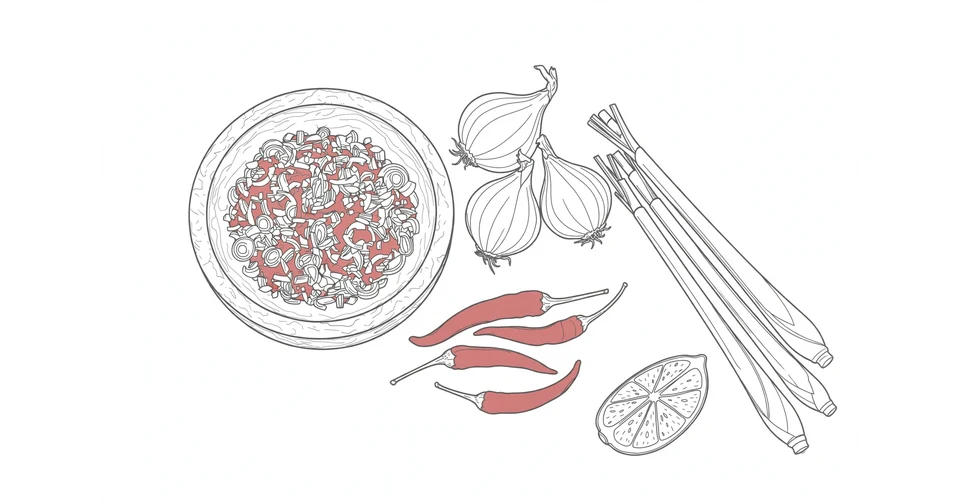
Sambal matah is a raw Balinese relish built from thinly sliced shallots, bird's eye chillies, lemongrass, makrut lime leaves and garlic, mixed with crumbled shrimp paste, lime juice, a pinch of sugar and salt, and finished with hot coconut oil. The ingredients are chopped, not ground, so the bowl keeps its texture. You can see every piece in it, the pale rings of shallot, the red flecks of chilli, the fine green threads of lime leaf, and that visible honesty is part of the pleasure. It looks like what it is, and it tastes like what it looks like.
The shallot is the backbone of sambal matah. Shallots are milder and sweeter than onions, with a faint garlic note, and that sweetness matters because the shallot is eaten raw. A raw onion would bully the bowl. A raw shallot sweetens it and gives it crunch. Cooks who want a gentler bowl simply add more shallots, and the relish softens without losing its character. Cooks who want heat do the opposite and let the chillies lead.
The chillies are bird's eye chillies, known in Indonesian as cabe rawit, small, elongated and very hot. They are the source of the heat, and the heat is real, but it is a clean heat rather than a heavy one. Because nothing is cooked down, the chilli keeps its fresh, almost fruity sharpness, and the lime juice keeps it from turning flat. Some cooks mix in a few milder red chillies to take the edge off, and some remove the seeds, where much of the heat lives, but the original version makes no apology for its fire.
Lemongrass is the third pillar, and it is the one that makes sambal matah taste unmistakably Balinese rather than generically Indonesian. Only the tender white inner core of the stalk is used, sliced fine, and it brings a citrusy, herbal note that no other ingredient can replace. The makrut lime leaves, cut into hair-thin slivers after the tough central rib is removed, add a floral citrus scent on top of that. Lime juice adds the acidity that ties the bowl together, and a little sugar rounds the edges without making anything sweet.
Then there is the shrimp paste, terasi, the fermented paste that gives sambal matah its deep, savoury undertow. A small amount is crumbled into the bowl, sometimes toasted first to soften its pungency, and it supplies the umami that makes the relish taste like more than a salad. Without it, sambal matah would be bright but thin. With it, the bowl has weight. Cooks who skip it usually add a little extra salt to compensate, and the result is still good, but it is a quieter version of the same idea.
Why raw changes everything
The difference between sambal matah and most other sambals is not the ingredient list. It is the absence of cooking. Most Indonesian sambals are ground in a mortar and then fried in oil, and that cooking is what turns them into a paste. The flavours melt together, the chilli softens, the garlic sweetens, and the result is deep and mellow. Sambal matah refuses that transformation. The ingredients are never ground and never fried, so each one keeps its own voice, and the bowl tastes like a conversation rather than a chorus.
That rawness is also a matter of time. Sambal matah is made to be eaten fresh, ideally within minutes of the oil being poured over it, and it does not improve with age. The shallots will turn bitter if they sit sliced in the open air for too long before the oil goes on, which is why Balinese cooks slice everything, pour the oil, and serve. Kept in a clean airtight container in the refrigerator, with the shallots kept submerged in oil, it will last a few days, and one careful home cook reports it keeping up to a week, but freshness is the point and the fridge is only a compromise.
I think the rawness is also what makes sambal matah honest in a way that cooked sambal is not. A cooked paste can hide a tired chilli or a dull shallot behind heat and time. A raw relish cannot hide anything. Every ingredient has to be fresh, every slice has to be thin and even, and the cook's knife work is on display in the bowl. That vulnerability is the charm. You are tasting the ingredients, not the technique.
The hot oil, the one moment of heat
If sambal matah is a raw relish, the hot oil is its one contradiction, and it is a deliberate one. Coconut oil is heated in a small pan until it is hot and shimmering, and then it is poured over the sliced ingredients so that it sizzles on contact. The oil is not there to cook the bowl. It is there to wake it up. The heat softens the sharp edge of the raw shallot just enough, it blooms the lemongrass and the shrimp paste so their fragrance fills the bowl, and it binds everything together in a glossy coating that carries the flavour to every bite.
Coconut oil is the traditional choice, and it brings a subtle tropical sweetness of its own, but a neutral vegetable oil works too, and the relish survives the swap. What matters is that the oil is genuinely hot when it hits the bowl, because lukewarm oil just sits there and greasy oil is worse than no oil at all. A good test, passed down by home cooks, is to drop a single slice of shallot into the pan. When it sizzles at once, the oil is ready.
After the oil, the bowl is stirred and pressed down gently with a spoon, which helps the flavours fuse without crushing the texture. The lime juice and a little sugar go in, salt is added to taste, and the cook tastes before adding more salt because the shrimp paste is already salty. That tasting step matters more than it sounds. Sambal matah is a balance of hot, sour, salty and sweet, and the balance is set by the cook's tongue, not by a fixed formula.
The company it keeps on the Balinese plate
Sambal matah is a team player, and its teammates are the grilled and roasted dishes of Bali. Grilled fish is its most natural partner. The fish is rich and oily, the relish is sharp and acidic, and the two correct each other in the mouth. A spoonful of sambal matah over a piece of grilled mackerel or snapper cuts through the richness the way lemon cuts through fried food, only with more personality. The same logic applies to fried chicken, which is why the relish turns up beside ayam goreng at warungs all over the island.
It is also a fixture of the feast plate. A plate of babi guling arrives as a small collection of things, slices of roast pork, crackling skin, rice, lawar and sate, and sambal matah is the bright note that keeps the rich pork from becoming monotonous. The pork is fatty and deeply savoury, the relish is raw and sharp, and the contrast is the point. Without it, the plate would be delicious but heavy. With it, the plate stays lively to the last bite.
The same is true of sate lilit, the minced meat satay wrapped around a lemongrass stalk. Sate lilit is soft, smoky and fragrant from the charcoal, and sambal matah gives it the crunch and the citrus snap that the skewer itself does not have. The two dishes share an ingredient, lemongrass, in two different forms, as a skewer in one and as a sliced aromatic in the other, and eating them together feels like hearing the same note played twice in different octaves.
Ayam betutu, the slow cooked spiced chicken wrapped in banana leaves, is another classic partner. Betutu is dark, complex and deeply spiced from its long cooking, and a spoonful of raw relish beside it acts like a window opening in a warm room. The contrast is not an accident. Balinese cooking loves to pair a long, slow, cooked flavour with a short, sharp, raw one, and sambal matah is the sharpest tool in that pairing. It is the reason a plate that should feel heavy never does.
Cooked sambal and raw sambal, side by side
To understand sambal matah, it helps to set it next to its cooked cousins. Sambal terasi, the most common sambal in Indonesia, is made by grinding red chillies, garlic, shallots and toasted shrimp paste together, often with tomato, and then frying the paste in oil. The result is bold, savoury and deep, and it is delicious. But it is a different kind of delicious. Where sambal terasi is a sauce that coats, sambal matah is a relish that crunches. Where one is mellow, the other is bright.
Sambal tomat, another Balinese favourite, sits somewhere between the two. It uses similar ingredients to sambal matah, red chilli, shallots, garlic and shrimp paste, but adds tomato and is usually cooked, which gives it a tangy sweetness that the raw version does not have. Sambal bajak, from Java, is cooked further still, sauteed with tamarind and palm sugar until it turns rich and almost jammy. Each of these is good in its own way, and each of them would be a fine companion to grilled fish. But none of them does what sambal matah does, which is to taste like the ingredients were picked ten minutes ago.
The distinction matters beyond flavour. Across Indonesia, more than four out of five sambal varieties are cooked, and raw sambals are the minority, found mostly in Bali and the eastern islands. Sambal matah is therefore not just a recipe. It is a regional statement about how food should taste. Bali keeps its sambal raw because Bali likes its food to taste alive, and the island's cooking has held onto that preference while much of the rest of the archipelago went the way of the frying pan. TasteAtlas, which ranks sambal matah among the best rated sambal varieties in the world, describes it as a raw mixture of chopped shallots, lemongrass, chilli peppers and sometimes garlic, mixed with coconut oil and lime juice, and notes that unlike cooked sambals it is prepared without any heat treatment, preserving the sharp, pungent flavours of its raw ingredients.
How a Balinese household makes it
There is no single written recipe for sambal matah, and that is not a gap in the tradition. It is the tradition. Every household makes its own version, and every version is correct. The method, though, is the same everywhere, and it is worth describing because it explains the dish better than any list of ingredients could.
The work starts with the knife. Shallots are peeled and sliced paper thin, chillies are sliced into fine rings, the white core of the lemongrass is minced, and the lime leaves are cut into threads so fine they almost disappear. Garlic, when it is used at all, is minced small. The cutting takes longer than everything else combined, and the quality of the cutting decides the quality of the bowl. Thick, uneven slices make a clumsy relish. Thin, even ones make a bowl that eats like lace.
Everything goes into a heatproof bowl, the shrimp paste is crumbled in, and the hot oil is poured over the top. The bowl sizzles, the cook stirs and presses the mixture down gently to help the flavours meet, and then the lime juice, sugar and salt are added and adjusted by taste. That is the whole method. There is no mortar, no blender, no pan of simmering paste, and no waiting. From first slice to first spoonful, a practiced cook is done in about ten minutes.
What I like most about this method is how little it asks of the cook and how much it asks of the ingredients. There is no technique to hide behind. A dull knife, a stale shallot or a tired lime will show up in the bowl immediately, and a good cook knows it. That is why sambal matah is usually made fresh for each meal rather than in a big batch for the week. It is a daily discipline, repeated in thousands of Balinese kitchens, and the repetition is what keeps the standard high.
Where to find sambal matah
The easiest place to meet sambal matah is on a plate of nasi campur at a morning warung. The relish will be there in a small bowl or a spoonful on the side of the rice, next to the shredded chicken, the vegetables and the lawar, and it is usually the part of the plate that makes people ask what they just ate. Morning is the best time, because the relish is made fresh each day and the warungs that sell out early are the ones that made it properly.
It also turns up at seafood grills along the coast, where the catch of the day is grilled over coconut husk charcoal and served with rice and a generous spoonful of the relish. Jimbaran is famous for this, but any beachside grill in Bali will do the same, and the smaller and less polished the place, the more likely the sambal matah is made that morning by the owner's own hand. At a temple feast or a family ceremony, it appears on the offering tray and the feast plate alike, because no Balinese feast is complete without something raw and bright to balance the rich, cooked dishes.
Outside Bali, sambal matah has travelled further than most Balinese dishes. It appears on menus in Jakarta and Surabaya, in Indonesian restaurants overseas, and even as a bottled sauce or a noodle flavour, and one Indonesian food writer notes that a major instant noodle producer released a sambal matah flavoured product as the relish gained popularity in recent years. The bottled versions are convenient, and the noodle flavour is fun, but neither of them is the real thing. Sambal matah is a fresh relish, and freshness is not something a bottle can hold.
If you are staying in Bali for a while, try sambal matah in more than one place, because the differences are the education. A warung in Ubud may make it hotter, a family kitchen in Gianyar may make it sharper with lime, a coastal stall may lean harder on the lemongrass. One Balinese cooking guide puts it simply, that the original version calls for bird's eye chillies, and that each bite delivers an umami flavour that keeps you spooning the dish over and over again. Another home cook's account describes it as a vibrant Balinese salsa made with sliced shallots, bird's eye chillies and aromatic herbs like lemongrass and lime leaves, tossed in a fragrant coconut oil and lime juice dressing, and served with grilled meats, seafood or rice dishes. Both descriptions agree on the essentials, and both agree that the relish is at its best beside grilled food.
Why a raw relish still matters
Sambal matah matters because it is proof that a condiment can be a cuisine's clearest statement. Bali's cooking is often described through its spice pastes and its slow cooked feasts, and those descriptions are fair, but they miss the other half of the island's palate. The other half is raw, sharp, citrusy and immediate, and it lives in this small bowl of sliced shallots and chillies. A cuisine that only cooked would be a cuisine that only remembered. Bali also tastes the present moment, and sambal matah is how it does that.
It matters, too, because it has resisted being standardised. There is no official recipe, no fixed ratio, no brand that owns it, and every family argues gently about the right balance of shallot and chilli. That looseness is not a flaw. It is the reason the relish is still alive, still argued about, and still made fresh every morning in kitchens across the island. Traditions that survive are usually the ones that leave room for the people who keep them, and sambal matah leaves a lot of room.
So if you find yourself in Bali at a warung in the morning, with a plate of rice and grilled fish in front of you and a small bowl of something bright and crunchy beside it, do not treat that bowl as a garnish. Take a spoonful with the fish, let the raw shallot crunch and the chilli bloom and the lime cut through the richness, and notice how the whole plate wakes up. That waking up is what sambal matah is for, and it is a small, daily reminder that the freshest thing on the table is often the most important one.
More in Food & Travel
- Sate Lilit Wraps Bali's Feast Around a Lemongrass Stick
- Babi Guling Turns a Whole Pig Into a Balinese Feast
- Lawar Is the Dish Bali Serves When the Whole Village Eats
- Goma Dofu Is the Forty Minute Tofu Ground by Hand
- Garuda Wisnu Kencana Rises Above Bali's Southern Cliffs
- Soba, the Buckwheat Noodles Japan Slurps on the Last Night of the Year
Latest posts
- Bonsho Is the Bell That Wakes a Japanese Temple
- Prajnaparamita Is the Wisdom Behind the Heart Sutra
- A Lamak Turns a Coconut Leaf into a Hanging Prayer
- The Heart Sutra Fits the Whole of Buddhism on One Page
- Shinran Turned Chanting Into Gratitude
- The Javanese of Suriname and the Language They Kept Alive
- Nembutsu Is the Name Japan Calls Out to Amida
- Konpon Daito Towers Over Koyasan in Vermilion and Gold
- Wuku Gives Every Week in Bali a Name
- A Penjor Turns a Whole Street Into an Offering
- A Mokugyo Keeps the Beat of the Chant
- Udon in Kagawa, Where Noodles Are a Way of Life
- Garuda Pancasila Carries Five Principles on One Bird
- Saptawara Is the Seven-Day Week Inside Every Weton
- Janur Is the Young Coconut Leaf Bali Folds Into Everything