Angklung, Indonesia's Bamboo Orchestra
· 9 min read
Angklung is a bamboo instrument where each player holds a single note, so no one can play a melody alone. This is how a shaken tube became Indonesia's most social instrument.
An angklung is a small frame of bamboo tubes, and it makes almost no sense on its own. Shake it, and you get one note. Just one. To hear a melody, you need a room full of people, each holding a different note and shaking at exactly the right moment. That is the whole idea, and it is why a simple bamboo instrument from West Java has become one of Indonesia's most loved cultural treasures.
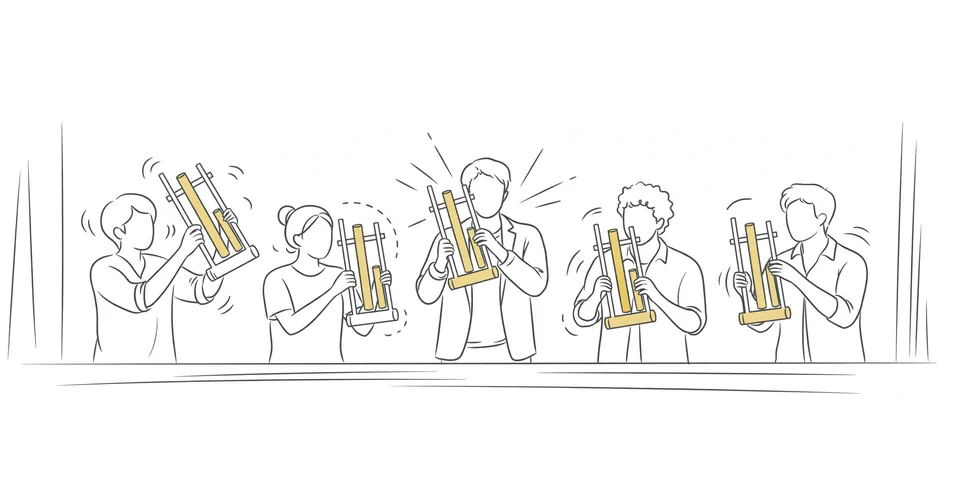
The angklung comes from the Sundanese people of West Java, and it is unlike almost any other instrument. A guitar or a piano puts a whole song in one pair of hands. It does the opposite. It divides a song among many hands, and it only works when those hands trust each other. In a country where music is often a shared activity, from village ceremonies to wedding stages, that is not a limitation. It is the point.
The world agreed. On 18 November 2010, UNESCO inscribed the Indonesian angklung on the Representative List of the Intangible Cultural Heritage of Humanity, recognising it as a living tradition worth protecting. For an instrument made of bamboo and rattan, that is a long way to travel, and the journey says something about why simple things endure.
How one note becomes a song
An angklung is made of two to four bamboo tubes suspended in a bamboo frame and bound with rattan cords. Each tube is cut to a different length, and each length produces a different pitch. The player holds the frame with one hand and shakes it gently with the other, and the tubes rattle against the frame to sound the note.
The catch is that one angklung plays only one note. A player holding the note C cannot play D, and a player holding G cannot play the rest of the scale. So a melody is not played by a person. It is played by a group, with each person responsible for one small part of it. The conductor points, the players shake in turn, and a tune emerges from dozens of separate hands.
That structure makes it a strange instrument to practise alone, and a wonderful one to learn together. Children in Indonesian schools often meet it before any other instrument, because a class of thirty children with thirty of them can play a real song on the first day. Nobody needs years of lessons to join in. You need to listen, watch the conductor, and shake at the right time. The music teaches cooperation before it teaches technique.
The sound itself is light and bright, a soft rattle rather than a ring. A single one is quiet, almost shy. A hundred of them together is a different thing entirely, a wave of sound that feels closer to a choir than to an orchestra. It is hard to describe until you have heard it in a room full of players, and that is probably why audiences remember it.
A short history of angklung
The angklung is old, and its earliest role was not entertainment. In the Sundanese kingdoms, it was played in agrarian rituals as an offering to Dewi Sri, the goddess of rice and fertility. The sound of bamboo was believed to call the goddess down to bless the harvest, and the instrument was treated with the respect given to sacred things. Some traditional forms, like the angklung buhun of the Baduy people, are still played only on ritual occasions, and outsiders are not always welcome to watch.
For centuries it stayed in that world of ritual and village ceremony, tuned to the pentatonic scales of Sundanese music. Then, in the 1930s, a teacher named Daeng Soetigna began to change it. He adapted the traditional instrument into a diatonic version that could play Western melodies, with the full range of notes used in songs from outside Java. The new version, called angklung padaeng after its maker, could play anything from folk songs to classical pieces, and it opened the instrument to schools, orchestras and audiences far beyond West Java.
That change mattered. The old version belonged to a place and a ritual. The new one could travel, and travel it did. By the middle of the twentieth century, ensembles were performing across Indonesia and abroad, and the instrument had become a symbol of Indonesian culture in the same way that gamelan had before it. Where gamelan is bronze, heavy and formal, this one is bamboo, light and open to anyone. The two instruments sit side by side in Indonesian music, and both are still played at the ceremonies and celebrations where they began.
Saung Angklung Udjo, where the audience plays
The best place to understand the angklung is not a museum. It is a bamboo theatre in Bandung called Saung Angklung Udjo, founded in 1966 by the musician Udjo Ngalagena and his wife Uum Sumiati. Their aim was simple: to keep Sundanese art alive by teaching it to children and sharing it with anyone who came to watch.
The daily show at the saung lasts about ninety minutes, and it follows a pattern that has barely changed in decades. There is a puppet show, traditional dances, and a gamelan performance. Then the angklung comes out, and the show changes. The performers hand instruments to the audience, and suddenly the people who came to watch are part of the music. A conductor leads them through a familiar song, and hundreds of strangers shake their bamboo tubes together until a melody appears.
It is a clever piece of teaching disguised as entertainment. Nobody in the audience needs to read music. The conductor points at each section when its note is needed, and the players respond. People who have never held an instrument leave humming the tune, and many of them say the same thing afterwards: it felt less like a concert and more like being invited into something.
The saung sits on about 1.3 hectares of bamboo gardens in eastern Bandung, at Jalan Padasuka 118, and it still runs as a family enterprise, now led by the next generation of the Udjo family. Its survival is not a small thing. Many traditional arts fade when their teachers die, but the saung was built around teaching from the start, and that is why it has lasted for nearly sixty years.
Angklung in schools and on the world stage
The UNESCO inscription in 2010 gave the instrument a new kind of protection. It recognised not only the instrument but the whole practice around it: the making of the bamboo tubes, the teaching in schools, and the performances that keep it alive. Indonesia had already been teaching it in schools for decades, and the inscription encouraged the government and communities to do more of it.
The instrument has also had its moments on the world stage. On 9 July 2011, 5,182 people played together in Washington, D.C., setting a Guinness World Record for the largest angklung ensemble. It was a fitting record for an instrument that only works in large numbers. Angklung groups now perform in many countries, and the instrument is taught in schools as far away as the Netherlands and Japan, where Indonesian communities brought it with them.
There is a comparison worth making here. Indonesian music has several great ensemble traditions, and keroncong, the gentle guitar music that made Waldjinah famous, is one of them. Keroncong asks a small group of skilled players to blend their sounds into something smooth. Angklung asks a large group of ordinary people to do the same thing with almost no skill at all. One rewards mastery, the other rewards participation, and Indonesian music has room for both.
Why angklung still matters
Instruments come and go, and most of them demand something from the player: years of practice, an expensive purchase, a quiet room. The angklung demands almost nothing except attention to other people. That is a rare quality, and it may be why the instrument has survived the arrival of recorded music, smartphones and every other distraction that was supposed to kill folk traditions.
There is also a lesson in it that goes beyond music. An angklung player holds one note, and that note is useless alone. The melody only exists when everyone plays their part and no one tries to play someone else's. It is hard to think of a better summary of how a community works, and it is no accident that teachers and parents in Indonesia describe the angklung as a lesson in cooperation. The children learn it without being told, because the instrument itself does the teaching.
The bamboo helps too. It grows fast, costs little, and can be replaced when it breaks. An angklung is not a precious object to be kept behind glass. It is a tool for making music together, and it is meant to be shaken, shared and, when it wears out, made again. That is probably the most sustainable thing about it, and the least discussed.
So if you ever find yourself in Bandung with an afternoon free, go to the saung. You will be handed a bamboo frame, a conductor will point at you, and for a few minutes you will be one note in a song much bigger than yourself. It is a small experience, and it stays with people longer than most concerts do. That is the angklung: a simple instrument that only works when everyone plays together, and a reminder that some things are better shared than owned.
More in Music & Entertainment
Latest posts
- Numazu Deep Sea Aquarium and the Creatures of Suruga Bay
- Numazu Himono and the Art of Dried Fish
- Numazu Imperial Villa and Japan's Seaside Imperial Retreat
- Numazu Port and the Freshest Seafood in Shizuoka
- Disaster Vending Machines in Japan That Give Their Drinks Away
- The E33G Remote Worker Visa and How to Legally Work from Bali
- Wabi-Sabi and the Japanese Beauty of Imperfect Things
- Bullet Climbing Mount Fuji, the Overnight Ascent Japan Is Trying to Stop
- Women Only Train Cars in Japan and the Problem They Answer
- Climbing Mount Semeru, Java's Highest Volcano
- Maneki Neko and Japan's Beckoning Lucky Cat
- Tamago Sando and Japan's Konbini Egg Sandwich
- The Baduy People and Life Without Modern Technology
- The Salaryman and Japan's Loyal Office Culture
- Onsen Tattoo Rules in Japan and How They Are Slowly Changing