Dangdut Koplo, Indonesia's Most Popular Music
· 8 min read
Dangdut koplo is the fast, drum-driven sound of Indonesia, born on East Java stages in the late 1990s and now everywhere from village weddings to TikTok.
If you want to know what Indonesia actually listens to, skip the charts and go to a wedding in East Java. The band is small, the speakers are huge, and the moment the kendang drummer picks up the tempo, the whole crowd is on its feet. That sound is dangdut koplo, the fastest and loudest branch of dangdut, and it is the most popular music in Indonesia.
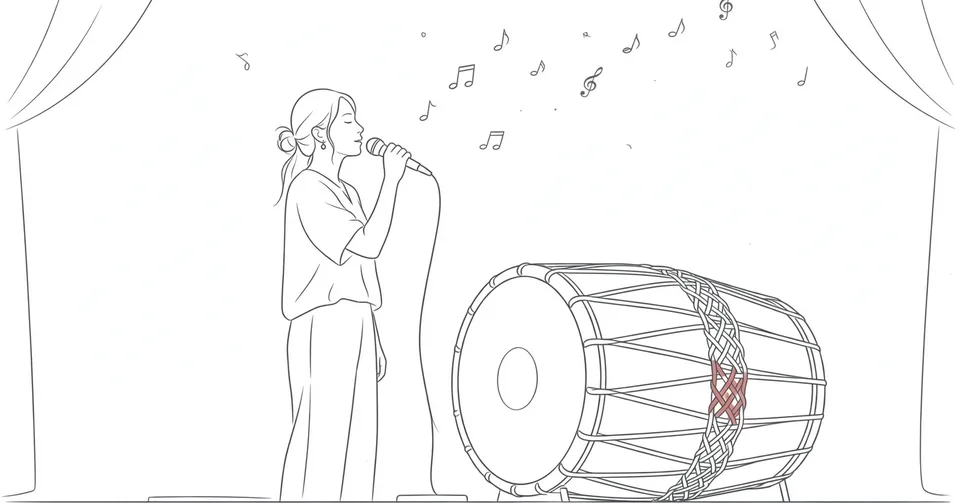
Dangdut koplo did not come from a studio in Jakarta. It grew out of village stages and night markets in East Java in the late 1990s, when local drummers started pushing the classic dangdut beat faster and harder. A generation later it fills stadiums, dominates TikTok, and still plays at every hajatan in the country, from small village gatherings to televised talent shows.
This is the story of how a rhythm that began as an insult became the sound of a nation, and why it refuses to slow down.
The music that started as an insult
Dangdut emerged in Indonesia in the 1970s, shaped by Indian and Bollywood film music, Arabic melodies, Malay pop, and Western rock. Its name is onomatopoeic, mimicking the "dang" and "dut" beats of the gendang drum. The word began as an insult, a dismissive label for music that polite society considered low class. The insult did not stick as an insult. It stuck as a name, and the music kept growing.
Rhoma Irama, known as the King of Dangdut, emerged in 1968 and turned the genre into a national phenomenon, while Ellya Khadam became known as the Grandmother of Dangdut. Their songs mixed romance, religion, and social commentary, and they reached listeners far beyond the cities. By the 1990s, dangdut had become so woven into Indonesian life that Secretary of State Moerdiono declared it "the Music of the People" in 1995, at a concert celebrating 50 years of Indonesian independence.
There is something honest about a genre that wears an insult as its name. Dangdut never pretended to be refined, and that is exactly why it lasted. It belonged to the people who danced to it, not to the critics who looked down on it.
How dangdut koplo sped everything up
Dangdut koplo was born in East Java in the late 1990s and early 2000s, when producers and performers began speeding up the tempo and layering electronic percussion, synthesizers, and powerful bass over the traditional beat. The heart of the sound is the rapid "koplo" drumming pattern, named after a local pill, which intensifies the standard dangdut rhythms. The drummer adds improvised rhythmic accents in conversation with the singer's dance moves, creating an air of wild excitement that listeners often compare to the feeling of flying.
The tempo usually runs at 120 to 150 beats per minute, far faster than classic dangdut. But speed alone is not the whole story. Dangdut koplo also mixes in regional elements: gamelan and angklung, the Central Javanese campursari, West Javanese Pop Sunda, and the East Javanese Kendang Kempul tradition from Banyuwangi. The result is music that sounds both modern and deeply local, a pop genre that carries the instruments of the villages it came from.
Koplo spread fastest along the Pantura coastal route and across East Java, carried by live performance culture. It was not radio that made it big. It was the stage: the orkes dangdut playing at weddings, circumcisions, village festivals, and night markets, night after night, in front of crowds that knew every song.
Inul and the stars who carried it
If one person brought dangdut koplo to the whole country, it was Inul Daratista. In the early 2000s, "Inul-mania" swept Indonesia as her energetic performances and her signature "goyang ngebor" dance made koplo impossible to ignore. Television, which had once kept dangdut at arm's length, suddenly could not get enough of it.
A new generation of stars followed and renewed the genre for younger audiences. Via Vallen's "Sayang" became a modern classic, blending koplo rhythms with pop sensibilities. Nella Kharisma, Siti Badriah, Ayu Ting Ting, and Lesti Kejora each brought their own style, and together they turned koplo from a regional sound into the default soundtrack of Indonesian popular culture. The Esplanade's guide to Indonesian music describes how these singers carried dangdut koplo from East Java stages to national television and beyond.
Television changed the economics of the genre without changing its center of gravity. Talent shows made koplo singers into household names across the archipelago, and a singer from a small East Java town could suddenly be known in Sumatra and Sulawesi. Yet the music itself stayed rooted where it was born. The big stages in Jakarta borrowed the sound of the village orkes, not the other way around, and the crowds at home still decide which songs matter.
What is striking about these stars is that none of them tried to make koplo respectable by watering it down. They kept the fast drums, the dance moves, and the crowd participation, and the audience rewarded them for it. Koplo works because it never apologizes for what it is.
A short timeline of dangdut koplo
| Year | Moment |
|---|---|
| 1968 | Rhoma Irama emerges and becomes the King of Dangdut |
| 1970s | Dangdut takes shape, mixing Indian, Arabic, Malay, and Western influences |
| 1995 | Dangdut is declared "the Music of the People" at the 50th independence anniversary |
| Late 1990s | Dangdut koplo is born in East Java with its fast drumming pattern |
| Early 2000s | Inul Daratista and "Inul-mania" bring koplo to the national mainstream |
| 2010s | Via Vallen, Nella Kharisma, and a new generation renew koplo for young listeners |
| Today | Koplo dominates weddings, TV talent shows, and viral short videos |
The timeline shows a pattern that repeats across Indonesian music. A form starts at the margins, is dismissed by the mainstream, and then becomes the mainstream itself. Keroncong followed a similar path a century earlier, carried by singers like Waldjinah, whose voice made a Portuguese-influenced street music into a national treasure. Dangdut koplo did the same thing, only faster and louder.
Why koplo works at a wedding and on TikTok
Dangdut koplo is the staple of weddings, night markets, village festivals, talent shows on TV, and viral short videos, and the reason is simple: it is music made for participation. The beat tells you when to move, the chorus is short enough to chant, and the drummer leaves space for the crowd to answer. You do not need to know the lyrics to join in. You only need to feel the drum.
That participatory quality is also why koplo survived the move to short video. A fifteen-second clip of a koplo chorus carries the same energy as a three-hour live set, because the hook was always the drum and the dance, not a complicated arrangement. Streaming data shows the genre's audience concentrated in Java's urban centers and coastal towns, but its reach now extends far beyond, wherever Indonesians gather.
There is a lesson in that durability. Music that asks its audience to sit still and admire it depends on fashion, and fashion changes. Music that asks its audience to stand up and join in depends on something sturdier: the pleasure of moving together. Koplo has lasted because it never forgot that a song is something people do, not just something people hear.
Two ways Indonesian music travels
Indonesian music reaches the world in more than one way, and dangdut koplo shows the road that starts from below. While a group like No Na takes Indonesian pop to the global stage through a polished international debut, koplo traveled the opposite direction: from village stages to national television to phones around the world, without ever changing its core sound. Both paths are real, and both say something about the country. One shows what Indonesian music can become, the other shows what it already is.
It is worth asking what a country gains from music like this. Koplo does not ask listeners to learn a new language or to understand a complicated tradition. It asks only that they move, and in doing so it gives strangers at a wedding a shared rhythm for one evening. That is a modest thing, and it is also the whole point. A culture stays alive not by being preserved behind glass but by being used, loudly, by the people it belongs to.
That is perhaps the most interesting thing about dangdut koplo. It did not need permission from Jakarta, from critics, or from the global music industry. It needed a drum, a singer, and a crowd willing to dance. Everything else followed. The next time you hear that fast kendang pattern rolling out of a speaker at a wedding or in a short video, listen for a moment. You are hearing the most popular music in Indonesia, and it got there by being exactly what it is.
More in Music & Entertainment
Latest posts
- Numazu Deep Sea Aquarium and the Creatures of Suruga Bay
- Numazu Himono and the Art of Dried Fish
- Numazu Imperial Villa and Japan's Seaside Imperial Retreat
- Numazu Port and the Freshest Seafood in Shizuoka
- Disaster Vending Machines in Japan That Give Their Drinks Away
- The E33G Remote Worker Visa and How to Legally Work from Bali
- Wabi-Sabi and the Japanese Beauty of Imperfect Things
- Bullet Climbing Mount Fuji, the Overnight Ascent Japan Is Trying to Stop
- Women Only Train Cars in Japan and the Problem They Answer
- Climbing Mount Semeru, Java's Highest Volcano
- Maneki Neko and Japan's Beckoning Lucky Cat
- Tamago Sando and Japan's Konbini Egg Sandwich
- The Baduy People and Life Without Modern Technology
- The Salaryman and Japan's Loyal Office Culture
- Onsen Tattoo Rules in Japan and How They Are Slowly Changing