Gamelan, the Sound of Java and Bali
· 10 min read
Gamelan is Indonesia's bronze orchestra, played at weddings, temples and shadow puppet shows for centuries. This is what it is, where to hear it, and why the world still listens.
If you have ever stood in a courtyard in Java at dusk, or watched a temple festival in Bali, you have probably heard gamelan before you saw it. A deep gong rolls out across the crowd, bronze keys ring in slow waves, and a drum keeps the whole ensemble moving. Gamelan is the traditional ensemble music of Java and Bali, one of the oldest orchestral traditions still played.
The honest answer sounds simple: an orchestra made mostly of bronze. But that description misses what makes it special. It is music that belongs to a place and an occasion. It is played at weddings, temple ceremonies, village celebrations, and behind the shadow puppets of wayang. In 2021 UNESCO added gamelan to its Representative List of the Intangible Cultural Heritage of Humanity, which is a formal way of saying what Indonesians have always known: this music matters.
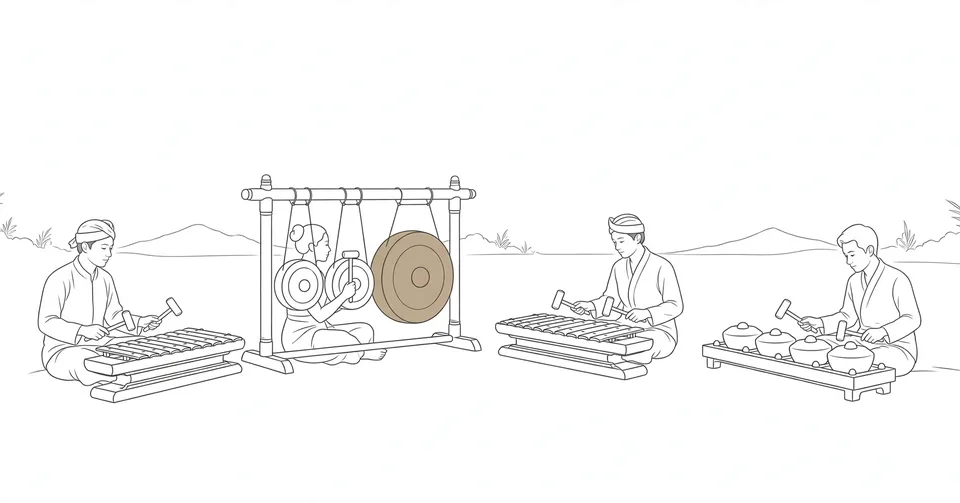
What surprises most first-time listeners is how different gamelan sounds from a Western orchestra. There is no conductor standing in front with a baton, and no single instrument carries the melody the way a violin does. Instead, the sound is built in layers. Big gongs mark the slow heartbeat, metallophones carry the main melody, and smaller instruments fill in the patterns around it. And one drum, the kendang, leads the whole group, setting the tempo and signalling every change. Once you hear how those layers fit together, it stops sounding strange and starts sounding inevitable.
What gamelan actually is
A gamelan is a set of instruments, not a single one. Most are bronze, cast and tuned by village smiths who learn the craft over a lifetime. The largest is the gong ageng, a great hanging gong whose deep note ends each musical cycle. Around it sit the metallophones: rows of bronze keys laid over bamboo resonators, struck with mallets. The saron plays the core melody, and the bonang, with its rows of small kettle gongs, plays a faster pattern around it.
Then there are the instruments that are not bronze. The kendang is a hand drum, and it is the most important instrument in the whole gamelan, which says something about how this music works. The suling is a bamboo flute that floats above the bronze, and the rebab is a two-stringed bowed instrument that often carries the most human-sounding line, bending and sliding between the notes of the keys. A full overview of the instruments and their history is on Wikipedia.
One detail matters if you ever hear two gamelan sets in a row: each set is tuned to itself. There is no universal standard pitch, the way a piano is tuned to A at 440 hertz. A set from one village sounds slightly different from the next, because each was tuned by ear for its own community. It does not belong to a concert hall. It belongs to the people who play it, and it sounds like them.
The players sit cross-legged on the floor, instruments arranged in a rough circle or in rows. There is usually no written music at all, so they watch each other. Pieces are learned by ear, passed from teacher to student, and a good player knows dozens by heart. The music is built on cycles: a melody repeats, the gong sounds, and the cycle begins again. It breathes rather than rushes, which is why it can go on for hours without feeling finished.
Two islands, two sounds
Java and Bali both play gamelan, but they do not play the same gamelan. The difference is the first thing any listener notices.
Javanese gamelan is generally slower and more meditative. It grew up in the royal courts of Yogyakarta and Surakarta, also known as Solo, where music was part of palace life for centuries. The playing is soft and refined, the tempo unhurried, the mood calm and inward. This is the sound of wayang shadow puppet theatre through the night, and of court ceremonies where every gesture has a meaning.
Balinese gamelan is faster, brighter and more explosive. It grew up in the temples and villages of Bali, where music is part of daily religious life and every village has its own community ensemble. The most famous Balinese style is kebyar, which appeared in the early twentieth century and is built on sudden changes: the whole ensemble races together, stops dead, changes tempo in an instant, and races off again. The players move as one body, leaning into the music together.
| Javanese | Balinese | |
|---|---|---|
| Home | Courts of Yogyakarta and Solo | Temples and villages across Bali |
| Tempo | Slow, unhurried, meditative | Fast, bright, explosive |
| Mood | Calm, refined, inward | Dramatic, communal, joyful |
| Famous style | Court gamelan | Kebyar |
| Where you hear it | Wayang, court ceremonies, weddings | Temple festivals, dance, village events |
The table makes the difference look neat, but the two traditions overlap and borrow from each other. Both use the same bronze instruments and the same idea of music in cycles, marked by the great gong. Both are still learned the same way: by sitting beside an older player and playing along until the music lives in your own hands too.
The drum that leads
If you watch a gamelan performance and wonder who is in charge, watch the drummer. The kendang player sits at the centre of the ensemble, and the kendang is the instrument that leads. It sets the tempo, signals speed changes, and cues the transitions. The kendang player is the conductor, except the conducting happens through the drum itself, not a baton.
This matters most during wayang, the shadow puppet theatre that gamelan so often accompanies. A wayang performance can last all night. The dalang, the puppeteer, controls the story, while the gamelan follows the mood: tense music for a battle, gentle music for a love scene, comic music for the clowns. The kendang player is the bridge between the puppeteer and the musicians, turning the dalang's cues into rhythm the whole ensemble can follow. It is a demanding job, and a great kendang player is respected like a great singer.
The same drum-led logic lives on in modern Indonesian music. Dangdut koplo, the fast, drum-driven sound that fills weddings and village festivals today, is built on the kendang too, and its drummers play in conversation with the singer. The instruments changed and the tempo sped up, but the idea is the same: the drum leads, and everyone else follows.
From Paris to everywhere
Gamelan stayed mostly in Indonesia until the late nineteenth century, when it reached Europe almost by accident. At the Paris Exposition of 1889, a Javanese gamelan ensemble played for crowds who had never heard anything like it. Among them was Claude Debussy, then a young French composer. He was fascinated by the sound, by the way the music floated without the push and pull of Western harmony, and by a tuning that matched nothing in European music. Its influence can be heard in his later work, in pieces that shimmer and drift rather than march from one chord to the next. It was one of the first times Indonesian music changed Western music, and it would not be the last.
From there, gamelan spread slowly and then steadily. Today it is taught at universities in Europe, North America, Australia and Japan, and community groups rehearse in church halls and basements, playing instruments made in Java and shipped across the world. Some play traditional Javanese pieces. Others write new music, or mix it with jazz and rock. The instruments travel well, partly because the music is learned by ear, and partly because this is a social music: hard to play alone, best played together.
UNESCO's inscription of gamelan in 2021 recognised this living tradition, not a museum piece. The listing covers the music, the instruments, and the communities that keep both alive. Archaeological evidence of the practice has even been found in the relief sculptures of the eighth-century Borobudur temple. Gamelan survives because people play it at weddings, temple festivals and village rehearsals, not because it is written in a book. The inscription helps protect that, but the real protection is the playing itself.
Indonesian music has always borrowed from its neighbours and from the outside world. Keroncong, the gentle music made famous by singers like Waldjinah, grew from Portuguese influence and Javanese sensibility, and it shares this patience: slow melodies, soft dynamics, music that does not hurry. Gamelan, keroncong and dangdut are very different sounds, but they come from the same place: a culture that treats music as something you live with.
Where to hear gamelan
The best place to hear it is where it is played for its own community, not for tourists. In Yogyakarta and Solo, the royal courts hold regular performances that visitors can sit in on. In Bali, temple festivals happen all year, and the music is open to anyone who shows up respectfully. Village weddings in Java and Bali almost always feature a gamelan ensemble, and if you are invited to one, the music will stay with you longer than the food.
If you are visiting and do not want to wait for a festival, there are easier options. Many cities in Java have gamelan workshops where visitors can try the instruments, and a short lesson is the fastest way to understand the music: you strike a key, you hear it ring, and you realise how much listening the playing takes. Ubud has regular evening performances at the palace, where dancers move to the music in the open air. In Yogyakarta, the Kraton palace and nearby streets are full of rehearsal spaces where you can hear ensembles practising in the late afternoon, doors open, no ticket required.
For first-time listeners, one piece of advice: give it time. The first few minutes can sound slow, even repetitive, if you are used to music that changes every few seconds. But gamelan is built on patience. Listen for the gong, and notice how the whole cycle comes back to it. Listen for the kendang, and notice how the drummer steers the group. Listen for the moment when the bronze keys land together and the sound hangs in the air. That is the moment most people understand why this music has lasted for centuries.
It does not need to be modern to stay alive. It needs to be played, and it is played every day in villages, courts and temples across Java and Bali, and now in rehearsal rooms around the world. A tradition that is used every day does not need to be saved. It only needs to be heard. The next time you hear a gong roll across a courtyard in Java, or a bright burst of kebyar in Bali, stay and listen. You are hearing one of the oldest orchestras on earth, still very much alive.
More in Music & Entertainment
Latest posts
- Numazu Deep Sea Aquarium and the Creatures of Suruga Bay
- Numazu Himono and the Art of Dried Fish
- Numazu Imperial Villa and Japan's Seaside Imperial Retreat
- Numazu Port and the Freshest Seafood in Shizuoka
- Disaster Vending Machines in Japan That Give Their Drinks Away
- The E33G Remote Worker Visa and How to Legally Work from Bali
- Wabi-Sabi and the Japanese Beauty of Imperfect Things
- Bullet Climbing Mount Fuji, the Overnight Ascent Japan Is Trying to Stop
- Women Only Train Cars in Japan and the Problem They Answer
- Climbing Mount Semeru, Java's Highest Volcano
- Maneki Neko and Japan's Beckoning Lucky Cat
- Tamago Sando and Japan's Konbini Egg Sandwich
- The Baduy People and Life Without Modern Technology
- The Salaryman and Japan's Loyal Office Culture
- Onsen Tattoo Rules in Japan and How They Are Slowly Changing