Daisho Was the Pair of Swords That Marked a Samurai
· 12 min read
The daisho was the matched pair of katana and wakizashi that only a samurai could wear, a legal badge of rank in Edo Japan that ended with the sword ban of 1876.
Walk down a street in Edo period Japan and you could read a man's place in society before he said a word. The clue hung at his waist. Two swords, one long and one short, worn together in the sash of his robe, told everyone he passed that he was a samurai. That matched pair was the daisho.
The daisho was not simply two weapons carried at once. It was a system, a legal privilege, and a piece of clothing all at the same time. The long sword was the katana, the short sword the wakizashi, and together they marked the line between the warrior class and everyone else. A merchant might be richer than the samurai he passed in the street, but he could never wear the pair.
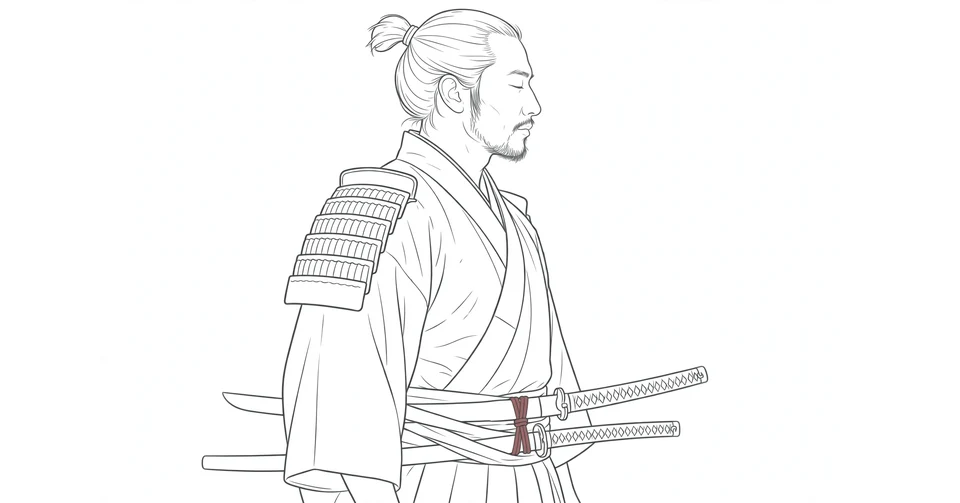
This article traces what the daisho was, who was allowed to wear it, and how it ended, from the civil war era to a spring day in 1876 when the Meiji government told the samurai to leave their swords at home. The daisho is gone from the streets today, but what it stood for still shapes how Japan remembers the samurai.
What the daisho actually was
The daisho was a pair of swords worn together at the waist: a long sword, the katana, and a short sword, the wakizashi. In some cases the shorter blade could be a tanto, a dagger, but the classic form of the daisho was katana and wakizashi, worn thrust through the obi, the sash of the robe, with their cutting edges facing up.
What made a daisho a daisho was not only the two blades. In its strict Edo period form, the pair was a coordinated ensemble, with blades, mountings, and fittings made to harmonise, so that anyone who saw the pair could recognise it as one set.
The practice grew out of the civil wars of the Sengoku period, from 1467 to 1615. On the battlefield, a second, shorter sword was practical, a reserve if the long sword broke and a weapon for close fighting where a long blade had no room. But in those war years the combination was still flexible, and the two blades frequently came from different smiths and were never intended to match.
That changed when the wars ended. After the Battle of Sekigahara in 1600, the Tokugawa shogunate began to codify the pair, and the daisho turned from a battlefield habit into an institution. The katana became the famous half, described in how the katana became the soul of the samurai, while the wakizashi was the quieter half that stayed with its owner all day.
Big little: the meaning inside the name
The word daisho comes from two characters, dai, meaning big, and sho, meaning small. Written together they read literally as big little. The name does not describe one sword. It describes a relationship. The pair only makes sense as a pair, and the name says so in two syllables.
There is something honest about a name that refuses to glorify either half. The katana gets the glory in films and novels, but the name of the pair gives the short sword equal standing. Big and little sit side by side with no word for better or worse between them. That balance is the first clue that the daisho was never only about fighting. It was about order. A modern reader might hear daisho and picture a weapon set, but a person in Edo Japan heard a social statement. To say a man wore the daisho was to say he belonged to the warrior class and that the law recognised him as a samurai.
Two lengths, one system
The daisho was defined by length as well as by law. A wakizashi had a blade of between about 30 and 60 centimetres, and a katana was longer, with a blade over about 60 centimetres. In the traditional units of the time, the wakizashi fell between 1 and 2 shaku, and the katana stood above 2 shaku, with one shaku equal to about 30.3 centimetres. A blade shorter than 1 shaku was a tanto, a dagger, not a wakizashi.
The two swords looked alike in construction, with the same curve, the same single edge, and the same kind of mounting. What separated them was their function inside the system, and the law made that function visible in small details. In an official Edo period daisho, the scabbard of the katana had to end flat, while the scabbard of the wakizashi had to end round. That one detail is still the most reliable way to identify an official pair today.
Who was allowed to wear the daisho
The daisho belonged to the samurai alone. The legal basis was laid by Toyotomi Hideyoshi, the warlord who unified Japan in the late sixteenth century. His sword hunt of 1588, the Katanagari, forbade peasants from owning swords, and from then on only the samurai class could carry long weapons. The Tokugawa shogunate, which ruled Japan from 1603 to 1868, expanded that privilege into a full system, and the right to two swords became the central legal characteristic of the samurai class.
The rules were strict, but they were not absolute for the short sword alone. Members of other classes were allowed to carry a wakizashi under certain circumstances, for example wealthy merchants when travelling, for self defence against highwaymen. But no commoner was ever allowed a second, longer sword. The legal difference between a commoner with a wakizashi and a samurai with a wakizashi lay in what else he was allowed to carry. Only samurai could add the long sword, so only samurai could wear the daisho.
The shogunate enforced the pair on duty as well. An edict of 1629 required the daisho on official duty, and by 1683 the right to wear the pair had been limited to the samurai class. The swords at a man's waist were a licence issued by the state, not private property in the modern sense. A society that ties identity to a visible object makes identity easy to read, and easy to police. The privilege and the burden were the same object.
The formal daisho and the rules of the court
The strictest form of the daisho was the banzashi daisho, the formal pair worn on obligatory visits to the capital, Edo. Under the sankin-kotai system of alternate residence, every daimyo, or feudal lord, travelled between his home province and Edo at regular intervals, and the samurai who accompanied him to court had to appear in the banzashi format. The regulations for that format were exact.
Both scabbards had to be lacquered black. The hilt had to be covered with white ray skin, and the pommel cap made of horn, with the hilt wrapping knotted over it. The hand guard was kept simple, usually with a fine nanako pattern and the family crest, and the katana had a flat scabbard end while the wakizashi had a round one, as the law required.
That uniformity had a political purpose. A uniform sword protocol prevented any lord from showing excessive wealth or political independence at court. At home in their own provinces, the same samurai could wear far more elaborate daisho, with golden lion motifs, dragon designs, and gilded hand guard rims. But at the shogun's court, reduction was the rule. To understand the pair, it helps to see how deliberately the shogunate shaped even the smallest fitting, a point the Samurai Museum Berlin explains in its account of the wakizashi and the daisho system.
The sword that stayed when the katana went to the door
The most revealing fact about the daisho is not how the two swords were worn together, but how they were separated. When a samurai met his lord, he took off his katana at the entrance, placed it in the sword racks of the anteroom, and stepped into the reception hall. The weapon he carried with him was the wakizashi, the shorter half of the daisho, and in daily life it stayed with him far longer than the long sword ever did.
In reception rooms and at audiences with higher ranking persons, carrying the long sword was forbidden or at least unwelcome. A host was not to be left defenceless against a possible attack, and a long blade in a guest's sash was an open threat. The wakizashi, by contrast, could be worn, short enough to defend its owner's immediate personal space without menacing the whole room.
Architecture reinforced the rule. Narrow corridors, low door frames, and low ceilings made drawing a katana indoors almost impossible, while the wakizashi could be used in those confined spaces. Even in the baths and the bedrooms it lay within reach, often beside the pillow while its owner slept. Sword stands called katana-kake held the long sword, but the short sword rarely left its owner's side.
Anyone who saw a samurai without a wakizashi was not looking at a samurai, or so the saying went. The long sword was the occasional weapon and the short sword the constant one. That is why the story of the wakizashi, the short sword a samurai never left behind is the necessary companion to the story of the pair. The daisho was two swords, but the shorter one defined the samurai's day.
This division of labour carries a quiet wisdom. The long sword announced who a man was to the world outside, while the short sword stayed with him in the rooms where no one was watching. Honour that only appears in public is costume, and the daisho worked because one half was public and the other half was private.
A badge of rank in a peaceful age
By the time the Tokugawa peace had lasted for generations, wars were rare and the samurai had become government officials and administrators rather than warriors. The daisho changed with them, becoming less of a battlefield necessity and more of a status marker. The pair was enforced by law, displayed on the street, and read by everyone, and its meaning shifted from what a man could do to who a man was.
That shift is the heart of the story. A weapon becomes a badge when the fighting stops but the wearing continues.
The end of the daisho in public life
The end came with the Meiji Restoration of 1868, when the Tokugawa shogunate fell and a new government set out to modernise Japan. The new rulers saw the samurai class and its privileges as obstacles to a centralised state with a national army, and the daisho stood at the top of the list of privileges to remove.
The first step came in 1870, when an edict prohibited farmers and merchants from wearing swords and dressing like samurai. In 1871 the government allowed samurai to cut off their topknots and wear their hair in the Western manner. In 1873 universal military conscription was introduced, ending the samurai monopoly on military service, and the hereditary stipends paid to the samurai were abolished in the same year.
The decisive step was the Sword Abolishment Edict, the Haitorei, passed by the Daijokan, the Grand Council of State, on March 28, 1876. It prohibited people from carrying weapons in public, with exceptions only for former lords, the military, and law enforcement officials, and violators would have their swords confiscated. The edict prevented former samurai, now known as shizoku, from carrying swords, and it ended the public wearing of the daisho after more than two centuries.
The ban was controversial even inside the government, but the argument that the swords were an anachronism out of keeping with the westernisation of Japan won out. The change brought real discontent, and the loss of status and income helped to fuel a number of samurai led uprisings, particularly in western Japan and Kyushu. Many swordsmiths were forced to turn to the production of farming implements and kitchen cutlery to survive. The full history of the edict is recorded in the account of the Haito Edict of 1876. A badge only works when it is visible, and the Meiji government understood that taking the daisho off the street was the fastest way to take the old order with it.
What the daisho left behind
The daisho is gone from daily life, but its legacy is easy to find. Japanese swords survive today as registered art objects, preserved in museums and private collections, and the craft of the smith, the polisher, and the scabbard maker is still practised. Students of traditional martial arts still train with the long and short sword, and the pair still appears in film, theatre, and festivals as the mark of the samurai.
Modern Japanese law still treats swords with care. Ownership is regulated and registered, and carrying a sword in public without a valid reason is prohibited. The rule is different in spirit from the Edo rules, since it now applies to everyone rather than marking one class above the rest, but the caution is the same.
There is something to admire in the pair itself, apart from the system that enforced it. Two swords, one long and one short, made as a matching set, each with its own work to do. The daisho worked as a weapon, as a uniform, and as a symbol because it held two truths at once: strength needs reach, and honour needs closeness.
More in Culture & Society
- Seppuku Was the Ritual a Samurai Chose Over Disgrace
- Saya Is the Lacquered Sheath That Guards the Katana
- Hamon Is the Wavy Line That Proves a Katana Is Real
- Ikebana and the Quiet Discipline Behind Japan's Flower Art
- The Wakizashi Was the Short Sword a Samurai Never Left Behind
- The Tsuba Turned a Sword Guard Into a Small Work of Art
Latest posts
- Omiyage and the Japanese Art of Bringing Something Back
- How the Katana Became the Soul of the Samurai
- The Menpo Gave the Samurai a Face Worth Fearing
- Japan Goes Maple Hunting Every Autumn and Calls It Momijigari
- Kabuto Gave the Samurai a Helmet Worthy of His Sword
- Christmas in Japan and the Fried Chicken Dinner That Started It All
- Kiso Yoshinaka Rode Out of the Mountains and Nearly Took Japan
- Sakayaki Gave the Samurai His Signature Hairline
- The Archer on the Tower Was Hangaku Gozen
- Koyo Turns Japan Into a Country That Forecasts Leaves
- Inside Japan's 100 Yen Shops, Where Everything Costs a Coin
- Tomoe Gozen Rode Into Battle When Women Were Told to Stay Home
- A Chonmage Is the Knot Every Sumo Wrestler Wears Before the Fan
- Onna-Bugeisha Held the Castle While the Men Were Away
- Momiji-Gari Is Japan's Autumn Answer to Hanami