The Wakizashi Was the Short Sword a Samurai Never Left Behind
· 24 min read
A wakizashi was the short sword every samurai wore beside his katana, and the one he kept on indoors when the long sword stayed at the door. This is the story of the blade that never left his side.
Ask a stranger to name a Japanese sword and the answer will almost always be the katana. The wakizashi is the sword that stood beside it, shorter, quieter, and far more present in daily life. It was the blade a samurai wore through his sash at his left side, and the one he kept on when the katana had to stay at the door.
A wakizashi has a blade between 30 and 60 centimetres long, roughly half the length of a katana, curved and single edged, made by the same smiths with the same steel and the same folding and quenching. What made it different was not the craft but the job. The katana was the sword of the open fight. The wakizashi was the sword of the room, the corridor, the doorway, and the daily life of a man who was never supposed to be without a blade.
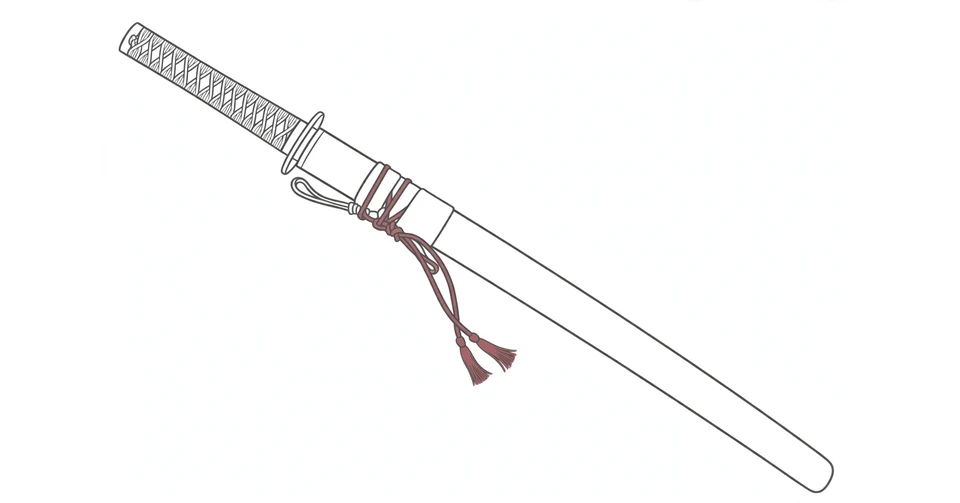
That closeness is the whole story. For more than two centuries of peace under the Tokugawa shogunate, the wakizashi was the sword a samurai actually lived with, while the katana became a formal badge worn on occasions that mattered. To understand the samurai as a symbol, look at the long sword. To understand how the samurai lived, look at the short one.
What a wakizashi actually is
A wakizashi is a traditionally made Japanese sword, a nihonto, worn by the samurai of feudal Japan. The standard definition is simple and it is the one museums still use: a curved, single edged blade between 30 and 60 centimetres long, carried in a lacquered wooden scabbard and worn thrust through the sash at the left side. The Wakizashi article on Wikipedia gives that 30 to 60 centimetre range as the defining measure, and the examples held by the great museums fall inside it, with a few long exceptions that sit close to the katana in size.
But the length alone does not explain the sword. A wakizashi is not simply a small katana. It could be forged differently from its longer partner, with a different cross section and a different balance, because it was made for a different kind of work. A katana is a two handed sword, gripped with both hands and swung with room to move. A wakizashi is a one handed sword, quick to draw in a space where a long blade would catch on a wall, a beam, or a sliding door. That difference in handling shaped everything about it, from the length of the grip to the curve of the blade.
The short sword had been in use since the 15th or 16th century, and the sources do not agree on an exact starting date, which is honest, because the wakizashi grew gradually out of the companion swords that warriors had always carried beside a longer blade. It became a distinct, named thing only when the law of the Edo period gave it a fixed length and a fixed place in the pair a samurai wore. Before that, the word was looser, and that looseness is part of the story.
I think the best way to picture it is not as a weapon at all, but as a piece of clothing that happened to be sharp. A samurai did not pick up his wakizashi the way a soldier picks up a rifle before a battle. He put it on in the morning the way other people put on a watch, and he wore it through the ordinary hours of his day. That ordinariness is what makes it interesting. The katana tells you what the samurai wanted to be. The wakizashi tells you what he actually was, a man who ate, slept, visited friends, and walked the streets of a castle town with a blade at his hip.
The name tells you how it was worn
The word wakizashi means, literally, side inserted. It is an abbreviation of wakizashi no katana, the sword thrust at one's side. The name describes an action, not a shape: the sword is the one you push through your sash at your side. The long tachi of the earlier age was different. It hung slung from a cord at the hip, edge down, made for a rider who needed to cut downward from a horse. The wakizashi, like the katana that followed, was worn thrust through the obi, the sash, with the edge facing up.
In the age of mounted warfare, when warriors such as Tomoe Gozen rode with the long tachi, the short companion sword was still finding its form. The tachi was a horseman's weapon, long and deeply curved, and it needed open ground. As warfare moved from the saddle to the foot, and as the castles and towns of Japan filled with narrow corridors, low ceilings, and crowded streets, the short sword worn at the side became more useful with every passing decade. The name stuck because the wearing never changed. Whatever else a wakizashi became, a badge, a treasure, a ritual object, it began as the sword at your side.
There is a small detail in the wearing that tells you a lot. The wakizashi was worn on the left side, secured to the waist sash, and drawn with the right hand across the body. A samurai could draw it while seated, while kneeling, or while standing in a doorway, and that was the point. The sword was designed around the rooms of a Japanese house, not around the battlefield. I find that quietly revealing. A culture that builds its houses from paper screens and wooden floors, where people sit close to the ground and pass each other in narrow halls, would naturally produce a sword that works in exactly those spaces.
How long is a wakizashi, and why the length was fixed
For a long time, the word wakizashi did not specify any official blade length. It was applied to companion swords of all sizes, from blades barely longer than a dagger to blades almost as long as a katana. The modern habit of sorting Japanese swords into neat boxes, with the tanto below 30 centimetres, the wakizashi between 30 and 60, and the katana above 60, is a later convenience, and it hides a messier history.
The sorting happened in 1638, in the Edo period, when the rulers of Japan tried to regulate the types of swords and the social ranks allowed to wear them. That was the year the lengths of the katana and the wakizashi were officially set. The law did not invent the short sword. It gave the short sword a legal size, and in doing so it turned a practical companion blade into a regulated object, a thing whose length could be measured by an official and judged correct or incorrect.
The edges of the category still blur. A wakizashi close to the length of a katana is called an o-wakizashi, a large wakizashi. A wakizashi closer to the length of a tanto is called a ko-wakizashi, a small wakizashi. The Metropolitan Museum of Art in New York holds a wakizashi attributed to the smith Fusamune of Soshu, made in the late 15th or early 16th century, whose blade measures 62 centimetres, just over the usual limit. It is an o-wakizashi, and it shows that the 30 to 60 centimetre rule describes the centre of the category, not a wall around it. The variation is not a flaw in the definition. It is evidence that real swords were made for real hands, and that hands differ.
What matters more than the exact centimetres is that the length was worth regulating at all. A government does not write laws about the length of a blade unless the blade matters to the order of society. The wakizashi mattered because it was the sword ordinary life was lived with, and ordinary life was exactly what the Tokugawa shogunate wanted to control.
The daisho, the pair that marked a samurai
No wakizashi can be understood on its own, because for most of its history it was one half of a pair. The pair was called the daisho, which translates literally as big little: the long katana and the short wakizashi, worn together through the sash. The shogunate required samurai to wear the two swords as a pair, and only samurai could wear the daisho. It represented their social power and personal honour, and everyone in the street could read it at a glance. A farmer could not wear one. A merchant could not wear one. The pair at a man's hip told the world exactly who he was.
The full story of the long half of the pair is told in how the katana became the soul of the samurai, and the short half completes it. The katana was the public sword, the formal sword, the one a samurai wore when he visited a castle or attended on his lord. The shogunate even regulated the formal daisho in detail, prescribing a black scabbard and a hilt wrapped with white ray skin and black cord for castle visits. The wakizashi was the private sword, the one that stayed with him when the formalities ended. The pair worked like a suit and an everyday jacket. One was for display, the other was for living in, and a samurai needed both to be fully dressed.
That division of labour explains a puzzle. The scholar Kanzan Sato, in his book The Japanese Sword, noted that there did not seem to be any particular need for a wakizashi as a weapon, since the katana and the tanto already covered the long and short ends of fighting. He suggested that the wakizashi may have become more popular than the tanto because it was better suited to indoor fighting. The long blade was too long for a room. The dagger was too short to be useful against an armed opponent. The wakizashi sat in the middle, long enough to fight with and short enough to draw indoors, and the middle turned out to be where a samurai spent most of his life.
I think there is something honest in that explanation. It refuses to make the wakizashi mystical. It was not a sacred object handed down from the gods. It was a practical answer to a practical problem: how do you stay armed in a house built for people without swords? The answer was a blade short enough for the hallway and long enough for the fight, and the samurai carried that answer at his hip for two hundred years.
The sword that stayed on indoors
The most telling custom of the wakizashi is the one that happened at the door. When a samurai entered a castle or a palace, he left his katana at the entrance. The long sword stayed behind. The wakizashi went inside with him. The rule was practical, since a long blade in a crowded room is a hazard, and it was also a mark of trust, since the host who allowed a guest to keep his short sword was saying that the guest was still a samurai, still armed, still a man of honour, even under his roof.
That custom made the wakizashi the sword of indoor life, and indoor life in Edo Japan was where most of the things that mattered actually happened. A samurai ate, drank, talked, negotiated, quarrelled, and made alliances indoors, in rooms where the katana could not be drawn. The wakizashi was the blade for those moments: close quarters fighting, sudden quarrels, and the defence of a room rather than a battlefield. It was also the backup sword, the one a warrior reached for when his long blade was lost, broken, or too long for the space.
The indoor role also explains why the wakizashi became a favourite of the people who made and decorated swords. A blade that was worn all day, in every room, was seen far more often than a blade worn only on formal occasions. Its fittings, the guard, the handle, the small ornaments tucked under the cord wrapping, and the lacquered scabbard, were on display from morning to night. In the peaceful Edo period, those fittings became ever more elaborate, and a wakizashi could be a work of jewellery as much as a weapon. The swordsmith Fusamune's blade in New York, for example, is carried in a luxurious late 18th century mounting of top quality, made long after the blade itself was forged. The blade was old. The clothing was new. The owner kept dressing his wakizashi because people kept looking at it.
There is a lesson in that for anyone who collects or studies these swords today. The katana gets the photographs, the museum posters, and the film scenes. The wakizashi got the daily wear, the fingerprints, the repairs, and the new mountings ordered by owners who loved a particular blade enough to dress it again. If you want to know which sword a samurai actually cared about, look at which one he kept remounting.
How a wakizashi was made
A wakizashi was made the same way a katana was made, by the same smiths, from the same difficult steel. The process began in a clay furnace called a tatara, where iron sand and charcoal were burned for about three days until the furnace was broken open to reveal a bloom of steel. The best parts of that bloom were tamahagane, jewel steel, a raw material with uneven carbon and flecks of slag. Japanese smiths had no rich iron ore, so they learned to make superb blades from flawed material, and the methods they invented are still admired today.
The steel was sorted, flattened, stacked, and forge welded, then folded again and again, usually around fifteen times, which drove out impurities and evened out the carbon. Most blades combined two steels: a harder, higher carbon jacket that took and held an edge, wrapped around a softer, lower carbon core that absorbed shock and kept the blade from snapping. The final transformation came in the quench, when the smith coated the blade in clay, thick on the spine and thin on the edge, heated it, and plunged it into water. The edge cooled fast and became very hard. The spine cooled slowly and stayed tough. The boundary between the two appeared as a visible wavy line, the hamon, and each smith shaped it into patterns that acted as both a fingerprint and a proof of the quench.
A wakizashi was not necessarily just a smaller version of a katana, and the difference went beyond size. A short blade could be forged with a different cross section, a thicker spine, or a heavier point, because it was meant to be used with one hand in close quarters rather than with two hands in the open. Some wakizashi carry engraving on the blade, and the Fusamune blade in New York shows tempering effects called hitatsura, a mottled pattern spread across the whole surface of the blade, typical of the late Soshu school. A short sword gave a smith a smaller canvas, and the best of them used it to show off.
The making did not end with the smith. After the quench, a polisher ground and refined the surface over many stages, a single polish could take weeks, and then the fittings were made by other craftsmen: the guard, the handle, the scabbard, and the small ornaments. A wakizashi, like a katana, was never the work of one person. It was the work of a chain of craftsmen, and a weakness in any link showed in the finished sword. That chain is one reason a good wakizashi costs so much today. You are not paying for a piece of steel. You are paying for weeks of attention from half a dozen pairs of hands.
The short sword and seppuku
No honest account of the wakizashi can avoid its darkest association, and it deserves to be handled plainly and briefly. The wakizashi was sometimes the blade used to perform seppuku, the ritual death by which a samurai could answer disgrace, protest an injustice, or follow a dead lord. The association is real, and it is part of why the short sword carries a sombre reputation that the katana, for all its fame, does not quite share.
It is worth saying clearly what that association was and what it was not. Seppuku was a ritual with rules, witnesses, and a second person standing by, not a solitary act of despair, and the wakizashi was the blade of that ritual because it was the blade a samurai always had with him. The katana was too long for the act and was usually set aside. The short sword was at hand, as it always was, and that availability, more than any special design, is what tied the two together. The wakizashi was not made for seppuku. It was the sword that happened to be present at the most solemn moment of a samurai's life, because it was present at every moment of his life.
I do not think the association should be hidden, and I do not think it should be dwelled on either. It is one use among many, and a rare one, and the samurai who wore a wakizashi every day did not spend every day thinking about it. The sword's daily work was ordinary: protection on the road, defence in a room, and the quiet statement of rank. To remember only the ritual is to turn a living object into a symbol of death, and the wakizashi deserves better than that. It was, above all, a companion, and companions are remembered for the days they share, not for the last one.
The wakizashi as a status marker in Edo law
The Edo period turned the wakizashi into a legal object, and the law around it tells you how Japanese society was ordered. The Tokugawa shogunate required samurai to wear the katana and the shorter sword in pairs, and the pair was the official sign of the wearer. Only samurai could wear the daisho. The rule was simple, visible, and enforced, and it made the two swords at a man's hip into a kind of identity card that anyone could read without asking a question.
But the law had an exception, and the exception is revealing. During the Edo period, commoners were allowed to wear one legal length ko-wakizashi, a small wakizashi, and that made the short sword popular with the general public. People wore it when travelling, because the roads carried a real risk of bandits, and a short blade that the law allowed was better than no blade at all. The ko-wakizashi was the compromise between a government that wanted a monopoly on arms and a population that still had to walk the roads alone. It was short enough to be legal and long enough to matter, and ordinary people understood that bargain at once.
The same law that gave the samurai his pair also took swords away from others. In 1588, before the Edo period began, Toyotomi Hideyoshi banned farmers from owning weapons and carried out a sword hunt, forcibly removing swords from anyone identified as a farmer. The hunt made the sword the exclusive property of the warrior class. The wakizashi sat at the centre of that settlement. It was the sword the samurai kept, the sword the traveller was allowed, and the sword the farmer was forbidden, and its length was the line the law drew between those three lives.
I find that division strangely moving, because it shows how much weight a society can put on a few centimetres of steel. A blade of 30 centimetres was a tool a commoner could carry on a road. A blade of 60 centimetres, worn beside a katana, was a statement that its owner belonged to a class above the law that bound everyone else. The wakizashi did not create that order. It carried it, visibly, on the hips of the men who walked the streets, and everyone who saw it understood the message without a word being spoken.
Famous wakizashi and where to see real ones today
The most famous wakizashi are not famous because they were used in great battles. They are famous because they were made by great smiths, kept by great families, and preserved well enough to survive into the present, and several of them can still be seen in museums today.
One of the finest is the wakizashi known as Ishida Sadamune, made by the smith Sadamune in the Nanbokucho period, in the 14th century. It is designated an Important Cultural Property of Japan, and it is held by the Tokyo National Museum, where it appears in the Japanese Gallery in Room 13, the room devoted to swords and sword fittings from the Heian to Edo periods. The museum's own list of works on display in that room names it alongside the katana known as Ishida Masamune, made by the great smith Masamune in the 14th century. The pairing is fitting. The two blades, long and short, sit in the same room the way they once sat at the same hip, and a visitor can stand in front of them and see the daisho as a single idea rather than two separate objects. The Tokyo National Museum's list of swords on display in the Japanese Gallery records both blades, their makers, and their periods, and it is the simplest starting point for planning a visit.
Other celebrated examples fill the same story. The Tokyo National Museum also holds a wakizashi made by Osafune Motoshige, dated 1356, from the Nanbokucho period, and a wakizashi forged by Soshu Akihiro from the same era, mounted in the early Meiji period. A wakizashi forged by Nanki Shigekuni in 1622, in the Edo period, carries engraving on the blade and is ranked as an Important Sword. A wakizashi by Koyama Sobei Munetsugu, also from the Edo period, carries engraving by Shoji Zenbei Nobutatsu. These names mean little to a casual visitor, and that is fine. What matters is the pattern: the great wakizashi come from the same centuries and the same schools as the great katana, and they were treasured by the same families.
There is one more place to look, and it is the museum that exists because the swords were almost lost. The Japanese Sword Museum in Tokyo is run by the Society for the Preservation of Japanese Art Swords, founded in February 1948 to save swords from confiscation and destruction after the war. The museum opened in May 1968 and moved to its present home in Ryogoku in 2018. Its collection holds about 190 items, mostly katana, along with mountings, armour, and documents of metalworking, and it includes three National Treasures, all of them tachi. The wakizashi are there too, standing in glass cases in low light like paintings, and the building is quiet in a way that suits them. These were working blades, carried in crowds and drawn in hallways, and they end their journey in silence, looked at rather than used. I think that silence is earned. A sword that survived the sword hunts, the Meiji ban, the war, and the occupation deserves a quiet room.
The wakizashi after the samurai
The wakizashi nearly did not survive the end of the samurai. In 1876, the Haitorei Edict forbade the carrying of swords in public, except for certain people such as former lords, the military, and the police, and the samurai class itself was gradually disbanded. Skilled swordsmiths could no longer make a living, and many turned to making farm equipment, tools, and cutlery. The craft was kept alive by a few individuals and by patrons who ordered swords and mountings to keep the workshops open. The wakizashi, the most everyday of swords, had the most ordinary of fates: it became an antique.
But it did not disappear. After the war, the occupation banned sword manufacture and sword martial arts between 1945 and 1953, and many swords were confiscated and destroyed. Since 1953, smiths have been allowed to work again under strict rules: a swordsmith must be licensed and serve a five year apprenticeship, and each licensed smith may produce only two long swords per month, or 24 per year. The limit is deliberate. It keeps the craft small, slow, and serious, and it means that a new Japanese sword is still a rare object made by a named person, not a product rolling off a line. A new wakizashi made today is made the old way, in a tatara furnace, folded, clay coated, and quenched in water, and it is registered with the Japanese government.
The short sword also kept appearing in history after the samurai were gone, sometimes in dark ways. During a speech at Hibiya Public Hall in Tokyo on 12 October 1960, Inejiro Asanuma, the chairman of the Japan Socialist Party, was assassinated by the 17 year old Otoya Yamaguchi, who used a wakizashi. The killing was photographed and filmed, and the image of the short blade in a public hall shocked Japan. It was a reminder that the wakizashi had never stopped being what it was: a short, concealable, one handed blade, easy to carry into a room where a longer sword would have been noticed. The samurai were gone. The sword they had carried indoors was still doing indoor work, and the country was forced to remember that the weapon had never been only a symbol.
Today the wakizashi lives in three places: in museums, in the hands of licensed smiths and collectors, and in the martial arts that kept its movements alive. Iaido, the art of drawing the sword in one smooth motion, is practised with the katana, but the principles of the draw in a small space belong to the short sword too. And a warning belongs here as well. Many of the katana and wakizashi sold around the world today are not Japanese swords at all. Mass produced copies, mostly made in China, copy the shape for martial arts practice and decoration, and a Japanese parliamentary association has warned that many Japanese style swords distributed worldwide are fakes. A real wakizashi is registered with the Japanese government, made by a licensed smith, and limited in number. The copies are not worthless, since a blunt practice sword has its place in a dojo, but a copy is not the thing itself, and the difference is the whole story: the material, the method, and the person who made it.
Why the short sword mattered
The katana is the sword the world remembers, and it deserves its fame. It is long, beautiful, and unmistakable, and it carries a thousand years of craft in a single curved line. But the katana was the sword a samurai wore on occasions. The wakizashi was the sword he wore on days, and days are what a life is made of. It was the blade at his side in the morning, in the hallway, at the door of a castle, on the road, and at the table. It was the sword that stayed on when the long sword came off, and that is why its story is worth telling on its own.
I keep coming back to the custom at the door, because it holds the whole meaning in a single gesture. A samurai left his katana at the entrance and walked inside with his wakizashi. The host trusted him enough to let him stay armed. The guest trusted the host enough to leave his long blade behind. Both of them understood that the short sword was not a lesser weapon but a different promise: I am a samurai, and I am also your guest, and I will keep the blade that belongs to the room rather than the battlefield. That is a civilised idea, carried in steel, and it is the reason the wakizashi was never left behind.
The samurai are gone. The wakizashi remains, in museums, in the hands of smiths, and in the quiet rooms where it is studied and preserved. It remains because people kept deciding it was worth keeping, and they kept deciding that because the short sword tells a truth the long sword cannot. A warrior is not only the man he is in battle. He is also the man he is at home, in a hallway, with a short blade at his side and nowhere to swing a long one. The wakizashi was the sword of that man, and it never left him.
More in Culture & Society
- Seppuku Was the Ritual a Samurai Chose Over Disgrace
- Saya Is the Lacquered Sheath That Guards the Katana
- Daisho Was the Pair of Swords That Marked a Samurai
- Hamon Is the Wavy Line That Proves a Katana Is Real
- Ikebana and the Quiet Discipline Behind Japan's Flower Art
- The Tsuba Turned a Sword Guard Into a Small Work of Art
Latest posts
- Omiyage and the Japanese Art of Bringing Something Back
- How the Katana Became the Soul of the Samurai
- The Menpo Gave the Samurai a Face Worth Fearing
- Japan Goes Maple Hunting Every Autumn and Calls It Momijigari
- Kabuto Gave the Samurai a Helmet Worthy of His Sword
- Christmas in Japan and the Fried Chicken Dinner That Started It All
- Kiso Yoshinaka Rode Out of the Mountains and Nearly Took Japan
- Sakayaki Gave the Samurai His Signature Hairline
- The Archer on the Tower Was Hangaku Gozen
- Koyo Turns Japan Into a Country That Forecasts Leaves
- Inside Japan's 100 Yen Shops, Where Everything Costs a Coin
- Tomoe Gozen Rode Into Battle When Women Were Told to Stay Home
- A Chonmage Is the Knot Every Sumo Wrestler Wears Before the Fan
- Onna-Bugeisha Held the Castle While the Men Were Away
- Momiji-Gari Is Japan's Autumn Answer to Hanami