Saya Is the Lacquered Sheath That Guards the Katana
· 17 min read
A saya is the lacquered wooden sheath that protects a katana, and it is far more than a cover. This is the story of the wood, the lacquer, the fittings, and the craft that keep the blade alive.
Every visitor to a sword museum walks straight past the most important object in the room. Eyes go to the blade, to the curve of the steel and the wavy temper line, and the sheath that holds it barely registers. It looks like a simple black tube. That is the wrong way to look at it. Without the saya, the blade would rust, chip, and dull within months.
A saya is the wooden scabbard of a Japanese sword, shaped to fit one blade and no other, sealed with lacquer, and fitted with a small set of parts that each do a precise job. It guards the edge, keeps moisture away from the steel, and makes it possible to carry a lethal weapon safely at the hip. The blade is the soul of the samurai, as the old saying goes, but the saya is the body that keeps that soul from harm.
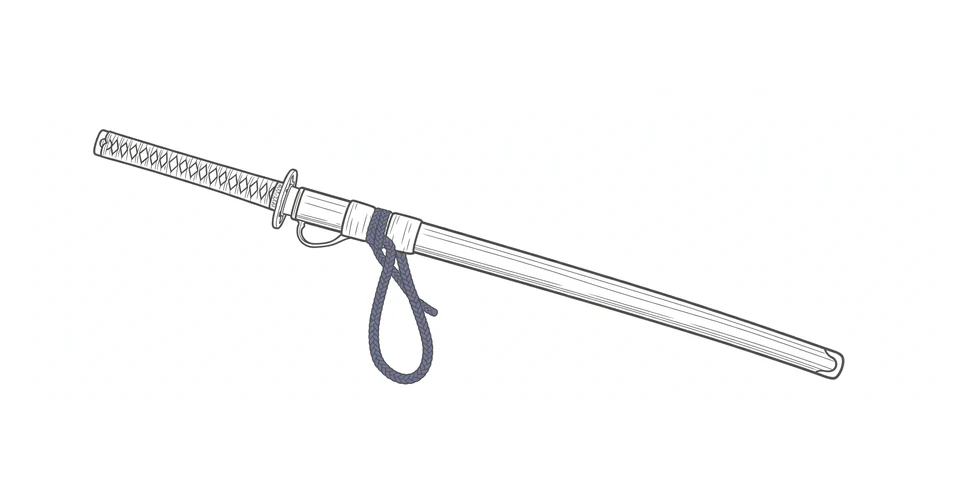
The first surprise is how much work hides inside something so plain. It is not carved from a single block and hollowed out like a canoe. It is made from two halves of magnolia wood, fitted to the blade so precisely that only the back of the blade touches the interior, then glued together with rice paste so the halves can be pulled apart again for cleaning. The lacquer outside goes on in layer after layer, sometimes ten or more, and a specialist may spend two or three months on a single saya.
What a saya is made to do
The job of the sheath sounds simple: hold the sword. In practice it does four things at once. First, it protects the edge. A katana edge is hard, thin, and easily chipped, and the saya keeps it from touching anything at all. Second, it protects the steel from moisture and dirt, which cause rust, the great enemy of a polished blade. Third, it protects the people around the sword, because a sheathed blade can be carried, stored, and handled without danger. Fourth, it makes the sword wearable, holding it at the hip in exactly the position from which it can be drawn in a single motion.
The clever part is how the sheath does all of this without damaging the very thing it protects. Japanese swords fit into their scabbards loosely. The blade does not press against the wood along its length. Only the burnished back of the blade, the mune, touches the interior, while the cutting edge rests in a tiny gap carved for it, touching nothing. Once the blade is fully home, the collar at the base of the blade, the habaki, wedges gently into the mouth and holds the sword still, so it neither rattles nor slips out. A good saya fits its blade the way a good shoe fits a foot, snug where it must be and free everywhere else.
That fit is the whole standard by which a sheath is judged. It must fit its blade precisely, because a poor fit can damage the edge or let moisture in, and its seams must be tight enough to keep out dirt and water, yet loose enough to be pulled apart for cleaning. It is a demanding brief for a hollow piece of wood, and it explains why the craftsmen who make these sheaths train for years. According to the Southern California Naginata Federation, a maker apprentices for about ten years, and the first six months are spent simply learning to sharpen and maintain the tools. I find that detail quietly wonderful. Before a student is allowed to touch a blade, he must learn to care for the tools that will care for the blade.
The wood beneath the lacquer
The saya begins as magnolia wood, known in Japanese as ho no ki, from the ho tree. Magnolia became the preferred wood from the Heian period onward, replacing the cedar and cypress used in earlier centuries. It is soft enough not to scratch a polished blade, yet strong enough to hold its shape, and easy to work with a chisel and plane. When properly seasoned, it has almost no sap in it, so nothing seeps out to stain or corrode the steel. It also absorbs moisture gently, which helps keep the air inside the saya stable, and that matters, because a blade rusts fastest when the air around it swings between damp and dry.
The wood is seasoned for a long time before it is touched. Natural drying is preferred, and the process can take anywhere from six months to ten years. Wood for the finest saya, the kind made for a sword that will be carried in full formal mountings, is often dried for more than ten years. The best magnolia is said to come from colder regions, such as the Kiso area of Nagano and the Aizu region of Fukushima, where the wood grows slowly and evenly.
A modern factory could shape a scabbard in minutes from plastic or cheap timber. A traditional saya asks for a decade of drying, ten years of training, and months of handwork, all for an object that most people will never really look at. I think that is the point. Care is not always visible, and the things which last are often the ones somebody bothered to make properly when nobody was watching.
How a saya is made
The making of a sheath is a sequence of small, exact steps, each one done by hand, barely changed in centuries. The craftsman who makes it is called a sayashi, a scabbard maker, and his work is one link in a chain of specialists that also includes the smith, the polisher, the lacquerer, and the metalworker. No one person makes a whole sword. Each person perfects one part, and the saya is the sayashi's part.
First, the sayashi takes a blank of seasoned magnolia, lays the blade on it, marks the shape, and cuts it out with a saw. Then he splits the blank straight down its length into two halves. This is the decisive moment of the whole process, because everything that follows depends on the two halves matching perfectly.
Next comes the hollowing. The shape of the blade is drawn on the inside of each half, and the sayashi carves out the interior with chisels, following the curve and taper of the blade. No sandpaper is ever used, because a single grain of abrasive left inside the saya could scratch the blade. Then comes the test. The sayashi coats the blade with clove oil, places it briefly between the two halves, and looks for oil stains on the wood. Every stain marks a place where the blade is touching. Those spots are planed down, and the test is repeated until only the back of the blade touches the interior.
Once the fit is right, the two halves are glued together with tsugui, a paste made from rice. It is strong enough to hold the saya together for years but weak enough that the halves can be pulled apart again for cleaning. That reversibility is deliberate. A scabbard is not sealed forever. It is made to be opened, cleaned, and put back together.
Then the outside is shaped. The glued sheath is planed into its final form, sometimes a simple oval, sometimes an eight sided shape that catches the light in facets. The surface is polished with ibota powder rubbed in with pieces of tokusa, horsetail reed. For a plain storage scabbard, the work ends here, with pale, smooth, unlacquered wood. For one that will be carried, the work passes to the lacquerer. A full walkthrough of the materials, the parts, and the making process is given in this complete guide to the katana saya.
The parts of a saya
The saya carries a small set of fittings, and each one has a name and a job. Learning them changes how you look at a sheathed sword, because suddenly the smooth black tube has a mouth, a knob, a cord, and a tip. The fittings are usually made of buffalo horn, metal, or lacquered wood, and on fine swords they are decorated to match the rest of the mountings.
The mouth is the koiguchi, literally the carp's mouth, and it is the part that works hardest. It is often reinforced with buffalo horn, because it must survive the habaki wedging into it every time the sword is sheathed. A worn or loose koiguchi is the most common fault in an old saya, and it is the fault that matters most, because a sword that slips out is a danger to everyone nearby. At the far end sits the kojiri, the end cap, which protects the tip from knocks and wear.
Halfway down, on the outer side, sits the kurikata, a small knob shaped like a chestnut, which is what its name means. The sageo, a braided cord of silk or cotton, passes through the kurikata and ties the saya to the wearer's sash, the obi, holding the sword at the hip so it stays put on the draw. A small metal fitting called the kaerizuno sits near the kurikata to stop the sageo from slipping, and the shitodome are tiny caps that finish the holes where the cord passes through. On the finest swords, the saya also carries two slim slots on its outer face, one for the kogai, a small grooming tool, and one for the kozuka, a small utility knife.
| Part | Japanese name | What it does |
|---|---|---|
| Mouth | Koiguchi | Receives the blade and grips the habaki to hold the sword still |
| Cord knob | Kurikata | Anchors the sageo cord that ties the sheath to the sash |
| Cord | Sageo | Secures the sword at the hip and steadies it on the draw |
| End cap | Kojiri | Protects the tip of the scabbard from knocks and wear |
| Cord stop | Kaerizuno | Stops the sageo from slipping out of place |
| Hole caps | Shitodome | Finish the sageo holes and add a small decoration |
What strikes me about this list is how little of it is decoration for its own sake. Every fitting solves a problem: the mouth grips, the knob anchors, the cord steadies, the cap protects. The decoration came later, layered on top of parts that already worked. That order, function first and beauty second, is the honest way round, and it is why a saya feels so satisfying to handle.
The lacquered surface
The scabbard most people picture is black and glossy, and that finish is the work of the lacquerer, the nurishi. A lacquered saya is called a nurizaya, and making one is a craft in itself. The lacquer is urushi, the sap of the lacquer tree, applied in many thin layers, each one dried and polished before the next goes on. The lacquerer sands each layer with charcoal to roughen it so the next layer grips, and the whole sequence may be repeated about ten times. A traditional lacquerer can spend two to three months on a single saya, which is one reason a handcrafted one can cost more than a thousand dollars.
The purpose of all that lacquer is not only beauty. Lacquer seals the wood against moisture, and a sealed sheath protects the blade better than bare wood in wet weather. But beauty was never far behind, and the Edo period turned the scabbard into a canvas. The most famous finish is roiro nuri, a deep black lacquer polished to a mirror shine. Maki e scatters gold or silver powder into wet lacquer to draw pictures of flowers, birds, and landscapes, and raden sets pieces of mother of pearl into the lacquer so they shimmer.
The formal sword of the Tokugawa period shows the restrained end of that range. When a samurai visited a castle, the law required a daisho, the pair of long and short swords, with a black saya and a hilt wrapped in white ray skin and black cord. The black saya was not a fashion choice. It was a uniform, and it told everyone in the room exactly who the wearer was. If you want the story of the blade it guards, read How the Katana Became the Soul of the Samurai.
The saya as an art object in Edo Japan
The Edo period, from the early seventeenth century to the mid nineteenth, was the golden age of the saya as an art object, and the reason was peace. After the wars ended, swords stopped being used in battle and became marks of status, and the fittings became the place where a samurai showed his taste and his wealth. The blade itself could not easily be decorated. It was steel, and its beauty came from the grain and the temper line. But the scabbard was wood and lacquer, and it could carry anything: gold powder landscapes, mother of pearl cranes, carved waves, whole scenes from legend.
The craftsmen who made these objects were specialists of the highest order, and their work was collected, appraised, and handed down like paintings. A fine saya was not a container for a sword. It was a partner to the sword, made to match the guard, the handle wrapping, and the small ornaments tucked under the cord. Samurai of rank dressed their swords as carefully as they dressed themselves.
That is also why so many fine saya survive while so many plain ones do not. The practical scabbards of ordinary soldiers were used hard and rarely survived, while the decorated ones were treasured, stored, and passed down. The everyday sheath, the one that did the real work on campaign, has mostly vanished.
Two lives of one blade
Every Japanese sword lives two lives, and the sheath marks the boundary between them. When the sword is carried, it wears its koshirae, the complete formal mounting: lacquered scabbard, wrapped handle, guard, and all the fittings. When the sword rests, it wears its shirasaya, the white scabbard, a plain handle and a plain saya of unfinished magnolia wood, with no lacquer, no guard, and no decoration at all.
The shirasaya exists because a lacquered sheath, for all its beauty, is the wrong home for a blade that will sit untouched for months or years. Lacquer seals the wood, and sealed wood cannot breathe. Moisture can become trapped between the blade and the scabbard, and trapped moisture means rust. The plain wood of a shirasaya breathes, so the air inside stays steady, and that is why it is sometimes called the resting scabbard.
The shirasaya carries one more feature that the koshirae does not: writing. A saya gaki is an inscription brushed in black ink on the pale wood, recording the smith who made the blade, its length, and the date the inscription was written. In the age of the great lords, the writing was an index, a way to tell one blade from another without drawing it. After the samurai era ended, it became a mark of authenticity, written now by professional appraisers rather than lords. The plain white wood of a resting saya is also a label, and I like that. The saya that shows nothing is the one that tells you the most about the blade inside it.
Drawing and sheathing in the martial arts
The saya is not only a container. In the martial arts of the sword, it is half the technique. Battojutsu, the art of drawing the blade, and its later form, iaido, are built around the moment the sword leaves its sheath and the moment it returns. Training in these arts focuses mostly on sheathing and unsheathing. They would not exist without the saya. It guides the draw, steadies the cut, and receives the blade again at the end.
The draw begins with the thumb. The practitioner pushes the guard forward with the thumb of the left hand, breaking the grip of the koiguchi on the habaki, a small movement called breaking the mouth of the sheath. The left hand then pulls the saya back as the right hand draws the blade forward, and the curve of the blade follows the curve of the sheath, so the cover itself guides the edge out in a clean arc. The power of the first cut comes from this motion. A blade drawn from its saya moves faster and hits harder than a blade swung from a ready position, because the draw adds the force of the whole body to the cut.
Sheathing is the slower, more careful half of the art, and it is where respect for the saya shows most clearly. The practitioner turns the blade edge up, finds the mouth with the back of the blade, and slides the steel home along the spine, never letting the edge touch the wood. The left hand guides the saya to meet the blade rather than forcing the blade into it. Done well, it is silent and smooth. Done badly, it chips the edge and scars the koiguchi. The short companion sword, the wakizashi, lived the same way, drawn and sheathed a thousand times in a lifetime at the hip, and its story is told in The Wakizashi Was the Short Sword a Samurai Never Left Behind.
Keeping a saya alive
It is a working object, and it needs care like any other. The first rule is to keep it dry and keep it steady. Magnolia wood swells and shrinks with humidity, and a saya that has swollen in damp weather may grip the blade too tightly, while one that has dried out may let it rattle. A saya that has become too tight can be eased by filing the inside of the koiguchi a little at a time, checking the fit after each pass. One that has become too loose can be tightened with thin wooden shims glued inside the mouth.
The second rule is to store the blade in the right home. For long storage, the blade belongs in a shirasaya, not in its lacquered koshirae, because the plain wood breathes and the lacquered wood does not. The blade itself should be lightly oiled before it is put away, and the inside of the saya kept clean and dry. A saya that is looked after in this way can serve for generations. One that is neglected will warp, crack, or loosen, and once the fit is gone, the protection is gone with it.
There is a quiet lesson in that. The blade gets the glory, the polish, and the poetry. The saya gets the dust, the damp, and the daily work of keeping the blade safe, year after year, without applause. I think that is a good model for care in general. The things that matter most are often the ones that ask for nothing but attention: keep it dry, keep it clean, check the fit, and put it away properly.
The saya is the lacquered sheath that guards the katana, and it has guarded it through war, through peace, through the banning of swords in public in 1876, and through the long revival of the craft that followed. It is wood and lacquer and horn and cord, made by hand over months, and it asks only to be used well and stored well. The blade is the soul of the samurai. The saya is the quiet keeper of that soul, and it has earned its place in the story.
More in Culture & Society
- Seppuku Was the Ritual a Samurai Chose Over Disgrace
- Daisho Was the Pair of Swords That Marked a Samurai
- Hamon Is the Wavy Line That Proves a Katana Is Real
- Ikebana and the Quiet Discipline Behind Japan's Flower Art
- The Wakizashi Was the Short Sword a Samurai Never Left Behind
- The Tsuba Turned a Sword Guard Into a Small Work of Art
Latest posts
- Omiyage and the Japanese Art of Bringing Something Back
- How the Katana Became the Soul of the Samurai
- The Menpo Gave the Samurai a Face Worth Fearing
- Japan Goes Maple Hunting Every Autumn and Calls It Momijigari
- Kabuto Gave the Samurai a Helmet Worthy of His Sword
- Christmas in Japan and the Fried Chicken Dinner That Started It All
- Kiso Yoshinaka Rode Out of the Mountains and Nearly Took Japan
- Sakayaki Gave the Samurai His Signature Hairline
- The Archer on the Tower Was Hangaku Gozen
- Koyo Turns Japan Into a Country That Forecasts Leaves
- Inside Japan's 100 Yen Shops, Where Everything Costs a Coin
- Tomoe Gozen Rode Into Battle When Women Were Told to Stay Home
- A Chonmage Is the Knot Every Sumo Wrestler Wears Before the Fan
- Onna-Bugeisha Held the Castle While the Men Were Away
- Momiji-Gari Is Japan's Autumn Answer to Hanami